Author: Olga Mariyan
The non-governmental organization Sofia Brotherhood has announced that it is developing strategies to help Ukrainian Orthodox believers find shared reference points and a metanarrative that could make dialogue between the Orthodox Church of Ukraine (OCU) and the Ukrainian Orthodox Church (UOC) possible. The future of Ukrainian Orthodoxy was discussed at a recent roundtable held as part of the project “Modern Ukrainian Orthodoxy: Debunking Myths for the Reconciliation of Ukrainian Orthodox Communities and the Consolidation of Ukrainian Society.”
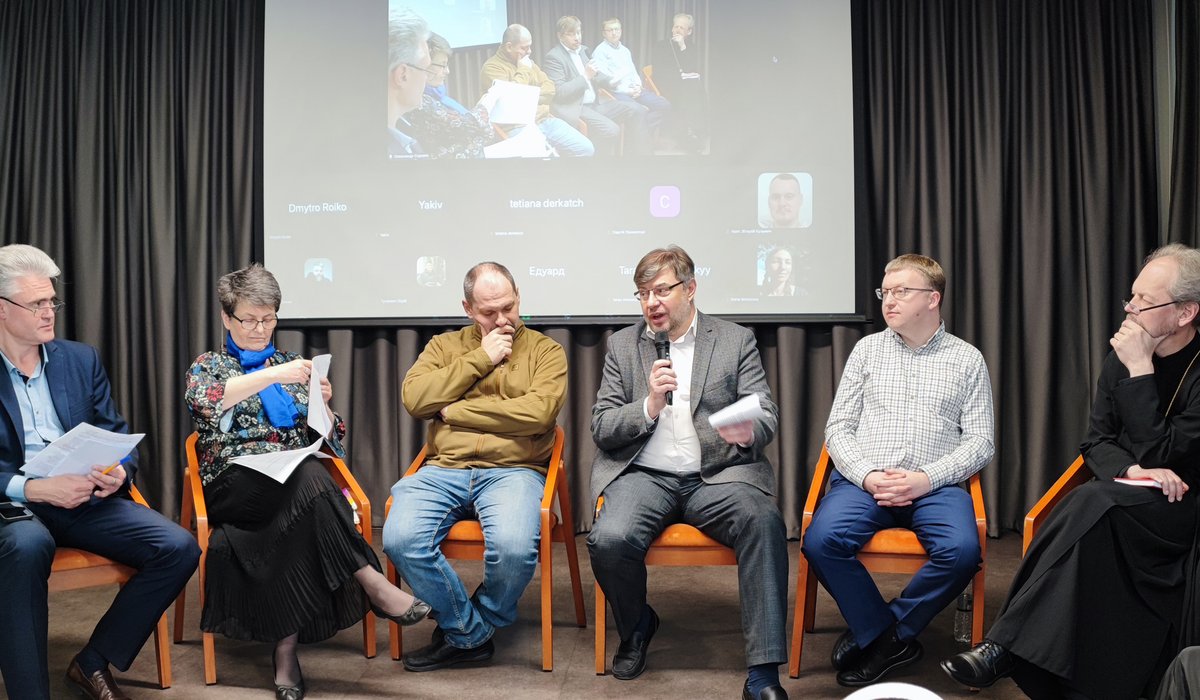
The event took place in late April with participation from members of The Sofia Brotherhood, theologians, philosophers, media professionals, and Orthodox clergy from various jurisdictions. The project is supported by the Renovabis foundation.
“When we realize that we are brothers and sisters, our attitude toward one another must change.”
During the first roundtable discussion, participants focused on the path to reconciliation and prospects for inter-jurisdictional dialogue.
Bishop Mykhailo (Anishchenko) of Komana, the Exarch of the Ecumenical Patriarch in Ukraine, noted that the Sofia Brotherhood has managed to create a platform where representatives of both Ukrainian jurisdictions can meet and discuss ways of realizing the unity to which Christ calls. Many initiatives have already been carried out — projects recognized not only in Ukraine but also internationally.
“This testifies to the fact that healthy processes are taking place in Ukrainian society and in the Orthodox community. Perhaps not as quickly as we would like, but it points to the quality of the work being done. The processes aimed at overcoming the thirty-year division will continue. I hope to see full unity in my lifetime. It is possible to live peacefully and carry out joint projects. Of course, we are different, and everyone has their own grievances. But if there is no conversation, there can be no dialogue among Orthodox believers. You are called to help revive that dialogue in order to achieve the long-awaited unity.”
Archpriest Volodymyr Vakin, rector of the Volyn Orthodox Theological Academy of the OCU, believes that promoting a state of two or three supposedly “legitimized” jurisdictions is dangerous, since what is happening in Ukraine today is not only a clash of civilizational values but also a clash of two types of ecclesiology. One is based on the Universal Church and the patristic tradition: in this model, it is unimaginable that Local Churches — sharing one nature — would not be in communion with one another. The other model, in which such separation is possible, resembles a confederation. In that case, the Eucharist ceases to be a sign of unity or of belonging to the Church as such — it becomes merely a tool of diplomatic relations between Churches, aimed at avoiding conflict or lowering tensions.
“Let us try to seek paths toward reconciliation, where jurisdictions can coexist in parallel. We have defined our ecclesiology, which is expressed in the Creed. That means we must talk openly about the problem we face — the division, the wound that continues to bleed. We are speaking of an anomaly, but under no circumstances should we legitimize it. If we accept the idea of a confederation, then within the sacred space of one building, we start putting up partitions and turn it into a kind of communal apartment — a practice widespread in Soviet times.
When it comes to finding a way out of this situation, transitional periods are needed — ones that will have their own timeline. In that context, a mediator is necessary. We are standing on the threshold of a new political architecture in Europe, and the Church will inevitably respond to it.”
Another key point raised by Archpriest Volodymyr was the models that should guide the development of the Church. In his view, more attention should be given to the Kyiv tradition as a model of conciliarity. He believes that all jurisdictions still suffer from the “phantom pains” of Moscow-style administration. To avoid becoming “ROC 2.0,” Ukrainian Orthodox believers must actively promote and discuss conciliarity at every level.
“The Statute of the Orthodox Church of Ukraine contains a well-formulated approach to how synods should be conducted: discussing documents, the agenda, candidates, and approving conclusions. But putting all of this into practice is difficult. That’s why time is needed. Dialogue is essential for a new culture to emerge. In this context, theologians, clergy, and the faithful all have an important role to play. When there is public discussion about the documents the Church intends to adopt — when people don’t just hear about them but engage with them, debate them — then we truly understand what the Church is living through and where it is headed. And in that case, decisions made by the Synod are no longer a surprise.”
Viacheslav Horshkov, head of the Department for Cooperation with Religious Communities at the State Service of Ukraine for Ethnic Affairs and Freedom of Conscience (DESS), notes that the history of Ukraine is a history of breaking free from imperial influence. A great war for independence is still ongoing. It began more than a hundred years ago, in 1917, when the Ukrainian People’s Republic declared independence. What kind of Ukraine were people dreaming of back then? Archival sources show that the vision was aligned with the Kyiv tradition. Kyiv never aspired to be a ‘Third Rome’ — or any other Rome. It was compared instead to Jerusalem — a non-imperial city with a fundamentally different stance and a different model of relationships.
According to Mr. Horshkov, it is crucial to return to biblical texts because they are inherently anti-imperial. In contrast, the theological traditions of the old Churches were shaped under the strong influence of empires. It is paradoxical that the Bible was later used to justify aggressive imperial policies. Yet the task before humanity was voiced nearly two thousand years ago by the Apostle Paul, who preached that God made all nations from one, emphasizing our unity. That was a revolutionary idea at a time when humanity was fragmented, and every people believed it descended from its own god, while others were naturally seen as enemies.
“When we truly realize that we are brothers and sisters, our attitude toward one another must change. Christianity has had a profound influence on interpersonal relationships, but it has had very little impact on international relations—on the relationships between large groups with collective identities shaped by religion, culture, or ethnicity. That is why our Churches often fail to grasp the kind of unity that should exist between them. They overlook the goal that God has set for all of us.”
The true result of knowing God must be the attainment of glory. Revelation chapter 21 says that the nations enter the New Jerusalem. This echoes the prophecies of Isaiah, written some 750 years before Christ’s birth: the nations come into Jerusalem, but they do not arrive empty-handed — they bring their glory and honor. Honor means dignity. We have come to understand a bit of this since the Revolution of Dignity. But glory is always the result of interaction, of how one group relates to others. Glory is not something a group simply invents about itself. The quality of the relationships we build will shape the glory we receive. If we work to bring glory not just to our own group, but to Ukraine as a whole, we will then have a shared purpose. And with that, we can overcome the narrow corporate interests that are hindering full and open dialogue.
Public philosopher and theologian Oleksandr Filonenko emphasizes that there is not always a single solution to a problem. He invites us to imagine a circle: two opposing points on it represent the sides of a conflict. One can endlessly attempt to engage in horizontal dialogue and communication. However, there is another option: if each point — each side — draws a radius toward the center, they will inevitably move closer to one another.
“In my view, it is a mistake to focus solely on horizontal efforts and on debunking myths. We could organize a struggle for peace in such a way that it leads to war. But I believe in a strategy that involves moving together toward the center — because in doing so, we draw closer to one another. At the center must be Christ. And for me, it’s also essential that we don’t just start a conversation, but also put the vertical dimension into practice — first of all, by understanding the real concerns people have.”
Over more than thirty years since Ukraine regained independence, a great number of mutual grievances and conflicts have accumulated among Orthodox believers of different jurisdictions. According to Hennadii Khrystokin, Doctor of Philosophy and professor, what currently hinders peaceful coexistence and dialogue between the UOC and the OCU is excessive fixation on certain myths and narratives. Myths, he notes, are clearly important and necessary, but they can take different forms and serve either constructive or destructive purposes. It is crucial to recognize that.
“The reality is this: over the past 30 years, Ukraine’s Orthodox jurisdictions have effectively developed two alternative church narratives — two competing visions of what the Ukrainian Church is, what its history means, and what its future should look like. These narratives function as opposites, built in direct opposition to one another. They reflect diametrically opposed views on nearly every foundational issue. On top of that, each jurisdiction seeks a monopoly on canonical primacy and therefore denies the other the right to fully exist. It’s as if they are speaking entirely different theological languages. And that is precisely what makes dialogue impossible. In truth, the fullness of Church life does not exist in isolation — it exists in unity.
The future of Ukrainian Orthodoxy lies in confronting and overcoming these destructive myths, acknowledging them, and striving to rise to a higher level of dialogue. This ‘meta-level’ would allow us to focus more on constructive, unifying narratives. And what should guide us? Christ and the Ukrainian state. As Ivan Ogyenko once said, there are two things that can unite Ukrainians: God and Ukraine. Only when those two stand at the center of our focus can unity become possible. For peace to prevail in Ukraine, the Church must become true to itself: step away from its corporate self-interest and serve society and the Ukrainian nation. It must learn to see a representative of another jurisdiction as a biblical neighbor. That is the essential task that both jurisdictions must now embrace.”
Mr. Hennadii explains that the existence of different theological meta-languages is completely normal. The problem begins when one of those meta-languages is monopolized, sacralized, and transformed into a myth — and then into an ideology. Ukraine has always been a multi-confessional country. Even today, nearly every denomination includes multiple directions, movements, or even internal branches. The issue arises when we try to build a single Church or single confession from the top down. Our goal is not to impose one unified Church. True unity will come when Orthodox Christians learn to accept and respect one another peacefully. Diversity, pluralism, and openness among religious groups are all entirely typical for Ukraine. When we rise to the meta-level — Christ and Ukraine — then religious freedom becomes essential to us, both externally and internally. That is what we must strive for.
Bishop Mykhailo shares his hopes: not only the clergy, but also the laity have begun to reflect on the situation within the Church and to acknowledge that things may not be entirely well. And acknowledging a problem is already half the solution. According to the bishop, the greatest virtue of our time is healthy, rational thinking. That’s why we must open our eyes, see things as they are, and analyze what is truly happening.
“It is both encouraging and joyful to hear the voices not just of bishops, but also of ordinary clergy and laypeople. Typically, the Church’s position is associated only with statements from high-ranking hierarchs. But when the Body of Christ as a whole begins to reflect — when laypeople are also able to disagree, express their own views, and gather together — that is a restoration of conciliarity. It is important for us to see ourselves honestly and to hear one another, to acknowledge problems without fear, and to search together for a way forward.”
According to Bishop Mykhailo, the Ecumenical Patriarchate also serves as a platform for communication among all Orthodox jurisdictions. Their representatives themselves understand with whom they can engage — and with whom they cannot. Yet within every Church, there are people who genuinely want to find a way out of the conflict rather than keep it frozen. Still, there remains a lingering fear of one another, rooted in old prejudices, mutual grievances, and wounds that date back to the 1990s.
“When people accept this reality, when they recognize that both sides bear some share of the guilt and ask for forgiveness, then dialogue will begin to take shape. We shouldn’t look for enemies outside ourselves. Living to spite someone, acting only to prove a point to others — that’s not a sound stance.”
An equally pressing question is whether Christian nationalism is possible in a globalized world. Viacheslav Horshkov explains that the term “nationalism” is often given a negative connotation, seen as being against someone or something. But that, he says, is untrue. Historical sources show that Ukrainian nationalism, in particular, has always carried a positive meaning.
“The term ‘nationalism’ has theological roots. It’s about nations developing subjectivity — coming to understand themselves as members of a single, universal human family, and building relationships with one another accordingly. Nationalism is not the same as Nazism. From the beginning, it has had a noble mission and in no way contradicts the biblical message.”
“From both a human and a Christian perspective, continuing relations with the Moscow Patriarchate is no longer possible.”
The second panel focused on the theme: “Theological, Philosophical, and Religious Studies Perspectives on Overcoming Prejudices and Achieving Reconciliation.” One characteristic common to the various Orthodox jurisdictions is exclusivism—the conviction that their own interpretation is the only correct one. Is it possible to develop a modern Orthodox ideology that would overcome this model and remain open to the contemporary challenges of Ukrainian society? This question was addressed by Fr. George Kovalenko, rector of the Open Orthodox University of Sophia the Wisdom (OCU). He noted that the ideas behind open Orthodoxy began to take shape as an outcome of a theological congress, where essential questions emerged: Who are we? What should we do with the legacy of our past experience?
“When we founded the Open Orthodox University, I was visited by Jews, Muslims, Protestants, Greek Catholics, and Roman Catholics. But not by representatives of the UOC, which I myself belonged to at the time. Then, in 2018, when the issue of the Tomos began, we used the abbreviation ‘OCU’ for the first time in the title of a roundtable. We wanted to name the Church in a way that wasn’t tied to any specific jurisdiction. And that time, only clergy from the UOC came. These were the people who endorsed a certain declaration of the Open Orthodoxy Network. They proposed peaceful coexistence, cooperation, and concelebration instead of jurisdictional conflict. That message remains relevant today, and it continues to guide us.
When the full-scale war began, we organized prayer gatherings and invited everyone to join. Let us condemn the war, pray together, and only then sort out jurisdictional questions. Unfortunately, only one deacon responded. The theological concept of exclusivism is probably the greatest obstacle. It is not possible to unite all Churches into a single one. But if we reflect on the words ecumenism and oikoumene, we see that at their root, they mean ‘the whole world.’ Perhaps that’s why, when we speak of the ‘Universal Church,’ we are speaking of all humanity, of the cosmos, of care for God’s creation. These are dimensions that require our Christian vision and a liturgy on a universal scale.”
Andriy Smyrnov, Doctor of Historical Sciences and professor at the National University “Ostroh Academy,” adds that the division we are currently experiencing is the result of historical events and persistent historical myths. While philosophers may argue that myths should not be reconstructed, historians strongly disagree, especially in the context of the Russian-Ukrainian war, where Russia exploits historical myths, appropriates history, lies, and spreads its ideology at any cost.
One major myth still present within the UOC is that the Russian Orthodox Church (ROC) is its “mother Church.” This is evident, for example, in the commemoration of the Moscow Patriarch as the first hierarch, sometimes done in altered forms. However, there is a critical distinction between the concept of a “mother Church” and a “kyriarchal Church.” A mother Church is holy, catholic, and apostolic. A kyriarchal Church is a missionary Church: it spreads the Gospel, converts peoples, and establishes its structure or jurisdiction in new territories. In such a process, a dependent local Church is created, whether autonomous, self-governing, or an exarchate. In Ukrainian history, it was the Ecumenical Patriarchate of Constantinople that extended its jurisdiction to the lands of ancient Rus-Ukraine, establishing the Kyiv Metropolia.
A kyriarchal Church can also be considered a mother Church. But in Ukraine’s case, it’s different: in 1686, the Kyiv Metropolia was annexed, and the Kyriarchal Church became the Moscow Patriarchate.
“We don’t need to seek approval from Moscow for everything, because there was no proper canonical incorporation of the Kyiv Metropolia into the ROC. Historical sources show that only the right to appoint or bless the Kyiv Metropolitan was transferred. That’s all. The mother Church never renounced her daughter. That’s why the Ecumenical Patriarch had the authority to revoke the charters and acts of 1686 and return the Kyiv Metropolia to his jurisdiction. So even if the ROC functioned as a kyriarchal Church for a time, we must still seek communication with the true mother Church.”
Yurii Chornomorets, a theologian, scholar of religion, military serviceman, Doctor of Philosophy, and professor, reflects on why we lack deeper reflection on how to reach a meta-level of dialogue. In his view, the reason lies in the conditions we are still living through: the horrific and bloody 20th century has not yet ended. It began in 1914, with the end of the First World War and the global reshaping of power.
“Open Orthodoxy, open Christianity — these are wonderful concepts. But at the same time, we must resist fundamentalist Orthodoxy, which is already sliding into fascism and Nazism. This is a challenge that cannot be tolerated. There are still many adherents of closed Orthodoxy who cling to fundamentalism.
But there is a much bigger problem: we are unprepared for the 21st century that is now being born. We still haven’t entered the post-postmodern era — one that keeps failing to arrive. Today, only about 11% of the Christian world is Orthodox. That’s a very small minority. So we must ask ourselves: what can we offer the world? All traditional structures are dying. We are going to live in a post-Orthodox age, beyond Orthodoxy as a unified institutional structure. And this is a challenge, because we are unready for the future.
Understanding this, the Ecumenical Patriarch is calling for the creation of a new generation of moderate conservative and liberal theologians of the 21st century — to formulate a new social doctrine, one that could be shared by all. Theology must serve as a guide to what Orthodoxy of the future should be.”
Alla Weissband, a philosopher, musicologist, and art historian, adds that both in the UOC and the OCU, there are reasonable, adequate centers that seek a balance between the conservative and the modern, the spiritual and the political. But there are also radical peripheries that absolutize one of these opposites. Certain tendencies can be observed: the UOC is more conservative, oriented toward tradition, authority, obedience, and the salvation of the soul. The OCU is more liberal, valuing human freedom and dignity, and more open to social, civic, and political engagement. This difference in emphasis is one of the key reasons for mutual misunderstanding.
“Representatives of the OCU, like much of Ukrainian society, sincerely cannot understand how a Church, during wartime, could maintain even canonical ties with the Church of an aggressor state. Meanwhile, representatives of the UOC sincerely cannot understand how the faithful could betray their Church over political motives, including, in their view, even the war itself.
Yet both Churches, despite now often denying each other’s canonical or Ukrainian legitimacy, are at least potentially both canonical and Ukrainian. Moreover, we can say that the existence of these two Churches, if they do not engage in a war of annihilation, is a profound gift and opportunity for Ukrainian Orthodoxy. These Churches, in their respective models, to some degree embody opposites which, from a Christian perspective, are equally necessary. This too is a kind of myth — but it is a constructive one, because it opens space for dialogue. And that is the very thing we are called to, as Christians and as citizens of Ukraine.”
There are questions regarding canonicity. For example, the Moscow Patriarchate (MP) interprets the canons differently than the Ecumenical Church or the Greek Church Fathers did. Ukraine must choose its own model. Yurii Chornomorets argues that under no circumstances can we rely on Moscow as a canonical reference point.
“At the celebration of Patriarch Kirill’s 70th birthday, Moscow publicly declared — in front of all delegations of global Orthodoxy — that it would never grant autocephaly to Ukraine. And yet Metropolitan Onufriy still says that any requests will continue to be submitted to Moscow after the war ends. But Moscow never ends its hybrid, cultural, imperialist war. It continues the bloody 20th century. If the MP, as a kyriarchal Church, did not grant autocephaly to the Ukrainian Church in the 1990s, it never will. As long as Russia exists — even if it is run by so-called ‘good Russians’ — they may be friendly with the world, commune with Catholics, do whatever they please, but they will never give Ukraine autocephaly. This must be understood once and for all.
The UOC must return to realism. Either autocephaly is self-proclaimed, or it is declared through consultations moderated by the Ecumenical Patriarch. Canon law and the actual situation offer no other path. A genocide is being carried out against the people, and you are a canonical Orthodox jurisdiction of that Orthodox people. To refuse to proclaim autocephaly in such a case is not only immoral — it is a betrayal of humanity.”
People who form the Sophia Brotherhood, according to Mr. Yurii, understand the critical nature of the situation. From neither a human nor a Christian point of view is it possible to continue relations with the MP. An information war against Ukraine is ongoing, directed by certain bishops of the UOC. In the theologian’s opinion, everyone who does not respond in the canonical and legal field — as well as the faithful — is complicit in its continuation.
“If you want to remain Ukrainians, there must be a response. If you want to remain Christians, there must be a response. If you want to remain Orthodox, there must be a response. Patriarch Kirill is a Gnostic-type heretic who preaches Manichaeism instead of Orthodoxy. To tolerate all this means to betray Orthodoxy, its traditions. The Orthodox Church of Ukraine is open. Its hierarchs do not claim to be perfect and can calmly concelebrate with the bishops of the UOC. The Ecumenical Patriarch is open. So why stay with Moscow?”
The leadership of the UOC remains silent. Father Heorhii believes our response to this must depend on each individual, since decisions are made on various levels — first and foremost in the minds of the faithful. Many UOC believers calmly attend services in OCU churches. Some of them even confess during confession that they go to the Moscow Patriarchate as well.
“We are open. I like the path of personal encounter with Christ in the church, in the Eucharist, when a person stops being afraid — stops being consciously intimidated and trapped in a ghetto-jurisdiction. A jurisdiction that breaks off relations with global Orthodoxy, a jurisdiction headed by someone who declares un-Christian messages and serves war. One must step outside the bounds. Although there is no sin in attending an MP church, if you are praying to God there, and not listening to political briefings.”
“Churches must join in shaping some kind of shared cultural code of the nation.”
No dialogue or unification is possible without public engagement and media influence. This was the topic of the third discussion panel. As Archimandrite Cyril Hovorun, Doctor of Philosophy, professor, noted, the media is a crucial aspect of the process of consolidating Ukrainian Orthodoxy. Although in Ukraine, we can speak of a high level of so-called confessionalization of the media: coverage that reflects the side of one or another party to the conflict.
“However, religious diversity in Ukraine does not suffer from confrontation. I would even say that it is exemplary for the global context. The war has consolidated our Muslim and Jewish communities — these religious groups are able to coexist peacefully. We, the Orthodox, need to learn from them how to overcome our differences (which are far fewer between us than between those two religions).”
The media helped overcome the confrontation between Greek Catholics and the Orthodox, becoming a platform for establishing lasting inter-confessional relations, including with Ukrainian Protestants. Meanwhile, each of the Orthodox jurisdictions tries to maintain its own media, and also to sway independent journalists to its side. In this sense, the existence of religious media not affiliated with any particular jurisdiction is important — on the basis of their work, a seedling of consolidation for Ukrainian Orthodoxy may grow.
“The problems Orthodox Christians have with inter-jurisdictional relations are a textbook example of how not to behave toward one another. Religious confrontation is like a tsunami. When an earthquake occurs on the sea floor, the wave is small in that place, but when it reaches the shore, the tsunami destroys everything in its path. I would apply this image to the socio-political situation in Ukraine: when confrontation between the two Ukrainian Orthodox jurisdictions has far-reaching consequences and acts like a tsunami for the socio-political climate in the country, for the political backdrop, and the international perception of Ukraine. Inter-jurisdictional confrontation has become, if not the cause, then at least the pretext for many obstructive processes for Ukraine on the international stage.”
Tetiana Derkach, religious publicist and editor of Religion in Ukraine, notes that for secular media, the topic of religion remains secondary and insufficiently explored — it tends to be covered only when nothing more interesting happens. Ratings are what matter.
“We decided to take a different stance toward everyone. At first, we refused to use the MP (Moscow Patriarchate) suffix for the UOC. People thought that by doing so, we were allowing the Moscow Patriarchate to deceive the faithful into thinking they were the Ukrainian Orthodox Church. My logic is the opposite: I want to legalize the Ukrainianness within the UOC, which is canonically connected to the Moscow Patriarchate. For me, ‘MP’ was just a suffix, opposite to ‘KP’ (Kyiv Patriarchate), and that’s it. We started using the titles of hierarchs as they are formally written. In other words, we remained within the bounds of academic neutrality at the rhetorical level.
Over two years, I’ve seen that people have gotten used to the fact that in media not affiliated with the UOC, it’s possible to write ‘UOC’ without adding ‘MP’. People need to get used to the idea that a bishop of the OCU doesn’t have to be written in quotation marks. We keep putting each other in parentheses. It seems to me that’s abnormal and un-Christian.”
Taras Antoshevskyy, historian, religious publicist, and editor-in-chief of RISU, holds a different opinion: he is against using epithets that may offend, but supports calling things by their proper names. In the publication he heads, the editorial team follows the rules of the Ukrainian language: some terms are still capitalized (even if they concern the aggressor state), but, for example, “Patriarch Kirill” is written that way, and not “Kyrylo” in the Ukrainian manner.
According to him, in the classical understanding, media should operate on the principle of a mirror: to reflect from the outside, to show how things really are. “The mirror is not to blame if you don’t like your reflection.” And there is also the well-known principle of diagnosis: “The doctor is not to blame if the patient doesn’t like the diagnosis.”
“Unfortunately, that’s not always the case today. Media may fail to show the real world and instead present a particular interpretation of that world. Biased outlets can deliberately create an information bubble. For our media and those of other societies, especially the American one, it’s typical to divide the world into ‘us’ and ‘them’. This leads to a distorted reality, the emergence of new biases and myths, and continued manipulation of the audience.”
On the other hand, what do media professionals see in the religious world? Some church communities try to be like an open book. Others behave as if the media doesn’t exist, and then take offense at reports about excessive drinking or serious traffic violations by individual clergy. Sometimes, direct communication with the church environment is impossible for journalists. And sometimes, the media choose not to engage because of constant dishonesty.
“Can journalists trust church newsmakers, believe their official and unofficial spokespersons, especially when they blatantly lie, manipulate, or falsify information? I’ve had several deeply unpleasant experiences like that. I don’t want to listen to manipulation, I want to find out what’s really happening.”
At the same time, there are other problems related to religion. Often in this environment, which is regarded as a model of holiness, there is a mixing of righteousness and sin, of black and white. “Grey,” in the eyes of society, is no longer seen as white or holy. Sociological studies show a decline in public trust in the Church. However, the issue is that the active public engagement of religious institutions is insufficiently covered or highlighted in the public sphere.
“When speaking about any environment, no matter if I like it or not, I follow the principle of “separating the flies from the cutlets.” No matter how negative the environment may be, I try to find at least someone in it who is still worth saving. On any side of the Orthodox conflict, for instance, it is worth seeking out those with whom dialogue is possible and mutual understanding can be pursued.
Of course, there are those who work to promote the so-called “Russian world.” This is not just an ideology promoted by Patriarch Kirill; it is also a Russian model of state–church relations, historical and cultural approaches to the past and present, and manipulative methods of presenting information. This is evil by definition. It has no confessional exclusivity — representatives of different denominations or Churches may suffer from it. Identifying and separating it is one of the ways to escape the mindset of “all is lost.”
According to Mr. Taras, the epithet “interconfessional” in society is now more often associated with the word “dialogue” rather than “conflict.” This is a positive development. However, new negative myths are also arising around dialogue: dialogue for the sake of dialogue, for business interests, for freezing the status quo, and so on. Within the work of the Sophia Brotherhood, this is yet another challenge that must be addressed.
“Media is a reflection of societal trends. We may look at it and dislike the reflection. But sometimes, perhaps, we need a cold shower. Maybe some people need a different mirror in a different world — especially the supporters of the ‘Russian world.’
Sincerity is extremely important. When, at the pan-Orthodox level, UOC representatives are referred to with the “MP” suffix, that’s understandable — to others, they are part of the Moscow Patriarchate. One shouldn’t try to say, “No, we’re not like that.” It’s worth acknowledging the facts and being open to communication, including with the media, and inviting them to cooperate. The conflict between Orthodox Churches harms all confessions, harms Ukraine, and serves the interests of the enemy.”
Doctor of Theology, staff member of the Department for External Church Relations of the UOC, and professor at the Kyiv Theological Academy of the UOC, Serhiy Bortnyk, states that, according to sociological surveys conducted by the Razumkov Center, 55% of Ukrainians now identify as Orthodox. Two years ago, that figure was 62%. Other denominations have remained almost unchanged. However, amid the decline in the number of Orthodox believers, the group of people who do not identify with any religion has grown significantly.
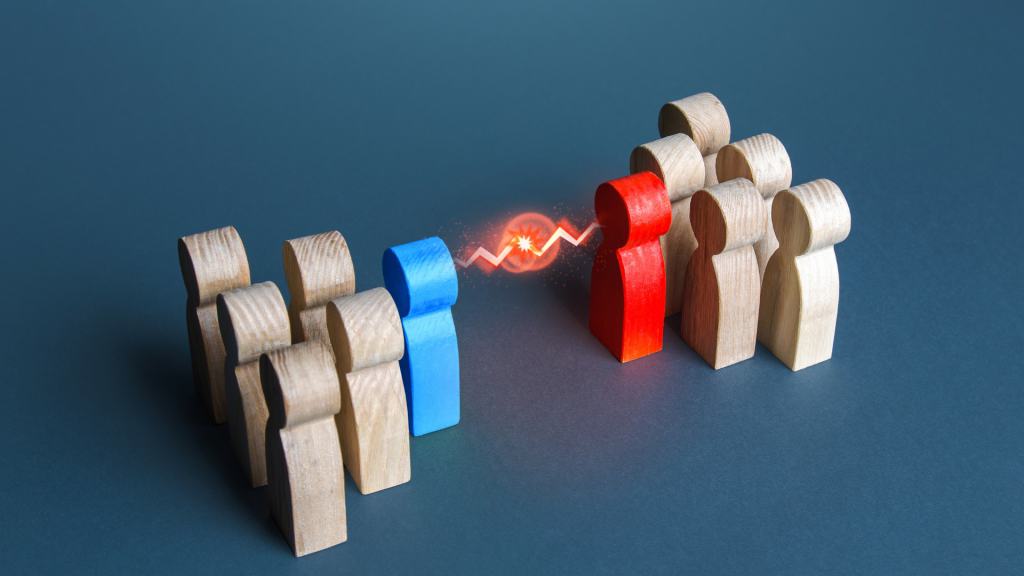
“I believe that our discussions about whether the UOC is a Moscow church or not lead to people who were once interested in religious topics simply losing interest. We are in a state of conflict between the UOC and the OCU. There are four phases of conflict: the latent phase, when we simply coexist as we are, but something about the other side already bothers us. The second phase is when we try to prove our case and show that the other side is wrong. The third phase is when we begin to see the other side as an enemy. The fourth is when proving our position no longer matters — what matters is destroying the enemy. I believe that today in Ukraine, we are in the fourth phase.
To bring the conflict down to a lower stage, we must move from the desire to destroy the enemy back to the latent phase — to simply existing alongside one another. When we say we want a single local Church that includes all Ukrainians, and that the others should be cast abroad, that’s just jumping from the fourth phase back to the second. Right now, we need everyone to hold to their own convictions, and let others simply exist — as long as they are not breaking the law.”
Danylo Leleko, philosopher and theologian, says that the strategy of current inter-jurisdictional relations among Orthodox communities in Ukraine is fundamentally flawed, as discussions often revolve around defending jurisdictional borders or boundaries of identity. He believes that the opposition of Christ and the Church to the world should grant a certain ethos to the life of the Christian Church. And the Christian response must lie beyond existing inter-jurisdictional misunderstandings — in a Christian way of life.
“Perhaps the solution to inter-jurisdictional issues lies entirely beyond jurisdiction. Perhaps the very existence of such a problem is not a good sign in the dichotomy of Christ and the world. I think the Church must now be called back to the place it ought to occupy in society. And that, in my opinion, should not mean it is a kind of separate spiritual realm to be guarded by law. Yes, religious life must be treated with respect, but it should not become isolated.
Looking back to the Eastern Christian context of Basil the Great’s era, Christian communities — whether hierarchical or simply horizontal fellowships — were communities of radical, innovative Christian concern for social justice and social liberation. They stood for the emancipation of women from traditional roles, the liberation of slaves. Does the Church today have this kind of potential? What, in comparison to the liberation of the human person, can the Church propose now? Christians are called to be the soul of the world, and this ought to be central for Orthodox believers in Ukraine and beyond.”
Mr. Danylo adds that dialogue for the sake of dialogue, or unity of jurisdictions, makes no sense. Only a return of Christian communities to social ministry can be a genuine form of action, and the very basis for unity. This should become the foundation for dialogue, not the other way around.
Serhii Bortnyk insists that dialogue is only possible between two equal parties, and currently, there is no such equality between Orthodox jurisdictions. He believes that all statements made by representatives of the UOC are mocked and distorted, and the clergy themselves are disrespected. That, he claims, is why the clergy remain silent.
Taras Antoshevskyy sees the activities of the Sophia Brotherhood as a good example of inter-jurisdictional dialogue. Although it is an informal interaction, such dialogue is more sincere and accessible, as church representatives can speak freely, independently of their positions.
“There’s an opinion that bishops find it harder to speak because they are under greater control. This is especially true in the UOC, where certain individuals have lost their posts for trying to express certain things. Still, I believe dialogue is very important for society, because it is one of the ways to seek mutual understanding.
If we are gathering just to talk, then it’s not really dialogue. There must be some goal we intend to reach through this dialogue. And two things are crucial: equality and sincerity. If I don’t trust the people I’m talking to, that’s not a dialogue — that’s a negotiation. Like between Ukraine and Russia.”
Tetiana Derkach observes that situational solidarity is typical of Ukrainian society. For example, since the beginning of the full-scale war, Ukrainians have demonstrated a unity that no one expected or could have imagined. But that’s not the whole picture.
“We have to look at least one step ahead: what happens after the war? The Churches must take part in shaping a shared cultural code of the nation. Right now, we have two Orthodox Churches with two mutually exclusive identities, and they do not coexist. So we need a third identity. Without such dialogue, we are putting our country in a highly vulnerable position. Russia won’t leave us alone — not in five years, not in ten. That means sooner or later, we’ll need to form a common cultural code with the UOC here. For that, dialogue is necessary. There are three stages of development in the world: war, competition, and partnership. We haven’t matured to partnership yet, but we must at least move from war to competition.”
She adds that any dialogue is necessary — even dialogue for its own sake, in her view, serves as a kind of “inoculation” against exclusivism, which is one of the root causes of the conflict between Orthodox Christians.
“For example, the Russian Orthodox Church has been holding theological dialogues with the Copts and other non-Chalcedonian Churches for decades. We’ve never seen a single document from these talks, but those Churches are friendly with one another.”
The multifaceted nature of Russian propaganda and its extraordinary capacity for manipulation are no secret, and the religious sphere is no exception. Responding to Tetiana Derkach, Taras Antoshevskyy emphasized this point.
“Why does the Russian Orthodox Church engage in dialogue with Churches in Africa and Asia? It’s simply fulfilling the Kremlin’s agenda to expand its influence and control. There are no documents, because when has Russia ever respected the provisions of any documents? That’s a rhetorical question.”
He continued:
“The ROC holds dialogues just to gain more votes for the Kremlin. The same kind of dialogue was conducted with the Catholic Church. Why? To derail the possibility of a global Orthodox–Catholic dialogue.
Dialogue is a serious thing. You don’t need dialogue with good neighbors — there you have genuine, friendly communication, built on healthy human relationships. It means being able to gather with like-minded people and stand with them during the hardest moments of life. That’s what happened on the Maidan, during shared prayers. Today, our military chaplains don’t have interdenominational conflicts — they help each other, they invite each other. This is normal communication when people treat each other with sincerity. Communication also arises when people share common interests — when they simply enjoy being together.”
Yurii Chornomorets explains that dialogue cannot be a value in and of itself, nor can Christian communities. In the history of Christianity, there have been vibrant communities, brotherhoods, religious movements, and dialogues, all aimed at common service. Orthodox theology, which has been developing since 2003, also emphasizes this point. However, Orthodoxy tends to forget the Gospel imperative: the Church is a community of Christ’s disciples called to serve others. Instead, internal processes have become the Church’s primary focus.
“It’s important to choose ministries that can bring together very different people and draw in those who sympathize with the renewal of Orthodoxy. We shouldn’t be asking about Orthodox identity, but rather: How can we influence the religious culture of Ukraine? Of all Christianity? How can we shape Ukrainian culture today and tomorrow? For example, I am engaged in a specific ministry: we are saving lives. And that’s an ecumenical mission. What we unite around should be what truly matters — to our youth, to the whole of Ukraine.”
Source: risu.ua