
The presentation was delivered on April 9, 2025, during the webinar “Myths and Prejudices as Obstacles to the Unity of Ukrainian Orthodoxy”, held within the joint project of the Sofia Brotherhood and the German foundation Renovabis: “Contemporary Ukrainian Orthodoxy: Debunking Myths for the Sake of Reconciliation and Social Consolidation.” The Sofia Brotherhood may not necessarily share the views expressed by speakers, and some opinions voiced by members of the Brotherhood in the framework of the project may not reflect the organization’s official position.
Tetiana Kalenychenko, religious studies scholar, sociologist of religion, dialogue facilitator, and coordinator of the organization Dialogue in Action.
I propose to view religion through the lens of conflictology and take into account its practical dimensions. To begin with, let us recall the words of sociologist Clifford Geertz, who noted that religion is interesting not only because it shapes social order, as previously thought, but also because it is shaped by the surrounding environment. Through changes in the religious environment, we can observe broader societal transformations. This is especially relevant in the context of inter-jurisdictional conflict and broader societal crises.
Let us view religion as a cultural system, and religious leaders and believers as social actors.
The Nature of Conflict

How do we define conflict itself? In the Chinese character for “conflict,” there are two parts: danger and opportunity. In other words, conflict includes both threat and potential for growth.
So, what can conflict threaten us with?
First, we may destroy existing relationships — not only with those directly involved in the conflict, but also with surrounding individuals, organizations, and communities.
Second, we may suffer material loss, which undermines our sense of security.
Third, we may lose our subjectivity — whether as individuals, organizations, or institutions involved in the conflict.
We may also lose opportunities for change, which are vital because, at times, change is impossible without conflict.
And finally, we risk losing status, reputation, or authority — our public identity.
Conflict as an Opportunity
How can conflict serve as an opportunity?
Primarily, it allows us to name the problem that triggered it — to understand the root cause of the situation. This doesn’t always happen, but the possibility is there.
Sometimes the real issue is hidden, and only through open confrontation or dispute can it come to light.
In many so-called religious conflicts, the root cause often lies not in religion itself, but in social or resource-related factors.
When viewed as a chance for improvement, conflict enables us to seek new common ground and new paths forward.
It can open doors to new support — from those previously unknown to us, or from within our own communities.
Conflict may lead to the restoration or transformation of relationships and to collective problem-solving.
I often refer to the metaphor of mediation: instead of sitting opposite each other and arguing, both sides sit together on the same side of the table, facing the problem as a shared adversary.
Here, we are not speaking of war or international conflict, but rather about the classic concept of interpersonal or community-level conflict and its dynamics.
In any case — whether it’s between individuals, groups, or communities — conflict always contains the potential to produce stronger relationships than those that existed before. Of course, this outcome isn’t guaranteed, but the potential is real.
In general, every crisis or conflict presents an opportunity for change.
Some changes, particularly within church environments, which once might have taken centuries, can now occur much more quickly when the system is in deep crisis.
Ось англійський переклад ключової частини тексту — розділу про рівні конфлікту — у науково-публіцистичному стилі. Решту частин (про ідентичність, сакральність конфлікту тощо) я можу перекласти далі, якщо бажаєш:
Levels of Conflict
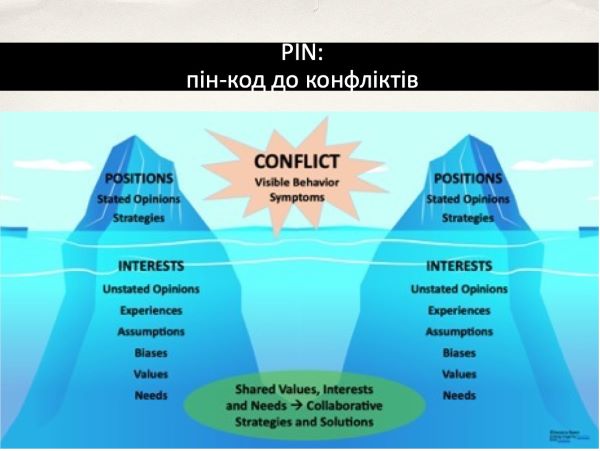
Let us consider the structure of conflict, which operates across three levels: positions, interests, and needs. The meta-level — where the deepest understanding lies — is like the base of an iceberg submerged underwater, representing needs. This is the level we most often fail to recognize, understand, or articulate.
Such analysis is typically carried out by experts or individuals who deeply engage with the issue. In everyday life, we rarely speak of needs directly — often due to emotional overlays that obscure them. And yet, needs reflect our values and genuine longings. Identifying these shared human needs — and seeking strategies that arise from them — is the key to constructive conflict resolution. Needs are universal, even if they are expressed or fulfilled in vastly different ways.
This is where a major problem lies: most conflicts are resolved — at best — at the level of interests, but ideally they should be addressed at the level of needs. If we are not aware of our own needs, let alone those of the other side, and if we are not ready to name and negotiate them, we drastically reduce our chances for meaningful resolution.
Most people remain at the level of positions — the visible tip of the iceberg. This is the superficial layer of “we do something” or “we refuse to do something,” or “we do it — but not really.” At this level, no true transformation is possible; at best, the parties walk away from each other.
At the level of interests, a small space for agreement opens up — when we ask: “Why are we taking this position? What do we actually want?”
Even partial transparency at this level allows us to imagine how to live peacefully together — perhaps not as close friends, but without violence.
Still, it is at the level of needs where real transformation begins. If individuals, including church leaders, clergy, and laity, became aware of what is truly at stake, the situation could look radically different. What mission does the Church currently declare? What do Church communities teach? What is genuinely important in Christian doctrine? If conflicting sides could access this level of awareness, we would live in a world where conflict resolution strategies are built not on suspicion, but on understanding.
Yet without the willingness to understand ourselves — or especially the “other” — this pathway to transformation remains out of reach.
The Mosaic of Identity
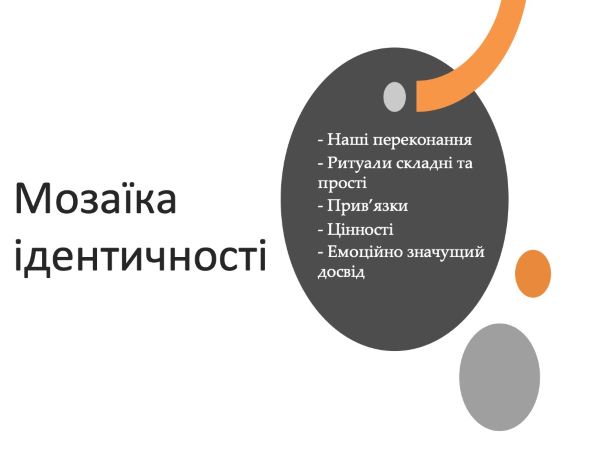
At the core of any party in a conflict lies its own identity. This is not just a question of how we define ourselves, but a set of interrelated components that may be activated simultaneously or separately, influencing how the conflict unfolds and how needs are expressed.
Beliefs and principles — These directly inform our positions. We often say: “This is a matter of principle; we won’t compromise; this is our red line.”
Rituals — These may seem simple, but they often hold the key to change. They can be as formal as liturgy or as everyday as having tea after a service. Even casual communal moments — like sharing coffee during a workplace meeting — can establish a connection. Through such shared actions, even something as small as a handshake, bonds begin to form.
Attachments — These are the people or things we are bound to, relationships we cannot or will not sever, even when under stress. They shape how we approach conflict and what we are willing to risk.
Values — Interestingly, values are often overlooked or taken for granted. Many organizations list them on their websites or hang them on the wall — words like integrity, love, honesty, service — yet they are rarely discussed, clarified, or lived through shared agreements. If these values were actively practiced and jointly defined within communities, the very quality of relationships — both within society and individual groups — would be profoundly different.
Emotionally significant experiences — These may be positive or negative, but negative ones tend to linger longer. For instance, someone at a parish may recall a past injury or offense so vividly that they are unwilling to seek reconciliation, even years later. On the other hand, positive shared experiences can act as safeguards, preventing violence or deepening trust between parties.
Conflict as Sacred Space
Returning to the theme of this talk, and drawing on the work of scholar Mircea Eliade, who introduced the concepts of sacred and profane time, I propose we view conflict as a kind of sacred time and space — one we enter under the influence of myth.
When we are caught in deep conflict — not merely over everyday matters, but over values — many elements of our identity become activated. This can place us in a mythic, symbolic realm in which we belong to a particular group, defend certain truths, and perceive ourselves in stark dualities — good versus evil, light versus darkness. In such a space, our actions take on ritualized and moralized dimensions. We sacralize the conflict.
And yet, the most uncomfortable — and often avoided — step is to desacralize the conflict and look at it rationally, to try to understand what is really happening.
This process threatens to break the myth. And that is precisely why it is so difficult.
Why do some conflicts last for years, even decades? Because they mobilize communities, create shared purpose, forge collective or individual identities, and reinforce myths about “the other.”
Who is “the Other”? In most conflicts, “the Other” is someone we do not understand. It could be a neighbor of another faith, or — in wartime — a person labeled as a draft dodger. It could be someone who remained behind while we moved forward. Often, “the Other” is an imagined figure — shaped by rumor, stereotype, or secondhand narratives, not direct experience.
This is dangerous because it becomes easy to construct wholly negative or idealized images.
Ukrainian society, for instance, often creates heroes who are then swiftly deconstructed — sometimes in mere hours — based on rumors or media revelations. These emotional swings between glorification and betrayal generate cycles of disillusionment.
And in these pendulum swings, from “victory” to “treason,” something vital is lost — social trust.
Trust is what allows a society to remain open to dialogue and cooperation — even with those it might perceive as “other.”
Religion and Uncomfortable Questions
So, what can be done in practice?
If we consider religious organizations as social actors, then here are some questions we might ask — both as individuals and as communities:
– Does the religious organization serve as an example of reconciliation — not between nations, but at least within its own community?
– Are difficult topics avoided? Is there space to speak openly about issues that provoke controversy?
How can religious communities be motivated to collaborate with one another — even in small gestures, like simply visiting each other?
What prevents someone from stepping beyond their familiar boundary — say, when an Orthodox parish stands next to a Seventh-Day Adventist congregation?
What stops us from engaging in conversation that could deconstruct the image of “the other”?
How does religious rhetoric shape our perception of others?
What do we say about the “other”? How is that image constructed? How does preaching influence it?
What does the parish leader say about it? What about the faithful — the very people who build community?
Can we somehow get to the real causes of conflict and strip away religious rationalizations?
Many so-called “religious” disputes are in fact resource-based — such as those seen in parish takeovers.
Often, personal grudges or desires for revenge get reinterpreted through theological justifications.
The real question is: Can such mechanisms be dismantled? Or is the process simply too painful, too inconvenient for anyone to want to begin?
Conflict Transformation
If we think in terms of transforming a conflict situation, there are three basic steps:
Recognize the problem. Naming the problem is already 50% of its resolution. But it requires self-reflection and often painful honesty — something we naturally resist.
Seek empathic understanding. First, we must understand ourselves — our positions, interests, and needs. Then, we must try to understand those of the other side.
Only then can we begin to see the true causes of the conflict — and whether there is room for shared solutions beyond confrontation.
Rebuild relationships. This may mean forging new connections or healing old ones — finding ways to move forward if we see the conflict as a problem and if we want to solve it.
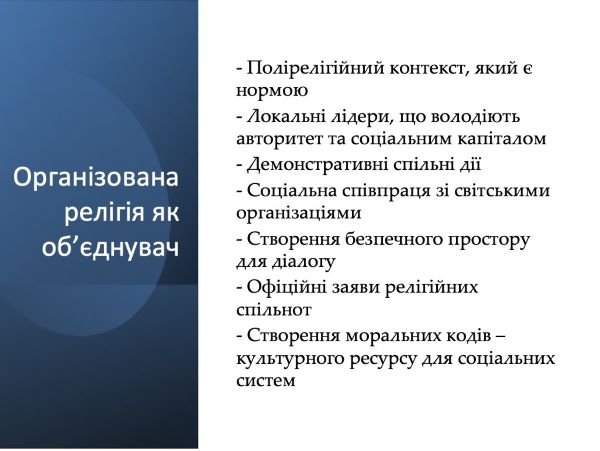
Organized religion can unite people — if it makes this a priority.
But it requires willingness — from religious leaders, communities, and individuals alike.
It begins with acknowledging that we live in a multi-religious or pluralistic society — not solely a Christian one — and continues with the cultivation of respectful, meaningful relationships, even within one’s own community.
Clergy and active believers are not just practitioners of faith; they are social leaders with moral authority and social capital.
They can become agents of transformation — offering initiatives, building bridges.
This could include symbolic joint actions, or social collaboration with secular organizations — a model that remains difficult for many religious groups, yet is increasingly recognized as part of their public ministry.
From a societal perspective, it is crucial to create safe spaces for dialogue. But dialogue is not simply “a conversation in a room.” It is an organized process, usually with a trained facilitator who helps the participants reach deeper levels of understanding — like the “bottom of the iceberg” — to make the conversation mutual and transformative.
There is a significant difference between ad hoc conversation and facilitated dialogue.
Only the latter leads to changes in perception, shared understanding, and the transformation of relationships between participants.
One of our favorite strategies in religious institutions is issuing official statements. They are easy to publish, quick to share — but often disconnected from daily parish life. These declarations usually go untranslated into ordinary human language, remaining abstract and impersonal. What’s missing is practical interpretation: How does this statement affect the way we live, speak, and think today?
The most important — and long-term — task is this: Religious organizations have the power to create moral codes that become cultural resources for broader society.
But this requires courage — to name and confront their own problems, to offer models for overcoming them, and to be examples not only for believers, but for society as a whole.
Dialogue in Practice
Here is a brief overview of how we implement dialogue in practice through our work at Dialogue in Action.
First and foremost, when we speak of restorative practices or dialogue work, we must create a space for interaction — a place where people will come, where they will feel safe, where they will not feel the urge to resort to physical confrontation, but instead will be willing to engage culturally and respectfully.
Once that initial contact is established, we can move toward cooperation — exploring what kind of collaboration is possible, or how people might stay in touch beyond the facilitated meetings. In the best-case scenario, this process leads to mutual acceptance — where people come to realize: “There is this person with different views, perhaps, but we can still live together in one country, one community, and even act together toward common goals.”
The way we speak to each other, the way we greet one another — this creates a visible culture. And others observe this culture and begin to adopt it, recognizing that shared decision-making through conversation is not only possible, but normal — something that requires neither coercion nor surveillance.
When people show a willingness to come together and see a shared purpose — and are ready to act for the common good — that is already a major step forward. It can change both the immediate environment and the larger society. But first of all, it changes people on a personal level — it transforms their perception of the other.
When we come face-to-face, when we gather and speak, myths begin to change. Sometimes they even transform into positive narratives — such as a new collective belief: “We can act together, even if circumstances change after the meeting.”
This emotionally significant, positive experience stays with us. It shows that cooperation is possible — and we carry this understanding into the future.