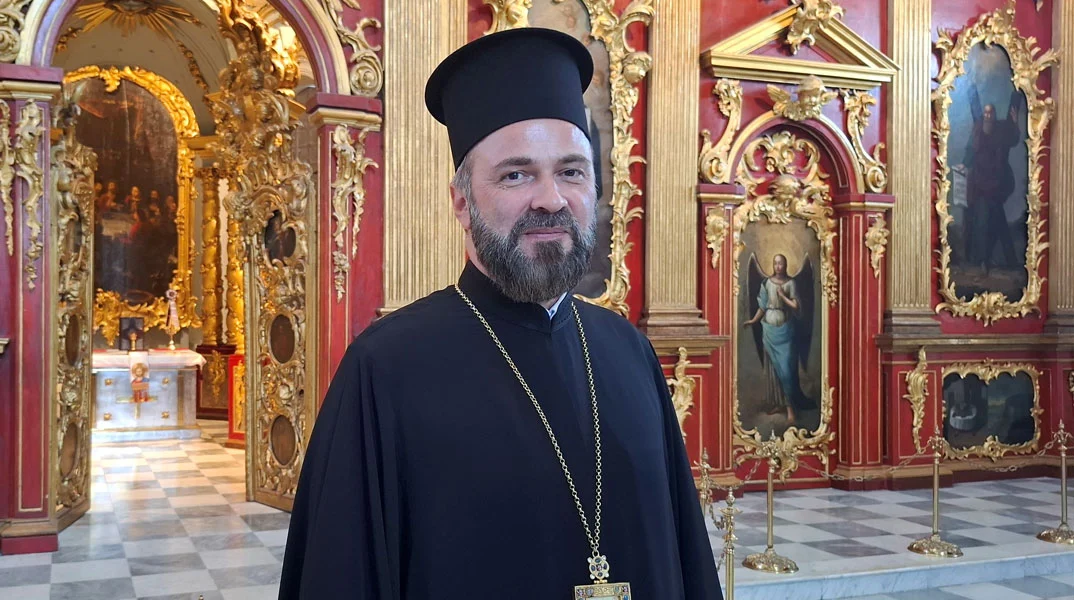
The first Exarch after a 300-year hiatus, who has remained in Kyiv since the first day of the war, speaks to Athens Voice.
Loukas Velidakis
Bishop Michael of Koman speaks about life in Kyiv, the Russian invasion, the responsibility of the Church, and the Greece that shaped him.
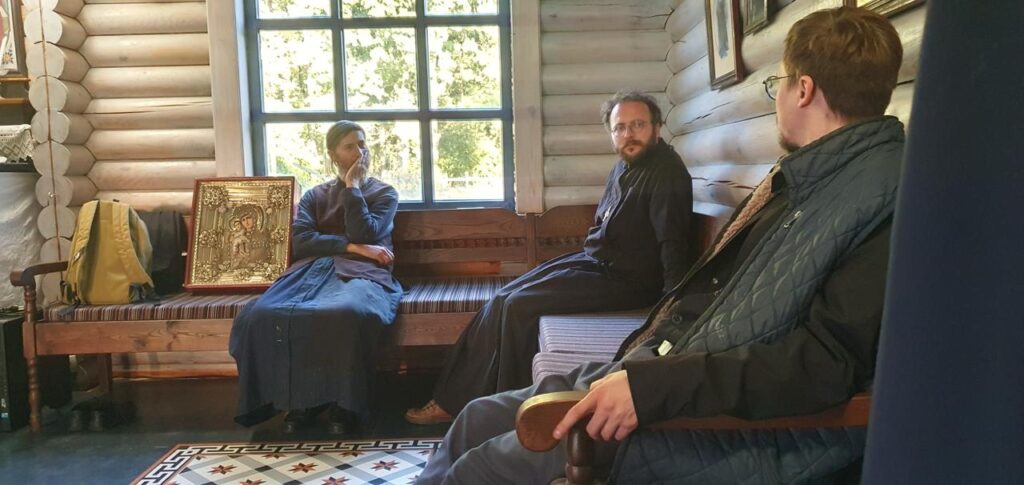
We met at St Andrew’s Church two days before Independence Day. During the interview, an air-raid siren sounded. He simply gestured for me to continue.
Two days before Ukraine’s Independence Day, at around noon on Saturday, I am sitting in the office of Bishop Michael of Koman at St Andrew’s Church in central Kyiv.
Bishop Michael of Koman on the War, the Church, and Greece
A simple and unassuming man, he welcomes us into a room where the Ukrainian and Greek flags stand side by side, while a large portrait of Ecumenical Patriarch Bartholomew hangs on the wall. Books are everywhere. An extraordinarily thick prayer book lies on the table, and when I ask whether he has read it, the bishop laughs: “It’s the pocket edition…”
He speaks Greek fluently, yet says: “Unfortunately, I am still embarrassed because I feel that I do not speak it well enough.” Whenever I compliment his Greek during our conversation, he blushes modestly.
Before long, a siren sounds over the city. The bishop simply gestures to me that the conversation should continue.
He introduces himself, carefully pronouncing his long full title: “I am Bishop Michael of Koman, Exarch of the Ecumenical Patriarch and Rector of the Stavropegion of the Ecumenical Patriarchate in Kyiv, at St Andrew’s Church.”
From Khabarovsk to Independent Ukraine
His secular name is Mykhailo Oleksiiovych Anishchenko. He is Ukrainian, although his origins, as he himself says, are a complicated story. “I come from the Soviet Union. My father was in the military, and in the Soviet Union they could send military personnel anywhere. I was born in Khabarovsk, near China.”
He lived there until the age of twelve. Shortly before the collapse of the USSR, his father, a Ukrainian from Sumy, returned to his homeland. The family settled in the west of the country: first in Ternopil, and two years later in Lutsk, Volyn, near the Polish border.
It was there that he spent his teenage years, where his parents still live, and where he witnessed the birth of independent Ukraine.
Athens – “Like a Fairy Tale”
He came to Greece in 2007. “I received a scholarship from the Church of Greece and went to study in Athens, at the Faculty of Theology.” By then, he had already been a priest for ten years. He knew no Greek – “good morning, good evening, and that was about it…” During his first year, he attended compulsory language classes at the Faculty of Philosophy, followed by examinations, and then continued at the Faculty of Theology. He received his degree in 2012. Meanwhile, the young man “with a Soviet Union mentality,” as he describes himself, found himself on Patission Street in Athens in December 2008 – right at the epicentre of the unrest.
“When I arrived in Greece, from the very first day I began discovering a new world. A different world. And not only that, but a different Orthodoxy as well – because, in terms of our worldview, we were living in a somewhat different reality at the time. I can say that the best and warmest things I experienced were in Greece. In Orthodoxy, in the Church – and not only in an ecclesiastical sense, but on a human level as well.”
“We lived as if in a fairy tale because we were students. We lived at the Synod and were protected. We had our goal: to study, obtain our degrees, and learn Greek.” Despite the tensions of the time, he did not feel afraid. There was even an occasion when he found himself in the middle of street clashes. “We felt as though we had stepped into a historical film. We knew where we should not be, but sometimes we had to walk through those streets – what else could we do! And despite everything, I can honestly say that no one touched us. No one even said a bad word to us.”
The First Exarch After a 300-Year Hiatus
After Athens came the Phanar. As a cleric of the Holy Metropolis of Ierapytna and Siteia assigned to the Ecumenical Patriarchate, he was sent by the Patriarch to Antalya to minister to Slavic-speaking Orthodox Christians. He spent eight years there – from late 2011 until early 2019. He also learned Turkish. “I have a B2 certificate from the official examinations.”
Ukrainian, Russian, Greek, English, French, Turkish, and now Spanish as well. The bishop speaks seven languages.
In January 2019, he arrived in Kyiv. The Tomos of Autocephaly for the Ukrainian Church had just been issued, and the Stavropegion – the Patriarchate’s official representation in the country – had been established. He became the first Exarch of Constantinople in Kyiv “after a 300-year hiatus.” In November 2020, Patriarch Bartholomew consecrated him as a bishop. A year later came the celebrations marking the 30th anniversary of Ukraine’s independence and the Patriarch’s visit to Kyiv. “It was a major event for Ukraine. That visit gave the Church momentum; there was significant progress.” A few months later came the Russian invasion. War.
“We Are Here, We Did Not Leave”
I ask him to go back in time. To four o’clock in the morning on 24 February, when his subdeacon called him. “He says to me, ‘Your Grace, I’m coming to get you and take you out of Kyiv.’ He lives outside Kyiv, so he would have had to come back, pick me up, and then we would have gone somewhere farther away. I refused. I told him to take his family somewhere more or less safe. I asked him not to come to Kyiv because we did not know what was going to happen. And I said that, with God’s help, I would somehow manage.”
“So I did not leave Kyiv.” Alongside him, of the entire diplomatic corps, only the Papal Nuncio, the Polish Ambassador, and the Azerbaijani Ambassador remained. “All the other consulates left. But from the very first days, we celebrated the Liturgies. Liturgies under bombardment, amid explosions, amid all of this. So now, when something happens, I am already used to it. I think many people are.” Four and a half years later, the siren has become part of everyday life.
Was he afraid? “I cannot say that I was not anxious. I was anxious; that is natural. But I told myself: I represent the Mother Church.” He repeats this – these were the very words that kept him there. “The historical legacy also prepared me. Throughout history, many Exarchs met tragic ends. They were killed.” He thought about the possibility that he might be next. “Why not? Anything could have happened.”
I ask him to explain how he understands this responsibility. “I no longer belong to myself. I belong to the Church and to God. Despite this, I can be afraid, but I have a responsibility. First and foremost, responsibility for the Church and for the ministry entrusted to me by the Mother Church. When people hold positions of responsibility, they become symbols. I am not simply Michael – I am a symbol of the Mother Church. And if I leave at a moment like this, it would be as though I were betraying my ministry and the faithful. And not only that. I would bring people even greater sorrow because I would take away the hope that my presence here gives them. That is how I felt.”
In those first days, they also recorded a video to support people. “I say: we are here, we did not leave.”
Three months ago, St Andrew’s Church shook when a drone fell onto the road directly in front of it. A kilometre downhill, a bridge was struck. What does a person think about at such moments – not only a bishop? “I thought only about my parents: how were they doing there in Lutsk? I could not believe this was happening. I still cannot believe it. It is like a terrible fairy tale, like a nightmare. As though I am about to wake up and it will all be over. That is what I felt. The people who came to the church helped me. They needed comfort; they wanted to talk. And that helped me cope with my own human emotions.”
Two Days on a Sofa – With Prosphora
He does not go down to a shelter. He points to the walls of his office – about two metres thick, with no windows. “Our shelter is here.” During one of the heavy overnight attacks on Kyiv, the authorities decided to impose a curfew for Saturday and Sunday. “And I said: what am I supposed to do? On Sunday I have to celebrate the Divine Liturgy. I had prepared the prosphora at home. Then I remembered: when the sirens begin, we are allowed to move to a shelter. So I immediately took the prosphora, came here, and stayed here for two days.” He slept on the sofa.
During one particularly heavy attack, children from the school opposite ran into the church because there was nowhere else they could reach in time. “When people are anxious, they come to you and see in you a servant of Christ. They feel trust. You do not need to tell them complicated things. You simply need to listen to them and be there for them. And that brings comfort.”
He attributes his calmness to people he met in Greece. He remembers his spiritual elder, the late Bishop Eugenios, who used to tell him: “Do not forget: no matter how difficult the situation, say, ‘God will provide.’” He remembers the late Metropolitan of Pisidia, formerly of Korea, who, even at an advanced age, was building churches in Turkey. “Once during the Liturgy, I said to him: ‘Your Eminence, when I serve with you, I feel such peace and tranquillity, as though you were my grandfather and I were your child.’ And he genuinely could not understand how it could be otherwise.”
He remembers the Metropolitan of Didymoteicho, then Bishop of Diavleia, who gathered foreign students and sent them to Athenian parishes so that they could learn Greek by interacting with Greeks. “That man foresaw the future. We are still in touch. Some have already become bishops – both Greeks and foreigners – and this always unites us like a brotherhood. So when I come to Greece, the bishops of Ierapytna and Didymoteicho say: ‘Come, you must come; this is your home. Do not forget that. Come, and we will serve together.’”
“God sent me people whom you simply look at – and learn from. You just look at them – and learn. I see all those years as preparation. It changed the way I think, even the way I view Church affairs, my attitude towards people. I learned not to be strict, but to be a Christian who wants to help another person. That is how I came to Ukraine prepared.”
As for the end of the war, he makes no predictions. “No war lasts forever. One day it will end. I am not a politician. I am responsible for Church affairs.” Since the beginning of the war, the Stavropegion has consistently worked on another means of fostering unity – publishing. The “unifying Ukrainian translation” of the Holy Scriptures is distributed free of charge and is used by various Ukrainian ecclesiastical jurisdictions. At the same time, a Ukrainian edition of Archimandrite Aristarchos Grekas’s book Artificial Intelligence and the Human Being is ready for publication. “This is where I see my work. I do everything I can.”
Smoke and a Wedding Dress
Before we finish, I ask him to address the Greek audience. In response, he expresses his gratitude. He came to Athens at the age of 31 and believes that the Greek world, the Orthodox Church, and the people he met there changed his entire life. “It broadened my horizons and opened up new meanings for me.”
Now he wants to give younger people at least some of what he himself once received: the opportunity to learn Greek, study at universities, and broaden their own horizons. Above all, he wants them to understand: “The Church is not something from the past, but something of the present and the future. I want them to see the Church not as a national museum, but as a living community and communion with God. We are all members of a living community.”
When the interview ends, Bishop Michael gives us a tour of St Andrew’s Church, and then we step outside. From this height there is a breathtaking view of Kyiv, but our attention is drawn elsewhere. In the distance, about ten kilometres away, a huge column of black smoke is rising. The Russians have just struck there – at the very moment when we were speaking in his office and the air-raid siren sounded.
And directly below the church, a couple has just been married. The bride and groom stand together, posing for wedding photographs, while behind them, in the very same frame, a column of black smoke rises into the sky. Sometimes an entire country can fit into a single image. In Kyiv in 2026, war and life do not exist in two separate worlds. They coexist on the same street, at the same moment, even in the same photograph. The city continues to be bombed, but it also continues to fall in love, to marry, to believe, and to live.
“We are here, we are not leaving,” the bishop tells me.
Source: Athens Voice