

Tetiana Derkach, religious publicist, Editor-in-Chief of Religion in Ukraine
We continue the webinar series of the “Youth for the Future of Ukraine” project, and today we are discussing perhaps one of the most demonized words in the context of the Ukrainian church conflict — the word “compromise.” Compromise in an inter-church conflict: capitulation or an investment in the common good? This is how I titled my webinar, but you will see that a contradiction is already embedded in this title.
Compromise is often confused with dialogue, and not without reason, although they are not the same thing. Dialogue is simply a conversation in which you exchange views and positions. But in a church conflict, this logic does not work quite so simply. If I do not recognize my opponent as a canonical subject, I have every right to ignore them — silence here is not weakness, but a consistent position. Yet the moment I begin communicating — even unofficially, but publicly — with someone who supposedly does not exist, I am already, in practice, recognizing the subjecthood of my opponent, and that is already a reputational concession, although dialogue is not yet negotiations, but merely the precursor to negotiations.
Why can simple dialogue be interpreted as a concession?
To answer this question, we need to understand something more important than church politics itself: we need to understand where a sense of status comes from in an individual and in a community. It turns out that there are at least three completely different answers to the question, “What makes my position right in my own eyes and in the eyes of others?” And whether each side of the conflict interprets dialogue as a normal working instrument or as betrayal before the first word is even spoken depends precisely on which of these three answers each side has unconsciously chosen.
Block 1. Three Status Cultures
We will now make a brief shift away from the specifics of the church conflict toward a tool that will help us understand why the very same words — “compromise,” “concession,” “dialogue” — provoke opposite reactions in different people. Some will hear something normal and reasonable in the word “compromise”; others will hear an insult.
As I have already said, individuals and communities answer the same question differently: what makes my position right? And depending on the answer, compromise may look like the mature step of an adult person — or like a betrayal of oneself.
Sociologists Bradley Campbell and Jason Manning wrote a book in 2018 entitled The Rise of Victimhood Culture. But it all began with an important observation on American university campuses sometime in the mid-2010s.
At that time, conflicts began to occur that, at first glance, seemed very strange. Someone wrote a political slogan in chalk on the pavement — and students began filing official complaints en masse with the university administration, demanding an investigation and punishment. A professor said an ordinary phrase — and a collective letter was written demanding that the professor be dismissed. Sociologists were puzzled: why, instead of simply arguing with one another or ignoring a trivial matter, were people going to complain to those in authority? And why was this behavior so actively condemned by older generations, who would say, “In our day, we would have sorted it out ourselves”?
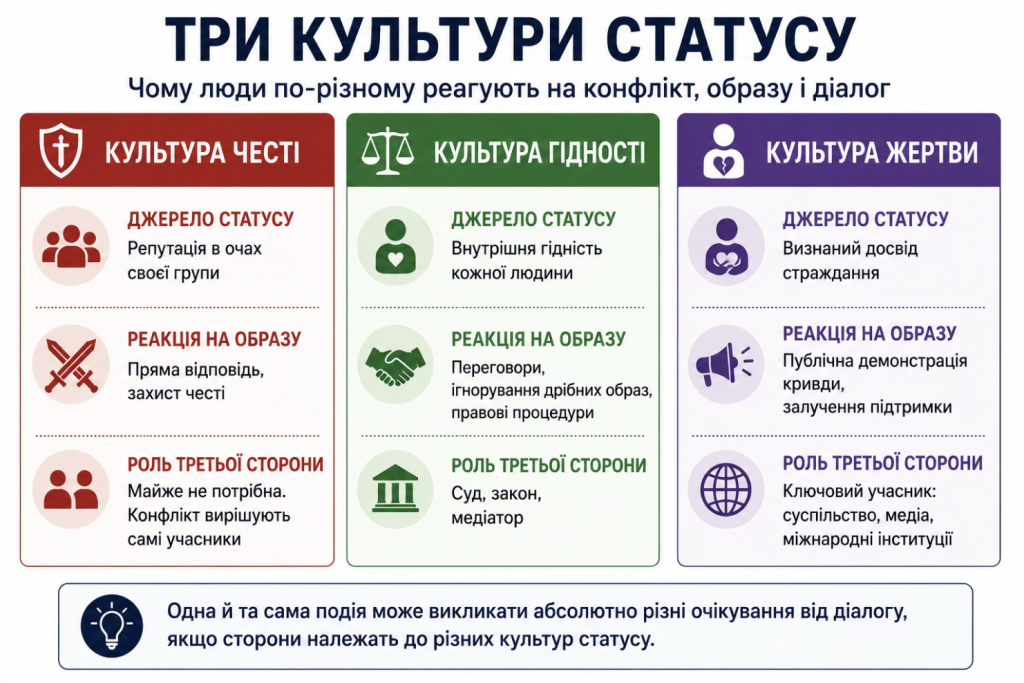
Campbell and Manning realized that before their eyes two different types of response were colliding, rooted in different cultural backgrounds. After examining the issue in greater detail, they developed a typology of three types of culture — honor, dignity, and victimhood — which we will now consider.
The first type: honor culture
This is the oldest of the three types, and sociologists had studied it long before Campbell and Manning. Anthropologists, for example, described it in Mediterranean societies, while researchers Richard Nisbett and Dov Cohen demonstrated it using the example of the American South.
In an honor culture, a person’s value is determined by external recognition, by reputation in the eyes of the community. This status must constantly be defended, and defended publicly. An insult cannot be ignored — that would be interpreted as weakness. An insult must be answered, often through direct confrontation. The classic example is a duel: not because the duelists believed that a fight would prove who was right, but because the very willingness to fight demonstrated that my honor matters more to me than my life. The typical pattern is to take offense at trivial matters and fight over those trivial matters.
In such a culture, a third party — a court, a superior, a mediator — is hardly necessary. Matters of honor are settled by the participants in the conflict themselves, face to face.
The second type: dignity culture
This type began to take shape in Western societies approximately from the Enlightenment onward, and it was described as early as the 1970s by sociologist Peter Berger in his famous article On the Obsolescence of the Concept of Honor.
In a dignity culture, a person’s status does not depend on what others think of them. Dignity is something a person possesses simply because they are human, and no one can deprive them of it or add to it. Therefore, minor insults can be ignored — they do not affect what is truly important. And if the conflict is serious, a neutral third party is brought in: a court, the law, a mediator, who considers the substance of the case rather than someone’s reputation.
It is precisely this culture that dominates contemporary Western legal systems, diplomacy, and business negotiations — and, importantly, most documents on inter-church dialogue are written in the language of dignity.
The third type: victimhood culture
And here we return to the strange university conflicts from which this discussion began. Campbell and Manning observed that the students who complained about chalk inscriptions were behaving neither like people of honor nor like people of dignity. They did not fight directly, and they did not ignore the insult as a trivial matter. They did something else: they publicly demonstrated their grievance and appealed to an external authority that was expected to recognize that grievance and punish the offender.
In a victimhood culture, status is the recognized status of the injured party. Not strength, not quiet confidence in one’s own worth, but precisely publicly validated grievance becomes the currency by which moral rightness is measured. Therefore, in this culture people speak not so much to one another as about one another, appealing to third parties and arbiters — the media, the authorities, society. The typical pattern is the public display of grievance.
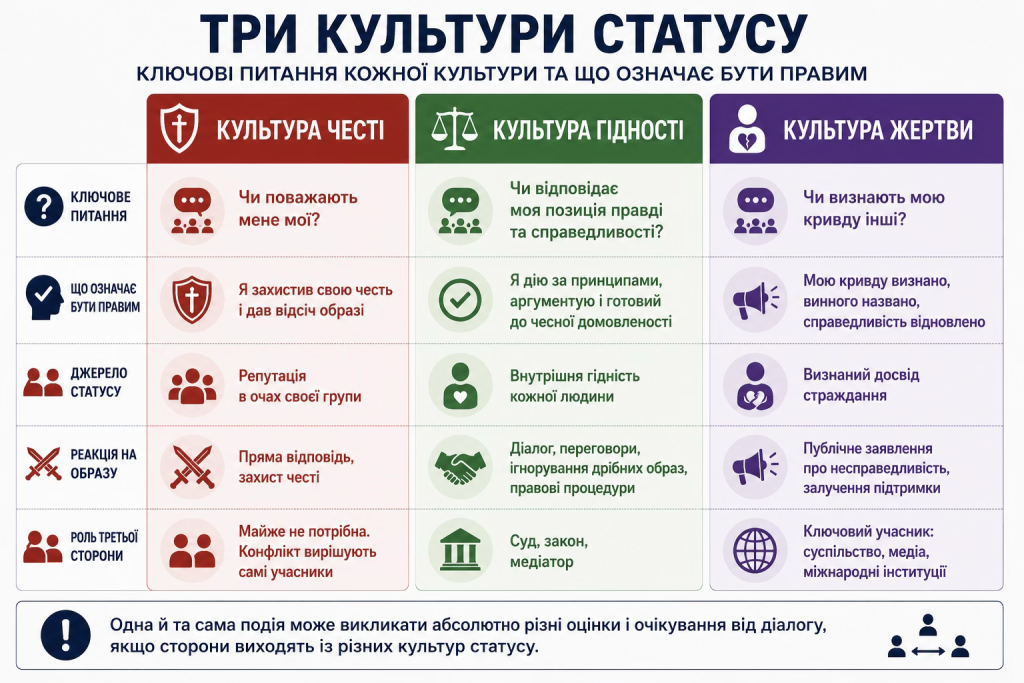
The key question of each culture in the context of dialogue or negotiations
Honor culture: “What will others think if I make a concession?”
The question is not “Is this agreement right in substance?” but rather how it will look from the outside — whether it will be interpreted as weakness. Here compromise almost always looks like capitulation. If you made a concession, that means you could be intimidated or bought, and that is precisely the kind of weakness that honor forbids one to display. In game theory, this is called a zero-sum game: if one side wins, the other loses exactly the same amount.
Dignity culture: “Are the terms of this agreement fair in themselves?”
The question focuses on the agreement itself, not on who is watching it, so the answer can be reached independently of how the group reacts. Reaching an agreement on terms acceptable to both sides is a rational action by adults who recognize one another as equals, not the capitulation of one side to the other. In game theory, this is win-win, a benefit for both sides. Here compromise appears not as weakness, but as a rational strategy.
Victimhood culture: “Will I lose recognition of my grievance or injury if I agree?”
Here the question is no longer about reputation or the fairness of the terms, but about whether my grievance will remain recognized. Compromise risks appearing as a voluntary abandonment of victim status. Hence the strategy of a retaliation or punishment strategy. Paradoxically, compromise here carries a special risk different from the previous two types. It is not a loss of face, as in honor culture. It is the threat of losing the very status of victim, because if you acknowledge even a fraction of your opponent’s rightness, this may be interpreted as voluntarily surrendering your own already recognized grievance.
The paradox is that victimhood culture may arise not spontaneously within the “victim,” but as a by-product of the fact that a side oriented toward honor culture has for a long time refused to play by the rules of dignity.
So, let us summarize: the three types of culture give three completely different answers to the same question: what does it mean to be right?
In honor culture, being right means not showing weakness, overpowering the opponent, and not admitting one’s own mistakes.
In dignity culture, it means acting reasonably and fairly regardless of recognition; acknowledging mistakes is an element of development and improvement.
In victimhood culture, being right means being recognized as the injured party. Suffering is transformed into moral capital, which the individual converts into a demand for social or material compensation. Acknowledging one’s own mistakes threatens the loss of moral capital.
And, as you have probably already guessed, no real dispute — including the one we are examining today — exists in the pure form of only one type. Usually, we hear the language of all three types simultaneously, often even from the same person in the same speech. And this is precisely what we can recognize in the example of the Ukrainian church conflict.
Block 2. The Theory of Compromise
Before we return to the church conflict, we need to understand what compromise actually is. It seems like a simple word: everyone intuitively understands what is meant.
What is compromise: definition
In everyday language, “compromise” is often understood as something one agrees to only when one lacks the strength to defend one’s own position. But in scholarly language — in political science, sociology, and negotiation theory — the definition is much more neutral.
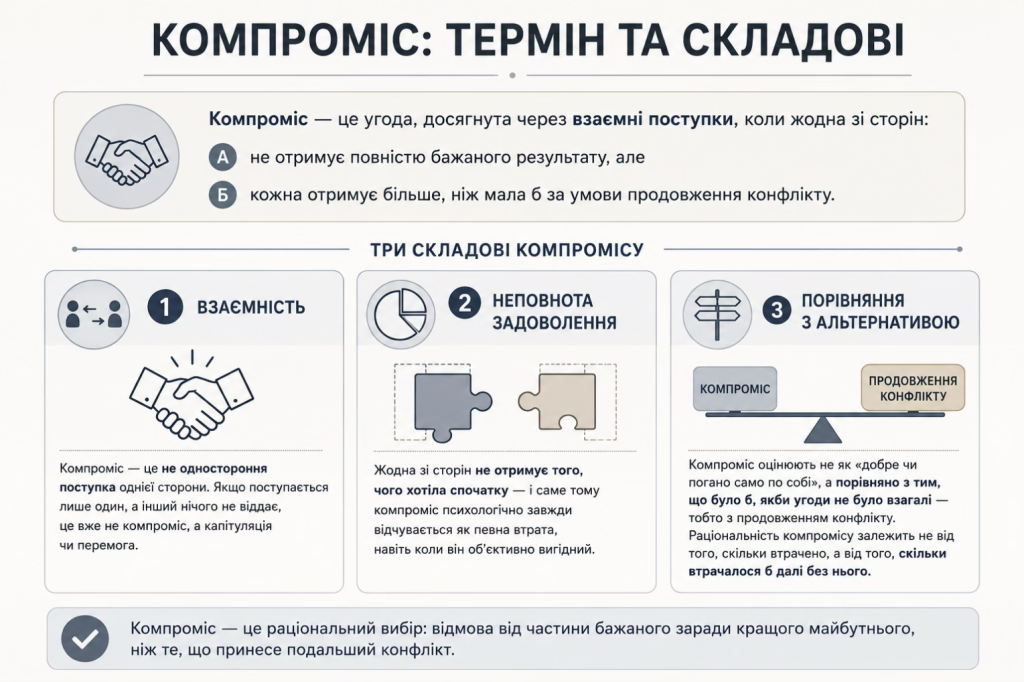
Compromise is an agreement reached through mutual concessions in which neither side:
A) obtains the result it fully wanted, but
B) each receives more than it would have received if the conflict had continued.
This definition contains three elements.
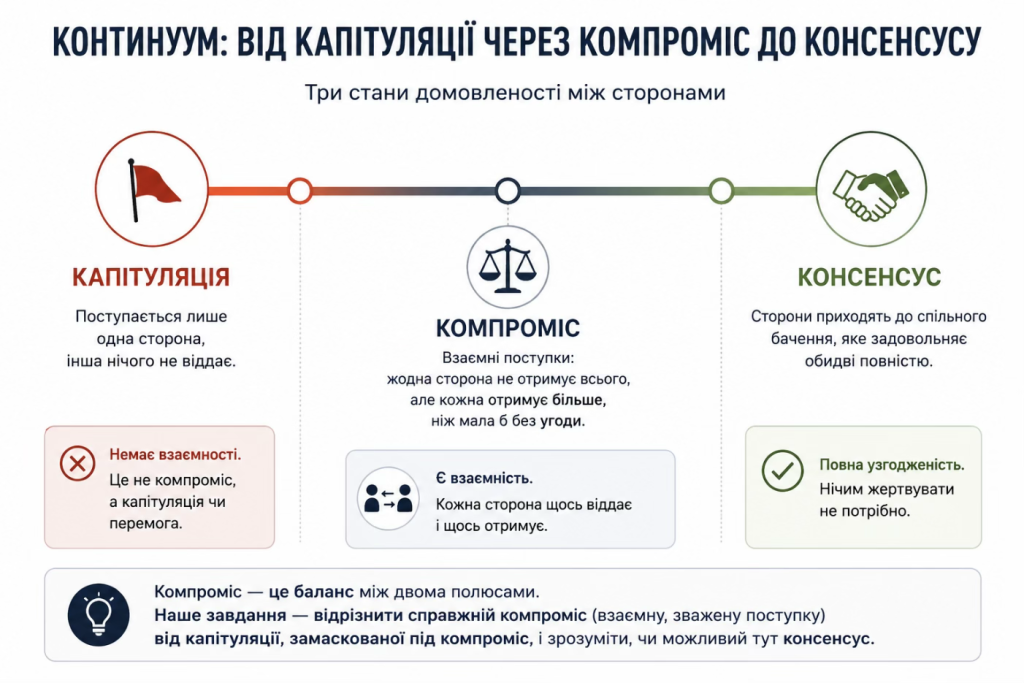
First, reciprocity. Compromise is not a unilateral concession by one side. If only one side gives something up and the other gives up nothing, that is no longer compromise but capitulation or victory. Confusion between these situations is what most often causes disputes over whether one side has “surrendered.”
Second, incomplete satisfaction. Neither side receives everything it originally wanted — and this is precisely why compromise always feels psychologically like a certain loss, even when it is objectively beneficial.
Third, comparison with the alternative. Compromise is evaluated not as “good or bad in itself,” but in comparison with what would happen if there were no agreement at all — that is, if the conflict continued. This is a key point: the rationality of compromise depends not on how much has been lost, but on how much more would continue to be lost without it.
It is important to distinguish compromise from two neighboring concepts with which it is often confused.
Capitulation is when only one side makes concessions and the other gives up nothing. There is no reciprocity here, so it is not compromise, even if the actions may look similar from the outside.
Consensus is when the parties arrive at a shared view that satisfies both completely, without a sense of loss. It is the opposite pole from capitulation: consensus is when nothing needs to be sacrificed because the interests have proved compatible.
Compromise lies somewhere between these two poles — and this is precisely why the question we are asking today is so difficult: how can we distinguish a genuine compromise, a mutual and balanced concession, from capitulation disguised as compromise, and can full consensus ever be possible where, at present, only compromise seems possible?
Six directions of disguise
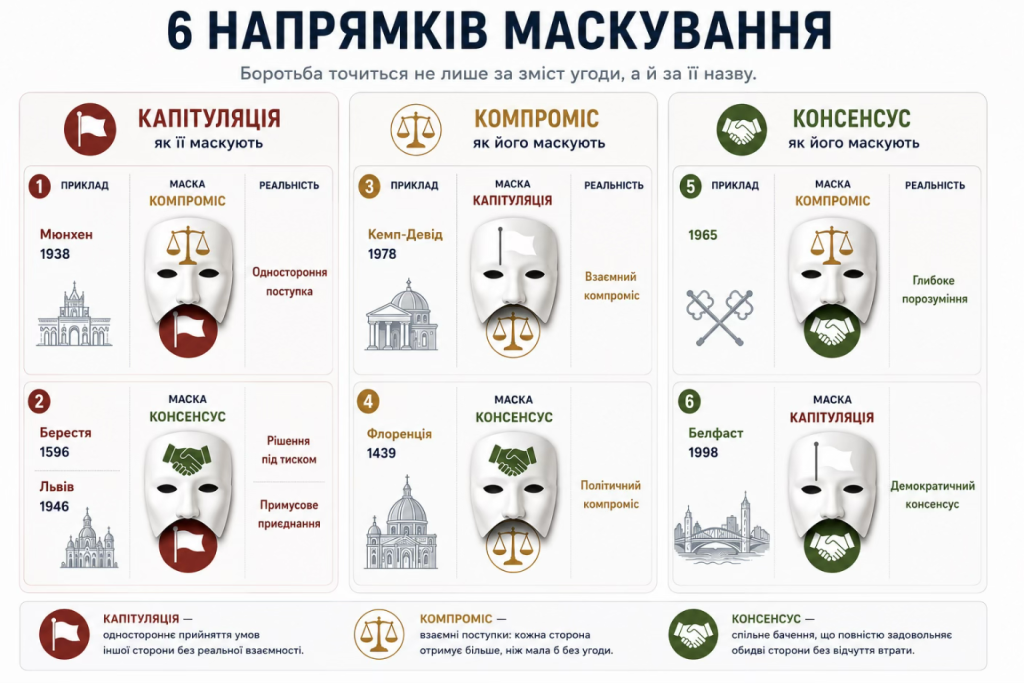
1. Capitulation disguised as compromise.
The stronger side deliberately uses the language of reciprocity — “we are both moving toward one another” — even though no real exchange has taken place, in order to make it easier for the weaker side to accept defeat and to avoid the image of a victor humiliating the defeated.
The mechanism is this: symmetrical language conceals an asymmetrical outcome.
An example is the Munich Agreement of 1938, under which Czechoslovakia was dismembered to appease Hitler. British Prime Minister Neville Chamberlain and French Prime Minister Édouard Daladier publicly presented the agreement with Hitler as a diplomatic compromise, “peace for our time,” achieved through mutual concessions. In reality, Czechoslovakia — the party whose territory, the Sudetenland, was being transferred to Germany — was not even invited to the negotiating table. The symmetrical language of “compromise” concealed a completely asymmetrical outcome: one side received territory, the other received nothing except a promise that was soon broken.
2. Capitulation disguised as consensus.
This is the most dangerous variety: a coerced agreement is presented as the free and organic choice of a party. Historically, this is a classic problem in evaluating processes of church union, when a decision taken under external political pressure appears in official documents as the voluntary and unanimous will of the hierarchy.
This case is the hardest to recognize because the greatest resources are devoted precisely here to producing a convincing rhetorical package.
An example is the Union of Brest of 1596. In official Uniate documents, the decision of part of the Orthodox hierarchy to submit to Rome is presented as the free and unanimous choice of the bishops. Historians still debate the degree of coercion, but a significant body of scholarship points to substantial political pressure from the Polish Crown and the personal interest of certain bishops in career advantages — in other words, a decision made under pressure appeared in the texts as the organic and voluntary will of the Church.
Another example is the so-called incorporation of the Ukrainian Greek Catholic Church into the Russian Orthodox Church in 1946, the Lviv pseudo-council. The official formulations there were particularly striking: “reunification,” “self-liquidation,” “voluntary abolition of the Union of Brest,” and so forth.
3. Compromise disguised as capitulation.
Here it is no longer a party to the agreement that is at work, but third-party actors — the internal “hawks” within each camp, who deliberately call a balanced, reciprocal agreement “betrayal” or “capitulation” in order to delegitimize negotiators and preserve their own political capital.
This is not a description of the agreement’s content, but a weapon against those who signed it — the classic dynamic of “betrayal” rhetoric in Ukrainian political discourse concerning any peace negotiations, regardless of their actual terms.
An example is the Camp David Accords of 1978 and the peace treaty between Egypt and Israel. The agreement was entirely reciprocal: Israel returned the entire Sinai Peninsula to Egypt, while Egypt became the first Arab country to recognize Israel and establish diplomatic relations with it. By any objective criterion, this is a textbook example of compromise, not capitulation.
Nevertheless, the Arab League called the agreement a betrayal of the common Arab cause and expelled Egypt from the organization for ten years, while President Anwar Sadat, who signed the treaty, was assassinated in 1981 by radicals who regarded the agreement as capitulation to the “enemy.”
Here the label “capitulation” was used not to describe the actual content of the agreement, but as a weapon against the very act of recognizing the opponent, entirely regardless of how advantageous or reciprocal the terms actually were.
4. Compromise disguised as consensus.
The parties publicly proclaim “complete unity of views,” although what actually occurred was an ordinary exchange of concessions, in order to preserve an image of institutional monolithic unity before their own audience or an external observer.
Church councils that proclaim a “unanimous decision” often conceal precisely this mechanism.
An example is the Council of Ferrara-Florence of 1439. The council publicly proclaimed full doctrinal unity between the Catholic and Orthodox Churches. In reality, according to many historians, it was a politically compelled compromise: Byzantine Emperor John VIII needed military assistance from the West against the Turkish threat, and it was this dependence, rather than theological agreement, that pushed the Greeks toward signing.
The union was publicly presented as consensus, although most Orthodox clergy and laity soon rejected it — demonstrating that no genuine consensus had existed.
5. Consensus disguised as compromise.
The reverse case: leaders who have actually achieved complete and sincere understanding deliberately understate this publicly and call the agreement a “difficult compromise,” because genuine consensus may appear suspiciously easy to their own audience — and in an honor culture, ease is perceived as a sign that one did not fight hard enough for one’s position.
An example is the mutual lifting of the anathemas between Orthodox and Catholics in 1965.
Pope Paul VI and Ecumenical Patriarch Athenagoras lifted the mutual anathemas of 1054 — a step that some theologians in both Churches regard as a sincere and profound mutual understanding in recognizing one another. Officially, however, the event was formulated cautiously, as a limited symbolic gesture rather than full reconciliation, precisely so as not to alarm the conservative sections of the faithful on both sides, for whom “too easy” a rapprochement would have appeared suspicious.
6. Consensus disguised as capitulation.
Internal radicals within one of the parties call an agreement capitulation even though it actually reflects sincere and unforced understanding — simply because the very fact of understanding with the “enemy” undermines the logic on which their own status rests.
Recall honor culture and victimhood culture: in both, any recognition of the opposing side threatens identity, regardless of the actual content of the agreement.
An example is the Belfast Agreement of 1998 between the governments of the United Kingdom and Ireland, with the participation of the main political parties of Northern Ireland. It ended a long and bloody ethno-national conflict. The agreement was approved in referendums both in Northern Ireland and in Ireland — meaning that it genuinely represented a broad, democratically confirmed consensus among the majority of both communities.
Nevertheless, radical factions in both camps — some unionists and dissident republican groups such as the Real Irish Republican Army — for years described the agreement as betrayal and capitulation, not because this corresponded to the facts, but because the very fact of reaching an understanding with the “enemy” undermined the logic on which their own identity rested.
All six cases demonstrate one thing: the content of an agreement and the way it is presented or interpreted are two separate stories, and it is often the gap between them, rather than the agreement itself, that becomes the source of additional conflict.
Someone may obtain an entirely fair and reciprocal agreement and still lose the public battle over what that agreement should be called. And conversely, actual capitulation may exist for years in public memory as a “courageous compromise,” simply because at the time no one had an interest in calling things by their proper names.
Block 3. Factors That Determine the Interpretation of Compromise
Let us move on. When the phenomenon of compromise came into the field of professional sociologists and negotiation experts, and when they began to study it carefully, it became clear that at least four different factors affect it simultaneously.

And if we confuse them, we will argue about compromise while in reality talking about different things.
1. Resources and interests: classical negotiation theory
In the 1970s, the Harvard Negotiation Project began operating at Harvard. Two of its founders, Roger Fisher and William Ury, wrote a book in 1981 that became one of the most influential books on negotiation in the world — Getting to Yes.
They began with a simple observation.
Imagine two sisters arguing over a single orange — both want it for themselves. The simplest solution is to cut it in half, and that is what people usually do. But if each sister is asked why she needs the orange, it turns out that one needs only the peel for baking, while the other needs only the juice. By cutting it in half, both received half as much as they could have received. In reality, their actual needs did not conflict at all.
Fisher and Ury distinguish between two things that are easily confused.
A position is what a person declares aloud: “I need the orange.”
An interest is what the person actually wants: the juice or the peel.
A compromise that splits positions down the middle is often worse than a solution that looks for the hidden common interest behind those positions.
For the church conflict, this raises an important question: when one side says, “We will never accept this,” is that a position or a genuine interest? Perhaps behind a rigid position lies an interest that can in fact be satisfied without violating what truly matters to the other side.
2. Power and control: the realist tradition in international relations theory
This is no longer about the psychology of negotiations, but about politics.
In international relations theory, there is an entire tradition known as realism. Its classical representatives, such as the German-American political scientist Hans Morgenthau, author of Politics Among Nations: The Struggle for Power and Peace from 1948, insisted that the outcome of negotiations is determined not by who has the better arguments, but by who has greater power.
There is an interesting observation here: when the stronger side makes a concession, it appears as generosity, a strategic move, a display of confidence. When the weaker side makes precisely the same concession, it is almost always interpreted as capitulation, regardless of how reasonable that concession may have been in substance.
In other words, the question “Who is stronger right now?” already predetermines how any agreement will be perceived, before anyone has even had the chance to assess its terms.
3. Sacred values
Now we come to the factor that is probably the most important specifically for our topic.
The American psychologist Philip Tetlock studied why certain proposals outrage people even when they are rationally advantageous.
He researched sacred values and taboo trade-offs.
Tetlock conducted the following kind of experiment: people were told about a hospital that had decided to spend money more efficiently in order to save more children’s lives for the same amount of money. Logically, this is a good decision. But when the hospital was described as having “calculated” how much it costs to save one child, people reacted with anger.
Not because the decision itself was bad, but because the very act of applying a monetary calculation to human life violated something that people regarded as sacred — something that cannot be measured at all in ordinary, secular categories.
Tetlock called this a taboo trade-off.
When a certain value is treated as sacred, any proposal to exchange it for something pragmatic — money, convenience, or even social stability — can itself provoke moral outrage, regardless of how beneficial the proposal may be.
And importantly, rational arguments in such a case not only fail to work — they can actually intensify resistance, because the very attempt to “calculate” something sacred is perceived as an insult.
If canonical fidelity, theological truth, or faithfulness to tradition are treated as sacred, then a proposal to “exchange” them for something secular — even for social peace or the common good — may provoke not merely disagreement but indignation because of the very form of the proposal rather than its substance.
The sacred cannot be exchanged for the earthly.
4. Trust and expectations of reciprocity: game theory
The final factor is whether one should expect a concession to be reciprocated.
Here the classic prisoner’s dilemma is useful. It was formulated in 1950 by mathematicians Merrill Flood and Melvin Dresher, with the name given by their colleague Albert Tucker.
Two accomplices are placed in separate cells and each is given a choice:
If you remain silent and your partner remains silent, both receive one year in prison.
If you betray your partner — that is, tell the authorities what happened and implicate them — while your partner remains silent, you go free and your partner receives ten years.
If both betray each other, each receives five years.
From a rational point of view, it is more advantageous for each individual to betray the other regardless of what the other does. But if both think this way, each receives five years instead of the more advantageous outcome of one year for each.
This is a model of why distrust destroys cooperation that would benefit both sides: the best collective outcome cannot be achieved if each side fears that its trust will be exploited against it.
Compromise, in essence, is the equivalent of “remaining silent” in this model: mutual restraint that requires taking the risk of believing the other side.
Later, the American political scientist Robert Axelrod went further and asked: what if this game is played not once, but many times in succession with the same partner — as happens in real, long-lasting conflicts?
He organized a tournament of computer strategies, computer programs that repeatedly played this same game against one another, and observed which strategy would win.
The simplest strategy won: tit-for-tat — begin by trusting your partner, and thereafter repeat what your partner did in the previous round.
The conclusion was this: when conflict is not a one-time interaction but a long history of repeated encounters, trust ceases to be a naïve risk and becomes a rational strategy built on observing a partner’s actual actions rather than their words.
The Ukrainian church conflict is not a single game, but decades of this kind of repeated interaction, in which every move by one side receives a response from the other.
If experience has accumulated in this history showing that gestures of rapprochement were regularly used against those who made them, then refusal to trust becomes not stubbornness, but a rational, learned strategy.
And this is worth remembering before urging the parties to “simply trust each other”: trust here is never a first step into emptiness; it is built gradually through consistent and verifiable reciprocal steps.
What Does a “Successful” Compromise Mean?
Here it is worth recalling the Norwegian peace researcher Johan Galtung, who founded the discipline of peace research itself.
He distinguished between negative peace — the mere absence of hostilities or open conflict — and positive peace — restored relationships, justice, and trust.
Compromise may produce the first without producing the second at all.
That is why the real question is not, “Did the parties reach an agreement?” but rather, “What exactly stands behind it?” Is it an agreement that merely stops the struggle, or an agreement that genuinely restores trust?
How All Four Factors Manifest Themselves in the Three Status Cultures
Now let us return to the three cultures discussed in the first block, because these four factors do not operate in the same way within each of them. They are filtered differently depending on what a person’s status is based upon.
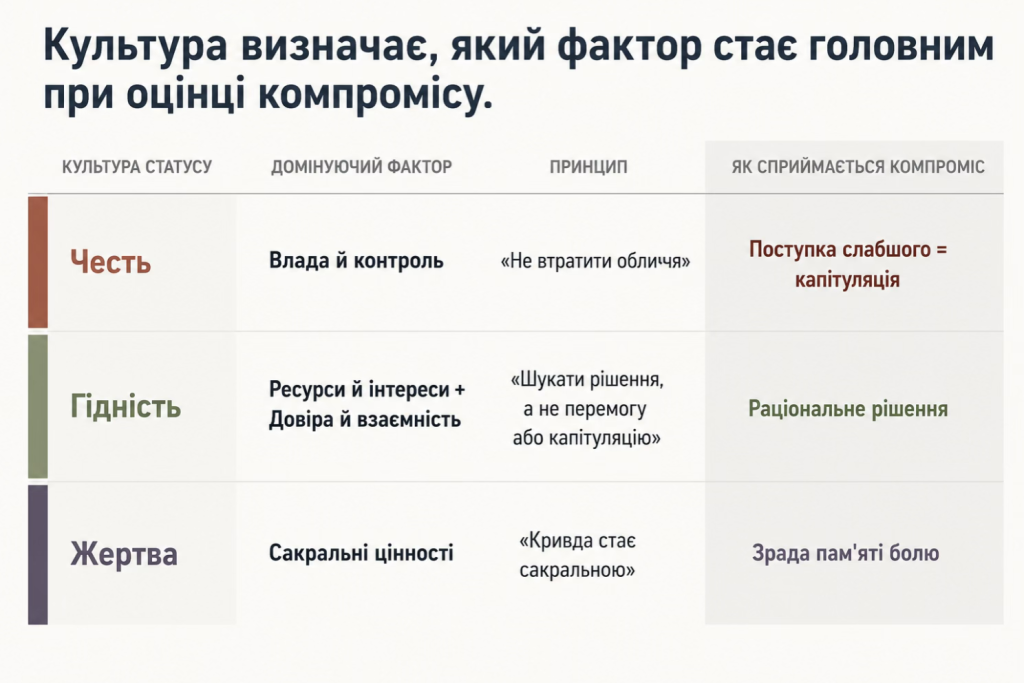
In honor culture, the second factor — power and balance — is felt most acutely. Because status depends on external recognition, any concession by the weaker side is automatically interpreted as capitulation, regardless of the actual interests or terms of the agreement.
Honor culture becomes visible where the conflict is formulated in the language of direct confrontation and the personal reputation of hierarchs: who “refused to shake whose hand,” who publicly “exposed” whom, questions of canonical seniority understood as matters of the dignity of the office itself, rather than merely legal status.
In dignity culture, the first and fourth factors work best — the search for common interests and the building of mutual trust.
Because status does not depend on who is watching, the parties can calmly search for a substantive solution rather than worrying about how it will look from the outside.
Dignity culture is the language in which your metanarrative itself speaks: a shared space of responsibility, a human-centered approach, and the willingness to coexist in disagreement without destroying the dignity of the other.
It is the normative, desirable type — but for that very reason, it is the least natural for parties that have been shaped for years by the logic of the other two.
In victimhood culture, the third factor dominates — sacred values, but in a special form: the recognized grievance itself becomes sacred.
Exchanging it for something pragmatic — even social peace — is perceived as a betrayal not of theological truth, but of one’s own already documented suffering.
Victimhood culture corresponds almost perfectly to the concept of competition of traumas.
In reality, both sides of the conflict actively cultivate the status of the injured party: the Ukrainian Orthodox Church speaks of religious persecution, seizures of churches, and discrimination on denominational grounds; the Orthodox Church of Ukraine and state rhetoric speak of a century-long colonial trauma, destroyed communities in occupied territories, and the instrumentalization of faith by the aggressor.
Both appeal to external authorities — international religious organizations, human rights institutions, public opinion — rather than to each other.
And in this culture, compromise carries a special risk: it may be interpreted not merely as weakness, as in honor culture, but as a betrayal of the victim status itself — as though by recognizing that the other side is partially right, you automatically diminish your own documented grievance.
The Three Types of Culture: A Brief Framework
| Honor Culture | Dignity Culture | Victimhood Culture | |
|---|---|---|---|
| Source of status | External recognition, reputation in the eyes of the group | Internal, inalienable human worth | Recognized status as an injured party |
| Reaction to insult | Direct confrontation, self-defense of reputation | Ignoring minor insults, recourse to law or negotiations | Public demonstration of grievance, appeal to third parties |
| Role of a third party | Minimal — matters of honor are settled by the parties themselves | Court, mediator, law — a neutral arbiter | Central — authority, media, international community, the “court of public opinion” |
| What compromise means | Loss of face, weakness, almost always capitulation | A rational, mature step between equals that does not threaten identity | Risky: may be interpreted as devaluing a recognized grievance or moving to the side of the “offender” |
| Typical rhetoric | “We will not forgive,” “we will not shake hands” | “Let us reach terms acceptable to both sides” | “We were not heard,” “the whole world must know,” appeals to human rights institutions |
So when we ask, “Is compromise capitulation or an investment?”, we are in fact asking four different questions at once:
whether a common interest has been found behind rigid positions;
whether the real balance of power has been taken into account;
whether the agreement violates something that a party regards as sacred;
and whether there are grounds to trust that a concession will be reciprocal.
Block 4. Historical Analogies
Before turning to history, one important caveat.
I am not claiming that participants in the events of the sixteenth and seventeenth centuries thought in the categories of honor, dignity, or victimhood that we have just examined. That would be an anachronism.
Instead, I would like to show that the form of agreement developed by politicians of that era under the pressure of entirely different circumstances bears a remarkable resemblance to the form of agreement produced today by each of the three status cultures.
This is not evidence of a causal connection — it is a structural pattern that is worth noticing in itself, even if the explanations are different.
Imagine that on the wall of an ancient temple one suddenly saw an image resembling an astronaut. I am not claiming that an astronaut was actually there, but the resemblance of form itself makes one wonder why it recurs.
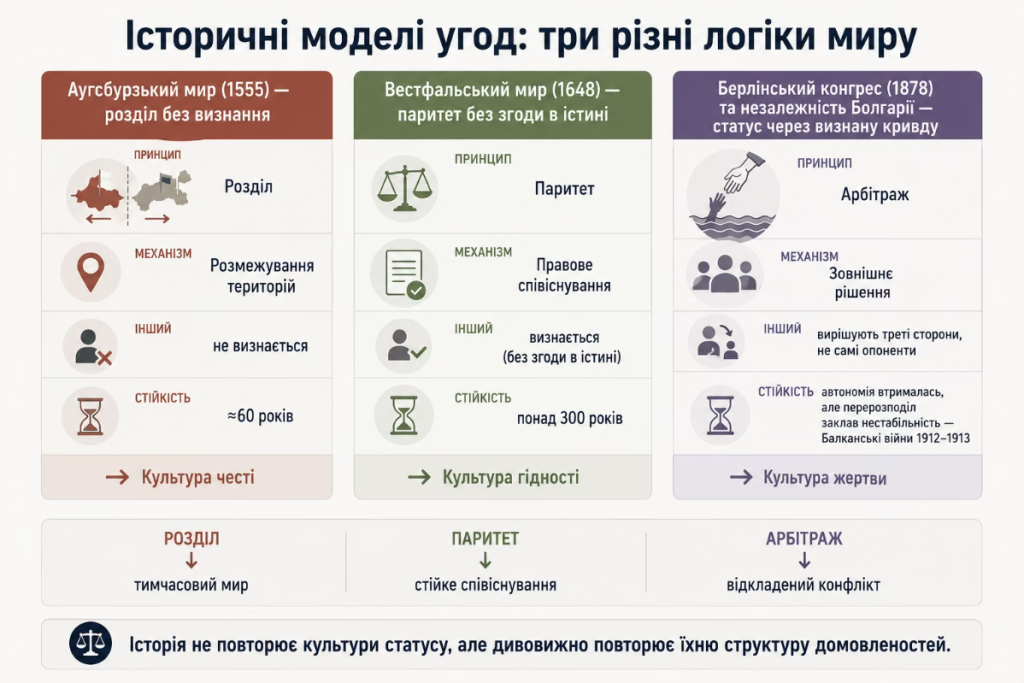
The Peace of Augsburg of 1555 — separation without recognition
After decades of religious wars in the Holy Roman Empire, the princes reached an agreement based on the principle cuius regio, eius religio — “whose realm, his religion”: the ruler of a territory determined which religion would prevail in his lands, Lutheranism or Catholicism.
Calvinists were not covered by the agreement at all — they remained outside it.
This produced peace, but not recognition: the parties were simply separated territorially rather than agreeing to coexist within the same space.
The agreement lasted for approximately sixty years and collapsed into the Thirty Years’ War in 1618 as soon as the balance of power changed: Calvinists emerged as a political force, and the Counter-Reformation strengthened the Catholics.
This is what we would call a temporary agreement sustained only by a balance of power rather than recognition — and structurally it resembles the way honor culture works: the parties did not reconcile; they simply went their separate ways while preserving face.
The Peace of Westphalia of 1648 — parity without agreement on truth
After another thirty years of war, the bloodiest religious conflict in European history, diplomats developed a different principle: the question of whose faith was “correct” was simply removed from the political agenda.
States recognized one another’s sovereignty regardless of the ruler’s denomination, Calvinists were finally included within legal protections, and guarantees appeared for private worship even by minorities living on territory dominated by another confession.
The important point is this: the parties did not agree on who was right theologically.
They agreed not to make that question a reason for politically destroying one another.
The result was more than three hundred years without another religious war of comparable scale in Europe.
Structurally, this resembles dignity culture: recognition of the other does not depend on agreement with the other’s position.
The Congress of Berlin of 1878 and Bulgarian Independence — status through recognized grievance
After the April Uprising of 1876 and its brutal suppression by the Ottoman authorities, tens of thousands of Bulgarians were killed. News reached the European press, and William Gladstone’s pamphlet transformed the tragedy into a matter of Europe-wide outrage.
Russia declared war in 1877, and at the Congress of Berlin in 1878 the Great Powers revised the treaty and granted Bulgaria autonomy — not because of Bulgaria’s own strength or a direct agreement with the perpetrator, but through international recognition of its suffering.
The Bulgarians did not negotiate directly with the Ottoman Empire; instead, they appealed to external arbiters.
However, territorial redistribution carried out without the participation of the Balkan peoples themselves laid the groundwork for future instability — the Balkan Wars of 1912–1913.
The structural instability of such agreements lies in the fact that the fate of the victim is decided by external arbiters — whose interests do not always coincide with those of the victim itself.
Comparative Summary
| Augsburg | Westphalia | Congress of Berlin | |
|---|---|---|---|
| Mechanism | Territorial separation | Legal parity | External arbitration based on recognized grievance |
| Recognition of the other | No | Yes, without agreement on truth | No — decisions are made by third parties rather than the opponents themselves |
| Who determines the fate of the party | The parties themselves, by separating | The parties themselves, by reaching agreement | External arbiters whose interests do not always coincide with the interests of the victim |
| Durability | Approximately 60 years | More than 300 years | Autonomy survived, but the redistribution laid the groundwork for instability — the Balkan Wars of 1912–1913 |
| Resonates today with | Honor culture | Dignity culture | Victimhood culture |
Source: Youth for the Future of Ukraine