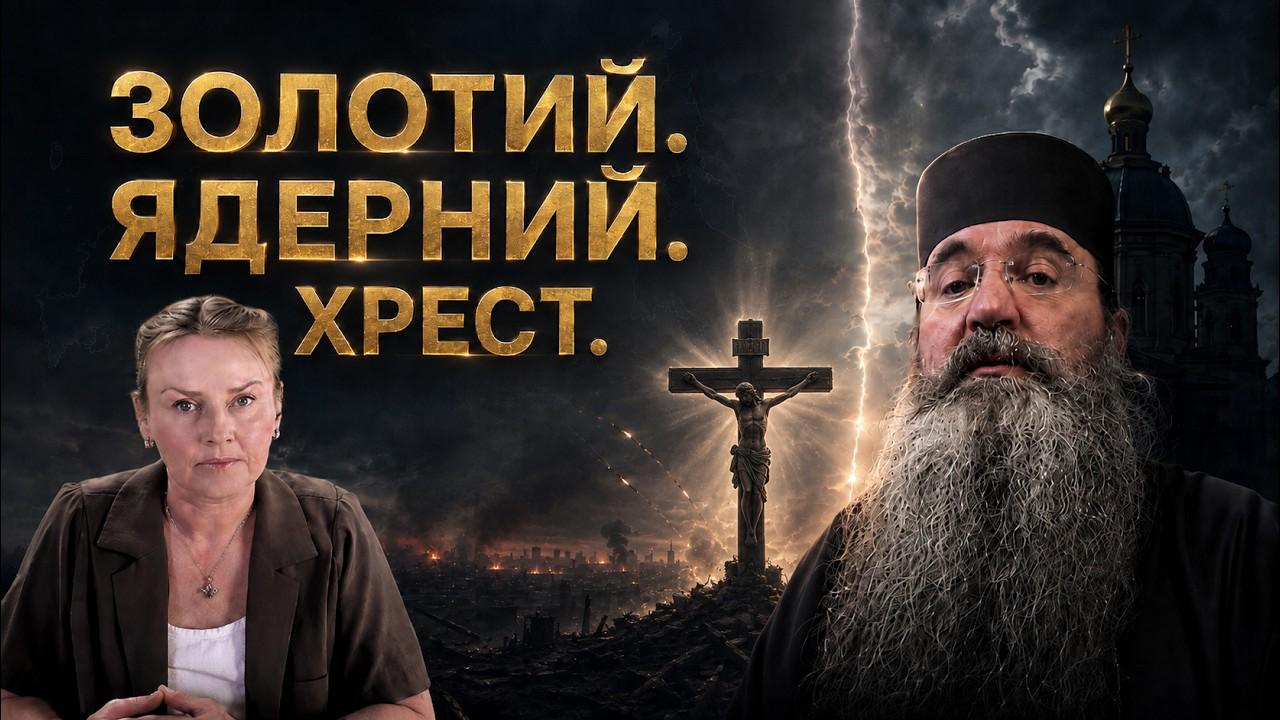
Interview by Ilona Sokolovska with Archimandrite Nikanor (at the initiative of the St. Sophia Brotherhood)
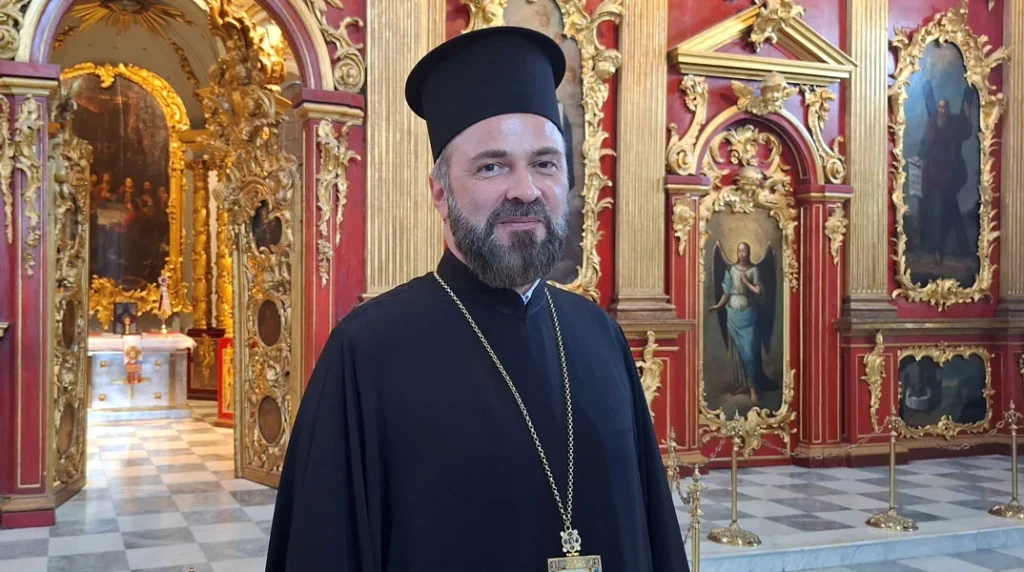
Archimandrite Nikanor is the abbot of the St. Cosmas and St. Damian Monastery in Tsrnogor (Gigintsi) and a cleric of the Bulgarian Orthodox Church. He openly supported Ukraine, found himself at the center of a high-profile conflict with the leadership of his Church, and is now standing trial before an ecclesiastical court. This conversation explores the reasons behind his conflict with Patriarch Daniil, the Bulgarian Orthodox Church’s attitude toward Russia’s war against Ukraine, the church trial, the Orthodox Church of Ukraine and the Ukrainian Orthodox Church, as well as possible ways of overcoming the division within Ukrainian Orthodoxy.
ILONA SOKOLOVSKA: Greetings to the viewers of the Viche YouTube channel.
The statement that the world has gone mad will hardly provoke objections or a desire to argue from any Ukrainian. But when it comes to the Orthodox Churches, another question arises: how is it possible that the successor of the Apostles, the Patriarch of a rather large Church, standing before his immediate superior—the eternal and living Head of the Church, our Lord Jesus Christ—declares that the creation of the atomic bomb in Russia was an act of grace and Divine Providence, and even writes an entire book explaining how right and even sacred it is to kill Orthodox believers in a neighboring country? And another Orthodox Patriarch supports his colleague, who is likewise a successor of the Apostles. How do Patriarchs reconcile the belief that the Holy Spirit acts through them, around them, and among them—and that He acts in such a strange manner?
Our guest today reminded me of the story about an entire city that went mad except for one person. When the townspeople learned about this one sane individual, they concluded that he must be the madman and decided to get rid of him.
Today, our guest on Viche is Archimandrite Nikanor of the Bulgarian Orthodox Church, Abbot of the Tsrnogor, or, as it is also known, the Gigintsi Monastery of the Holy Unmercenary Healers Cosmas and Damian. Father, welcome.
ARCHIMANDRITE NIKANOR: Greetings. Thank you for the invitation.
ILONA SOKOLOVSKA: Thank you for accepting our invitation and agreeing to speak with us. And thank you, Father, for your unwavering prayers and active support for the Ukrainian people in our struggle for freedom and independence. Before we begin our conversation, I would like to briefly tell our viewers your story.
ARCHIMANDRITE NIKANOR: Allow me to interrupt you for a moment—this feels a little unusual. I only wanted to point out that what you said about the Russian Patriarch Kirill is no secret. They stole their atomic bomb from the Americans. The people who passed atomic secrets to the communists were convicted and executed in the United States. That means, according to Patriarch Kirill’s own words, that God blessed a sin—namely, theft.
ILONA SOKOLOVSKA: Yes, according to his words.
ARCHIMANDRITE NIKANOR: Then it follows that this was a kind of “blessed theft”: that God Himself supposedly chose to violate His own commandment, “You shall not steal.” I simply wanted to emphasize this important detail.
ILONA SOKOLOVSKA: Thank you. We often speak about Patriarch Kirill’s rather peculiar understanding of God’s will and of Holy Scripture. But I would still like to briefly tell our viewers your story.
Even before the election of the future Bulgarian Patriarch Daniil, you publicly declared that you would not remain in the Church under his authority. The very next day after his election, on July 1, 2024, you submitted a request for a canonical letter of release. However, after a personal meeting with the new Patriarch, you agreed to remain. Later, Patriarch Daniil refused to release you from your duties as abbot, although you requested this, and he also refused to confirm the new successor elected by the monastery brotherhood. As a result, you continued serving as abbot of the Gigintsi Monastery.
At the same time, throughout this period you spoke increasingly openly in support of Ukraine: you hosted Ukrainian children, concelebrated with representatives of the Orthodox Church of Ukraine, and publicly criticized the actions of your Patriarch. When you were summoned once again to the Metropolitanate, you refused to appear, after which the conflict fully entered the public sphere. Now you are to be tried by the ecclesiastical court of the very Church you once wished to leave, but which itself refused to let you go.
Why did you take such a principled position of rejecting the future Patriarch Daniil from the very beginning? And what exactly did he say or promise you during your personal meeting that made you withdraw your already publicly announced decision to leave? Later, you yourself described those promises as, I quote, “deceitful.”
ARCHIMANDRITE NIKANOR: Where should I begin? My reaction against his election was spontaneous. I simply could not imagine that a person of this character could become the Bulgarian Patriarch. I believed that our Church possessed enough spiritual wisdom to elect a normal Patriarch—a mature, elderly bishop with sufficient experience. And although this is not the most important thing, someone pleasant, someone who would be accepted by the whole society; someone capable of becoming the spiritual father of the nation and, like Patriarch Neophyte, guiding people on the path to salvation, offering them wise counsel and comforting them.
As I feared at that time, during these two years we have witnessed countless public scandals. Hardly a month passes without a scandal caused by a word or an action of the Bulgarian Patriarch. I do not wish to burden your audience with examples, but only last month he interfered in Bulgaria’s foreign policy. He telephoned the Prime Minister—a secular man who understands nothing about religion—and told him that Patriarch Kirill must not be denied entry because that would be directed against all Russian Orthodoxy. The Prime Minister followed the Patriarch’s advice, and this placed Bulgaria in a very unfavorable light before the European countries that are our partners. Similar things have been happening throughout these two years.
Therefore, I dare say that Patriarch Daniil should already begin considering retirement. Being Patriarch simply is not working for him. I know that neither our Church nor our state is ready for such a step, but someone has to be the first to say that the emperor has no clothes.
ILONA SOKOLOVSKA: Then why did you remain?
ARCHIMANDRITE NIKANOR: I remained because he promised that we would work together. I simply believed him. Christians are called to be simple and guileless. I believed him as one human being believes another. I thought: who knows, let us see, let us give him one more chance. I did not want to become his judge, and I treated him with goodwill. But it turned out that he does not understand such gestures.
ILONA SOKOLOVSKA: In my personal opinion, as an Orthodox Christian and a Ukrainian, from the very beginning of Russia’s war against Ukraine you stood on the side of good—the side of the victim. Let us set aside the positions of the Patriarchs for a moment. There are two Local Orthodox Churches—the Russian Orthodox Church and the Bulgarian Orthodox Church. How did it happen that, essentially, not a single priest in either the Russian Orthodox Church or the Bulgarian Orthodox Church publicly and openly defended you, except perhaps Father Ioann Burdin? Moreover, seventy-five priests of your own diocese signed a declaration against you and in support of Patriarch Daniil. The rally organized in your support by civic activist Manol Glishev was attended, if I am not mistaken, by around thirty people.
Could it be that you and I are mistaken in our understanding of good and evil? Could it be that we have found ourselves on the wrong side, while those who remain silent are the ones who are right?
ARCHIMANDRITE NIKANOR: There are two aspects here. The first is how we understand the Gospel and how we have come to know Christ. I do not know exactly what the situation is with those seventy-five priests; perhaps another five from other dioceses will join them because their metropolitans will force them to do so. But I do not merely believe in God — I know God. I know what I am doing. I have no doubts about my position as a Christian: this is my witness before the world.
Perhaps I will cease to be an archimandrite, perhaps I will be expelled from the Church altogether, lose my social standing, or suffer something even worse — who knows. But I am ready for that, because this is what Christ taught us. Whoever believes in Christ must follow Him. Christ Himself ended His earthly journey on the Cross, and after the Cross there is always resurrection — true resurrection. I know God; I do not merely believe in Him.
On the other hand, a person must always ask himself whether he has fallen into delusion and self-deception. But here we are helped by the clear and firm position of Ecumenical Patriarch Bartholomew, the senior hierarch of the Orthodox Church. I share his views. The same views were expressed by our late, truly most holy Patriarch Neophyte: he repeatedly spoke in support of the Ukrainian people. The outstanding Bulgarian hierarch Metropolitan Nikolay of Plovdiv, a brilliant speaker who has more than once spoken very clearly, has said the same. So has Metropolitan Naum of Ruse, a deeply spiritual and profoundly church-minded man, as well as Metropolitan Kiprian of Stara Zagora, an exceptional and highly respected hierarch in his diocese. So I am not alone in my position.
As for the priests who signed against me, I knew in advance that this would happen, and I even wrote about it. It says something only about those who organized the collection of signatures, and it confirms what I have said: that our holy Orthodox Church is being turned into something resembling a communist party dressed in religious clothing. In those days, labor collectives signed letters against “enemies of the people.” A priest’s signature in support of a metropolitan or patriarch is no different from the signature of a serf beneath words saying that his landlord is the best and kindest master, while anyone who does not want to work for the master is a very bad person whom everyone repudiates. It is as simple as that.
ILONA SOKOLOVSKA: My next question belongs to the category of “I do not think this is a coincidence.” As abbot of the Gigintsi Monastery, during the full-scale war you twice organized pilgrimage trips for Ukrainian children from the frontline Sumy region. For this, I bow deeply to you. But on both occasions, literally the day after the children left, you were banned from celebrating divine services for fifteen days. It reminded me of the Soviet practice of fifteen-day detention for petty hooliganism.
I do not understand why Patriarch Daniil is so stubbornly keeping you in a position from which you yourself have repeatedly asked to be released. You asked to be released from the Bulgarian Church under the omophorion of Patriarch Bartholomew, or at least to remain as an ordinary monk in your own monastery. The monastery brotherhood elected Hieromonk Zahariy as the new abbot, yet Patriarch Daniil still has not blessed or confirmed this decision. At the same time, an ecclesiastical case has been opened against you, which, in essence, will be considered and presided over by the Patriarch himself.
In an interview with Bulgarian National Radio, responding to Diana Yankulova, you said powerful words: “They may excommunicate me from the Church, but they cannot separate me from God.” In essence, you have just repeated them. How do you yourself explain Patriarch Daniil’s persistent refusal to let you go? What do you think is driving him?
ARCHIMANDRITE NIKANOR: I am an emotional person, and I always want to speak plainly. In Bulgarian we say, “Pravo kume v ochi,” meaning to say everything directly to someone’s face. Unfortunately, the Patriarch’s spiritual DNA is the spiritual DNA of spiritual murderers. Such people have never been able to tolerate dissent or a different opinion on various issues.
Apparently, he deceived me so that he would have the opportunity to find something against me and kill me ecclesiologically, by depriving me of holy orders — by taking the epitrachelion from me. That is why he dragged out the inspection and thought he would find something, but he found nothing. There is not a single accusation against me related to documents. It is simply a joke, and it will end badly for them, because there is also the civil court.
The canonical accusations brought against me concern only my words. I was stunned: I am not being accused of some deed, but of what I said. I will be tried for words. What can one say to that? This is the situation we are in.
I am even glad that all this is happening, because the whole world can see it. Let everyone make their choice and decide whose side they are on. I know everything about myself. Let the other Patriarchs and hierarchs decide as well. I think everything that is happening only reveals more clearly the profound crisis in which the entire Orthodox Church finds itself today. This is no longer only about Russian Orthodoxy. It is a disease that has affected everyone.
To judge a cleric because he follows Christ and the Gospel is to become the Sanhedrin. We have come full circle and returned to the place where people are persecuted and destroyed for truth and for love of Christ. Let them look at themselves from the outside.
ILONA SOKOLOVSKA: We have already touched several times on Patriarch Daniil’s position regarding Russia’s war against Ukraine. I will quote just a few of his public statements for our viewers. For example, he said: “None of the participants in the conflict can be justified for what is happening, nor justified at the expense of the other”; “In this conflict, Russia was defined as the sole and unprovoked aggressor. But what should we call the coup in Ukraine itself, carried out by a third party?” For Ukrainians, statements like these effectively mean repeating Russian talking points about the war, such as those heard, for example, on the Rossiya 24 television channel.
Just a few days ago, last Sunday, a highly publicized incident took place during a service at the Holy Nedelya Cathedral in Sofia, presided over by Patriarch Daniil. After the Russian Federation’s Ambassador to Bulgaria, Eleonora Mitrofanova, appeared in the church, some parishioners greeted her with whistles and shouts of “This is not Moscow!” and similar words. Bulgarian media reported that the Patriarch allegedly even had to interrupt the service twice in order to calm the people.
On the one hand, we see Patriarch Daniil’s public position, which is objectively perceived in Ukraine as pro-Russian. On the other hand, we see the directly opposite reaction of some Orthodox Bulgarians. Does the Patriarch’s position reflect the views of the majority of Orthodox Bulgarians, or do the attitudes of the church leadership and those of a significant portion of the faithful nevertheless differ regarding the war launched by Russia against Ukraine?
ARCHIMANDRITE NIKANOR: I do not know the situation that deeply. I am the abbot of a monastery; I do not have the broad overview or the connections that would allow me to judge how widespread the pro-Russian line is within the Bulgarian Church, and how widespread the evangelical, Christian line is.
I know that many churchgoers have become targets of pro-Russian propaganda by priests who long ago betrayed Christ in their hearts and now serve the idol of the “Russian world.” For some Bulgarians, Russia itself is an idol. They expect the solution to their problems, including everyday problems, not from God and Christ, but from Russia and Putin: “Russia will come, and everything will be fine for us.” They do not say: “God will lay His hand upon us, and everything will be fine.”
These are former communists who, after the bankruptcy of communist ideology, embraced Orthodox Christianity merely as a sheepskin covering the same communist mentality. In that sense, there are quite a few people in the Bulgarian Church who think in the same way as Patriarch Daniil.
But there is another side as well. Come to Bulgaria on any Sunday — the churches are empty. There are three, five, twenty, or thirty people in them. Where the Patriarch serves, in Sofia, a city of almost two million people, there may be one hundred people or fewer. Across all of Bulgaria, probably no more than eight thousand of the four and a half million Orthodox Christians living in the country attend church regularly.
A huge chasm has long opened up between the Church and society. Patriarch Daniil and his followers, with their hatred, are only deepening it. When I warned that this meant division, I was later accused of creating that chasm. But I did not create it: I merely saw the chasm that was already there when I came to the Church. And it continues to widen.
ILONA SOKOLOVSKA: At the end of the program, I would like to ask a question that concerns every Orthodox Ukrainian. You spoke about a spiritual crisis and a chasm. Patriarch Daniil has expressed himself quite clearly regarding relations between the Ukrainian Orthodox Church and the Orthodox Church of Ukraine. He stated that, since the Orthodox Church of Ukraine was formed from two church structures that he considers non-canonical, it itself is likewise non-canonical. At the same time, he calls the Ukrainian Orthodox Church headed by Metropolitan Onufriy the only canonical Church in Ukraine.
You, by contrast, through your recent concelebration with Metropolitan Epiphaniy in Kyiv, showed that you do not consider the Orthodox Church of Ukraine to be outside the Universal Orthodox Church. At the same time, in one interview you described the Ukrainian Orthodox Church as a structure of Moscow’s ecclesiastical presence in Ukraine.
It is one thing to make a diagnosis, and quite another, much more difficult thing to propose a way out. The problem of two Churches on the same canonical territory is obvious to us, and in my broadcasts we often seek a solution to it. Today in Ukraine there are two large Orthodox communities, millions of believers, the open wounds of war, mutual distrust, and a very painful history of recent decades. What way forward do you see for Ukrainian Orthodoxy? Is it possible to overcome this church division? If so, where, in your view, should the movement toward one another begin?
ARCHIMANDRITE NIKANOR: First of all, I want to say this: when Patriarch Daniil claims that he recognizes only the Church of Metropolitan Onufriy as canonical, he is lying very dishonestly to the whole world. If that were true, then at every liturgy, alongside the heads of the other Orthodox Churches — Patriarch Bartholomew, Patriarch Theodoros, and the others — he would have to commemorate Onufriy of Kyiv. But when Patriarch Daniil commemorates the primates of the Orthodox Churches according to the diptychs, there is no primate named Onufriy among them.
So how can he say that the only canonical Church in Ukraine is the Ukrainian Orthodox Church? The only canonical Church on the territory of Ukraine that he recognizes is the Russian Orthodox Church, the Moscow Patriarchate. That is what he recognizes — these are different things. Of course, it could hardly be otherwise: where Russia is, there is the Russian Patriarchate. This needs to be understood.
As I have already said, Orthodoxy is very sick. We boast that our faith is the most apostolic, that we have the Church of Christ, that it is the one true Church, and we boast of various manifestations of “grace”: someone brings some Russian leaflet or photocopy, and it begins to exude myrrh. But there have been thousands of such cases in the world. Ancient pagan statues of Zeus were said to exude myrrh; in Russia, I think even a statue of Lenin once exuded something — I do not even know what sort of “myrrh” that was.
We boast a great deal, but I do not see the fruit, I do not see the result of this supposedly special Divine grace. The spiritual level of followers of the Orthodox Church is very low everywhere. In Russia, the situation is simply tragic, but one cannot say that everything is fine in Greece or Romania either. We do not see good fruit — I would even say that we see the opposite.
Today I was returning by plane from far away, through Italy. A Bulgarian who lives in Italy recognized me, spoke approvingly of my position, and said: “Father, I know two Catholic priests here. Look at how people trust one another, how kindly they treat one another, how they are friends and help each other. But in Bulgaria, among us, there is hatred, envy, and bitterness toward one another.”
We need to look at this directly and honestly: this is what our “most Orthodox” Church looks like. Unfortunately, this is our problem. Part of it arose because Soviet thinking has been preserved: there must always be hatred, there must always be an enemy, there must always be classes that need to be destroyed. In the past, these were the bourgeoisie and other “exploiting classes”; now they are the “classes of heretics,” who likewise have to be destroyed. The same thinking extends to sexual minorities: destroy them, and then piety and grace will supposedly reign. The more of them we kill, the better we supposedly become. As if it were not the Lord who created them and the Lord who sustains their lives, as if they were not His children.
This needs to be addressed spiritually. As Andrei Kuraev said, the blessing of hatred has become part of the Orthodox ethos, part of Orthodox thinking. Unfortunately, in my opinion, this hatred is stronger on the side of the former “canonical” Church — that Russian structure that opposed Filaret. People were kept in spiritual captivity by being told that the “Filaretites” and the “Makariites” were the worst of all, as if they were subhuman. This is a very serious problem.
It is difficult for me to say how it should be treated, because the poison of pride, hatred, and contempt is very strong. But something else must also be understood: on the side of the present canonical Orthodox Church of Ukraine, and perhaps even more so on the side of Ukrainian society, hatred has also accumulated. I understand this. Today people were killed at a bus stop. Perhaps they were my relatives, acquaintances, or simply fellow citizens. And if afterward I hear that somewhere people are praying for and commemorating the one who blessed this killing, I myself might grab something, smash everything there, and drive them out: “Traitors! This is vile!” That is also hatred, but now it is natural hatred. And so two kinds of hatred collide with one another.
This is a major problem that must be treated by spiritual means. Enormous attention to Ukrainian society and the Ukrainian Churches is needed. I do not want to criticize anyone — in a moment you will understand whose garden I am about to throw a small stone into. But a mother cannot give birth to a child and then leave it entirely on its own. Whoever gives birth to a child must raise and feed that child. If the child has a difficult relationship with an older brother or son, then the mother, if she calls herself a mother, must help repair the relationship and hold the children by the hand. It is impossible, during all these years of war, not even to visit them. That is very bad. Perhaps after these words someone will stop liking me, but I am telling the truth.
ILONA SOKOLOVSKA: Who is this child in the context of Orthodoxy?
ARCHIMANDRITE NIKANOR: This child is the Orthodox Church of Ukraine. And who is its mother? Everyone understands who gave birth to this child.
ILONA SOKOLOVSKA: The Ecumenical Patriarchate?
ARCHIMANDRITE NIKANOR: It is its responsibility. It must be there. Not like this: in the fifth year of the war, some Athonite archimandrite arrives, we go with him to Bucha, and then he leaves. Is that the way a mother cares for her child?
It cannot be that all the truth is on our side or all the truth is on their side. There is a major conflict and division among the faithful. One cannot simply stand on the sidelines and watch. One has to help, to be with the people, to communicate with both sides, and to search for a path toward reconciliation. Someone has to do this. You cannot give birth to a child, abandon it, and say: “Let it survive somehow.”
ILONA SOKOLOVSKA: So, Father, do you believe that our problem in Ukraine should be resolved from above by all of world Orthodoxy — by the other Local Churches? Is it impossible to resolve it here?
ARCHIMANDRITE NIKANOR: No, responsibility cannot be shifted onto others. The other Churches are the mother’s aunts and cousins. They can help if they want to, but the mother is obliged to do it. I am not speaking about all of world Orthodoxy. Whoever created the Orthodox Church of Ukraine must deal with this issue.
ILONA SOKOLOVSKA: So we ourselves in Ukraine, among ourselves, can no longer solve this problem?
ARCHIMANDRITE NIKANOR: Unfortunately, on both sides a great chasm of hatred and misunderstanding has formed. Someone is needed who will go to one side and to the other, speak and communicate, and search for how everything should be arranged. Left to yourselves, you simply throw stones at one another, and the chasm remains.
We came to support the Ukrainian people, and Metropolitan Iona covered us in mud. He is not a bad person — he is even a good person — but this inertia is at work: he had to cover some segment in mud, even if it was only three or five people. Why does this happen? Because we come so rarely. We should have been with you long ago. We should have been with you constantly.
ILONA SOKOLOVSKA: Father, thank you for this candid and very difficult conversation. In conclusion, perhaps you would like to address the Ukrainian people, to say something that I did not ask you about?
ARCHIMANDRITE NIKANOR: What can I say to the Ukrainian people? I thank Ukrainians for saving themselves from this terrible beast and thereby saving us as well. I pray that God will put an end to the extermination of young, good Ukrainians and peaceful civilians, that all this horror will finally stop.
Protect your freedom. If you let them in, they will kill you anyway. I would rather die with a weapon in my hands — I would not surrender to them. You must hold on to the very end. Forgive me for saying this, but they do not treat you as human beings. They will never want to come to an agreement in good faith. They want to destroy everything Ukrainian. You cannot imagine what they will do if they seize Ukraine. Ukraine will become one enormous Auschwitz, one enormous Gulag, the most terrible concentration camp imaginable. I do not even want to think about it. Fight for your children to the very end. Not one step back!
ILONA SOKOLOVSKA: Thank you for your support, your prayers, and your heartfelt words.
Dear friends, I would also like to express special thanks to the St. Sophia Brotherhood, thanks to which our meeting today took place. It was the St. Sophia Brotherhood that helped us meet with Father Nikanor. Thank you, Father.
And a few words to our viewers. From Holy Scripture we know that Judas Maccabeus had a vision. The prophet Jeremiah appeared before him with a golden sword in his hands and said: “Take this holy sword — a gift from God; with it you shall crush your enemies.”
If we develop this analogy, then Patriarch Kirill apparently also had a vision. The prophet Joseph Vissarionovich appeared before him with roughly the same words, only this time not about a golden sword, but about a golden atomic bomb.
History does not ask whether you are a democrat or a dictator. From time to time, it gives certain individuals a terrible right — the right to press the nuclear button. And somewhere in the reception room of the supreme leader, Patriarch Kirill, waiting in line for such golden swords, are probably those to whom history gave this power: Harry Truman, Winston Churchill, Charles de Gaulle, Mao Zedong, Indira Gandhi, Levi Eshkol, Nawaz Sharif, Kim Jong Un, Mojtaba Khamenei.
As of this moment, seventeen people are known to have been killed and forty-four wounded as a result of today’s Russian attack on Kyiv and the Kyiv region. Every day, Russian strikes take the lives of peaceful residents of Ukraine. I express my deepest condolences to the families of those who have been killed. Rescue operations are continuing, and unfortunately, these figures may still change.
Take care of yourselves, dear Ukrainians. This was Viche. Until we meet again.
Source: youtube.com