
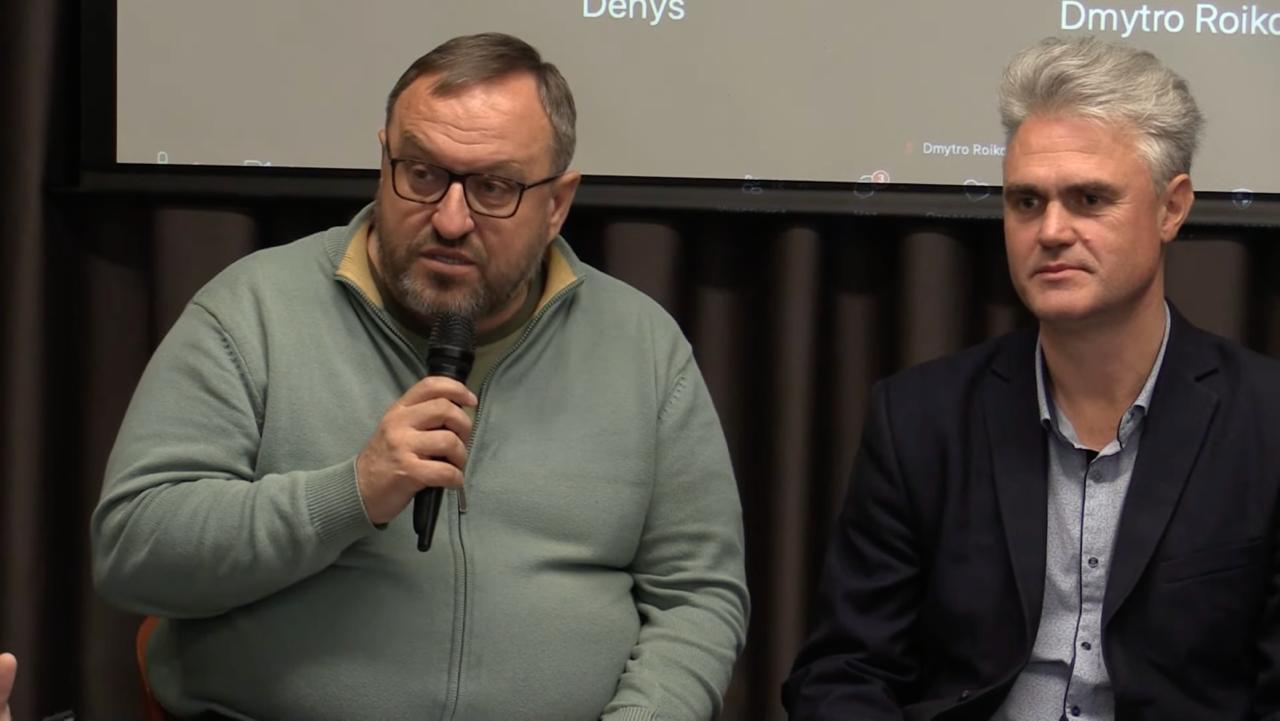
This presentation was delivered on April 29, 2025, during the Round Table “Contemporary Ukrainian Orthodoxy: Debunking Myths for the Sake of Reconciliation and Social Consolidation in Ukraine,” organized by the “Sofiyske Brotherhood” with the support of the Renovabis Foundation. The Sofiyske Brotherhood may not necessarily share the views of the speakers; likewise, individual opinions expressed within the project may not reflect the consolidated position of the Brotherhood.
Oleksandr Filonenko, public philosopher, theologian
Christ is Risen!
As long as Kyiv sees itself as the Second Jerusalem, the Patriarch of Jerusalem sees Putin as Orthodoxy’s only hope. This is a vivid example of the crisis of conciliarity.
Naturally, the first point here is unity. I want to talk about unity itself — about how we might try to attain it. First, let me recall a medieval patristic metaphor for resolving tensions and conflicts. If we imagine a field of tension with two points — the conflicting sides — there are two ways to address the problem: either engage in endless horizontal dialogue, or have each point draw a radius toward a common center. From a purely geometric standpoint, the closer each point gets to the center, the closer they get to each other. I believe this idea of “organizing the radius” is the most pragmatic version of conflict resolution.
Why is this important? Because today we greatly value horizontal connections, and at times we delude ourselves into thinking that by building only horizontal ties we will achieve unity. But we won’t. One flawed model is to deconstruct myths, including the myth of why the conflict exists between us.
I don’t much believe in myth-deconstruction because it often leads directly to the destruction of unity. We can organize our fight for peace in such a way that it becomes a war. That’s why I don’t put my trust in myth-busting — but I do in this strategy of moving together toward the center, where we grow closer to one another. What does this movement entail?
Let us recall the words of a British king who, on the first day of World War I, said something simple. He prayed to the Lord asking for a vision for Britain, and the Lord answered: there would be no vision, but there would be a hand. If you hold onto this hand, the king was told, there will be a path, unity, and victory — but not with a vision.
For me, the key question is that hand — how can we remain connected to the center? The first principle here, in the theological sense, is quite simple: Christocentrism.
But what does this mean for the relationship between the Sofiyske Brotherhood and society, or the state, or other churches? It’s very important that we start not only with horizontal dialogue but also with a conversation about verticality.
What does that mean? The German historian Barthold Georg Niebuhr once said that the most absurd thing we can do is try to answer questions that no one is asking. So, the first thing the Brotherhood and all of us must do is understand what questions society is really asking. For me, it’s not the question of Orthodox unity — that’s important, but secondary. The primary question is: is there a vertical?
For priests and believers, the question is not what the vertical is or why it matters. For me, today — in the light of modern culture — the question of verticality is the question of maturity and subjectivity. The Church has something to say in response. Yet we oddly insist on starting from horizontal ties. I propose we reflect more deeply on the vertical — not just on horizontal connections.
For me, this verticality breaks down into three aspects. We’ve spoken about conciliarity — that’s important, but not primary.
The first aspect is vocation. And the question we must ask is: do we have a vocation? What is vocation? This question isn’t only for believers.
The second is Sophianness — the degree to which vocation can be fulfilled, embodied. So I hope, as Lesya Ukrainka wrote, “I hoped without hope,” that the Sofiyske Brotherhood will be about the embodiment of meaning, not just talking about it.
Embodiment is our “Sophianness.” It is how we live out the name of our Brotherhood — and thus we strive to be as Sophiac as possible.