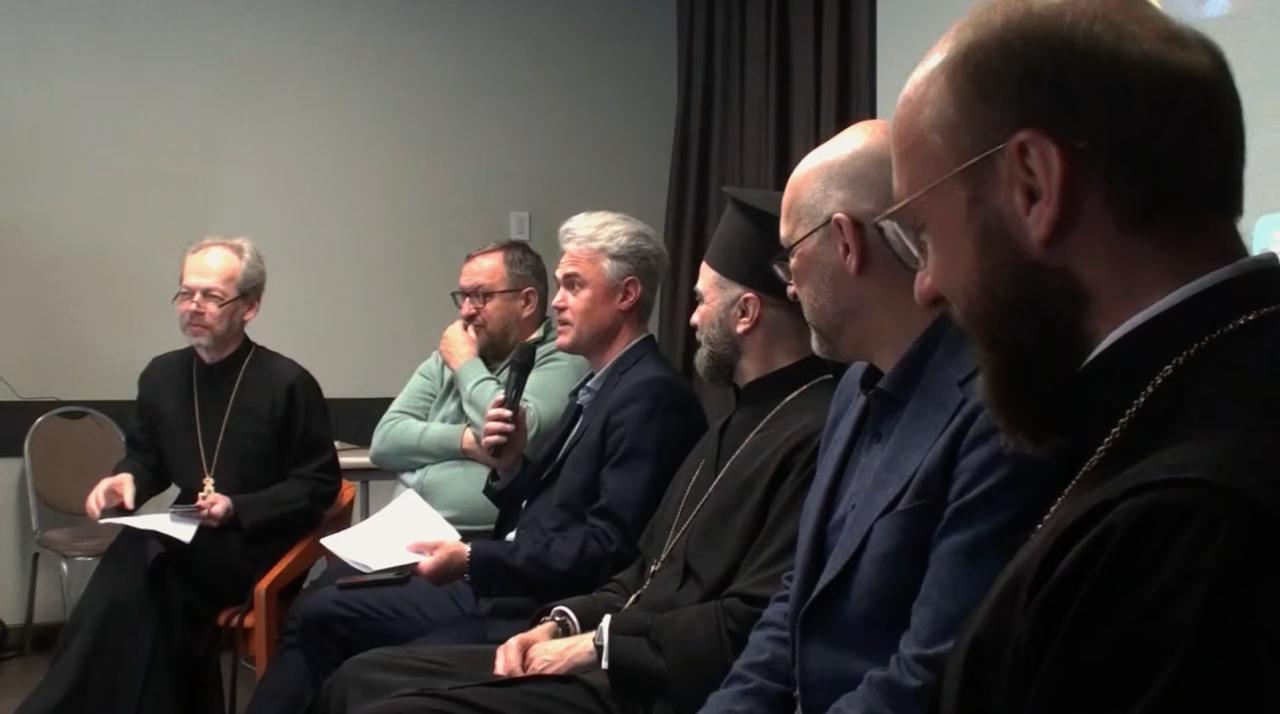
Statement provided during the discussion panel at the Round Table “Contemporary Ukrainian Orthodoxy: Breaking Myths for Reconciliation of Orthodox Christians in Ukraine,” held on April 29, 2025, in Kyiv. Organized by the Sofia Brotherhood with support from the Renovabis Foundation.
Archpriest Georgiy Kovalenko: Gennadiy Khrystokin delivered a wonderful speech on the meta-level and meta-language. But what can be done to help our faithful, clergy, and hierarchs ascend to this meta-level and begin speaking a meta-language? Surely there must be a single meta-language, because every group will find its own language of division.
Gennadiy Khrystokin, PhD in Philosophy, Professor at the State University “Kyiv Aviation Institute”: In seeking a meta-level and a meta-language, first of all, we shouldn’t fear the existence of multiple meta-languages. It’s perfectly fine to have one meta-language. The problem arises when it becomes monopolized, sacralized, or turned into a myth or ideological dogma. That’s when difficulties emerge. But when alternatives and diversity exist, that’s a very positive thing.
Let’s recall a well-known fact in religious studies: what is Ukraine and has always been? A multi-confessional religious country. Always in the past and still today.
From a sociological perspective, nearly no religious denomination in Ukraine lacks several internal strands—such as Pentecostals, Baptists, or Orthodox Christians, for example. And we see that this diversity isn’t problematic.
The problem begins when we try to build a single church or a single confession. I believe that Ukraine’s typical situation—pluralism, openness, and parallel coexistence of various directions, confessions, and religious groups—is absolutely normal.
If we reach a meta-level that embraces religious pluralism, religious freedom, and confessional liberty—not just external freedom but the internal freedom to calmly discuss issues with hierarchs of our own church, to enter into dialogue with representatives, theologians, or believers from other churches—this is a healthy model we should return to. Our religious scholars, scientists, theologians, laity, seminaries, and universities can all play a significant role here—an endless opportunity for Ukraine!
Unfortunately, due to Russian aggression, this complex tapestry of Ukrainian life has been simplified into a search for easy answers to simple questions: “Who’s to blame?” “The enemy is at fault, and we must overcome those who hinder us.” I think we must rise above that. The meta-level means rising above offenses and rising above confessional narrowness. The meta-level means transcending this monologue—when “we are canonical” and “they are Moskvites,” or vice versa, “they are non-canonical.” Such language limits us.