Priest Serhii Barshai, Member of the Sophia Brotherhood (UOC)
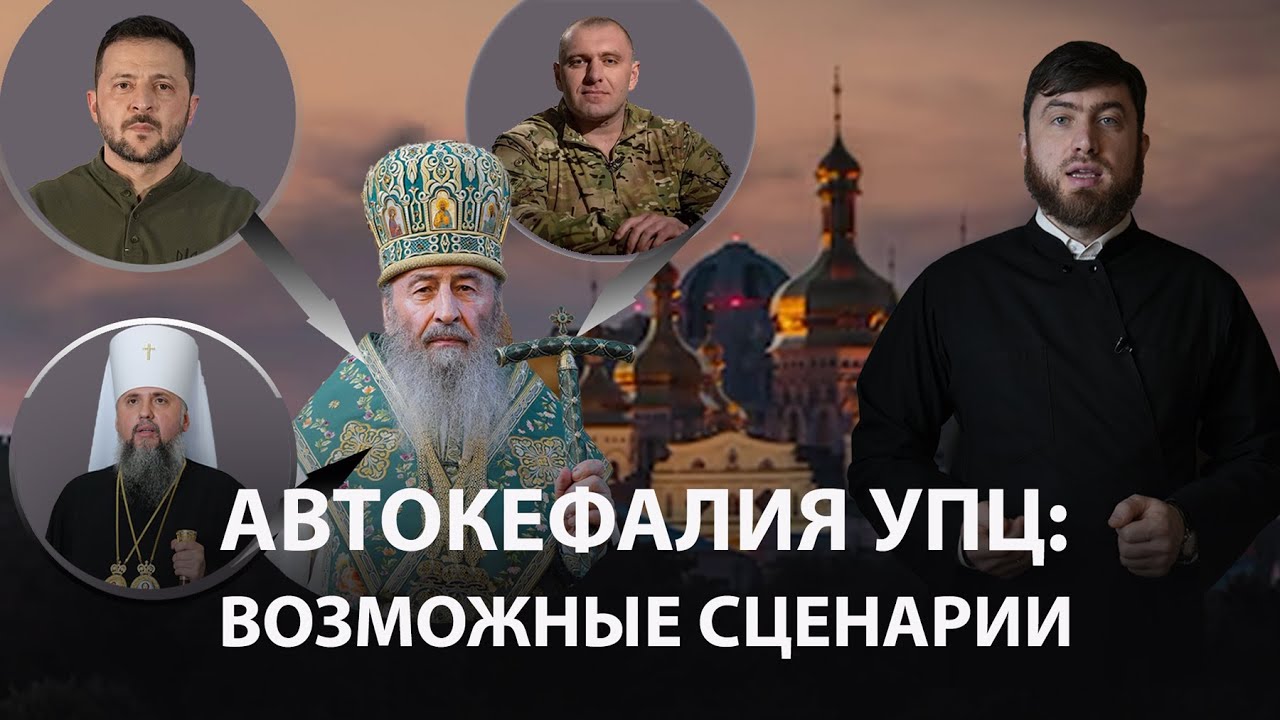
Cleric of the UOC, Priest Vasyl Maksymyshynets, who currently resides in Belgium, recently published on his YouTube channel a new episode of his authorial program entitled “Why Did the UOC End Up in the Grey Zone and How to Get Out of It? The Path to Autocephaly.” In it he presents his own version of the latest events (since 2022) that have taken place in the life of the Ukrainian Orthodox Church. Despite the obvious partiality of the presentation (since the author himself is also a cleric of the UOC), the analysis itself turned out to be fairly objective (as far as such a thing is possible now from the lips of a Ukrainian cleric).
Today, among modern media, the lack of even a somewhat objective coverage of religious life in Ukraine is a significant problem. When searching for news about current Ukrainian inter-Orthodox relations, we constantly encounter myths: either about “collaborators in cassocks” (clerics and faithful of the UOC), who will supposedly soon all be expelled from churches in favor of the patriotic OCU, or about the “Poroshenko political project” OCU, which allegedly helps the state persecute the truly canonical and grace-filled UOC.
The main flaw of contemporary church chroniclers is precisely their extreme bias and unwillingness to delve into the depth of the issue. It is obvious that simply dividing the two Churches into two camps, presenting all events from one side as inherently good and from the other as inherently evil, is certainly a false step. And Father Vasyl must be given his due, for he probably has to work hard internally (considering his own confessional orientation) to sufficiently distance himself from the new Ukrainian religious “mythology” and present material in a sufficiently sober form. For in matters of inter-church relations, clerics of different jurisdictions, for understandable reasons, are usually not known for their objectivity.
The first question the author posed and attempted to answer was: what went wrong that “the authorities began repressions against the UOC” six months after the Council in Feofaniya? What is happening with the new independent status of the UOC now, and why does society, so to speak, not believe in it?
The priest recalled the rather strange situation during the Feofaniya Council. It turns out that even the bishops who participated in the Council could not obtain the new version of the UOC Statute (which they themselves had just adopted). And precisely for this reason, according to the blogger, “the decisions of the Feofaniya Council, at least in the form in which they were presented on the official website, created obscurity and ambiguity.” Although this problem, in the author’s opinion, could have been resolved “if the Kyiv Metropolia had actively communicated with the public and the media.”
Father Vasyl then reminds us of the long-standing problem from which the Kyiv Metropolia suffers — the absence of adequate spokespersons. Two people from the Primate’s entourage, who at that time most often commented on church events, gave opposing interpretations regarding the Council’s main decision (on the independence and self-sufficiency of the UOC).
Metropolitan Klyment (Vecheria), head of the Synodal Information and Educational Department of the UOC, told journalists that the UOC “does not sever relations with the ROC, and its status remains unchanged. The Council only emphasized the independence that the UOC has possessed for 30 years.” Another spokesperson, Archpriest Mykola Danylevych of the Synodal Department for External Church Relations, on the contrary, stated that “all references to the ROC were excluded from the statute, and in fact now the statute of the UOC corresponds to the statute of an autocephalous church.”
Nevertheless, within the program episode the author could not resist: recounting the most notorious cases of persecution of UOC hierarchs by the authorities, he did, in fact, take on the role of defender, at times openly distorting certain facts. This was clearly the weakest point in an otherwise interesting review.
Thus, he presents as absurd the fact of the SBU search of the Kyiv-Pechersk Lavra for weapons. “Admit it, searching a church for weapons and saboteurs sounds rather absurd,” concludes the priest. Here, however, he somewhat misrepresents reality. Weapons and other prohibited items were sought not only in churches, but throughout the monastic premises — which is not so absurd. Moreover, something was indeed found in the Lavra this time. Father Vasyl says they were looking for sabotage groups, foreign citizens, and weapons, but found only banned literature and money.
Regarding the money (and what was “criminal” about it I myself do not understand), Google easily provides news from that time reporting that not only undocumented individuals but also citizens of the Russian Federation were discovered in the Lavra. And during Russia’s aggression, leaflets featuring political speeches of the ROC head and brochures of the pro-Russian political party Opposition Platform — For Life, also found in the Lavra, are hardly “innocent” materials, unlike harmless sermons of John of Kronstadt or books about Russian imperial military campaigns (which in the context of Russian aggression are clearly not so harmless).
“Despite hundreds of such searches, during the first eight months of the war only 23 criminal cases were opened, although many of them are questionable,” the priest notes. But the question arises: is 23 really few? If these are indeed real facts of hiding certain illicit things (or worse — people), how could this have happened during the height of the Russian-Ukrainian war in Orthodox churches and monasteries? Why do our churches continue to be associated not only with something pro-Russian, but specifically anti-Ukrainian?
“Obviously, mass searches without subsequent criminal cases were used as an instrument of pressure rather than for ensuring law and order,” the author concludes. On this I agree. The authorities gently pressed so that our clergy would, at least voluntarily, cast off the old Russian rags (especially the literature) that filled church libraries and shops. And so that our beloved brothers and sisters in Christ would finally realize that Russians are not our brothers but brutal murderers. Today they are enemies — our enemies and enemies of Christ. And the instrument of pressure was quite appropriate here.
But then came even greater revelations from Father Vasyl. “Their main goal (of the searches. – S.B.) was to create a social mood in which the UOC is perceived as a hostile structure, and its clerics as Russian agents. That is, it was a deliberate campaign to demoralize and destroy the image of the UOC in the eyes of Ukrainians,” the priest asserts.
But could searches for contraband alone have demoralized and destroyed the image of the UOC? Really? Was not the shameful sitting in the Verkhovna Rada during the moment of silence destructive to the UOC’s image? Or the refusal of the Kyiv Lavra abbot, Metropolitan Pavlo, to call Russia an aggressor even in court — how did that help the Church’s image? His public on-camera statement years before the full-scale war that Crimea “has always been Russian,” the multiple instances of UOC clergy collaborating with the enemy even in unoccupied territories (all the more in occupied ones), and the complete lack of reaction to this from the Church leadership? Finally, the highest-level official church response being only “disagreement with the position of Patriarch Kirill of Moscow and All Rus’ regarding the war in Ukraine” (instead of condemnation, which would have been logical), while many churches and monasteries still commemorate the bloody patriarch as their “great lord and father” — does all this raise the UOC’s image in the eyes of Ukrainians? Or are we to assume that ordinary citizens, like church fanatics, also think “the bishop knows best”?
Father Vasyl also mentioned the arrest of the abbot of the Sviatohirsk Lavra, Metropolitan Arsenii, for listing checkpoints near the monastery in a sermon published online. “But in reality such information is often publicly available,” says the presenter. Here the author himself does not know whether the data mentioned in the sermon was indeed public. Yet even if one could find this information elsewhere, how does that excuse a metropolitan who, being near the frontline, knowingly and on record (with his sermon published on YouTube) publicly mentions such things?
When recalling cases of church seizures, the priest mentioned the most high-profile one — the seizure of St. Michael’s Cathedral in Cherkasy in autumn last year. The author described in detail that truly horrific event, reminding that “the climax of the violence was the moment when one of the attackers struck Metropolitan Feodosii on the head with a bat.” I will add that many parishioners also suffered from beatings and tear gas. But Father Vasyl, as a reasonable man, perfectly understands that all of this was provoked by Metropolitan Feodosii himself. He is one of the few UOC bishops who publicly continues to commemorate Patriarch Kirill in the liturgy. Despite constant indignation from people, despite parishes in the relatively calm (before his appointment) Cherkasy diocese transferring en masse to the OCU, with its most prominent churches seized, he continued and continues this practice. Thus doing everything possible to make the thesis of the UOC being an FSB subdivision appear not a myth but a terrible truth to the majority of Ukrainians (and not only Ukrainians). The Cherkasy case is a vivid testimony of the criminal activity of a UOC hierarch against his own Church.
Therefore, the author’s assertion that “not the crimes of UOC representatives but the change in Zelenskyy’s entourage led to unprecedented pressure and its prohibition,” as well as that “the so-called revelations by the SBU were fictitious, and what the press wrote about the UOC was mostly slander,” is more of a desired myth than a real truth. No, the Church, primarily through the hands of its own hierarchs, has done and continues to do much to remain in the crisis in which it finds itself.
At the end, the priest himself notes that such behavior of church leaders (continuing to commemorate Kirill, the lack of reaction of the church leadership to cases of collaborationism) itself gives rise to the current problems.
“Why the leadership of the UOC demonstrates inaction, I do not have a clear answer. On the one hand, perhaps this is due to a lack of effective governance and an inability to communicate with the authorities and the public. On the other hand, some interpret such an approach as waiting for, so to speak, more favorable times,” the blogger concludes. Yes, the thought is clear, though very sad, and it is hard to disagree with it.
At the end, the priest lists possible options for the further development of the UOC, or rather options for attempting to obtain autocephalous status: to request a Tomos from Moscow or from Constantinople. Both are unrealistic for certain reasons. What remains is to seek recognition from all local churches collectively — at least this would demonstrate that our Church truly aspires to autocephaly.
*“An open striving for autocephaly will strengthen its authority in the eyes of the faithful, society, and the state authorities…
The UOC still has the opportunity to state its position more clearly, to take at least small steps forward. For example, last year the head of the State Service for Ethnic Policy and Freedom of Conscience proposed that the UOC publish a letter about its withdrawal from the Moscow Patriarchate, and also inform the heads of the local churches about it.
From Viktor Yelenskyi’s perspective, this would confirm the independence of the UOC and exempt it from the application of this law. It is important to understand that the Church is not only a spiritual organism but also an earthly organization. Therefore, when it comes to its welfare and conditions of existence, we cannot simply remain in our cells and pray.
We must come out of seclusion and take sensible actions that will help the Church preserve itself and its ministry in difficult circumstances.”* — concludes the author of the program.
From ourselves we may add that the obvious way out of the deadlock is certainly not sitting “in a cell” and claiming that we are good, pious, and unjustly persecuted. It is, first of all, a public acknowledgment of one’s own mistakes (both personal and as church leaders), and secondly — building contacts: with Ukrainian society, with the Patriarch of Constantinople, and also with other brothers in faith in Ukraine.