
Priest Heorhiy Hurtovyi, Candidate of Physical and Mathematical Sciences, Associate Professor at the Department of Mathematics and Digital Technologies, Volodymyr Vynnychenko Central Ukrainian State University, Member of the Sophia Brotherhood
Historical Overview
From the Old Testament to the Second Rome
In the Old Testament, Israel is described as the “chosen people” of God (Exodus 19:5–6): “You shall be My treasured possession out of all the peoples.” The idea of “chosenness” was closely linked to the Covenant — a special agreement between God and the people of Israel. God promised protection and blessing, while in return He demanded faithfulness, adherence to the commandments, and a moral way of life. To be “chosen” meant to live according to God’s law and to serve as an example for other nations.
The ancient Romans also considered themselves “chosen,” but in a different sense — as bearers of a higher civilization, destined to establish order and power over other nations. Their “chosenness” was not based on a spiritual Covenant with God, but on the idea of cultural and political superiority. In Vergil’s Aeneid, Rome is depicted as the instrument of the gods’ will, destined to rule the world. Such rhetoric served as a justification for imperialism, granting conquest a sacred meaning. Unlike biblical Israel, the Roman “mission” glorified strength, law, and the triumph of the state.
The idea of the Second Rome embodied the combination of two models of “chosenness” — the biblical and the imperial. Constantinople arose as the new center, where the strong secular power of the emperor and civilization was combined with his spiritual mission — to guard the true faith. The Orthodox Church became the main support of this idea, reinforcing the conviction that Byzantium was the sole legitimate heir of Rome and at the same time the new Israel — a people not only mighty but also chosen to preserve the truth. Thus emerged the concept of the Second Rome as a sacred empire in which politics and religion merged into a single ideological project.
The Fall of Constantinople and the Birth of the Myth
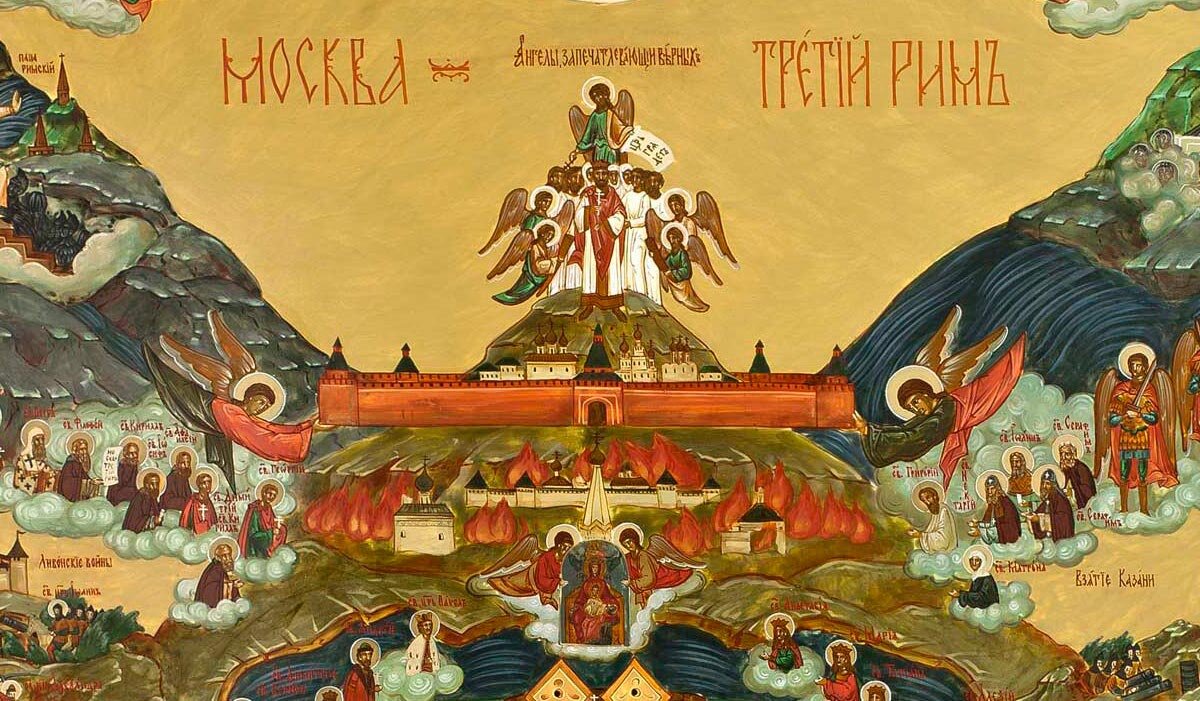
The myth of the “specialness” or “chosenness” of the Russian people in its modern form was largely shaped in the Muscovite Tsardom in the fifteenth and sixteenth centuries. One of the key turning points was the fall of Constantinople in 1453, when the Byzantine Empire, the center of the Orthodox world, was conquered by the Ottomans. Moscow’s rulers and church hierarchs began to present themselves as heirs of the Byzantine tradition, which gave rise to the idea of the “Third Rome.”
This concept was formulated by the monk Philotheus of Pskov in his letters to Grand Prince Vasily III at the beginning of the sixteenth century. Philotheus wrote: “Two Romes have fallen, the third stands, and there will be no fourth.” Here Moscow was proclaimed the new center of Christianity, and its people — chosen to preserve the true faith. This idea became the ideological foundation for justifying the centralization of power and the expansion of the Muscovite state. From that period on, Muscovy, and later Russia, justified the conquest of neighboring peoples (Tatars, Siberian tribes, Caucasian peoples) as a “divine calling” to unite lands under the “Orthodox scepter.” This led to the suppression of cultures and freedoms of other peoples, and sometimes their complete annihilation.
The Slavophile Interpretation of the Myth
In later centuries, especially during the time of the Russian Empire, this myth acquired new details. In the nineteenth century, the Slavophiles, such as Aleksey Khomyakov and Ivan Kireyevsky, added a romantic and nationalist dimension, claiming that the “Russian people” had a special spiritual mission, distinct from the “decaying West.” Another representative of this movement, Ivan Aksakov, head of the Moscow Slavic Committee, asserted: “Russia is destined to take under its protection all Slavic peoples… God has appointed the Russians to be the eldest brother in the great family of Slavs.”
The Transformation of the Myth in the 20th–21st Centuries
After the Bolshevik coup of 1917, the idea of Russian exceptionalism did not disappear but was transformed into the concept of the special mission of the Soviet people as the vanguard of the world proletarian revolution. Vladimir Lenin, in his speech “The Tasks of the Youth Leagues” (1920), declared: “In place of the old Russia came a new Russia… which sets an example for everyone.” Joseph Stalin, despite his initial condemnation of “Great Power chauvinism,” gradually rehabilitated a Russia-centered vision. In his famous toast of 1945 he proclaimed: “I drink, above all, to the health of the Russian people, because it is the most outstanding nation of all the nations forming the Soviet Union…”
The revival of the ideology of Russian exceptionalism in the post-Soviet period has come through the concept of the “Russian World,” confirmed by the statements of Patriarch Kirill, Vladimir Putin, and official documents of the Russian Federation, which have been described in numerous studies.
Today this myth is actively used in political rhetoric, particularly in Russia, to justify the war against Ukraine, imperial ambitions, and to create the image of a “special people” allegedly resisting external enemies and fulfilling a historical mission.
Criticism from the Perspective of the Bible and Orthodox Theology
The Biblical Understanding of “Chosenness”
From a biblical perspective, the idea of the “chosenness” of a single nation in the modern context contradicts the basic principles of the New Testament. In the Old Testament, there truly is the concept of the chosen people — Israel, whom God chose for the Covenant (Exodus 19:5–6). In Deuteronomy (7:7–8) it is written: “It was not because you were more numerous than any other people that the Lord set His heart on you and chose you—for you were the fewest of all peoples. It was because the Lord loved you…” This did not provide grounds for superiority or domination, but rather placed upon Israel a spiritual mission — to bear witness to God in the world.
The prophet Amos (3:2) warns: “You only have I known of all the families of the earth; therefore I will punish you for all your iniquities.” Thus, chosenness in the biblical sense is not privilege but greater responsibility and stricter judgment.
The Abolition of Chosenness and the Universality of Christianity in the New Testament
With the coming of Jesus Christ, however, this Covenant is extended to all nations. In the Epistle to the Galatians (3:28), the Apostle Paul states clearly: “There is neither Jew nor Greek, there is neither slave nor free, there is no male and female, for you are all one in Christ Jesus.” The Apostle Peter affirms: “Truly I understand that God shows no partiality, but in every nation anyone who fears Him and does what is right is acceptable to Him” (Acts 10:34–35). This emphasizes the universality of salvation, which is not limited to any ethnicity or nation.
Jesus Christ gives the apostles a universal commission: “Go into all the world and proclaim the gospel to the whole creation” (Mark 16:15). The universality of the Christian message is also emphasized in the Gospel of Matthew (28:19): “Go therefore and make disciples of all nations, baptizing them in the name of the Father and of the Son and of the Holy Spirit.” The apostles indeed spread the Good News among various peoples, without elevating any one of them as special. Early Christian communities were formed in Jerusalem, Antioch, Rome, Corinth, Ephesus, and other cities without any ethnic hierarchy.
Also in the Gospel of John (3:16) it is written: “For God so loved the world that He gave His only Son…” — here “the world” encompasses all humanity, not a single nation. Thus, any attempt to appropriate for oneself the status of special or “chosen” contradicts the spirit of Christianity, which rejects national exceptionalism in favor of spiritual unity.
The apocalyptic perspective of the Bible speaks of the New Jerusalem as a spiritual center (Revelation 21:2–3), and not of any earthly city as the last stronghold of the true faith: “And I, John, saw the holy city, New Jerusalem, coming down out of heaven from God, prepared as a bride adorned for her husband. And I heard a loud voice from the throne saying, ‘See, the dwelling of God is with men. He will dwell with them.’”
The Biblical View on the Pride of Nations
Moreover, the Bible warns against pride, which often accompanies such claims. The story of the Tower of Babel (Genesis 11:1–9) shows how God resists human pride and the attempts of a people to exalt themselves. The Book of Proverbs (16:18) warns: “Pride goes before destruction, and a haughty spirit before a fall.”
The prophets regularly proclaimed judgment against proud nations and empires. The prophet Ezekiel (16:49–50) names pride as the main cause of downfall: “This was the guilt of your sister Sodom: she and her daughters had pride, excess of food, and prosperous ease… they were haughty and did abomination before me.” Isaiah foretells the fall of Babylon, calling its pride the reason: “How you are fallen from heaven, O Day Star, son of Dawn! … You said in your heart, ‘I will ascend to heaven… I will make myself like the Most High’” (Isaiah 14:12–14). Ezekiel pronounces judgment on Tyre: “Your heart was proud because of your beauty; you corrupted your wisdom for the sake of your splendor” (Ezekiel 28:17).
The prophet Isaiah warns Assyria, which considered itself the instrument of God’s judgment against Israel: “Shall the axe boast over him who hews with it, or the saw magnify itself against him who wields it?” (Isaiah 10:15). This passage reflects the biblical attitude toward nations that consider themselves “chosen” to carry out judgment upon others. Indeed, the myth of the “chosenness” of a particular state has often been used to justify aggression, violence, and the suppression of other peoples, which directly contradicts the commandment: “You shall love your neighbor as yourself” (Matthew 22:39).
Criticism from the Perspective of Orthodox Theology
Orthodox theology likewise does not support the idea of national “chosenness.” In the Orthodox tradition, the Church is considered sobornaya (from the Greek katholike), that is, catholic or universal, uniting all believers regardless of their origin. Saint John Chrysostom in his works emphasized that Christ came for the salvation of all people, not for the exaltation of one nation. In the Orthodox understanding, “chosenness” belongs not to a people as an ethnic group, but to the Church as the community of believers, which is the “Body of Christ” (1 Corinthians 12:27).
The idea of the “Third Rome,” which lies at the foundation of the myth, also has questionable theological grounding. It reflects more the political ambitions of the Muscovite Tsardom than a spiritual reality. The Byzantine heritage claimed by Moscow was not exclusive — Orthodoxy developed in many cultures (Georgia, Serbia, Romania, and others), and none of them claimed absolute exceptionalism. Theologians such as Vladimir Lossky emphasized that Orthodoxy is not a national ideology, but the path to deification (theosis), accessible to all.
Furthermore, Orthodox tradition warns against the mixing of the worldly and the spiritual. Using religion to justify political power or national superiority is a distortion of the Gospel. Saint Gregory the Theologian wrote that “The Kingdom of God is not of this world” (John 18:36), underscoring the separation of spiritual vocation from earthly ambitions.
The Myth of “Chosenness” as an Instrument of Imperial Propaganda: Religion in the Service of War
Thus, the myth of the “chosenness” or special mission of the Russian people is a historical construct that arose in specific political circumstances and has no solid foundation either in the Bible or in Orthodox theology. Biblical teaching emphasizes the universality of salvation and warns against pride, while Orthodoxy underscores the catholicity of the Church, not the exclusivity of a single nation. This myth, therefore, is more an instrument of ideology than a reflection of Christian truth, and its use has often led to the distortion of spiritual values in favor of worldly aims.
The myth of “chosenness” is used for political purposes — to justify expansion, war, or the subjugation of other peoples. Such a conflation of religion with nationalism is a classic manifestation of ethnophyletism, whereby the Church becomes an instrument of the state rather than a spiritual community.
In the context of the war in Ukraine, the myth of the “chosenness” of the Russian people and the ideology of the “Russian World” serve to justify Russia’s imperial ambitions, to create the image of a “special people,” and to mobilize society against supposed “external enemies.” This rhetoric rests on historical distortions and religious manipulations but does not withstand criticism from the standpoint of the Bible and Orthodox theology. The war it fuels is a tragedy that contradicts the Christian principles of peace, love, and catholicity, laying bare the true nature of this myth as an instrument of power rather than a spiritual truth.