This presentation was delivered on April 29, 2025, during the Round Table “Contemporary Ukrainian Orthodoxy: Debunking Myths for the Sake of Reconciliation and Social Consolidation in Ukraine,” organized by the “Sofiyske Brotherhood” with the support of the Renovabis Foundation. The Sofiyske Brotherhood may not necessarily share the views of the speakers; likewise, individual opinions expressed within the project may not reflect the consolidated position of the Brotherhood.
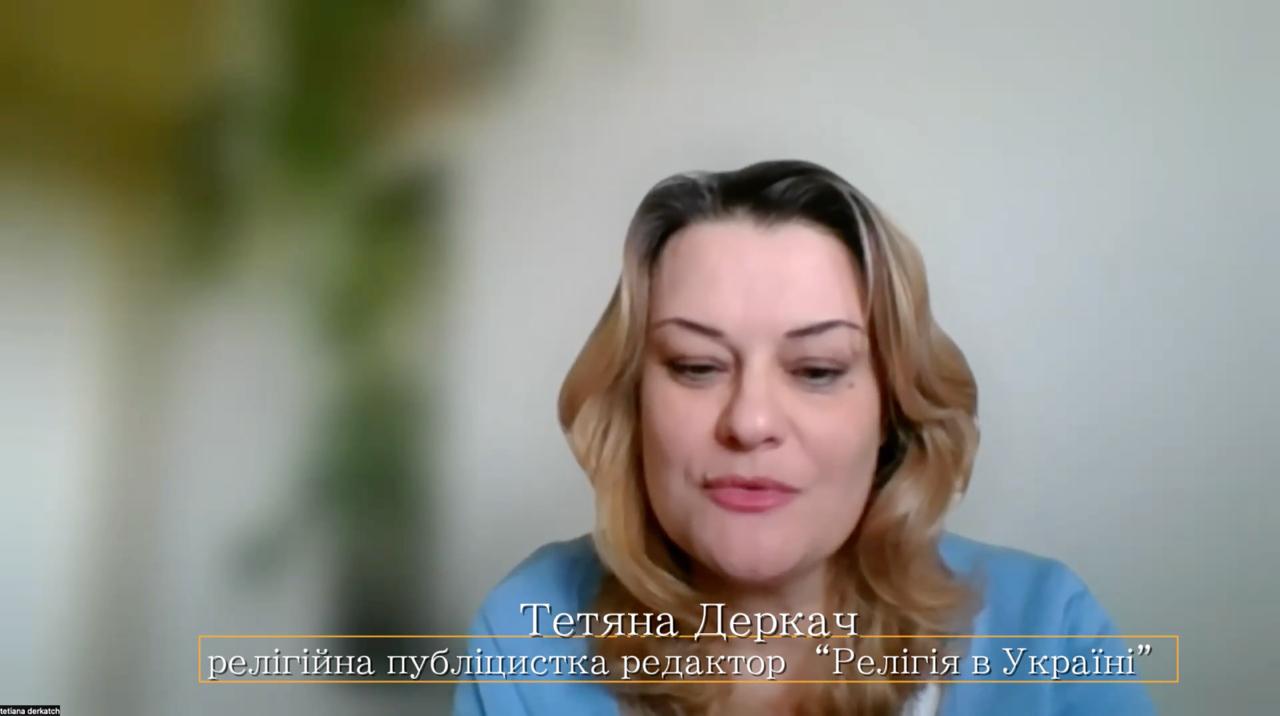
Tetiana Derkach, editor of the portal “Religion in Ukraine”
In Ukraine, as is well known, three types of media deal with religious topics: secular, jurisdictional (that is, church) media, and extra-jurisdictional religious media. One can draw two types of oppositions: between inter-jurisdictional and extra-jurisdictional religious media (that is, two kinds of specialized media), and between secular and religious media.
It has happened that in our country the media are at once the third leg of the table, the fourth estate, and the fifth column. Their role in covering religious events is enormous. The media can propel very important processes forward – and can also break the lives of very many people.
Choosing an Editorial Policy from a Vulnerable Position
I will share my own experience as editor of the extra-jurisdictional religious portal “Religion in Ukraine.” When I personally was invited to try to shape such a policy for the portal, the question before me was: what, and how, should be done in order to move beyond the classical paradigm in which media that deal with religion cover narrowly church interests. The first aim was to move away from the typical rhetoric employed by secular media.
One should have no illusions about how secular media work on religious topics. For them, religion is not a core beat, but if they cover it, what matters are sensationalism, hot headlines, clickability of the news, and so forth. And from this “sizzle” they then form content that can be very destructive. I was given the task of shaping the portal’s policy precisely against the background of the church conflict in Khmelnytskyi.
We decided to occupy a somewhat non-mainstream niche, which placed us in a very vulnerable position. But at that time it seemed to me that I was, in principle, a sufficiently strong person to allow myself to consciously take a vulnerable position. The first thing we did was a simple, elementary step: we refused to add “MP” to the name of the Ukrainian Orthodox Church.
This was very risky, and there was a negative reaction: people thought that in this way we were legalizing a hidden Moscow Patriarchate in Ukraine, that is, that we were allowing the Moscow Patriarchate to deceive people into thinking that it is supposedly the Ukrainian Orthodox Church. I proceeded from the opposite logic, namely, that in this way it was necessary to legalize the Ukrainianness within the Ukrainian Orthodox Church, which is canonically connected with the Moscow Patriarchate. I had been in the Kyiv Patriarchate since 2005 and was a witness to the fact that “MP” functioned as the opposing prefix to “KP,” the Kyiv Patriarchate. That is, it worked as a pair when there were “UOC KP” and “UOC MP.”
Therefore the logic was as follows: if there is the Orthodox Church of Ukraine, let the alternative be the Ukrainian Orthodox Church, as it calls itself.
It was also decided that we would refrain from using epithets such as “Gundyaev’s priests,” “an FSB sect,” and so forth. We began to use the titles of priests and hierarchs in the form in which they exist from a formal point of view, according to internal rules. This applies even to such odious figures as Patriarch Kirill, whom we do not call by the surname Gundyaev. That is, at the level of rhetoric we decided to remain within academic neutrality or lexical even-handedness. At the same time, we have no taboo on well-founded criticism of both conflicting jurisdictions.
Other media choose a somewhat different policy and employ confrontational rhetoric. But what did I, as a news editor, feel within myself when I began to work on the portal “Religion in Ukraine”? When I look at a piece of news on some site with a headline like “Gundyaev’s priests, by sheer lawlessness, seized a church in which the community the day before had declared a transition to the Orthodox Church of Ukraine and ‘de-occupation,’” then for me personally such news is already very questionable, because it seems to me that some manipulation or emotional winding-up is already at work there.
We must, in principle, state that we now have a crisis of journalistic standards; they have been greatly discredited. This is evident even in how respectable Western media cover the Russian-Ukrainian war. No one takes responsibility for their epithets, facts, interpretations, or forecasts. Therefore I consider neutral presentation of news, without the use of such manipulative epithets, to be elementary respect for the reader. The whipping up of hysteria in the news excludes critical thinking. And I consider that today, in the twenty-first century, the application of critical thinking is one of the basic human rights. I consider that today the media, at the semantic level, legitimize not merely division but a state of hatred. They entrench it, and we bequeath this story to our children, who may not be able to cope with it.
I do not particularly like the aphorism of the philosopher Hryhorii Pomerants that “the devil begins with the foam on the lips of an angel who has entered the fight for a holy and just cause,” but it seems to me that in our concrete case, when the media cover the inter-Orthodox conflict, this works. I do not yet know to what extent the tactic that we have chosen for “Religion in Ukraine” will play a positive role, since it is not mainstream so far, and we understand this perfectly well, but in these two years, as I have seen, people have already grown accustomed to the fact that in media not connected with the Ukrainian Orthodox Church one can write “Ukrainian Orthodox Church” without adding “Moscow Patriarchate.”
However, everything may change. Recently the Minister of Foreign Affairs of the Russian Federation, Sergei Lavrov, again put forward among the conditions for negotiations on reconciliation the preservation of everything Russian, including canonical Orthodoxy. It seems to me that if this condition ends up in the documents of a “Grand Agreement,” this will require the official renaming of the Ukrainian Orthodox Church (if it agrees to this, of course), and then we will change the name of that part of the Ukrainian Orthodox Church which will come to be designated as a part of the Russian Orthodox Church.
It seems to me, in principle, that the chosen tone for covering religious news is, at the present moment, working for the positive. It does not produce a quick “bang,” because people need to get used to the fact that “Bishop of the Orthodox Church of Ukraine” is not put in quotation marks. We are constantly putting one another outside the parentheses, and it seems to me that this is abnormal both humanly and Christianly.
The Need for Inter-Church Dialogue
What is the problem when we speak not about interconfessional dialogue but about dialogue between the Ukrainian Orthodox Church and the Orthodox Church of Ukraine? On the one hand, we now have very great solidarity in society; on the other hand, it is very situational. We now have a war, and people have rallied to help the front in a way that no one expected of us. But in order to have lasting solidarity in society, which in fact forms the state, we need to have before us a vision of the common good. We do not have this, because without dialogue a particularistic country is being formed, in which each separate confession, each separate group of people, sees the country as a source of its own existence, enrichment, and living space, while all the others are regarded as aliens or competitors. We must look somewhat ahead, at least one step ahead, at what we will have after the war. I believe that even with the level of the decline of trust in the church that polls speak of, the churches nevertheless must participate in forming some kind of common cultural code of the nation. What we see today is that we have two churches that in fact have two identities that exclude one another. Therefore we need a third identity, with common components.
In this respect one can say that it is precisely the “Sophia Brotherhood” that can become the basis for a third Ukrainian identity. Without this dialogue we place our country, globally, in a very vulnerable state. If we now preserve ourselves in some territorial form as an independent country, with full or limited sovereignty (we do not yet know how we will emerge from the war), we must understand that Russia will not leave us alone—not in five years, nor in ten years. This means that sooner or later we will need to form some common cultural code of the nation here together with the Ukrainian Orthodox Church. Dialogue is necessary for that.
In principle there are three stages in the development of the world. The first is war, the second is competition, and the third is partnership. We have not yet matured to partnership, but at a minimum we need to pass from the stage of war to the stage of competition, and then to write the rules of fair competition. Because we are in a stage of competition without rules, like sprinkling nails into pointe shoes in ballet. We must nevertheless move toward a more civilized path, so that we do not regress into modernity, then into pre-modernity, the Middle Ages, and so forth down the civilizational ladder.
Moreover, we must inscribe the urgent necessity of dialogue into the global transformation that is already breathing down our necks. We must study it, because the world will no longer be what it was in 2022, 2023, and all the more so in November 2024.
Is There Sense in Communication for the Sake of Communication?
Even taking into account the complexity of inter-church relations, I would like to speak in favor of dialogue as an intrinsic value, for its own sake.
There is in fact a very great need for any dialogue, even if it is based on very distant prospects. Why? The first thing that dialogue does is to inoculate against the very exclusivism which, as we often say, is one of the causes of the division of Ukrainian Orthodoxy.
That is, we actually fulfill not only the first but also the second commandment, and in this are the Law and the Prophets. That is, we see the person with whom we enter into dialogue already as a neighbor, and not as a stranger.
How are metal balls made? A square rod is taken, identical cubes are cut from it and put into a drum. Then this drum is spun at very high speed. These cubes rub against one another, and at the output we have identical calibrated balls. So it is with people. The habit, the skill of dialogicity, is precisely what we categorically lack.
We do not need dialogue merely for the sake of dialogue in the sense that we simply leave our own comfort zone, that we do not want to be “calibrated” against other equally clumsy “cubes.” There are various methods of building peace in conflicts, including things such as shared positive experience and shared positive rituals that are based on such experience. Look at local churches that often conduct theological dialogues with various communities for years without visible results. But in fact there is a result—the churches are simply learning to be friends with one another. Therefore I am in favor of dialogue even simply for the sake of dialogue.