
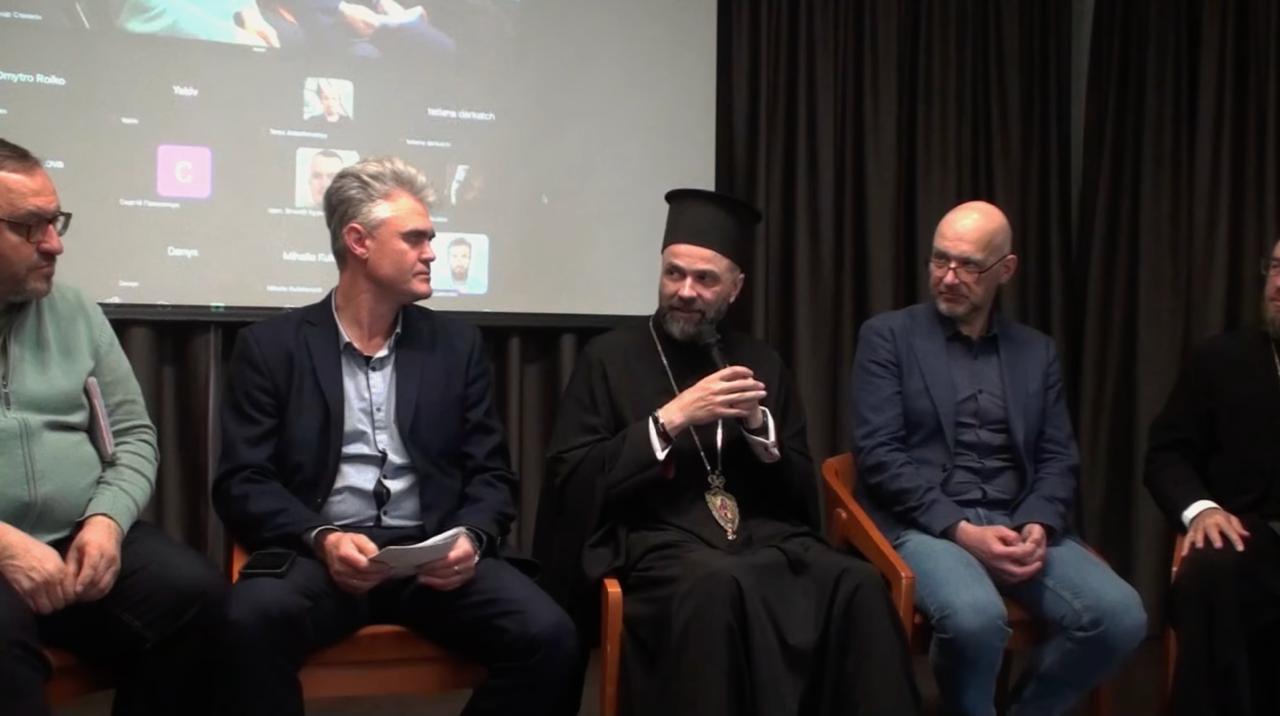
Statement made during the panel discussion at the Round Table “Contemporary Ukrainian Orthodoxy: Debunking Myths for the Sake of Reconciliation Among Orthodox Christians in Ukraine,” held on April 29, 2025, in Kyiv. The event was part of the educational–analytical project organized by the Sophia Brotherhood with support from Renovabis.
Archpriest Heorhii Kovalenko: “We spoke about utopia. Personally, I believe the Gospel is an anti‑utopia. In church life, we often try to build a perfect, utopian community. But the Gospel offers the opposite—an anti‑utopia. Only through modern literature and film can we understand that Revelation is written in a post‑apocalyptic style. Life continues after the apocalypse—this tension is important to recognize.
The problem, as I see it, is that we have the Gospel, which is not utopian; it does not construct an ideal community. Instead, it reveals real problems. More than that, it’s not just a distant vision—it is almost our present reality. However, our church structure, its internal relationships, and its outward presentation, tend to portray an ideal community and flawless system.
So the question becomes: how much do you believe in a structural, inter‑jurisdictional dialogue? What needs to happen for our institutions to initiate this conversation? I can imagine dialogue at the grassroots level—among church communities or even clergy—but at the level of jurisdictions—I’m skeptical. Does the Ecumenical Patriarchate have any ideas on this?”
Bishop Mykhail (Exarch of the Ecumenical Patriarchate in Ukraine): “I’ll share from my own experience. At our Stavropegia platform, representatives from all Orthodox jurisdictions come and communicate freely. We never announce who attends or when—they know they can speak openly, including with me. I’ve seen sincere people who genuinely want to find a way forward, not just freeze the situation. That spirit of looking for resolution was exactly what drove the idea of granting autocephaly and the Tomos to Ukrainian Orthodoxy.
Yes, I hold hope for inter‑jurisdictional dialogue—but I also see that people are still afraid of each other. Old prejudices accumulated since the 1990s remain: so many harsh words and hurtful actions have left scars.
True reconciliation requires that people admit all sides made mistakes, that they ask forgiveness—even from those they don’t personally know—and say, ‘Yes, we’ve been through this; let’s not repeat it anymore.’ Sadly, I sometimes see that even those who joined the new church still experience ostracism and, in turn, ostracize others—creating the impression they don’t belong to the same Church.
This is a psychological reluctance to admit everyone was wrong. Let’s acknowledge our mistakes, apologize, and live on—without seeking external enemies. Because there is a real danger in living just to oppose someone, to act against someone, to spite someone. That’s an unhealthy position — doing something solely to prove a point to someone else.
Let’s act out of our own fullness—develop parish and church life not to prove we’re better, but because it’s genuinely needed to live the Gospel.
I believe that the greatest obstacle to Church unity is fear and lingering wounds from the past. Once we overcome those, admit our errors—then real dialogue becomes possible. Nothing before that.”