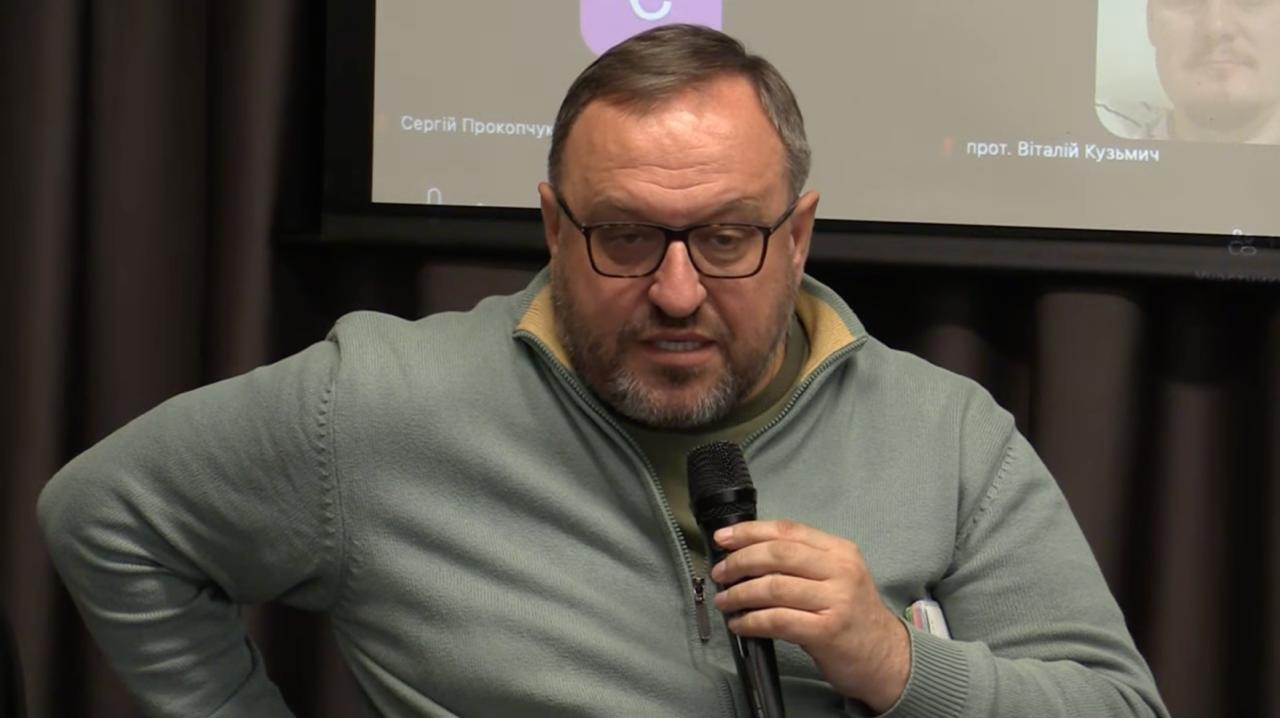
Statement made during a panel discussion at the Round Table “Contemporary Ukrainian Orthodoxy: Debunking Myths for the Sake of Reconciliation among Orthodox Christians in Ukraine,” held on April 29, 2025, in Kyiv as part of the educational and analytical project “Contemporary Ukrainian Orthodoxy: Debunking Myths for the Sake of Reconciliation and Consolidation of Ukrainian Society,” organized by the St. Sophia Brotherhood with the support of the Renovabis Foundation.
Archpriest Heorhii Kovalenko: We’ve mostly been discussing general ideas, often on the level of communities. But I’d like to shift the focus to the personal dimension: Can individual subjectivity exist in the context of inter-jurisdictional dialogue? Can there be subjectivity on the level of a particular person or community? Are communities capable of subjectivity even beyond jurisdictional boundaries? And overall, what direction or choice should a believer make—what position should a person of faith take?
Oleksandr Filonenko: What is a person to do in a situation of inter-jurisdictional dialogue or conflict? For me, everything begins with subjectivity. And if someone doesn’t understand what jurisdiction they belong to, then they have a religious question. It’s crucial for Christians to recognize that religious questions are not reserved for “professional” believers. Everyone—even those who know nothing about religion—has religious questions. And the mission of Christians is to respond to or at least offer space for dialogue, particularly with a society that doesn’t understand who it is.
Yet, we’re only beginning theological relations between jurisdictions, and we’re trying to determine if that’s truly theological dialogue. It isn’t. In a post-post-post… [postmodern, postsecular, poststructuralist, postliberal, post-truth, etc.] society, it doesn’t work that way.
For me, the first problem of subjectivity is the problem of maturity. We’re still stuck in a Kantian paradigm—what is Enlightenment? “Enlightenment is man’s emergence from his self-imposed immaturity,” Kant said. That’s a mature person. But we’ve come to understand maturity as a release from disagreement or conflict. And that’s a problem. I think one manifestation of this issue lies in the use of all those “-isms.” All the “-isms” were once great: nationalism, Marxism, conservatism, liberalism. But now we face a crisis of all those “-isms.”
To me, a mature person is someone who tries to begin a conversation outside the framework of “-isms.” That’s a meta-level. Subjectivity begins not by finding historical examples, but by asking ourselves and one another: What does it mean to live with a religious question today? Who is God? In other words, we begin again—from the start. That’s a sign of adulthood—not of childhood. A child asks, “Who is God?” A mature person, during or after a war, begins to ask, “God, who are You?” And that’s the first question Christians so often neglect to ask themselves. We start with jurisdictional disputes, or other surface-level issues, but we don’t begin with subjectivity. And for me, that’s a very important point of departure.