This presentation was delivered on April 29, 2025, during the Round Table “Contemporary Ukrainian Orthodoxy: Debunking Myths for the Sake of Reconciliation and Social Consolidation in Ukraine,” organized by the “Sofiyske Brotherhood” with the support of the Renovabis Foundation. The Sofiyske Brotherhood may not necessarily share the views of the speakers; likewise, individual opinions expressed within the project may not reflect the consolidated position of the Brotherhood.
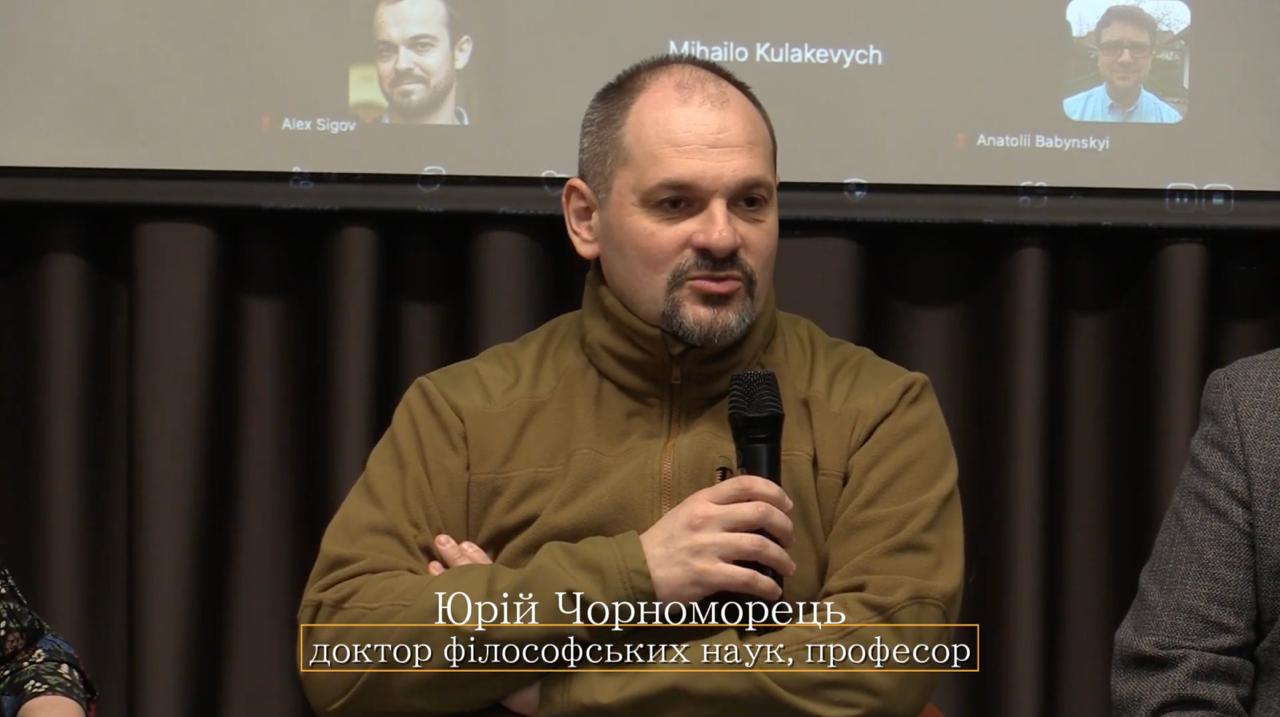
Yurii Chornomorets, Doctor of Philosophy, Professor at the Ukrainian State University named after M. Drahomanov
Dear friends, I am glad to be among this close circle of people who are trying to comprehend the situation and find ways out of the crisis. The problems of the UOC and OCU have already been discussed, and moving to a meta-level has been noted as a unique opportunity to overcome the crisis of jurisdictional confrontation. By this transition, I mean finding an identity for the Orthodox Church that would be more Christian and more relevant to the present-day context. We need to see Ukrainian Orthodoxy as the Orthodoxy of the future — one to which believers of both jurisdictions would want to belong, either by their own will or under the pressure of historical change. I want to emphasize that we really lack deep reflection precisely on the possibilities of this meta-level shift, although discussions within the Brotherhood around this have already begun, and the need is partly recognized.
First and foremost, we need to analyze the context and clarify the conditions under which we are trying to rise to the meta-level. We are doing this in the conditions of the 20th century — which is coming to an end… and yet not ending. The point is that there is the concept of the “Long Century,” whose boundaries do not coincide with a simple chronological calculation. For example, the “Long 19th Century” began with the French Revolution in 1789 and lasted until 1914. That beautiful European culture was destroyed on the battlefields of the First World War because of nationalist outbursts in the most absurd war — a war that gave rise to a pacifist protest that continues to this day, insisting that all conflicts should be resolved through dialogue. It was indeed a war, but there was no absolute evil, like in the Second World War, against which one could mobilize. It was a war that should never have happened, yet it did — interrupting Europe’s grand cultural development and starting the bloody 20th century. Since 1914, this absurd, terrible 20th century has continued. In 1990, everyone thought it was the end of history, the end of this bloody century of ideologies and ideological wars, and cultural-ideological wars. But the 20th century immediately returned, and it continues to this day; we live in this ongoing bloody century. And you see how the whole world is feverish with ideological confrontations that should have ended long ago but keep coming back again and again.
We keep trying to live in a fundamentally different, post-ideological world, wanting to find ourselves in a postmodern world, but constantly ending up in the world of late modernity. We must understand that our Orthodoxy of the future must be appealing to young people who already live in the real 21st century, in a time of searching for something genuine after all the postmodern experiences; but it must also have something to say to the relativists who believe in the dogmas of postmodernism — our theology and our practices must free them from its grip; and our Orthodoxy must also be an acceptable worldview option for those believers who are still captive to the modernist worldview, caught in the discourse of the great ideological 20th century with its conflict between closed and open societies.
It is very important to realize that the concept on which many hopes rest — “open Orthodoxy” — is itself an ideological construct of the 20th century. Historically, it is a variety of the concept of “open Christianity.” And the latter is a beautiful concept, invented by Henri Bergson and elaborated in his 1932 book The Two Sources of Morality and Religion. Bergson portrayed Christianity as an open religion that promotes the creative potential of the individual because Christianity’s core is a personal relationship with God; the French thinker saw Christianity in the light of the mystics’ legacy. Islam, on the other hand, was depicted as a closed religion, where collective traditions enslave the individual. Of course, this is a simplification — Islam too has mystics and their theories of personal connection with God. But despite these caveats, the dichotomy works. Sociologists have actively used the division into open and closed societies, open and closed religions. Open Orthodoxy recognizes the priority of the individual over the collective and respects the personal connection with God as the core of religion. Closed Orthodoxy tries to reconstruct the traditional order with the subjugation of the individual to the collective, sometimes employing fundamentalism in theology and even descending into religious fascism or religious Nazism, as we see with Patriarch Kirill. And this opposition between open and closed Orthodoxy is basically a constant return to the logic of the 20th century, the era of ideological confrontations. For us, as a Brotherhood, there are two challenges — to resist closed Orthodoxy and to affirm open Orthodoxy. But at the same time, we must recognize that we need a 21st-century Orthodoxy — an Orthodoxy that is truly post-ideological.
And this is the main challenge, the most global problem: we are not adapted to the 21st century, to the post-ideological century. We are not adapted to the century that has been trying to be born since the 1970s, since the advent of all the postmodern trends — yet it cannot be born because we never quite make it to this postmodern era or the post-postmodern era that is also trying to dawn but never seems to come. We are still stuck in the 1960s, when the Orthodox were a certain force in the Christian world, thinking that Catholics and Protestants of the West wanted to hear our voice, that they looked to us as a source of spiritual renewal for the entire Christian world. In reality, we find ourselves in an era where the Christian world no longer exists. Around us is a post-Christian world. And we are becoming an almost invisible entity both qualitatively and quantitatively. We Orthodox make up just 11% of the Christian world — and even less if you consider global statistics. We have become a small minority, and the question is: what can we offer to the world now that sociologically we are no longer a global force? We all orient ourselves toward cultivating open communities of communities, religious movements of these communities, opposing closed structures — that is, changing the Church by continually creating new structures. But we live in an era of the death of all structures, a time when on one territory there may be communities of different Local Churches, and when each community is such a unity of diversity that it is rhizomatic, that is, an amorphous reality rather than something structured. Such an unstructured unity of diversity is already post-postmodern Orthodoxy — Orthodoxy that survives in new conditions as a complex unity of network connections, where individuals are more important than the communities they belong to and more important than the structures that those communities are part of. We will live in an age after Orthodoxy as a structured unity, in the era of a new Orthodoxy that is only now being born. We will live in times when even network unity mostly disappears, when the ideas of open Orthodoxy, as relevant to late modernity, no longer work. Even open Orthodoxy is too ideological for the new post-ideological era — and we have not yet found anything new as an idea.
I am encouraged that, understanding the lack of adaptation to the future, Ecumenical Patriarch Bartholomew has consciously commissioned a new social doctrine from 21st-century Orthodox theologians after the Pan-Orthodox Council in Crete. The social doctrine For the Life of the World, created by the best theologians, is the social teaching of the future Orthodox Church, even though it uses the theological language of Zizioulas and Yannaras. This doctrine was crafted, on the one hand, by moderate conservative theologians who try to offer a new theology after postmodernism, and, on the other hand, by liberal theologians who inherit all the ideas of open Orthodoxy but now develop them with entirely new methodologies. Thus, the two currents of contemporary Orthodox theology produce a shared doctrine, one that is common to all. What is very important? That what was in the late modern era — conservatism and liberalism — as irreconcilable opposites, in the post-postmodern era are now post-conservatism and post-liberalism: they find a common language and can create a shared social doctrine.
Let us actively reflect on what the Orthodoxy of the future might be, what the Orthodoxy of the 21st century will be like, when it comes — what its identity might be. And this social doctrine is a guidepost, and modern Orthodox theology itself is a guidepost. In my view, modern Orthodox theology, when popularized in Ukraine, could play the same role here as that of Saint Paisius Velichkovsky. At that time, in this land, there were various structures, various ideas, and the imperial air was stifling. Saint Paisius did not transform structures — he built on the margins. He simply organized the hesychast movement, and that changed Orthodoxy and transformed the understanding of what true Orthodoxy is. We need future-oriented ideas that will inspire and sprout, no matter how hard the pavement. So that the life of the true 21st-century Church — the Church of the future — may overcome all these 20th-century structures, breaking through the ruins of the past.