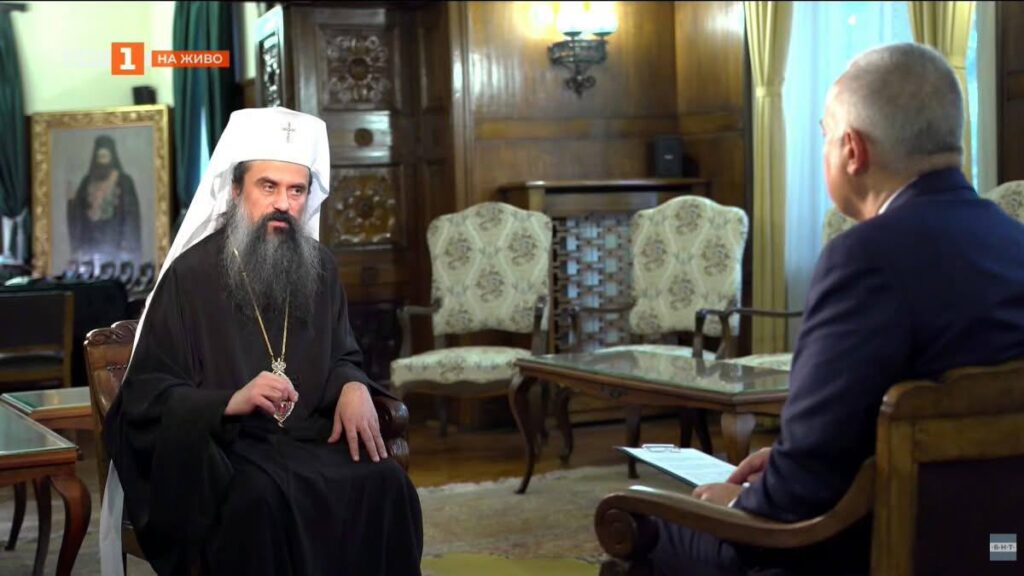
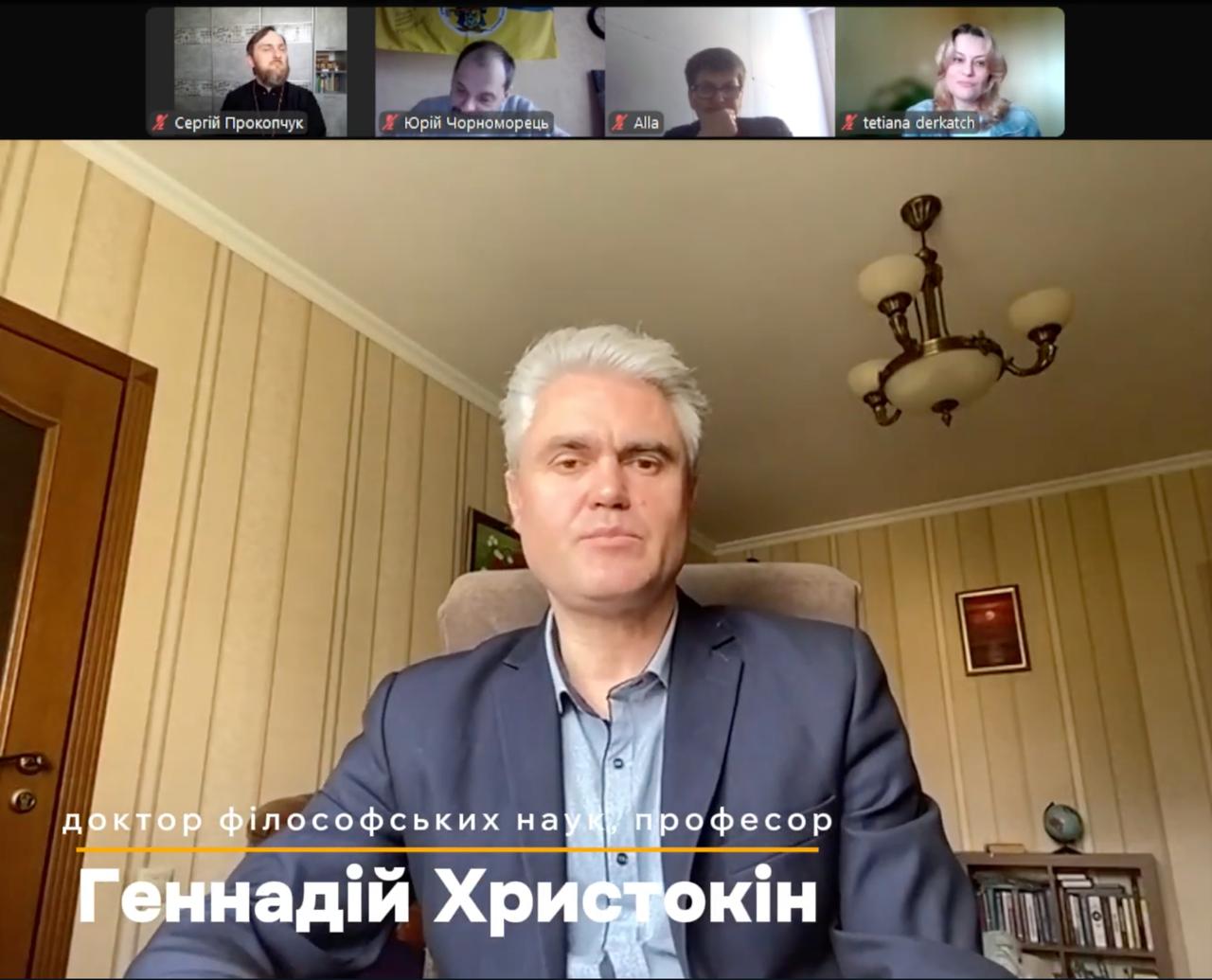
The presentation was delivered on April 9, 2025, during the webinar “Myths and Prejudices as Obstacles to the Unity of Ukrainian Orthodoxy”, held within the joint project of the Sofia Brotherhood and the German foundation Renovabis: “Contemporary Ukrainian Orthodoxy: Debunking Myths for the Sake of Reconciliation and Social Consolidation.” The Sofia Brotherhood may not necessarily share the views expressed by speakers, and some opinions voiced by members of the Brotherhood in the framework of the project may not reflect the organization’s official position.
Hennadii Khrystokin, Doctor of Philosophy, Professor, Professor of the Department of International Relations at the State University “Kyiv Aviation Institute”
Good day, dear friends, colleagues, brothers and sisters!
Today is a very important meeting. I hope that we, as theologians, as believing Christians, as Orthodox, will be able to draw important lessons to comprehend the situation and to overcome the myths that, unfortunately, are extremely widespread in Ukrainian Orthodoxy.
I chose this topic deliberately, to attempt a deeper understanding of myth as a methodological and philosophical problem. I would like to shed more light on the situation that accompanies us all. We constantly witness conflicts, arguments, debates, “battles,” and heated discussions among Orthodox believers on social media, conflicts around churches, and how these are presented in the mass media. We ourselves participate in these discussions and see how Orthodox people and their sympathizers argue. Yet we don’t fully understand what is happening to us and to others during these battles. In the heat of the moment, we say what we believe to be right, trying to respond to our opponents more sharply and precisely. We emotionally react to the conflict and often don’t think about truth as such, but rather try to defend our own position. That is why it is crucial for us to pay attention to what is happening within us at that moment—and what philosophy and psychology say about it.
We need to attempt to look at these disputes not just as participants. Every side has its own truth—its own vision of the situation. I suggest looking at these discussions as a conflict of narratives (discourses), a conflict of myths, a conflict of perspectives conducted by their bearers.
Types of the Real: Reality and Actuality
I would like to begin with a question that is constantly raised and appealed to by both sides. Every participant in a discussion, in one way or another, appeals to reality and claims that their viewpoint reflects reality. The participant believes that the way they perceive the church, church history, the conflict situation, the present and the future of their jurisdiction, is the true vision of events. Consciously or unconsciously, all justifications are based on references to the so-called reality.
But what is reality?
And to what extent can we consciously and critically operate with this category? Let’s agree that the view where a person is convinced that the way they see past or present events is actual reality—that they possess direct knowledge of reality—is what philosophy calls naive realism. This approach has been thoroughly and critically examined for quite some time. Philosophy, especially 20th–21st century philosophy, has taken a critical (analytical) stance on understanding reality. Many concepts and explanations have been proposed regarding what we may consider real. The primary achievement of philosophical knowledge lies in recognizing that reality is not as self-evident as we often assume. Only an uncritical, spontaneous, and emotional outlook considers real whatever we see on television, read in the news, hear from a friend, see in a post, or learn from an eyewitness. We then form the belief that this is reality. In truth, discovering reality is not so simple, and to do so, we must first clarify certain categories.
On one hand, we can speak of actuality—factual reality—which we constantly encounter. We see events, situations, relationships, tragedies around us. They are indeed evident. On the other hand, there is a more complex category—reality. This includes not only actual events, but also emotions, communication, and the values of the one speaking. This means that we can never separate our view of facts from evaluations of actuality. We cannot extract ourselves—our beliefs, perspectives, and historical context—from our perception of reality. As modern philosophical hermeneutics testifies, this is impossible. Events happen—or have happened—and we must still recognize them as facts, but we are always conditioned in doing so. Understanding how context, motivations, assessments, and systems of ideology influence our interpretation of actuality is crucial. And this is what I will try to focus on and what we will discuss today.
So what can we truly consider reality? The hypothesis of my presentation is the following, and I will try to substantiate it: reality is not only what we see; it is not only events and situations. Reality cannot be reduced to physical reality. When we speak of reality, it is better to speak of realities—physical, ideal, social, inner, imagined. Each of these contains many non-physical and non-empirical components and dimensions. Most often, we deal with social reality, which is not only sensory but also psychological, historical, political, moral, and religious. That is, dear friends, we constantly live in a situation of multiple realities that together form Reality. We must see and understand this. We cannot forget this when trying to understand the root of conflict.
Analysis of Religious Consciousness: The Problem of Overcoming Cognitive Bias
What is unique about religious consciousness? Often, representatives of religious consciousness—and any other worldview—fall under the influence of naive realism. They believe that their faith, the view of their confession, the claims of tradition, the position of authorities that legitimize the truth of the church—are the ultimate reality. What does this mean? We must understand that when we speak about religious reality, we are not merely dealing with obvious facts. We face a particularly complex reality that includes spiritual, textual, and praxeological dimensions. A significant role in religion—and in other spheres—is played by social imagination. We do not see spiritual worlds directly, but when reading the Gospel, we speak of reality through interpretation. When we believe in the Lord and feel His grace, we do not encounter physical sensations. In religious consciousness, many aspects depend on our faith, collective imagination, the tradition we are part of, institutional factors, and the interpretations, emotions, and values that shape our awareness.
The analysis of religious consciousness, just like political and other types, reveals the human mind’s tendency toward certain biases. Religious consciousness can be subject to psychological biases, cognitive distortions, logical fallacies—just like any other consciousness of any person or group. We are weak beings, constantly influenced by psychological, mental, political, and linguistic factors that, to some degree, unconsciously manipulate us—and we don’t notice it. Therefore, we must understand the complexity of the religious phenomenon and religious reality. In fact, religion is not only psychologically complex—it is phenomenologically complex. That is, it is a phenomenon with many structures and layers of development.
Usually, any religious phenomenon contains a jurisdictional aspect, elements of doctrine, a moral aspect, and also a practical and even factual dimension. But there is also a deeply important dimension to which we must constantly return when speaking of religious reality: we must account for the deep, communicative, ideal dimension of religious and ecclesiastical reality, which most profoundly and essentially embodies Christian ideals and values. This includes the Gospel truth itself, Christ Himself, and the values of Christ and Christianity: love, openness, communion, forgiveness, peace. This dimension of reality, with which every Church and religious person must deal, is the reality of the Church of Christ. And here we may encounter a substitution of reality—where the reality of church structures is mistaken for the reality of the Church itself.
So what is the problem with naive realism—whether one is a believer or not? Naive realism creates a simplified image of reality. It imagines it in an oversimplified form. And what shapes this image is its narrative nature. We must constantly consider that our views about the world and the Church are narrative—they are constructed as messages, as religious stories. And there are many stories: everyone has their own, and there’s the story of the community. These are stories with specific goals, values, and ideals. This means that reality appears to us through our views, narratives, and beliefs. Reality is inherently complex and multifaceted—we assign meaning to it.
Naively realistic perceptions are usually built on a model of unambiguous interpretation of actuality; they offer only one interpretation of events. This kind of narrative follows the logic of “either-or,” “black or white,” “us or them,” “with us or against us.” Such unambiguity is closely linked to the second trait—binary (polarized) consciousness. It is the belief that only one side can be right, and the other cannot. The truth of the other side is ignored because it is not recognized. This type of consciousness is exclusivist (closed); it prevents us from seeing the complexity of reality and the possibility that the other side, at least in part, might also hold some truth. The other can be mistaken—just as I can be mistaken. And the final trait of naive consciousness is that it is mostly destructive—it breeds destructive actions, destructive decisions, and therefore, destructive consequences.
What Can Be Proposed?
It is worth suggesting a more constructive approach to solving the complex issues discussed above. Socio-political and religious phenomena may appear unambiguous because social events and phenomena do exist — yet they are perceived and interpreted in different ways. I believe that ambivalent thinking is more suited to tolerance, to dialogue, to understanding the other. The logic of ambivalent thinking follows the principle of “both mine and the other’s.” Considering another’s perspective is a key trait of ambivalent, non-polarized thinking. Such a position allows one to transcend exclusivism and foster inclusive (open) consciousness. This is the path toward constructive thinking.
As philosophers, theologians, experts, and responsible citizens, we must cultivate the awareness that beyond our own narrative, our own story — which is important to us — and beyond the stories of our own church or other churches, there exists a higher meta-position. This meta-position enables us to go beyond the narrow confines of specific historical or ideological visions. It is only at this point of meta-position that we can truly encounter another person — a bearer of different meanings — and that is where real dialogue becomes possible.
Methodological Tools
What tools might help us here — especially philosophical ones? These tools include the wide palette of conventional methodologies of the 20th and 21st centuries. Among them are:
- Discourse analysis, which enables us to analyze our statements as discourses.
- Narrative analysis, which treats language messages as social constructs.
- Communicative philosophy, with its contributions in the theory of communicative action and ethics, viewing our statements as intersubjective.
- Contemporary non-classical ontology, such as that of Lacan.
- Phenomenology.
Although I won’t focus on these in detail now, I have taken them into account in this presentation. I believe they allow us to methodologically address the construction of a potential ontology of peace. Our task is to substantiate the possibility of an ontology of religious peace. We must ask: How is dialogue and peace in Ukraine possible?
Meta-Narrative and Myth as Social Conventions and Constructs
I would like to draw attention to some key concepts that are essential for our continued discussion. Among them: meta-narrative, narrative, and myth. All of these have a symbolic nature and are the result of collective convention. How do these concepts actually influence us, or the reality behind them? To what extent do they describe the reality in which we find ourselves?
A meta-narrative is a grand story of a certain group (whether political or religious) that defines itself and positions itself on a global, universal scale. It sets a system of coordinates and values — a framework within which reality is interpreted. The uniqueness of religious meta-narratives — and every religion constructs such narratives (Buddhism, Christianity, Islam, etc.) — lies in their layered complexity. They resemble a multi-story building: beneath each level lies a deeper one.
For example:
- The surface level involves contemporary religious narratives;
- Below that lies doctrinal reasoning;
- Then, a theological foundation accepted by faith;
- Then, the Gospel level;
- And ultimately, the infinite idea of God.
Thus, the religious meta-narrative is infinite in depth and cannot be fully deconstructed.
When analyzing religious narratives, we are not seeking to destroy Christian faith or religious belief. Absolutely not! Rather, the goal is to distinguish within religious belief:
- the meta-narrative — the deep layer of Christian meaning,
- the narrative — the more surface-level historical adaptation,
- and the myth — the illusory and cognitively distorted representation of Christian ideas.
We consciously emphasize the difference between narrative and myth, even though they are often treated as synonymous in academic philosophy. We do this to separate the necessary and important from the illusory and speculative in religious consciousness.
The problem with religious-narrative thinking is that it often confuses the universal idea with its mythological (illusory) projection. If the deep purpose of the Christian meta-narrative is to overcome mortality, reach God, and achieve salvation, then myths hinder this goal by simplifying and distorting the narrative.
Examples of local narratives might include:
- The story of a specific Orthodox Church;
- Belief in its eternal legitimacy or the illegitimacy of others;
- Narratives about the importance or irrelevance of nations for the Church;
- State–Church relations (symphonia, autonomy);
- Stories about saints and pious figures.
By contrast, myths are illusory beliefs such as:
- That the UOC (Ukrainian Orthodox Church) is “Moscow-run” or “FSB-infiltrated”;
- That the OCU (Orthodox Church of Ukraine) is “uncanonical,” “nationalist,” or a “political project”;
- That all UOC priests are “traitors,” and all OCU clergy are “open to dialogue.”
Meta-Narrative, Myth, and the Distance from Reality
It is crucial to note that narrative thinking often overlooks the distance between narrative and reality. Every narrative — especially meta-narratives — is a social construct, a result of collective imagination. This imagination can never fully grasp reality but can construct it. More accurately, the (meta)narrative builds upon and imagines the factual, physical reality in which we live. We must always remember the gap that exists between narrative and reality.
When we forget about this gap — when we lose the distance between narrative and reality — we begin to mistake our narrative for reality. This leads to polarization, with its inevitable consequences: categorical thinking, destructiveness, and binary oppositions.
That is why we need religious culture. Religious culture is, in essence, the cultivation of an awareness of this distance:
- Between God and our ideas about Him,
- Between the spiritual world and our mental representations of that world.
It is distance, not rupture.
Ось переклад англійською мовою:
Narratives as the Language and Expression of the Lifeworld
Every narrative resembles a language that enables us to speak and describe reality. People who engage in endless debates about truth are like individuals speaking different languages. To understand another person means to understand what they are saying, what they are trying to communicate, what message they carry behind their words, and what meanings they attach to those words. Just as we need translators for different languages, I believe we also need translators for narratives. In fact, our task — and particularly the aim of this webinar and our future meetings — is to create the possibility of hearing one another and understanding the language of the other.
We must also acknowledge that all narratives exist within and are products of certain lifeworlds — a reality that transcends narratives. From this reality our stories, messages, and representations are born. This shared reality — in our case — is the lifeworld of Ukraine. It is our common home. It is the shared space where we can see, hear, and speak to one another. It is not an abstraction; it is real communication, real life together, real tragedies shared, real pain experienced collectively, the personal dramas we feel. And ultimately, it is the profound shared experience of war and of enduring aggression.
Thus, for us, this common home — Ukraine — is our lifeworld. It is greater than our individual narratives. It is the true reality, the social reality we live in and which unites us. Therefore, it is vital that we nurture this reality, protect it, love it, and improve it so that our shared communicative reality becomes a common space — a home where we feel like true children and stewards.
Destructive Myths: Who Triggers Conflicts?
Why do conflicts arise in lifeworlds? Typically, conflicts are triggered at moments when lifeworlds begin to fracture — when the tension between social groups reaches a critical point. External factors often play a significant role in this process. These include artificial propagandist myths, which are not created organically or spontaneously (as most myths are), but intentionally designed to exacerbate contradictions among members of Ukraine’s common home — to initiate fractures within lifeworlds.
What Are Spontaneous, Constructive, and Destructive Myths?
A myth (or narrative), as I understand it, is a social construct, born of collective imagination and convention. It differs in modern usage from the way it functioned in antiquity or in ancient Indian thought. Modern myths are not expressions of ancestral consciousness, but rather reflections of mass consumer consciousness. Today’s myths lack the spontaneity of archaic or ancient times, when myths presented a singular worldview. Now, myths arise spontaneously, but they exist among other stories.
- Spontaneous myths are the result of social imagination and, at times, cognitive distortion within communities. Yet their origin is primarily psychological. These myths are less threatening than artificial myths, which are crafted with propagandist intent and ideological foundations. Artificial constructs are designed to undermine communities, to promote polarized thinking, and they tend to be exclusive and closed.
Examples:
- Spontaneous beliefs about charismatic modern elders or “Holy Rus’”
- The myth of “nationalist Ukraine”
- The narrative about “traitors and corrupt leaders” in power
We must clearly distinguish between:
- Spontaneous myth – a product of social imagination aimed at making sense of life;
- Artificial myth – a closed, exclusive, polarizing construct, and
- Meta-narrative – which lays the deep foundations, principles, and meanings of human existence.
Examples of artificial myths include:
- Ukraine as a “Western colony”
- The President as “embodiment of evil”
- Claims of religious persecution and lack of freedom in Ukraine
Constructive vs. Destructive Myths (Narratives)
There also exist constructive and destructive myths.
- A constructive myth might be the idea of the Ukrainian political nation, whose origins trace deep into antiquity.
- A destructive myth would be the ideology of the “Russian world” (russkiy mir), which seeks to dismantle Ukraine.
As for religious consciousness, I firmly believe that at its core, the Christian meta-narrative is inherently open and inclusive. It allows us to encounter God and to build a shared space within the Church. Spontaneous or constructive myths accompany our faith and lives and can be helpful. But destructive myths, on the contrary, isolate us and push us into conflict.
Foundations of Destructiveness
Spontaneously, people are always bearers of certain stories—religious, political beliefs—and they are unconsciously prone to losing the distance between their views and reality. When such belief-holders enter into conflict, a certain phenomenon arises—what could be called “narrative blindness.” What one sees as reality, the other perceives as myth, something unreal. This is a form of cognitive distortion, and it presents a serious challenge. What my opponent sees as real, I perceive as illusion. This is easily explained by the differences in meaning and symbolic frameworks between narrative perspectives. It’s as if people are not only speaking different languages, but different meanings. Conflicts often arise from this misalignment: when I say one thing, the other person interprets it as something else entirely—and vice versa. But at this level, the issue is not yet irreconcilable, because no direct cause for hostility has yet formed.
A religious myth (or narrative) can also emerge when, under the pressure of modern challenges, a meta-narrative begins to collapse. The modern world pokes “holes” in religious narratives (or political ideologies), thus undermining our convictions. In response, we try to patch these holes, but in doing so, we effectively reconstruct and extend the narrative, attempting to answer its exposed problems. When this reconstruction happens spontaneously, the “patches” are often stereotypical and simplistic—and usually myth-producing.
Another way a myth is formed is when we fail to recognize ourselves in the words of another. We hear how others talk about us, but we are sure “that’s not about me.” This misrecognition—or false understanding of the other—also gives rise to myths.
Finally, conflictual histories produce myths. When communities clash, they generate mythologies as a form of self-defense. These are psychological conditions for the creation of myth.
The psychological nature of cognitive distortions is well explained in science, and modern psychology has little trouble describing it. The real problem arises when deliberate ideological or propagandist constructs are introduced—constructs that oversimplify complex reality into a banal formula and push it aggressively through the media. For example: “If you follow this path, you’ll find truth in eight steps,” or “If you look at your opponents in this way, everything will become clear.” This logic fits into a simple scheme: “they are clearly wrong, we are clearly right.” Therefore, “we are justified in hating them.” Such simplification is the result of artificial and manipulative technologies.
How Can Ukrainian Orthodoxy Overcome Its Current Situation?
To overcome the limitations of conflictual narratives, we must rise to the meta-level. This involves turning to the deep reality that is shared by all Orthodox Christians—indeed, by all Christians. This is the ideal ecclesial reality, which includes the communicative dimension of core Christian values, ideals, and norms. The meta-level, then, is directed toward the ideals of Christ’s Church. This is our first task.
I believe we can and must reach this level—this possibility is always present, though we often neglect it. Secondly, we must rise to the level of the ideal social communicativity of Ukraine as our common lifeworld. For all of us, Ukraine is our common home, the space in which we can find each other and realize ourselves.
The Sofiiske Bratstvo (“Sophia Brotherhood”) starts from the assumption that de facto this Church of Christ already exists in Ukraine—we all belong to Christ. On the meta-level, we are already united. Friends, we simply need to accept and realize this. Differences remain only at the level of jurisdictional distinctions. At the level of our respective narratives—UOC in theirs, OCU in theirs—we remain separate. But at the meta-level, in Christ, there is only one Church.
It is also vitally important that the Ukrainian legal state, civil society, and international legal norms act as guarantors of peaceful coexistence between jurisdictions. These safeguards help protect our world. It is crucial that we support the Armed Forces of Ukraine, that we have the courage to resist our common enemy, the one who imposes alien narratives and destroys our shared home—the very home we strive to defend with all our efforts.
We must search for the foundations of an ontology of peace between Orthodox jurisdictions. And we urgently need to propose a unifying meta-narrative—one that could bring the two jurisdictions together into a single Church.
To Do This, We Must:
- Understand what is happening to us;
- Become aware of how our thinking depends on narrative constructs;
- Notice the distance between our convictions and reality;
- Realize that our opponents have the right to hold and cherish their own stories (identities);
- Avoid absolutizing our own narratives;
- Identify both our own and others’ destructive myths;
- And foster constructive ones—those that help Ukraine survive and thrive.