Yakiv Tsypin, Sophia Brotherhood
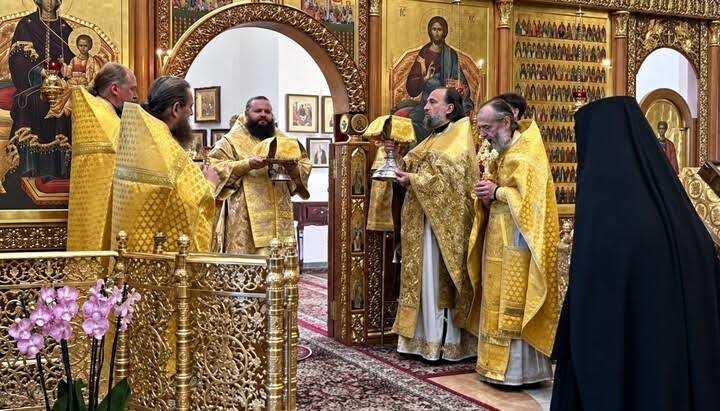
On 14 September, Metropolitan Pimen of Rivne and Ostroh celebrated the Divine Liturgy at the Gorny Convent in Ein Karem, which belongs to the Russian Ecclesiastical Mission of the Moscow Patriarchate. Metropolitan Pimen was concelebrated by the head of this mission, Archimandrite Vassian Zmeyev.
It was the Russian Ecclesiastical Mission itself that made this public. In its report, it referred to Pimen as a metropolitan of the “Ukrainian Orthodox Church of the Moscow Patriarchate” and specifically noted that Vassian had concelebrated with him.
For the UOC, which has spent years trying to convince Ukrainian society of its independence from Moscow, it is difficult to imagine a worse image. Especially when one recalls who Vassian is.
In 2023, he was expelled from Bulgaria together with two other clergymen. Bulgarian security authorities stated that they had been engaged in activities aimed at influencing socio-political processes in favour of Russian geopolitical interests. He was also banned from entering the country for five years.
So I will say it plainly: in my view, Metropolitan Pimen’s decision was a serious mistake. And an entirely unnecessary one.
The day before, Pimen had prayed together with Ukrainian pilgrims at the Holy Sepulchre. The service there was celebrated by a hierarch of the Patriarchate of Jerusalem. Yes, representatives of different Local Orthodox Churches, including the Russian Orthodox Church, may find themselves together at such services.
But the situation the following day was entirely different. Pimen himself presided over the Liturgy at a monastery of the Russian Ecclesiastical Mission, with the head of that mission concelebrating with him. At that point, it becomes difficult to speak of a chance encounter between Orthodox Christians in the Holy Land.
The Explanation Made the Situation Even Worse
The following day, the Rivne Eparchy published an official clarification. We were told that the Metropolitan had been invited by Ukrainian sisters living at the monastery. That mothers of fallen Ukrainian soldiers had asked for prayers. That during the Liturgy prayers were offered for Ukraine, our defenders, prisoners of war, the missing, and a just peace. The eparchy also explicitly condemned Russian aggression.
But no one was asking whether you prayed for Ukraine. The question was entirely different: why was it necessary, in order to do so, to serve together with the head of the Russian Ecclesiastical Mission?
No answer was given to that question. And this is precisely where the story ceases to be merely a story about one ill-judged Liturgy.
Abroad, This Problem Does Not Simply Disappear
We need to acknowledge one thing honestly. Outside Ukraine, the Orthodox world is considerably more complicated. A Ukrainian priest may find himself in Germany, Italy, France, or another country. The language is different, the culture is different, the people are unfamiliar. Catholic and Protestant communities also remain unfamiliar environments for many of our Orthodox priests, because in Ukraine we are not particularly accustomed to regular interaction with them.
And then suddenly there is an Orthodox church nearby. A familiar Liturgy. Familiar icons. A similar culture. Often a language one understands. And that church may well turn out to be a parish of the Russian Orthodox Church.
The Russian Orthodox Church has an extensive infrastructure abroad: parishes, dioceses, monasteries, missions, and representative offices. Ukrainian clergy will therefore encounter it many more times. This may also happen at services of other Local Orthodox Churches. But that is precisely why we need greater caution, not less. The inevitability of contact does not make that contact neutral.
There is an enormous difference between a situation in which a Ukrainian priest serves with a Greek hierarch and a representative of the Russian Orthodox Church happens to be among those invited, and a situation in which a Ukrainian hierarch himself goes to serve at an institution of the Moscow Patriarchate together with its head. We need to recognise that difference.
Orthodox Brotherhood Can Also Be Manipulated
The problem with the Russian Orthodox Church is not that Russians serve there, nor is it that an Orthodox Ukrainian should cease to see a Christian in an Orthodox Russian. The problem lies elsewhere. The sense of brotherhood that is natural to the Church has for many years been used as a pathway for an entirely different ideology. At first, everything sounds good: we are Orthodox, we are brothers, politics should not divide the Church, we share one faith, common saints, and much of the same history.
But then something else appears alongside this: “one people,” one spiritual space, a special role for Moscow, and Ukrainian separateness portrayed as a historical mistake or a foreign political project.
This is how the “Russkiy Mir” (“Russian World”) operates. Its danger lies precisely in the fact that it does not always arrive speaking the language of hatred. It can come speaking of love, brotherhood, and unity. A hierarch therefore has no right to switch off his critical thinking simply because another Orthodox hierarch or priest is standing before him.
Loving Your Enemy Does Not Mean Giving Him the Keys to Your Home
Here, I find a simple family analogy helpful. Imagine someone who was once very close to your family but caused it serious harm. You may wish that person no evil. You may renounce revenge. You may pray for them. But if they have not acknowledged the harm they caused and continue to behave in the same way, love does not oblige you to hand them the keys to your home again. Especially when your children live in that home and you are responsible not only for yourself.
Christ’s commandment to love our enemies is not a commandment to be irresponsible. Decisions whose consequences will be borne by other people cannot be justified by invoking the words of Christ. And a bishop is responsible not only for himself. His public actions affect priests, parishes, and thousands of people who are then forced to explain that they are not part of a Russian ecclesiastical project.
Why a Bishop Is Expected to Explain Himself Today
There is another problem here that we do not particularly like to discuss. In the early Church, the community played a much greater role in the election of a bishop than it does today. In the third century, St Cyprian of Carthage wrote that a bishop should be elected in the presence of people who knew his life, and that the entire church community, together with the bishops, participated in the election. Over time, the ecclesiastical system changed, and the decisive role gradually passed to the episcopate itself.
Today, in the UOC, a diocesan bishop is elected and appointed by the Holy Synod. The faithful of a particular diocese do not vote for him directly. In the Orthodox Church of Ukraine (OCU), a bishop is likewise elected and appointed by the Synod, although its statute provides for the views of the clergy and laity of the diocese to be taken into account.
This does not mean that a modern bishop has ceased to be a spiritual figure, but a substantial part of his actual work today consists of administration: appointing people, making personnel decisions, managing property and institutions, relations with the state, relations with other Churches, public statements, and responses to conflicts. In other words, to a considerable extent, a bishop also performs the role of an ecclesiastical leader.
And this creates a perfectly logical situation: if people did not choose their leader, had almost no influence over his appointment, and often do not even understand why this particular person was given the see, then they have all the more reason to expect clear explanations of his decisions.
Yes, formal church courts and mechanisms of disciplinary accountability do exist. In the UOC, for example, cases concerning bishops fall within the competence of the Council of Bishops, which is not convened very often.
But for an ordinary believer, these mechanisms are distant, complicated, and almost entirely disconnected from the possibility of asking their bishop a simple public question and receiving a straightforward answer.
A Bishop Must Speak to the People
That is why, in my view, Metropolitan Pimen should now do something very simple: address the people himself, rather than through his press service.
He should explain how this situation arose. Did he know in advance that Vassian would concelebrate with him? Why did he agree to serve specifically at the Gorny Convent? How does he himself assess that decision now? And if he understands that he made a mistake, he should apologise. Not because a bishop should humiliate himself before social media, but because without the ability to say, “I made a mistake,” normal dialogue within the Church is simply impossible.
Unfortunately, the problem is much broader than Metropolitan Pimen and broader than any one jurisdiction. Ukrainian Orthodoxy still has a deeply rooted culture in which a bishop does not consider it necessary to explain his decisions to the people. Sometimes the attitude looks roughly like this: I am the hierarch, the decision has been made, why should I have to justify myself to anyone?
But a modern church community no longer works that way. People read documents. They search for old statements. They compare photographs. They study the canons. They debate history and theology. If church leadership does not create a healthy space for conversation, that space emerges on its own: Telegram channels, anonymous pages, sarcasm, public ridicule, posts demanding explanations and repentance.
One may dislike this form of discussion; I myself am far from comfortable with it in every instance. But we should honestly ask why it has become so popular. Perhaps because, for many people, it is almost the only way to get a bishop to respond at all.
And the worst thing church leadership can do in response is to decide: we will say nothing, and in a few days everyone will forget. People then learn a very simple lesson: if you want a hierarch to hear you, do not speak to him – create a scandal. That is not a healthy model of church life.
The End of the War Will Not Take Us Back to the Past
There is one more thing we need to understand now. In church circles, one sometimes hears the hope that the war will eventually end, political tensions will subside, and the question of relations with the Russian Church will somehow return to its pre-war state. In my view, this reflects a fundamental misunderstanding of what has happened to Ukraine.
The war may end, but memory does not end with the war. The memory of murdered relatives, of occupation, of destroyed cities, of people who never returned from the front, of years of air-raid alerts, of nights when parents listen anxiously to determine where a missile or Shahed drone is heading.
We are already living through the fifth year of the full-scale war, and this experience will remain not only with us – it will be passed on to our children. We still argue about events from the Russian Empire and the Soviet Union, even though generations separate us from many of them. It would be strange to think that the present war will leave a smaller mark.
Therefore, building church policy around the calculation that “we should not make things too confrontational now, because after the war we will have to restore the old relationships anyway” simply means failing to understand Ukrainian society. And anyone who does not understand the society among which they serve will inevitably begin making decisions that harm that society.
What Should Happen Next
I do not want the story of Pimen to end with a few days of outrage. Everyone argues today, another scandal appears tomorrow, and a month later hardly anyone remembers the details. We learn nothing that way.
Stories like this should not be used simply to prove, once again, who is the worst. They should help us see the problem and call a mistake a mistake. We need to hear the explanation of the person who made it, understand why such a situation became possible in the first place, and develop rules that will help us avoid stepping on the same mine again.
As a member of the Sophia Brotherhood, I would especially not want cases like this to become yet another pretext for an endless internal war among Orthodox Ukrainians. The point of dialogue is not to conceal mistakes. Its purpose is to keep searching for shared answers even after difficult questions have been asked.
Ukrainian Orthodoxy will have to learn to live in a new reality. To remember evil without calling it good. Not to allow appeals to Christian love to justify irresponsibility. Not to confuse forgiveness with the restoration of trust. Not to confuse Orthodox brotherhood with an obligation to turn a blind eye to the ways in which that brotherhood is manipulated. To demand accountability from our leaders. And, at the same time, not to lose the ability to speak to one another.
Because our task is not merely to respond properly to one scandal. We will still have to answer a much more difficult question: what will Ukrainian Orthodoxy look like after everything that has happened to us? And will we be able to come through this war without losing our memory, our sense of responsibility, our humanity, and our very capacity to be the Church?