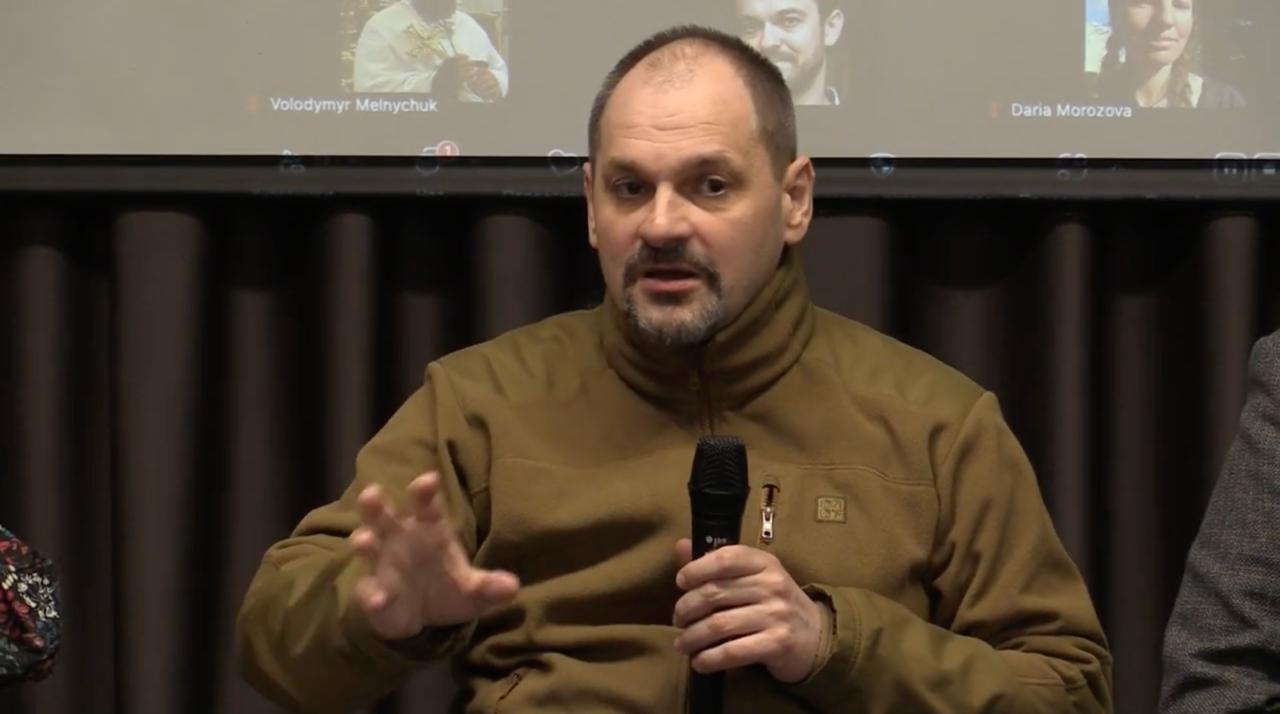
Response given during the panel discussion at the Round Table “Contemporary Ukrainian Orthodoxy: Debunking Myths for the Reconciliation of Orthodox Christians in Ukraine,” held on April 29, 2025, in Kyiv as part of the enlightening-analytical project “Contemporary Ukrainian Orthodoxy: Debunking Myths for the Reconciliation of Orthodox Christians in Ukraine and the Consolidation of Ukrainian Society,” organized by the Sophia Brotherhood with support from the Renovabis Foundation.
Fr. Ioann Tronko: “Can we expect not only radicalism, but also constructive proposals for the UOC?”
A brief reflection. We have many cases where any process takes place, if not in a revolutionary, then in an evolutionary way. And we have to go through a certain path, which may not be easy. We have seen individual cases when priests, changing jurisdiction, make only external changes without any inner renewal; they fail to acquire a new identity, remain in terrible cognitive dissonance, and draw sharp attention to themselves. It seems to me that the process required of the majority of the UOC faithful is simply overwhelming.
I therefore expect some proposed tools — a framework for how we can move forward in these evolutionary steps — and whether such a path exists at all, whether it is possible or not. I know how it works for me and in our parish — it is a great and very inspiring journey — but still a gradual one for most people.
Can we expect not only radicalism, sometimes deeply bitter, but something constructive — a constructive proposal for the UOC?
Yurii Chornomorets: “I look at the UOC with great hope, because there is a huge number of living parishes.”
Every theologian works in two possible modes. One mode is prophetic ministry, and the other is teaching ministry. It is very important to further develop the “gentle” teaching of the 21st century — for example, to hold theological conversations with Oleksandr Filonenko. We must point to something that is truly valuable for everyone, something that many priests are working on in their own fields.
Back in 2004 during the Orange Revolution, we gathered — Fr. Petro, Fr. Andrii, Fr. Mykhailo Shpolyansky — and we discussed what was more important: that the Church be Ukrainian, that it be Christian, or that it be a Church of the future. And for us it was more important that it would not be about jurisdiction, but about whether the Church was truly the Church of the future.
There are many ideas in contemporary theology — from Oleksandr Filonenko, Fr. Kyrylo Hovorun, myself, and other authors. And there is the question of how to popularize them and present them as new methodologies. I believe this is what needs to be done — perhaps the Sophia Brotherhood could successfully start such work.
I thought that perhaps, when the hot stage of the war is over, we could start publishing translations, for example, of contemporary Orthodox theologians, making sure that every third book is in Ukrainian. And we could approach it in a way that allows all these ideas to be understood on a theoretical level, to hold theological conversations under the slogan “Sophia Ethos” — combining theory with practice and popularizing these ideas. Perhaps Oleksandr Semenovych and I could do this together.
Thank God, there is autonomy in every parish, even if people struggle with the jurisdiction they belong to. People too often forget two important things: first, that they can do a lot within their own parish; and second, that since this is the 21st century, one should give great freedom to laypeople and priests — and then you will see how much they can do themselves.
I myself was in the UOC for a long time — from 2004 to 2014 — because I was part of a living parish at the Cancer Institute, where I never heard a sermon, and all parish activity was directed toward helping children with cancer. I was in one of the best parishes, and I do not regret that experience. On the contrary, I look at the UOC with great hope, because it has a huge number of living parishes, priests, and laypeople. That is why I am puzzled why there is no break with Moscow. The Church is not only ready for autocephaly — at the grassroots level it is very healthy, strong, and vibrant — yet it constantly ties its own hands, lowering itself into this Moscow well, drowning in its stagnant water.
It is important to understand one thing: we have entered the post-postmodern era. In postmodernity, there was already a crisis of structures — you can consider that all structures have collapsed.
If a bishop comes, act like in the villages of Western Ukraine: no matter who the bishop is, we will serve with him. The bishop serves with everyone, and everyone serves with all bishops.
Educational and theoretical work is truly crucial. We know very little about how remarkable contemporary Orthodox theology is — theology that the Ecumenical Patriarch rightly supports. This is our foothold for change. In fact, standing on this foundation, we could transform both Ukraine and global Orthodoxy. We never even dreamed of this, because world Orthodoxy is in crisis. Just see what the Serbian Patriarch says when he visits. We must bring transformation not only to Ukraine, but to the entire world — and Kyiv could become the leader in this.