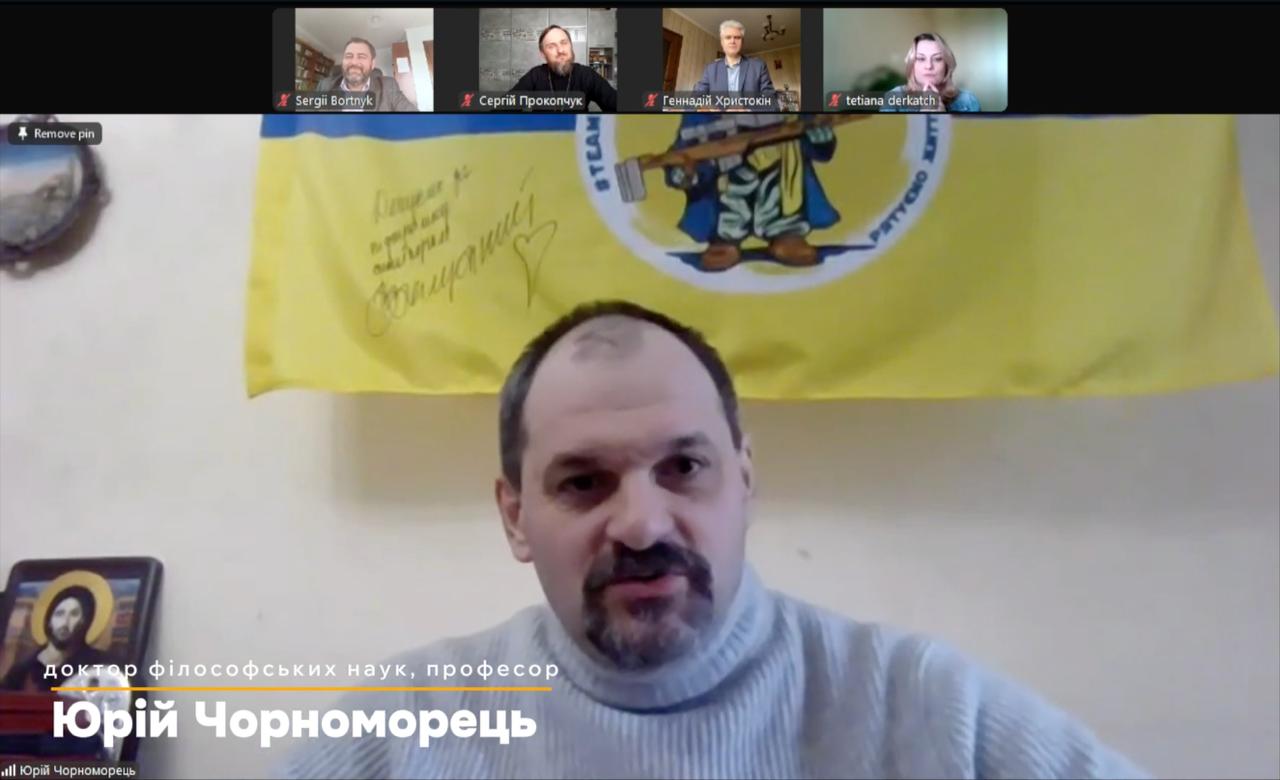
The presentation was delivered on April 9, 2025, during the webinar “Myths and Prejudices as Obstacles to the Unity of Ukrainian Orthodoxy”, held within the joint project of the Sofia Brotherhood and the German foundation Renovabis: “Contemporary Ukrainian Orthodoxy: Debunking Myths for the Sake of Reconciliation and Social Consolidation.” The Sofia Brotherhood may not necessarily share the views expressed by speakers, and some opinions voiced by members of the Brotherhood in the framework of the project may not reflect the organization’s official position.
Yurii Chornomorets, Doctor of Philosophy, Professor at the Department of Theology and Religious Studies, Dragomanov National Pedagogical University, Ukrainian religious scholar and philosopher
Since 2004–2007, Orthodox theology has undergone a radical turn toward a new type of theological thinking. Leading contemporary theologians—especially David Bentley Hart, John Manoussakis, Cyril Hovorun, Aristotle Papanikolaou, Pantelis Kalaitzidis—have elevated Orthodox theology to a qualitatively new stage of development. In this process, a number of myths that had long dominated Orthodox theology and shaped modern Orthodox identity have been overcome.
The new paradigm in Orthodox theology seeks to eliminate divisions introduced by the modern era, such as the separation of theory and practice, science and religion, rationality and emotion, contemplation and reason, etc. Notably, it aims to bridge the gap between phenomenological contemplation and hermeneutical-narrative interpretation, promoting an approach in which we recognize that our representations are narratively conditioned, that we act as interpreters of these narratives—yet without denying our access to reality and to facts.
This paradigm also aims to overcome postmodern relativism, striving to return from the totalizing playfulness of postmodernity to a renewed sense of reality and personal identity. At the same time, it is post-postmodern theology, because it fully acknowledges that worldviews are and always have been shaped by narratives. The key aim of early 21st-century Orthodox theology is to return to the foundational narratives that are central to the Bible and Christian tradition. All other narratives are subjected to critical re-evaluation, and many of them do not withstand scrutiny, being exposed as mythological or illusory, based on false assumptions.
Let us consider some of the most prominent myths currently debated, against which people often respond by constructing counter-myths or narratives—yet in modern Orthodox theology, this entire type of mythologizing is rejected.
Myth 1: The Church is Primarily a Structure of Spiritual Authority Symphonically United with Secular Power. According to this myth, society is governed by two powers: one is the Church (as spiritual authority), the other the state (as secular authority), and between them there should be symphony.
Contemporary Orthodox theology identifies several false assumptions embedded in this myth.
The first is the notion that the Church is inherently called to pursue symphony. Even more erroneous is the idea that the state is called to engage in symphony with the Church.
The concept of symphony was proposed by Eusebius of Caesarea in the 4th century—a court theologian serving Emperor Constantine. It is widely criticized in modern theology as an idea that deeply distorted the historical development of Orthodoxy. Church leaders, seeking ideal cooperation with worldly power, longed for Orthodox empires or national states, forgetting the Church’s independence.
Even the myth surrounding Ecumenical Councils claims they cannot occur without an emperor. However, when St. Maximus the Confessor organized the Lateran Council of 649, which he understood as an Ecumenical Council, he referenced earlier precedents—before Constantine’s role in the First Council of Nicaea—to argue that the Church is autonomous and capable of convening councils independently. For him, symphony was merely secondary.
The very term “symphony” appears in Justinian’s Code, where it describes legal coordination, such as clergy facing both ecclesiastical and civil jurisdiction in marital matters. Thus, symphony was never a comprehensive theological principle, but an administrative convenience. Viewing it as central to Byzantine thought is therefore misleading. While interpretations of symphony varied across periods, all such versions should be systematically critiqued—both for their theoretical errors and negative historical consequences.
When we orient theology around the idea of symphony, we fall back on outdated schemes that theology has already discarded. Symphony between Church and state may be acceptable when practiced as a cooperative model. But symphony can also lead to subordination, as we see in Russia, where the ROC (Russian Orthodox Church) claims moral authority but functions as a supportive hierarchy, largely dependent on state structures.
Many observers fear that the Orthodox Church of Ukraine (OCU) might become a state church, leading to subordination to the state and potential discrimination against other religious groups. However, Ukraine is moving from a separationist to a cooperative model, where the state partners not with a single Church but with the entire spectrum of religious organizations, represented through the AUCCRO (All-Ukrainian Council of Churches and Religious Organizations).
Furthermore, most contemporary Ukrainian Orthodox theologians agree on the value of symphony between the Church and civil society. As an advocate for civil society, the Church cooperates with the state only to the extent demanded by society.
Overall, modern Orthodox theology emphasizes the self-sufficiency of the Church—that the Church does not require symphony with secular institutions such as the state or even civil society. This ecclesial autonomy allows the Church to preserve its authentic essence and avoid the distortions that arise from improper alliances.
Yet even in asserting autonomy, a new danger arises: imagining the Church as a spiritual authority in itself—even without symphony. That, too, can lead to distorted views of its true nature.
The second false narrative is the widespread perception of the Church as a form of spiritual power. Contemporary Orthodox theology deconstructs the idea of the Church as a power structure and denies the notion that the Church is called to exercise spiritual authority over society. This concept is viewed as a radical error that has caused immense harm throughout the history of Orthodoxy and Christianity in general.
Modern Orthodox theology emphasizes that the true essence of the Church, which is most fully revealed in the Eucharist, is eschatological: every local community is a partial manifestation of the future Kingdom of God. For today’s theologians, the Kingdom of God is not a dominion, but a triumph of loving relationships. It reveals Christ and the saints as those who serve humanity, not as rulers over it. The Church is Church insofar as it is an icon of the Kingdom of God—a space of profound interpersonal relations, involving full acceptance of the other in their uniqueness, and selfless love.
A Christian is a person called to communion with God, and the realization of this calling makes a Christian a person of love, living in a network of deep interpersonal relationships with both God and fellow humans. The very concept of personhood only exists within relationships—and without openness to others, communion with God is impossible.
Contemporary Orthodox theology embraces the ethical ideal of accepting the other and insists that the Church is called to serve society, regardless of the state that society is in. The Church is not meant to dominate, but to engage in diakonia (service). This vocation is known since apostolic times. Importantly, this service is seen as the defining character of Christians as citizens of the Kingdom of God.
In Ukraine today, we see a shift: from self-enclosed Christian communities with claims to social control, to communities that serve societal needs—especially in the fields of volunteer work and chaplaincy. Increasing participation in public service and acceptance of others as they are may gradually cultivate a high culture of communication.
Both jurisdictions (OCU and UOC) need to realize that their mutual rejection of each other contradicts basic Christian morality. Their unwillingness to accept one another as they are severs their living connection with God, reducing the Church to a secular institution characterized by covert forms of violence against the dignity of the person.
This myth is dismantled in three major steps:
- Rejecting the belief in the necessity of symphony between the state (as secular authority) and the Church (as spiritual authority).
- Affirming that the Church is not a power structure, but rather an icon of the Kingdom of God whose primary calling is to serve society, not to govern it.
- Redefining the Church not as a structure, but as a communion of communities.
Modern Orthodox theology asserts that ecclesial structures are historically contingent and non-essential, while the community has always been the true bearer of ecclesial identity. This vision, deeply rooted in the theology of Fr. Nikolai Afanasiev, emphasizes that where there is community, there are sacraments, and that is what matters most. Overarching structures are secondary.
The community is understood as a space of communication—a horizontal, interpersonal network of connections among believers.
Most importantly, contemporary Orthodox (and Christian in general) theology holds that ecclesial communities must be defined by unique interpersonal relationships. If these relationships are indistinguishable from those of secular society, then such a body is not truly Church, not an icon of the Kingdom of God.
This explains why these Christians are inclined to serve society: because they are grounded in distinctive interpersonal bonds—first with God, then with one another, and then with the surrounding world.
The Church is also conceived as a communion of communities. Its defining trait is movement: movement toward the Kingdom of God, toward service (diakonia) in the society where it lives.
A community remains truly Christian if:
- It is growing and moving forward.
- It is serving the surrounding society.
In this way, modern Orthodox theology proposes a “symphonic diakonia” between Church and society, replacing the outdated idea of symphony between Church and state. This redefines ecclesial identity.
In the Ukrainian context, this means the Church is where the volunteer movement is, where chaplaincy is, and where faith meets the suffering of wartime reality. Where the Church clings to power, dreams of symphony with the state, and resists becoming a movement of communities, its ecclesiality is diminished.
Modern Orthodox theology emphasizes the need to think globally and act locally: each community must cultivate ethically oriented relationships without waiting for institutional reforms. This is precisely what the Sophia Brotherhood is doing—and it is theologically sound.
The second myth concerns the danger of absolutizing the community. It claims that since personhood only exists in community, communities are therefore more important than the person.
This idea is popular not only among conservative Orthodox believers, but also among liberals. Many religious thinkers present the Church as more valuable than the individual and their personal relationship with God. From there, it’s an easy step to assuming ecclesial structures are even more important.
A related variant—one seen in theologians like Christos Yannaras—involves criticism of state and ecclesial institutions but an idealization of traditional and Church communities that dominate the individual, shaping them into a person. This totalitarian potential, which modern theology has critiqued in state ideologies, can return via the community, when its significance is absolutized at the expense of the person.
Contemporary Orthodox theology in the 21st century strongly critiques the theories of Yannaras and Zizioulas, developing instead a new personalism that places the dignity of the person at the center of political theology.
This personal dignity is affirmed by both conservative and liberal streams in contemporary theology.
For instance, the neo-conservative project of Hart and Manoussakis, aligned with radical orthodoxy, emphasizes that the person and their communion with God is of absolute value.
Liberal theologians—such as Hovorun, Kalaitzidis, Papanikolaou, and virtually all American Orthodox theologians advocating liberal democracy—also absolutize personal dignity, building whole theological systems around it.
They argue that the person is the most valuable thing, absolutely sacred to God, and therefore must be absolutely sacred to Christians as well.
A human being is not only made in the image of God but called to divine communion, called to holiness. Therefore, every person is a potential saint, and must be viewed as if they already were a saint.
From the perspective of this absolutization of the person—their rights, freedom, dignity, communion with God, deification, and individuality—the social doctrine of the Ecumenical Patriarchate titled “For the Life of the World” was written. This document, commissioned by Patriarch Bartholomew, was crafted by a special commission comprising both neoconservative and liberal Orthodox theologians, making it a shared doctrinal project. This clearly demonstrates that we are dealing with a new type of Orthodox theology—even though it includes internal differences, it nonetheless presents a unified framework capable of forming a common social teaching grounded in a renewed Christian humanism.
This stands in direct opposition to all theories of the “Russian World”, which claim that a certain authority once chose a path a thousand years ago and that path must be followed by everyone forever—leaving no room for personal freedom, and condemning it outright.
By contrast, modern Orthodox theology affirms the freedom of the person, their moral choice, and places ecclesiastical structures in a tertiary role. Even ecclesial communities are secondary to the person and their relationships, which are primary.
In Ukraine, amid jurisdictional struggles, believers are often faced with the challenge of preserving Christian identity by shifting attention away from ecclesiastical structures and toward communities that transcend these structures. The next step must be to nurture personal relationships with God.
The strengthening of Christ-centered spiritual life is often the only path toward maintaining one’s faith identity. Theology underscores the centrality of divine-human communion (theosis). In fact, according to modern Orthodox theology, the Church is communion with God, and all existence is grounded in divine-human communion.
Viewing all Orthodox Christians as being in relationships of communion with God is key to restoring the respect and conditions for dialogue that are so urgently needed today.
The third myth, subject to theological deconstruction, is the idea that Orthodoxy represents a single, uniform tradition. This myth has long prevailed in Orthodox circles, including among the Neo-Patristic movement of the 20th century, which often portrayed Orthodoxy as the exact opposite of Catholicism, and reduced its essence to Palamite thought or a singular Greek model.
Theology in the 21st century is now emphasizing the diversity of tradition.
We are witnessing a rediscovery of the plurality of Orthodox traditions from the first millennium. This leads to a broader validation of diversity within the Orthodox Church today.
- First, we now recognize the importance of Syriac patristics, once marginalized in favor of more mainstream Greek thought.
- Second, the re-evaluation of Augustine has become central. It is now understood that Augustine was a personalist, and his Trinitarian theology bears strong resemblance to that of Gregory of Nyssa.
- In his philosophy of history, Augustine echoes Maximus the Confessor; in his theology of divine knowledge, he aligns with Symeon the New Theologian.
This new understanding of Augustine allows us to perceive deep affinities between Orthodoxy and Catholicism, helping us move beyond old polemical narratives rooted in binary oppositions of “Orthodoxy versus heresy,” and fostering a theology of understanding rather than condemnation.
This recognition of tradition’s inner diversity implies that a greater plurality within Orthodoxy today is not only legitimate but necessary. In the past, it was assumed that “Greek Orthodoxy” or “Russian Orthodoxy” held the singular truth. Today, such distinctions are no longer tenable. These are marginal mythologies, still circulated even in Ukraine—where some claim that Russian Orthodoxy is “authentic,” and Greek Orthodoxy is “in decline.” Modern Orthodox theology has moved beyond this, embracing the enormous diversity of the Orthodox tradition as a whole. Ukraine, with its historic openness to dialogue and diverse traditions, must adopt this same vision.
Using these three myths concerning identity, we can see that modern Orthodox theology is indeed operating on a meta-level—a level at which our problems are often revealed to be pseudo-problems, and contradictions, pseudo-aporiae. Therefore, we must turn our attention to the heritage of contemporary Orthodox theology and the social doctrine grounded in it. Around this, we can build a universal Orthodox identity in a national Ukrainian form.