
“Instead of methodically and strategically working to remove prejudices, the Church of Greece is daily digging an ever-deeper ditch that separates it from society.” As the optimist says, things could be worse! If we forget that the Church is about life in Christ — not about “seating oneself at the head of the synagogues” — all our Churches risk collectively relegating themselves to the margins of social life. The excellent priest and psychiatrist Fr. Vasilios Fermos shares Greece’s bitter experience — and it’s time we listened too. Read the article in translation by the Sophia Brotherhood.
Archpriest Vasilios Fermos, Child and Adolescent Psychiatrist, Former Professor at the Higher Ecclesiastical Academy of Athens
Shortly after the Thessaloniki Book Festival 2025, reviews were published on a website dedicated to books, including the following excerpt, accompanied by a photo of me from the exhibition space — naturally, I was unaware of this.
“Among the drawbacks is the noticeable presence of church and religious publications featuring the lives of saints and similar topics, as well as similar events with priests that do not particularly fit the style of the exhibition — and I don’t mean this in terms of faith. It’s as odd to me to see young people crossing themselves as they walk past churches as it is striking to see a crowd drawn to a religious booth of 60 square meters! I haven’t seen so many fraudsters with microphones — and, above all, such a devoted audience — in a long time.”
The journalist argues that the presence of priests does not fit the style of the exhibition, ignoring the fact that hundreds of clergy are authors of books. It would obviously be too much to expect him to know that Greek theological books are translated into other languages.
In an era when the word “inclusivity” has become a fetish, opinions are openly voiced that a certain category of our fellow citizens is unwelcome at the celebration of the book fair! Clearly, democratic ideals of equality apply only selectively, depending on the author’s preferences.
Another bibliophile website also noted: “Images of monks dominating the center of the exhibition remind many people of countries with which we do not like to compare ourselves (and quite rightly so).”
It is reasonable to ask: at what distance does a priest become harmless? Or at what concentration does his presence become cause for concern?
The common sentiment in both comments: priests do not belong in the book space. They were even disturbed that, when priests spoke, the audience listened attentively.
A few days later, there was a second incident. I took note of it only because it again concerned me. A news portal wrote:
“When the General Staff of the Army decides to mark International Family Day, it doesn’t invite a sociologist or even a family policy expert. It invites… a priest!
Specifically, they invited a priest, a Doctor of Theology from the University of Athens and a child psychiatrist, as the keynote speaker to analyze ‘where we are and where we are headed’ as a family. It’s interesting what this says about the General Staff’s new view of the family needs of its officers. Instead of focusing on care, increased benefits, support for families during transfers, and activities for military children, they drone on about spiritual guidance and… repentance! If the Staff continues in this vein, it wouldn’t be surprising if next year they invite a spiritual father to ‘solve’ housing and salary problems. In the end, when you have no strategy, you call for faith.”
The press release specifically mentioned that I hold the rank of professor at the university, but this was omitted from the website’s review. Of course, it never occurred to them that a person who has worked professionally with families for forty years might have something useful to say about them. And here, too, there was a prevailing certainty that even an expert has no right to speak publicly if he happens to be a clergyman.
What do these posts tell us? They clearly express prejudice, or even hostility. When you add to this the many aggressive comments toward clergy that flood social media and electronic news sites, a grim picture of anti-clericalism emerges in our country.
In my book How to Fix a Country? I examined this phenomenon, which continues to astonish me with its spread and intensity. My subjective feeling is that Greece — perhaps alongside Spain — ranks among the top in Europe for anti-clerical sentiment. Clearly, research is needed to provide concrete data.
So let’s try to interpret this phenomenon. First, a decisive factor in our history was the dictatorship [the “Regime of the Colonels”]. The State Church’s collaboration with it, combined with the post-political dominance of leftist discourse, produced a revulsion toward the clergy as a bearer of power. For many, it became associated with cowardice, lack of freedom, and selfishness.
Second, we should not underestimate envy, which is an endemic phenomenon in our country. Since the clergy are paid by the state, they become a target for the negative emotions of those who consider them unnecessary or even harmful. The ease with which clergy rise the social ladder — the fact that (unfortunately) incompetent or careerist clergy feed off the state’s budget for life, courtesy of one individual’s decision (a bishop) — and often live in luxury if they reach high office — does not make a good impression.
Furthermore, the segment of scholars who identify with the Enlightenment era has reasons to hate this professional group, which is guided by “irrational” principles. Here we must distinguish: on the one hand, there is a vast ignorance among rationalists and modernizers about contemporary theological developments (as well as history, since many Greek Enlightenment figures were clergy), along with dishonest prejudice. They operate from preformed cognitive schemas where enemies appear as caricatures. On the other hand, when clergy publicly use hate speech, spread phobias, obscurantism, and oppression, their outrage is fully justified.
The important thing is that lost time cannot be recovered. Instead of methodically and strategically working to remove prejudice, the Church of Greece is daily digging an ever-deeper ditch that separates it from society. We don’t know where this tactic will ultimately lead, but it would be no surprise if we have to talk about a “refounding” of the Church — not in the sense of the God-human Body but in the sense of its form within specific space-time conditions.
Finally, the persistently ambiguous or negative attitude of the Church’s organization toward intellectuals and Greek society in general is hammering the last nails into its coffin. It seems that our clergy are content with those who attend churches and respect them, and flatter themselves that they enjoy society’s sympathy. Nothing in their behavior indicates that they care about expanding the Church’s influence in society, about understanding the concerns of people in literature and the arts, about grasping the mindset of the new postmodern generation, or about perceiving the sensitivities of the average citizen. Cultural “osmosis” (mutual permeation) is avoided; the missionary spirit has disappeared; a cemetery-like spirit of complacency prevails. Greek society has realized that the Church has turned its back on it, that it has become intoxicated with its own self-sufficiency. And psychology teaches us that neglect is perceived by the psyche as abuse. Hence anger is justified toward the abuser.
Source: polymerwsvolos.org
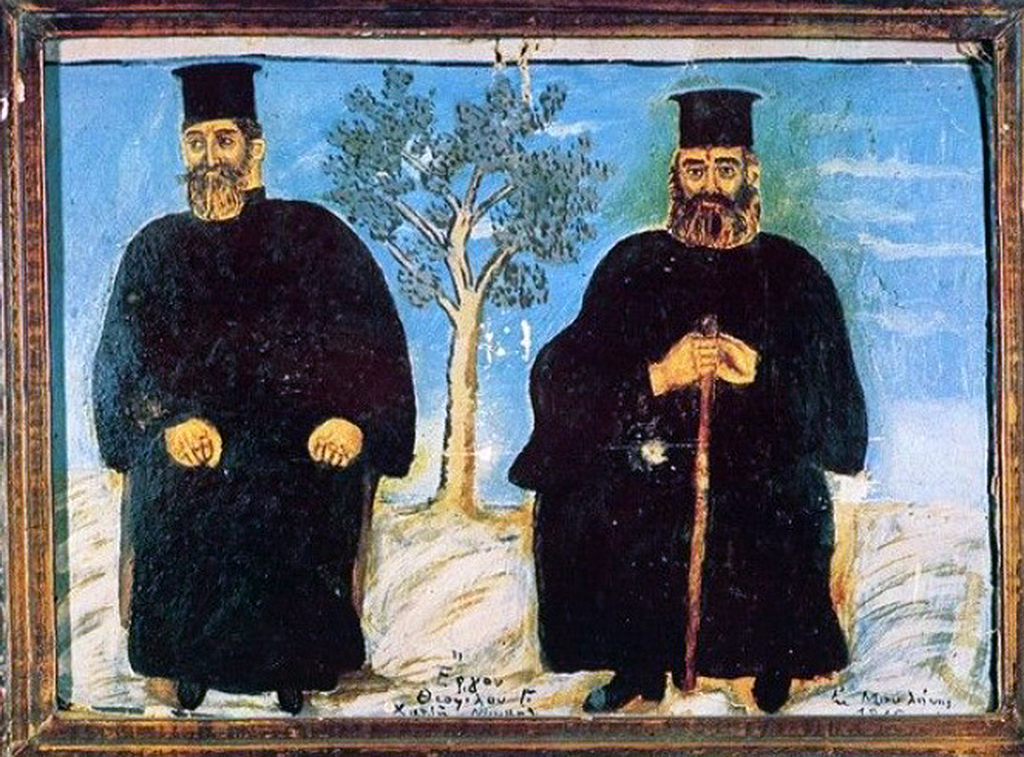
Photo: Theophilos Chatzimichail, “Two Seated Priests,” 1915