This presentation was delivered on April 29, 2025, during the Round Table “Contemporary Ukrainian Orthodoxy: Debunking Myths for the Sake of Reconciliation and Social Consolidation in Ukraine,” organized by the “Sofiyske Brotherhood” with the support of the Renovabis Foundation. The Sofiyske Brotherhood may not necessarily share the views of the speakers; likewise, individual opinions expressed within the project may not reflect the consolidated position of the Brotherhood.
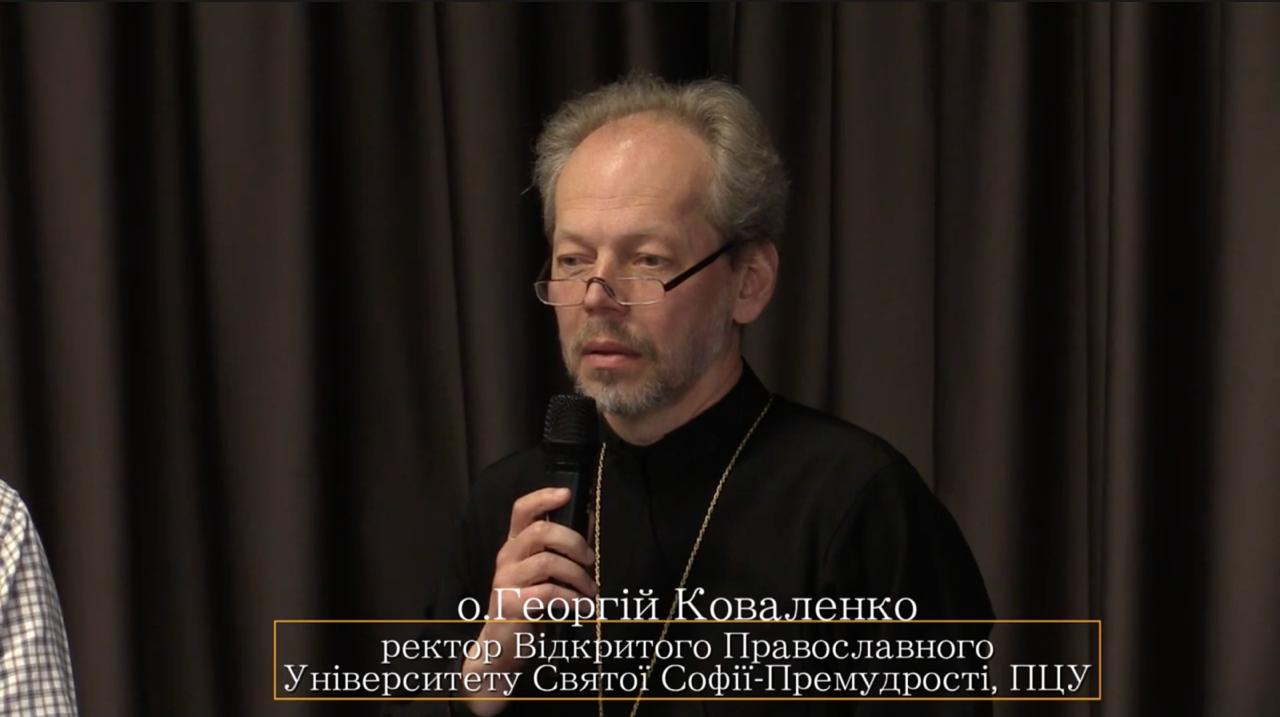
Fr. Heorhii Kovalenko, Rector of the Open Orthodox University, Priest of the Orthodox Church of Ukraine
A good question – what should theology be like? And should there even be theology? That’s a different question. Another question: is theology actually a form of thinking? At least, contemporary theology. At least, the kind that exclusivist or fundamentalist models rely on. And yet another question: does theology in Ukraine exist as a living tradition, and which tradition does it stem from? There are more questions than answers. So I will probably begin with my own story.
The idea of “Open Orthodoxy” emerged as a response to the narrowing of theological context, when it became clear that something had to be done about the tendencies we were seeing emerge since the early 2000s. Within a circle of people who had come to the Church in the 1980s–1990s and remained active into the 2020s – those involved in theology, education, public outreach, media, publishing – the idea emerged as a direct response to the challenge.
They asked: what do we do with these tendencies? And who are we? That’s when the idea of Open Orthodoxy was born.
Interestingly, once this idea was articulated publicly and the Open Orthodox University began its work, I was able to invite and gather virtually anyone at our events: Jews, Muslims, Protestants, Greek Catholics, Roman Catholics all came. But no one came from the UOC (Moscow Patriarchate), to which I then still belonged.
There was, however, a paradoxical moment. When the story of the Tomos began, we organized a roundtable in the summer, where we used the term “Orthodox Church of Ukraine” for the first time in the event’s title. We thought the term was neutral – detached from any of the jurisdictions that then existed in Ukraine. And to that roundtable, clergy and believers from the UOC MP came – in the majority. The answer to the question posed above was actually included in the Declaration of the Open Orthodoxy Network from August 2018:
“We propose not a war of jurisdictions, but peaceful coexistence, cooperation, and concelebration.”
This message, I believe, remains as relevant today as ever. It could serve as a guidepost.
When the war began, in its earliest days, we organized the first prayers in Saint Sophia of Kyiv. I had the opportunity to speak through the media to the UOC MP. The message was: “Condemn the aggressor, and let us pray and struggle together. Come! All jurisdictional and organizational issues we will solve later.” Sadly, only one deacon responded – Fr. Mykola Lysenko – who came to pray with us and sang under the vaults of Holy Sophia: “O God, the Great and the Only, protect Ukraine for us…”
But where am I going with all of this?
To the point that the theological concept of exclusivism is the greatest obstacle on the path to unity in Ukrainian Orthodoxy.
It is impossible to achieve unity with people who believe they are the only Church. The only valid Church, the only grace-filled Church, the only canonical Church.
No dialogue is possible from a position of exclusivism. It is an insurmountable problem.
But then, which direction should we move?
Last year I read a brilliant new book by French Orthodox theologian Antoine Arjakovsky, A Sketch of Ecumenical Metaphysics. In short, his proposal is to look broader than just interjurisdictional, interconfessional, or interreligious dialogues. Let’s look at the word “oikoumene” – and thus “ecumenism” – in its original meaning. It refers to the whole civilized world, or even the entire universe.
Perhaps, then, when we speak of the Universal Church, we don’t just mean the Church of the civilized world, but also our relationship with all people— – is, with humanity as a whole. Perhaps we even mean the universe as a whole: care and prayer for all of God’s creation.
This is about the real challenges of our time, which genuinely demand our Christian vision – and a liturgy lived out on a truly universal, global, cosmic scale.