The material was created within the mini-project “Thinking Out Loud” for the joint project of the Sophienbruderschaft and the German foundation Renovabis, “Modern Ukrainian Orthodoxy: Debunking Myths for the Sake of Reconciliation among the Orthodox in Ukraine and the Consolidation of Ukrainian Society.” The Sophienbruderschaft may not share the positions of the authors; likewise, individual opinions expressed by representatives of the Brotherhood within the framework of the project may not represent the consolidated position of the Sophienbruderschaft.
Tetiana Derkach, religious publicist
The public podcast held by Archbishop Sylvester Stoichev and Fr. Roman Makar in Vinnytsia on August 15 undoubtedly became an information bomb not only of the month, but of this year as well. And the key idea that I personally would single out in this two-hour discussion was the reflection that “we are responsible for those whom we have taught.” Taught that autocephaly is an existential evil that is not justified even by martyrdom. That Ukrainian autocephalists are “costumed laypeople,” spawn of hell, enemies of the true Church. That only in the Russian Church is there salvation and grace-filled sacraments.
In Soviet times there appeared such a meme: “When they clip nails in Moscow, they chop off fingers in Kyiv.” Ukrainian party-state bodies, in their desire to please the center, reached the point of absurdity: they banned what was not banned in Moscow, they saw “anti-Sovietism” where no one else saw it, and so on. And the UOC in this respect is a typical church of the Soviet people. Today such adequate bishops as Bishop Sylvester are trying to prove that autocephaly IN ITSELF is not a schism and not satanic attempts to tear the tunic of Christ. Or bishops like Bishop Klyment Vecheria put on a surprised face when they are reminded of the “prophecies” of Venerable Lavrentii of Chernihiv about the “inseparability of the triune Rus’.” It turns out there is no evidence at all that he really said this, and one can attribute anything one likes to an elder who died half a century ago.
But the fact remains: the UOC priests who now cannot cope with their own radicalized flock did only what the hierarchy ordered them to do. After the emergence of the UOC–Kyiv Patriarchate, THE ENTIRE UOC as one, STARTING FROM THE VERY TOP, rushed to create this anti-autocephalous mythological “ecclesiology” of its own, seasoned with frightening “prophecies” and “testaments” of various “elders”—with one single goal: to nullify the UOC–KP. No one invested as much into the “dubious canonical status” of the hierarchy and clergy of the OCU as the UOC itself. And no one invested with such zeal into the total isolation of competitors as the UOC. This isolation led to very destructive distortions of ecclesiological consciousness, which have not been overcome in the OCU to this day (whatever they may say about their exclusive tomos-based canonical status, the tomos has for now restored the external condition of the OCU, but not the internal one). Why was all this done? So that later, when more than one generation of believers had grown up on this destructive mythology, to stop commemorating the patriarch of the ROC (and even then optionally) and to call one’s hybrid condition “factual autocephaly,” which Moscow nevertheless considers apostasy, and Onufrii de facto a schismatic? And how are ordinary UOC priests now to begin turning the stubborn consciousness of their flock in the opposite direction—without acknowledging that what was hammered into them earlier was a mistake and a deliberate deception?
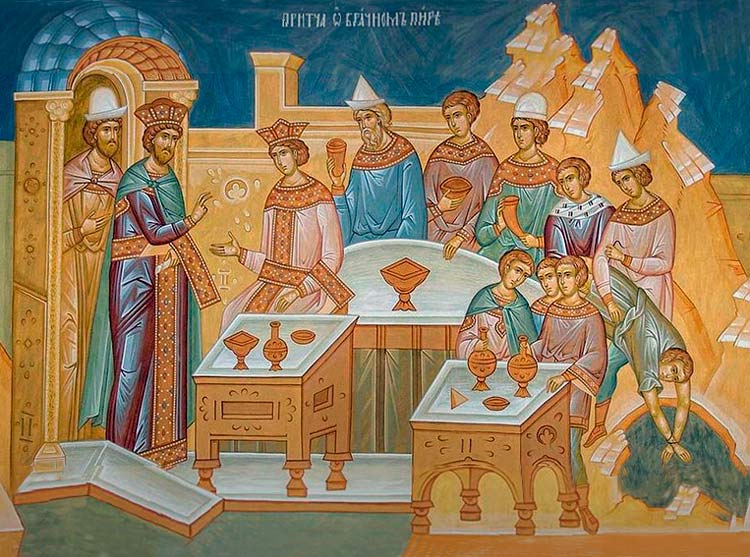
Here the parable of the wedding banquet comes to mind (Matthew 22:1–14), when the king first invited the “proper guests” to the wedding of his son, but they refused under various pretexts. Then the king grew angry and “said to his servants: The banquet is ready, but those who were invited were not worthy. Go therefore to the crossroads, and as many as you find, invite to the wedding. So those servants went out on the roads and gathered all whom they found, both bad and good.” And so all these people gathered at the crossroads came to the wedding—as they were—and received wedding garments from the king. The cherry on top: in the very end one person still slipped in without a wedding garment. And in fact the UOC is precisely that odd fellow without a wedding garment at someone else’s wedding, who is already bound hand and foot and is waiting in horror to be deported into outer darkness.
We return to the beginning of this post—to the question of responsibility for one’s spiritual and educational activity, which ended in complete collapse. They wanted to block the autocephalists—and in the end they blocked themselves. So how does the UOC now see a way out of this dead end? In the classic version, the way out is usually found in the same place as the way in. That is, precisely in acknowledging one’s mistakes. After all, this is exactly what the UOC today demands from the OCU—to admit its mistakes and renounce the tomos, returning to a non-canonical condition. To leave the wedding banquet, take off the wedding garments, and join those who have their hands and feet bound.
But no: the UOC is not ready for such radical self-reflection. All of its current rhetoric boils down to the message that for all 35 years since receiving the letter from Patriarch Alexy, the UOC leadership made correct decisions, including the decision of an unhealthy loyalty to the Moscow patriarch. Now, however, in the eyes of many believers there is shock and a mute question: what did we do that, despite our dog-like devotion to him, the patriarch blesses rockets to fall on our heads? And what question do the believers still not have? The question toward their own leadership: why did you (and we after you) for 35 years so zealously burn bridges not only with “schismatics,” but also with basic Orthodox ecclesiology, only to end up with kyriachal rockets over our heads and to declare that we have “factual autocephaly”? After all, “factual autocephaly, like the ROC in the 15th century” is the same incurable mythology as “autocephaly tears the tunic of Christ.”
That is, one cannot simply now take up and start speaking about the normality and correctness of the “factual autocephaly” of one’s Church, half of which continues to commemorate Patriarch Kirill as master and father—and at the same time continues to demean the episcopal and priestly dignity of those who went this path honestly and openly.
Autocephaly (whether factual or juridical) does not mean that no one from outside can impose administrative decisions on you; it means that no one from outside can nullify your canonical legitimacy. The wedding garment for the “costumed laypeople” from the UOC–KP and the UAOC was given by the Ecumenical Patriarch, and none of them will leave the wedding banquet anymore. Despite numerous manipulations, the truth is that the same king still has wedding garments left for this same banquet. And the guests who are already present should have the humility that their number may increase—perhaps even to the point of setting tables in a neighboring hall. But for this, one simply needs to call things BY THEIR NAMES. To acknowledge one’s fatal affiliation with the ROC and to show the will to resolve the Ukrainian church crisis. Where there is will, a path will be found. As long as the UOC continues, under a new signboard, to build its own exclusivist project, pretending that “this is how it was planned from the very beginning,” the situation will only degrade.
Once, fifteen hundred years ago, Orthodox theologians fought over a single letter in a word, because that letter radically changed the meaning of a dogma. By one letter in the confession of faith it was decided whether you were a heretic or Orthodox. Today the Orthodox need such clarity of formulations, positions, assessments of the past, and visions of the future more than ever. This is, in fact, what is called responsibility.