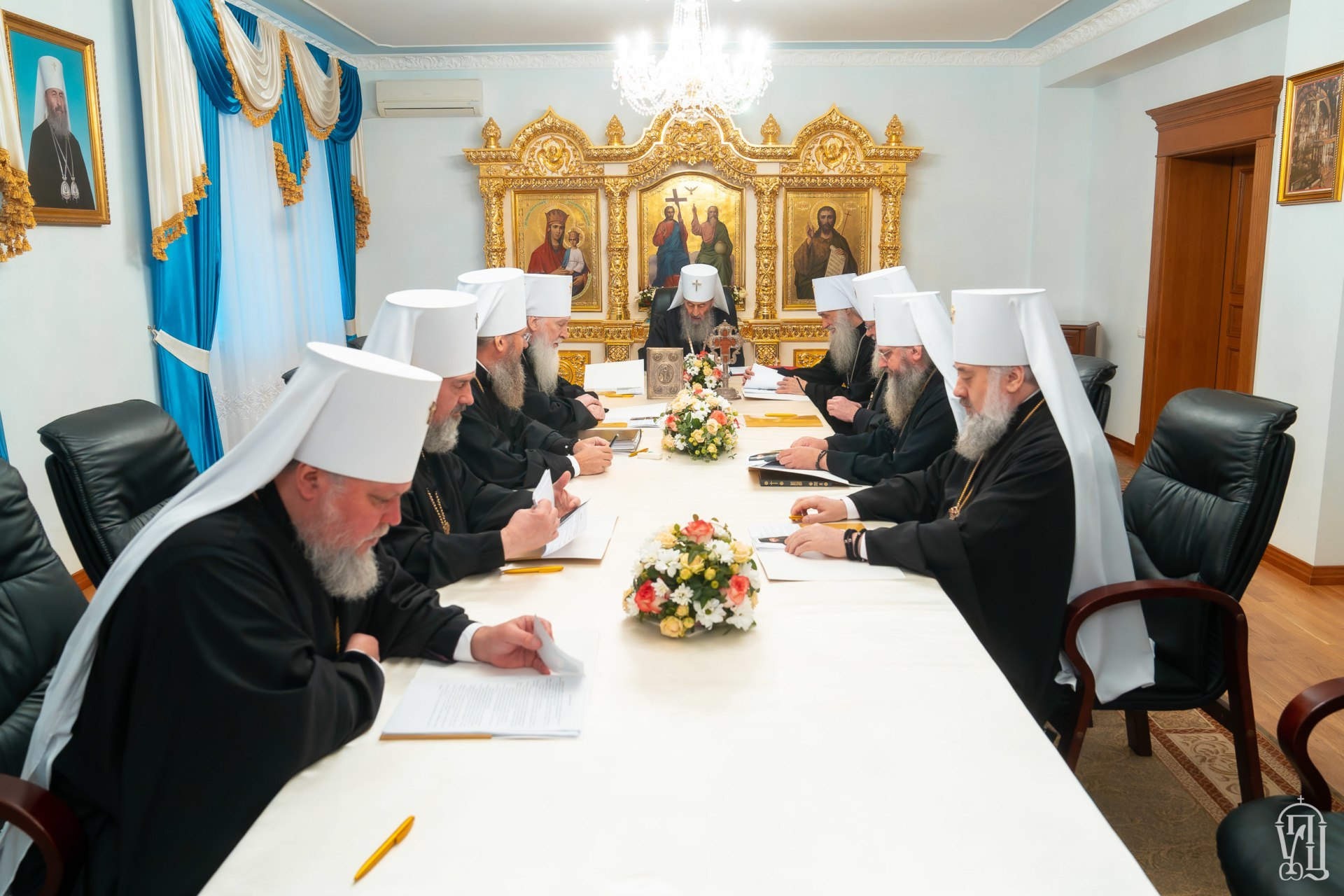
Yesterday’s meeting of the Holy Synod of the Ukrainian Orthodox Church turned out to be historic. For the first time in UOC history, the decisions of this governing body were not published anywhere, although they have always been made public immediately after the meeting, either on the official website (or in the 1990s, in the journal “Orthodox Herald” or “Church Newspaper”). This time, however, the announcement on the website only stated that “during the work of the Holy Synod, the hierarchs considered issues related to the church life of the Ukrainian Orthodox Church.”
In recent years, the UOC Synod has rarely produced meaningful or truly beneficial decisions for the Church. Typically, the Synod would elect new bishop candidates, approve decisions to canonize new venerated icons, confirm prayer texts or liturgical services, and less frequently, bless the opening of new monasteries. At the conclusion of the meetings, they usually issued one or two statements expressing “concern” or “strong protest” over various issues negatively affecting the Church.
Unfortunately, in recent years, the Synod’s decisions have not included any documents that would logically continue the process of autonomy for the Church, initiated at the Council in Feofaniya in 2022. These should have included, for example, statements about the complete withdrawal of UOC bishops from all governing bodies of the Russian Orthodox Church (including the Local and Bishop’s Councils and the Synod of the ROC) and a demand to stop listing UOC hierarchs in the ROC’s official calendar as part of their episcopate. The Synod never gave any moral assessment of the widespread collaborationism among its clergy and remained silent on the sudden presence of certain hierarchs on the territory of the aggressor state. Moreover, many find it shocking that there has been no reaction whatsoever from this governing body regarding the criminal investigations, imprisonments, or even loss of Ukrainian citizenship by some bishops.
Naturally, there were expectations from yesterday’s Synod, beyond just fundamental steps (though hope for this is steadily fading) on the Church’s future, that it would address the issue of Metropolitan Theodosiy of Cherkasy and Kaniv, whose actions led to the loss of the cathedral in Cherkasy. It would have been fitting for the Synod to strictly prohibit the commemoration of the Moscow Patriarch during services—even through appropriate sanctions.
So, why has the UOC’s official website remained silent about yesterday’s events? Most likely, it is because the hierarchs failed to make any sensible, urgent decisions. And perhaps writing about new bishops or prayers would be embarrassing. Thus, the UOC leadership likely decided it was better to publish nothing at all. After all, both the laity and secular readers would be disappointed—possibly more than before. Better to be criticized for silence than for foolish decisions.
However, there was also some undoubtedly good news yesterday. Insider sources revealed that during a recent meeting between Ecumenical Patriarch Bartholomew, Synod members, and Ukraine’s Foreign Minister Andrii Sybiha, the Patriarch requested the diplomat’s assistance in facilitating a visit of the leaders of both Ukrainian Orthodox Churches and their delegations to the Phanar. This suggests that communication between Constantinople and the UOC leadership indeed exists and, hopefully, will soon bear some positive fruit.
So, we await good news from the Bosphorus shores.