
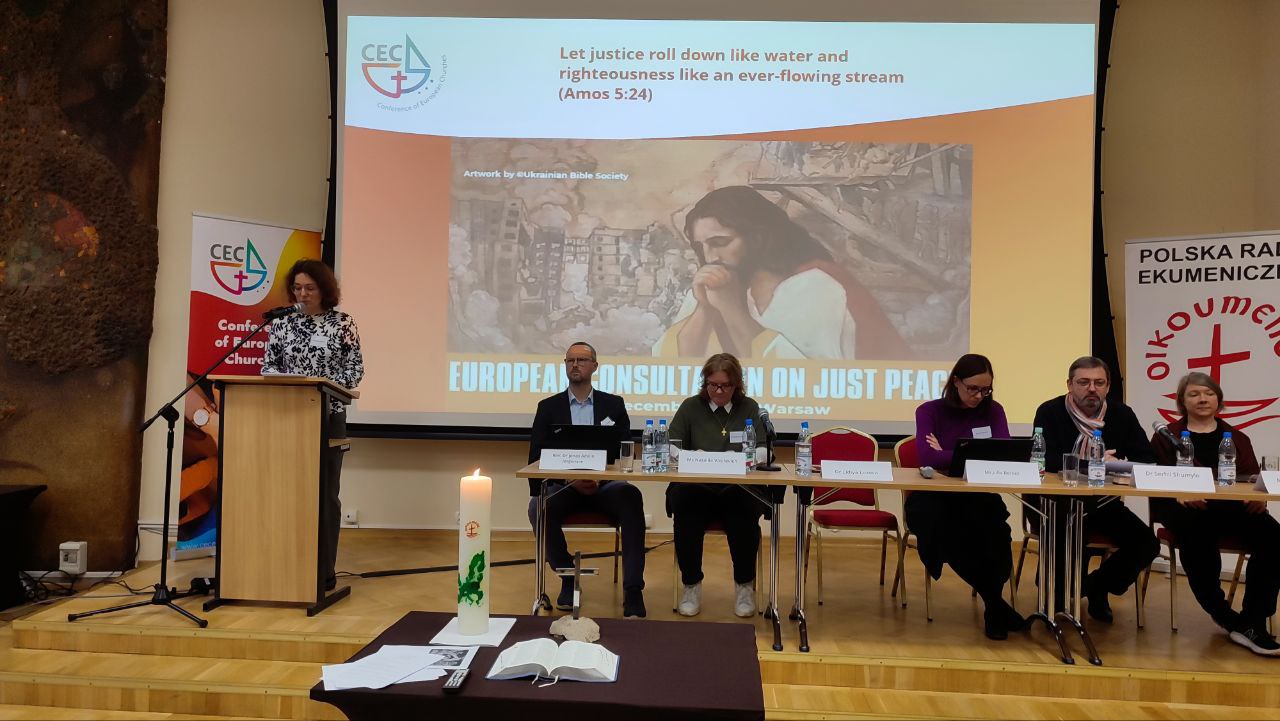
Human Rights and Just Peace for Ukraine: A Church-Focused Perspective
Dr. Lidiya Lozova
My presentation deals with the topic of human rights and just peace not from a legal but from an ecclesial perspective. What is it in the church that encourages or hinders the perception and appreciation of human rights and the establishment and maintenance of a just peace ensured by the observance of these rights? And how does the stance of the Church on this issue affect the observance of human rights and just peace in society outside the Church? Not surprisingly, the background for my presentation is Russia’s war against Ukraine.
The consequence of ecclesial exclusivism and failure to recognize the value of human freedom is violence and a violation of human rights
Where the Church is exclusivist, for example on the issue of “canonicity,” and anti-dialogical – and where this is encouraged and supported by the state – we observe horrific violations of human rights.
First, this concerns the exclusivist stand of the Russian Orthodox Church in the Russian Federation, where “non-traditional” denominations are being banned and persecuted.
Second, this is evident in the Russian-occupied territories of Ukraine, where the communities of the autocephalous Orthodox Church of Ukraine are being destroyed both physically (at the level of individuals tortured and killed for their church identity) and structurally. But the Ukrainian Orthodox Church, which is still canonically connected with ROC, undergoes human rights violations, too, as on the occupied territories it is being forcibly transformed into the eparchies of the ROC.
Finally, exclusivism is the cause of the inter-Orthodox conflict within Ukraine itself. The primary reason for this conflict is the aggressive denial by the leadership of both ROC and UOC of the very existence and subjectivity of the OCU and their breaking of communion with the Ecumenical Patriarchate. The closed, fundamentalist, anti-ecumenical, anti-dialogical position of the current leadership of the UOC towards the OCU, EP and other churches in Ukraine, Ukrainian civil society and the state – as well as the obvious canonical connection of the UOC with the church of Russia – inevitably provokes various forms of conflict and violence in Ukrainian society and excludes the possibility of a just peace.
On the other hand, exclusivism is also manifested in the general unwillingness among OCU members to dialogue with any representatives of the UOC unless they want to directly join the OCU, including those UOC members who are patriotic and dialogically inclined towards the Ecumenical Patriarchate and the OCU. This is because the UOC members are by now usually indiscriminately perceived as a collective national traitor. The indifference of many members of the OCU to violations of rights of the UOC members is especially appalling during violent confrontations over church buildings – a reality that, although not dominant (!) in the Ukrainian context (in fact, except for the Cherkassy accident, recently things have been very quiet), is an alarming symptom of the state of the Church. Where does this indifference come from? On the one hand, this is a consequence of the extremely traumatized state of Ukrainian society (including in the church), primarily because of Russia’s war against Ukraine. On the other hand, all the “branches” of Orthodoxy in Ukraine are ‘infected’ with the imperial, Soviet legacy of the Moscow Patriarchate, whose main feature has been dominant exclusivism supported by the state.
It is very important to note the following point here: where church exclusivism leads to violations of human rights, we observe the rejection of the idea of human rights as such in the church, except when it is instrumentalized to protect the rights of this church’s own members. In both the ROC and the UOC, the idea of human rights was and still is considered to be virtually incompatible with Christianity as it historically emerged from a secular, anti-church context; despite this, nowadays the UOC is intensively defending its rights against violations by the state.
But let us consider the root of this problem. Deeper than the rejection of human rights in the church is the rejection of the positive value of human freedom. The Social Concept document of the ROC (2000) states that a social doctrine cannot be based on the needs of human beings since man is prone to sin; therefore, the basis of a social teaching should be Christian values, which the church should ‘instill’ in the secular society with the help of the state. Values in this worldview are more important, more reliable than a human person – a situation, which, as we can see, ends in a terrible war against people for the sake of values, one of which is the sacralised “Fatherland”.
Respect for human rights and a just peace are possible through the recognition in the church of the positive value of human freedom, the relational character of human existence, and a commitment to dialogue.
On the contrary, respect for human rights and the desire for a just peace in the church become possible when there is an appreciation of human relatedness, “being as communion”, openness and trust based on the positive value of human freedom given by God, including religious freedom. Only with such an attitude is it possible for a church to recognize the positive value of democracy. A good example of this attitude is the social concept of the Ecumenical Patriarchate (via the document “For the Life of the World: Toward the Social Ethos of the Orthodox Church”, 2020), which, unlike the concept of the Russian Orthodox Church, is not built around values, but first and foremost, around the human person in communion with God and other people, despite human sinfulness. It is not surprising that due to such fundamental Christian humanism, a whole section of this document is devoted to human rights, which are considered not as perfect, but the best available means of affirming human dignity and freedom today.
Having this in mind, what is the situation of Orthodoxy in Ukraine?
Unlike the UOC, the OCU positions itself as an open church. At the highest level, it declares its support for democracy, participates in all ecumenical events, appreciates the fundamental plurality of the Ukrainian religious landscape, proclaims openness to the human person and society, and prays for a just peace (i.e., a good for all and not just for the “Orthodox homeland,” as in case of ROC). Moreover, unlike the UOC, it understands its own “canonicity” in administrative rather than spiritual terms, meaning that the sacraments performed in the UOC are not proclaimed “graceless” in the OCU. As a believer of the OCU, I support this attitude and rejoice in it. However, I must also admit that there is still a difference between declarations and reality, and the indiscriminate exclusivism of many in the OCU towards all members of the UOC, as well as the frequently present desire for exclusive influence on the state, often contradict what is proclaimed on the official level.
The Sophia Brotherhood and a just peace for Ukraine
Recently, in the course of less than a year, an important phenomenon of Orthodox life in Ukraine has become the Sophia Brotherhood – a non-governmental organization that unites clergy and laity of the UOC, OCU, and EP. On the one hand, they seek to overcome the split within Ukrainian Orthodoxy by recognizing the very existence of one another and the inevitability and necessity of relationality and relationships. On the other hand, more broadly, they dream of the reality of “open” rather than closed Orthodoxy (“open Orthodoxy” is a term suggested by Fr. George Kovalenko), in which the presence of Christ could clearly manifest itself against all odds. A grassroots initiative that began as meetings of priests from both sides despite the existing jurisdictional walls in 2023, today the Sophia Brotherhood is the beginning of an Orthodox movement which seeks to create a space for dialogue at the interpersonal level, the level of parishes, and in future, the level bishops. An integral part of this movement – which is currently developing specific informational, educational, and missionary projects – is the appreciation of the human person, human dignity, human freedom, human rights, and humaneness based not on corporate or individual interests, but the pursuit of the good for all, from which, and only from which, a just peace in Ukraine and the world may begin.