
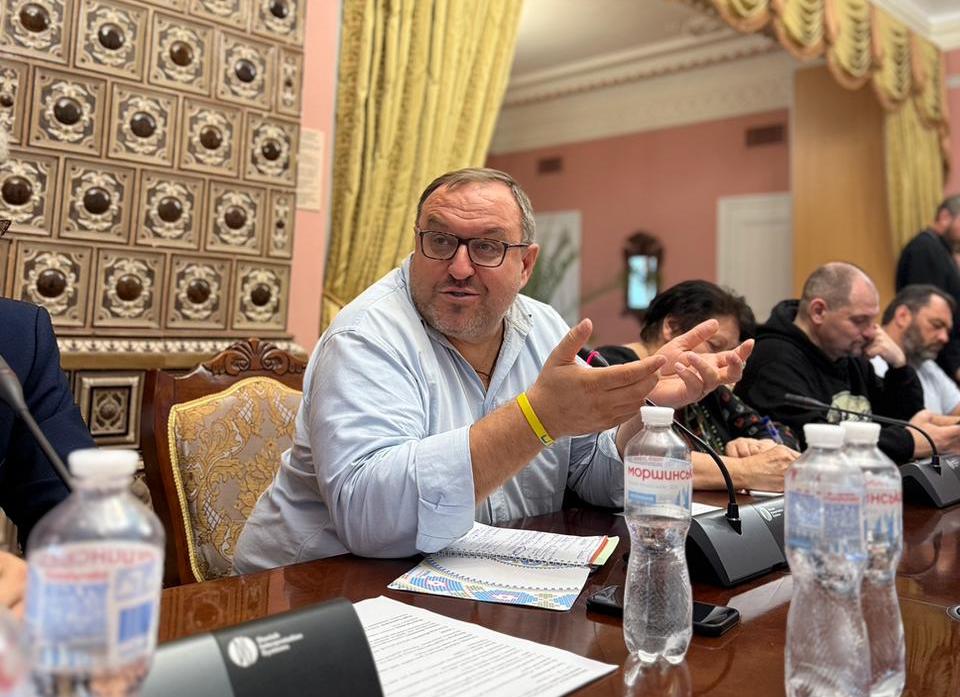
The presentation was delivered on September 17, 2025, at the Round Table “From Dispelling Myths to the Search for the Common Good: Contemporary Dialogical Initiatives in Ukrainian Orthodoxy and the Prospects of Post-War Renewal,” organized by the Sophienbruderschaft with the support of The Centre for Humanitarian Dialogue (HD) and held within the framework of the joint project of the Sophienbruderschaft and the German foundation Renovabis, “Modern Ukrainian Orthodoxy: Debunking Myths for the Sake of Reconciliation among the Orthodox in Ukraine and the Consolidation of Ukrainian Society.”
The Sophienbruderschaft may not share the positions of the speakers; likewise, individual opinions expressed by representatives of the Brotherhood within the framework of the project may not represent the consolidated position of the Sophienbruderschaft.
Oleksandr Filonenko, public philosopher, theologian
I have become the author of the position that dispelling myths is not something particularly useful or interesting. However, it needs to be clarified that we are talking about certain destructive myths. I think that one of the problems with destructive myths is that they are opposed to reality. There is also the problem of distinguishing myths from ideologies, for example. And when we start by asking which ideological positions are destroying us, and if we begin to dismantle myths, we will never finish. This is not a very promising direction.
There is another very destructive narrative—the dream of a post-war condition. It will not exist in our lives. And then we must reformulate what we mean when we speak about the perspective of a post-war condition. When is this post-war condition? The post-war condition is not a historical concept, but rather a metaphysical one. What is it? Well, of course, it is peace. But what kind of peace? The peace of Christ.
If we speak about religious communities, we somehow feel embarrassed that we are Christian communities. We speak in a language that could equally belong to a political party, a cultural movement, Ukraine as a whole, or a religious community. It seems to me that we need to define the specificity of Christian communities. And the first point is that Christianity is a tradition of peace. For me, it is very important that there are positions of peacebuilding and peacemaking. When we create this peace, it is a Christian position, because peace, first and foremost, is Christ. And when we become participants in this peace, we open within ourselves the capacity to be peacemakers.
And here lies the problem: in a state of war, we must be peacemakers. What does this mean?
A friend of mine from Zaporizhzhia initiated the creation of an institute of peace in Zaporizhzhia, right on the frontline. And he explains this very beautifully. He says that before the war we were all in a kind of illusion, believing that war is a catastrophe and that the normal condition of human beings is peace. Today we understand that this was a mistake. We are always in a state of war; peace is a miracle. And therefore, a great deal of work is needed for peace to exist at least somewhere. And who will do this, if not Christians?
That is, the tradition of creating peace in a state of war and near the frontline is a Protestant tradition; it was initiated by the Mennonites in Zaporizhzhia, in the Azov Sea region of Zaporizhzhia Oblast. And today this is extremely relevant. And I cannot imagine who else, besides Christians, would speak about this today in terms of practical steps.
What does peacemaking mean? Our problem is that in academic literature there is an established term—“peacebuilding.” We are builders of peace; we build it; we participate in it. But for Christians, first one must find this peace, and then practice it—that is, to be witnesses of this peace that we know as Christians, to embody these practices. And therefore, for me, the problem is that we can speak not about post-war perspectives, but about the fact that there are two modes of human existence: a person in a state of war and a person in a state of peace. Peace is always eschatological. And we need a theology of peace in a time of war. For me, this point is extremely important.
I do not particularly like the concept of “cultural wars,” because culture is about what already exists—about heritage and so on. For me, this is a different concept—semantic wars, because these are indeed wars over meanings. And if we speak about a semantic war, then we are not doing very well with it—neither at the level of the state, nor society, nor anywhere else.
Semantic wars are a critical issue. And we need to return to the language developed by sociologists when they spoke about anomie as the loss of meaning in society. It is very interesting that post-Soviet societies share a certain similar anomie, yet the solutions are fantastically different. Russia has taken an authoritarian path. But we cannot understand what the Ukrainian path is. And this is the biggest problem: we are doing nothing about this anomie.
For me, the Sophienbruderschaft can be a place where the question is raised: what meanings can we speak about today, and to what extent is this activation of meaning a Christian task?
In this context, a semantic war is not so much an ideological war as it is a struggle for the birth of meanings, not for indicators or scores in this war. When we speak about anomie, the basic problem for me is that we have all found ourselves in a society defined as “not Russia.” Many people describe their behavior as “not Russia”: “We are not Russia, we are not Russia.” Indeed, we are not Russia—but who are we? What is the “new Ukraine,” and what is it like?
And these discussions about the common good—for me, the common good is precisely the discussion about the new Ukraine that is being born. What is the function of Christians in this story?
We all speak about the triangle “state–society–religious communities.” And we set a very high national, state-centered bar. But for me, over these three to four years of war, it is important to speak about another level—one that is very close to the nature of brotherhood. When we speak about the state, the national level, we begin to speak about hierarchs, about political and geopolitical decisions, and we lose the level of cities and territorial communities. Throughout the entire war, we have been traveling across Ukraine and trying to initiate such an approach—possible transformations of cities, villages, and territorial communities.
I am from Kharkiv. Very important stories are also being created in Zaporizhzhia, in Dnipro, in Chernihiv. These are cities that definitely will not be the same as they were before 2022. I think that no cities will be, but in many cities it is very clear what perspective awaits them. There will be other meanings in these cities. And for those who can work with meanings in cities, encountering Christian communities is extremely important, because in them these meanings are alive. If these meanings are not alive, there are no communities at all. That is, religious communities in cities are nourished by the meanings of those cities.
And there are very beautiful stories. For example, there is currently a fantastic exhibition, “The Chernihiv Savior in Saint Sophia of Kyiv.” This is a very important cultural step in semantic wars. In Chernihiv, around the Transfiguration Cathedral, there is Soviet asphalt. And it is said that beneath this asphalt lies the largest pantheon of Old Rus princes in Ukraine. In Kyiv, we have lost these pantheons. Ukraine is almost the only country in Europe that does not have a pantheon. And this is a colossal problem for the country: where is our pantheon? It does not exist.
And it is said that in Chernihiv there is a place where eight princes and the first archbishop lie beneath Soviet asphalt. And there is not a single plaque stating, “Here lies Prince Mstyslav.” This is a fantastically paradoxical story. And suddenly, during the war, Chernihiv acquired a sister city—Reims. The city administration does not know the importance of this story; for them it means nothing: Reims is just a French city that sends humanitarian aid, volunteers, and so on. But Reims is, first and foremost, a pantheon of kings, Anna of Kyiv, and so forth.
And it turned out that even a small project of real relationships between Reims and the cathedral in Chernihiv means more than all the programs launched during the war period between the two cities. The same happens when we work with the meanings of cities: we gain new opportunities for their development. That is, religious communities are living communities that live thanks to these meanings. These meanings are necessary when we speak about the transformation of cities.
Another issue that is very important to me: we talk a lot about values. We need to say that values are a very limited tool of sociological language. What are values about? Values are a language for describing identity. When there is the question “Who are we?”, we answer: we are people with such-and-such values. And this is normal. When we speak about identity, we use the language of values.
But when we speak about the transformation of a city, a country, a state—the language of values does not work. It does not allow us to describe transformation. There is a Christian language that works. And Christians do not use this language. And for me this is a paradox, because this is our heritage, our life, and yet we do not use it. We have fantastically poorly adopted the language of values and forgotten that Christianity is the language of virtues. The entire Christian tradition is the language of virtues. And virtues are about transformation. This is what Ukraine needs today. And we do not speak about it.
Christian theologians and Christian philosophers must somehow begin to address this, because we all speak about the conservation of identity.
In this context, it is very important how these virtues are unfolded. For me, the theme of national shrines is important. First of all: Ukraine does not have a list of national shrines. Poland has around one hundred; Ukraine has none. For the state, national shrines do not exist. And we worked for two years in the Kyiv-Pechersk Lavra as a national shrine. And this is our local horror—when we cannot understand that the Lavra is a national shrine, not merely a monastery or a preserve. It is something more for Ukrainians.
Therefore, as Christians, we can understand what a national, non-confessional shrine is—something extremely important for society, where the search for the common good is formed. The Lavra has always been such a place in the history of Ukraine, a place that shaped visionary programs.
And the second very important story I call “new geography.” That is, geography is the Church’s testimony about what makes us alive. And who are our saints? We do not celebrate canonizations; we do not have this tradition, but saints appear somehow, and no one knows how. The most important event was, of course, the canonization of Kyrylo Zaborovskyi and Yelysei Pletenetskyi in the Lavra. But society is not really in resonance with these stories. Who is responsible for this? Christians.
This is a story of memorializing our memory. But meanings are not born through memory. They are born in some other way. And we need to talk about this.
And finally. We never speak about the division of communities, about splits within communities. We speak about division between religious communities, about brotherhood. But it is very important to imagine that there are divisions between two types of people. There is a very distinct type of person who defends our values. And there is a person as a witness of Christ. These are different people, even visually. The defenders are very stern people who walk around and say that someone is destroying your values. And the witnesses of Christ are joyful people who are in shock that they have encountered Christ and do not know what to do with it now.
These are two types of people in every Christian community. And for me this is one of the problems, because this is a question about a living community that gives birth to meanings.
We should not be ashamed to call ourselves Christians. Because when we speak about the common good and go to a forum, to a veche where we say something—on whose behalf do we speak? On behalf of Christ. And when we debated this in the Sophienbruderschaft, there were many priests who said: “This is immodest. What is this? We are just the Sophienbruderschaft! We have very simple interests; we want to protect our communities.” But this is a horizon about nothing—certainly not about the future.
If we are not witnesses of Christ, then what is all this for? Therefore, when we speak about the common good, it is very important what kind of relationship Christ has to this common good. Our hypothesis as a brotherhood is that He deeply loves the embodiment of His meanings. And this is our stake.
Therefore, all the classic, old theological themes—Christ in culture, Christ in community, Christ in the state—must be unfolded. A fantastic book by Grigorios Papathomas, “Canonical Amorphemes,” has been published, but we have not yet debated it. It is the only interesting theological book translated over the past three years. And all these questions are there.