
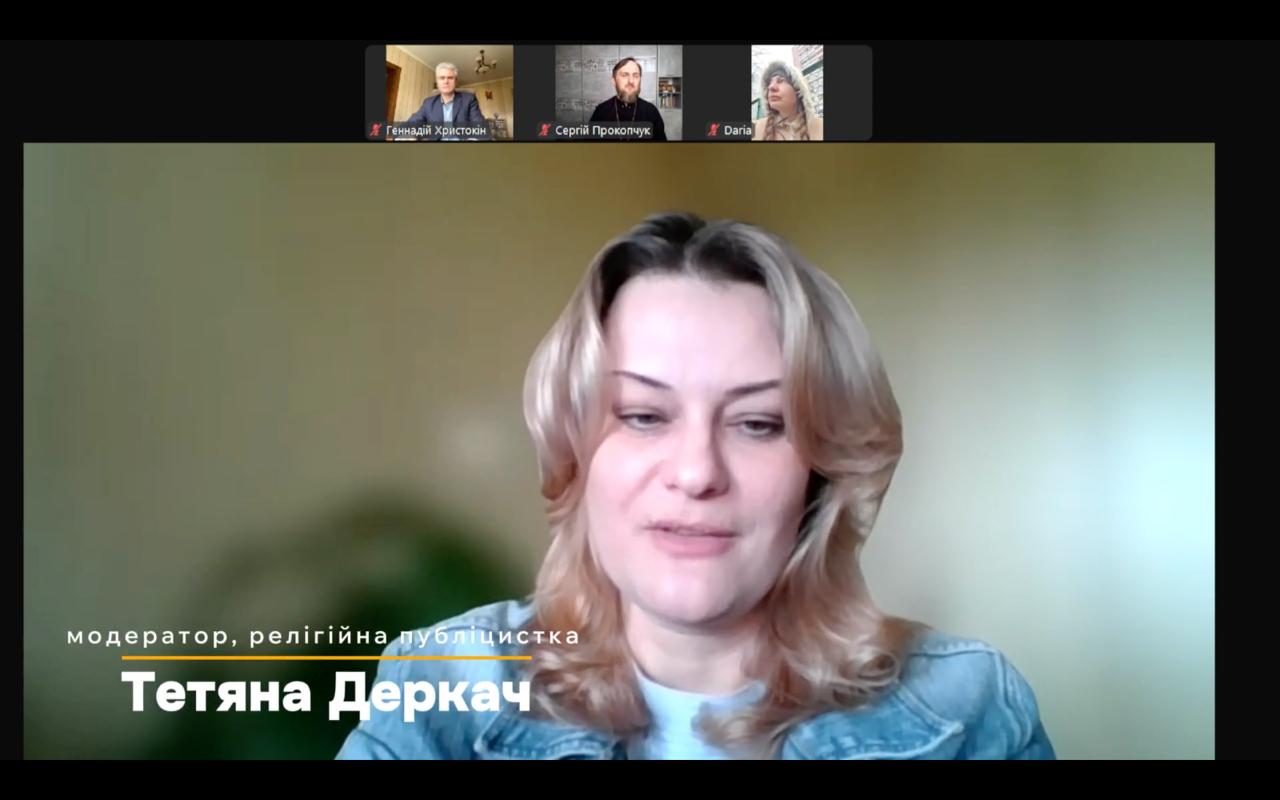
The presentation was delivered on April 9, 2025, during the webinar “Myths and Prejudices as Obstacles to the Unity of Ukrainian Orthodoxy”, held within the joint project of the Sofia Brotherhood and the German foundation Renovabis: “Contemporary Ukrainian Orthodoxy: Debunking Myths for the Sake of Reconciliation and Social Consolidation.” The Sofia Brotherhood may not necessarily share the views expressed by speakers, and some opinions voiced by members of the Brotherhood in the framework of the project may not reflect the organization’s official position.
Tetiana Derkach, religious publicist
The Russian–Ukrainian war, especially since the full-scale invasion in 2022, has forced us to confront difficult questions: What kind of state have we been building, and what kind of state do we want to see after the war? Since this war is existential — for both sides — religion plays a crucial role as a motivating factor and a framework for making sense of what is happening. Ukraine is traditionally an Orthodox country, where its historic confession — Orthodoxy — has been caught in a tug-of-war between two powerful meaning-making centers. These are not only spiritual but also political meanings. Unfortunately, some of these meanings are built on mythical or manipulative foundations, which often lead to a loss of genuine Christianity, reducing faith to a kind of cargo cult.
Today, we are witnessing a unique situation: two religious centers of influence, two Orthodox Churches — and both are only partially recognized. One does not officially recognize the other as a Church; the other does so unofficially. This amounts to deliberate mutual delegitimization: canonical delegitimization by the UOC toward the OCU, and societal delegitimization by the OCU toward the UOC.
The UOC refuses to recognize the OCU canonically — relying on myths about church canons, canonical precedent, and the culture of canonical law enforcement. The OCU, in turn, uses non-theological arguments to delegitimize the UOC, often relying on generalizations that unfairly affect real communities and individuals. We must understand that the lack of internal legitimacy pushes the Churches to seek external validation, which in turn undermines their ecclesial subjectivity — for both.
It must be acknowledged that, although both Churches share the same creed, they embody different cultural codes and have formed distinct identities that intersect only at a narrow range of points. There are historical and objective reasons for this confrontation that cannot be easily resolved without addressing the root causes. There are also particular or personal grievances, disguised as canonical principles or national interests. These reasons for conflict are the subject of discussion in the “Myth-Busting Project”. Its goal is to identify, among all the arguments fueling mutual hostility, the systemic and situational myths — stereotypes, prejudices, cognitive distortions, dishonest extrapolations, and manipulative generalizations — that, through repetition, become embedded in religious identity.
When we examine UOC–OCU relations, we increasingly see distortions of core Christian values, resulting in Church communities slowly losing their ecclesial character and transforming into politicized entities. These entities claim exclusive rights to “de-Christianize” their opponents. Each Church views the other as a traitor — to faith and to country — and these concepts are sometimes cast as mutually exclusive. Believers experience cognitive dissonance. They face internal conflict between moral values and orientation points, and many are left struggling with how to prioritize their Christian ethical system.
Let me outline the issues that deserve attention within the framework of this myth-deconstruction project, which aims to dismantle the foundations of the Orthodox conflict in Ukraine.
What stands out most? The lack of self-criticism within the Churches and a fundamental inability to engage in dialogue. Each Church justifies its position as a defense of faith and justice. In an environment where each side believes it is unequivocally right — and insists on treating that as dogma — there is no felt need for dialogue. If the Churches could exist in parallel worlds, without intersecting, this would be the least traumatic form of coexistence. But instead, they constantly clash. This inability for self-reflection, self-restraint, and self-improvement leads only to mutual loss.
In pursuit of dominance, the Churches generate myths: about canonical status, parish transfers, their own size and homogeneity.
And there is a real danger that busting these myths in the name of external unity could destroy what internal unity remains — which is why Churches so often resist demystifying the foundations of their identities.
Another urgent issue is the instrumentalization of religion. In Russia, Patriarch Kirill has instrumentalized the Church for war against Ukraine. In Ukraine, we are witnessing the instrumentalization of “persecution” and “patriotism.” There is mythologization of a third party — the Ukrainian state — which is increasingly labeled as “godless authority” or “anti-Christian government.” Laws are called “anti-Church,” even if they only affect a narrow group of religious institutions. In these narratives, “Church” and “Christianity” are understood to refer exclusively to oneself, denying others the right to the same identity. This exclusive fallacy is destructive to the Church from within. The greatest danger is that hatred may be instrumentalized to preserve or expand religious or political power.
There is another factor influencing Church behavior: the sociopolitical context. All sociological surveys show that religion is an essential component of social resilience. But here we must ask: are the Churches hostages to public sentiment, agents of it, or opponents of it? In truth, it’s a feedback loop: the Churches fuel societal narratives, and society pressures the Churches. Once social media and mass media get involved, the process becomes nearly uncontrollable.
To break this cycle, we must collectively acknowledge one common starting point — even if not unifying, then at least solidarizing — and that is our shared life-space, our shared homeland. But the two jurisdictions do not agree on a common vision of statehood.
We cannot, on the same territory, build opposing sociopolitical projects. If one group wishes to build a “pro-Moscow” model, then by default, the other will be “anti-Moscow.”
In this context, we must understand that our shared homeland is not a “supreme” value, but rather a foundational one. If some in the UOC claim that their earthly homeland is not a sacred value, then certainly Russia — which seeks to monopolize the baptismal legacy of Kyiv — is not sacred either. What we need is the “de-Muscovization” of Orthodoxy. But for this to happen, Churches must understand that for some of their members, the destruction of Muscovite myths may be existentially shattering.
So each of us must answer a difficult question: Is my Church part of the problem for Ukraine, or part of the solution? What does each Church want — or is able — to contribute directly to: nation-building or nation-dismantling? Is the UOC ready to become part of a new Ukrainian national project? Is the OCU ready to allow the UOC into this shared national project?
We neither want nor know how to reflect on one another, nor take responsibility for the future. What kind of country are we building in the context of global political transformation? To move forward, we must acknowledge and formulate a shared understanding of the common good.
But what kind of dialogue can we speak of, if we still haven’t clarified the most basic issue — whether or not the UOC has condemned Russian aggression? No matter how many anti-war statements the UOC makes, they are not seen as sufficient, because trust in words has been lost.
If we can honestly identify what within our religious identity is a malignant myth, then we can begin to address methods for resolving Ukraine’s ecclesiastical crisis. Can this crisis be resolved solely through state institutional mechanisms? Is it possible to resolve it purely by canonical means, assuming such even exist? Can other Local Orthodox Churches be invited as moderators?
In my opinion, the key to Ukrainian church reconciliation lies not in Istanbul or Moscow, but in Kyiv. It is Kyiv and Kyiv, not Constantinople and Moscow, that must be reconciled — and many oppose such a reconciliation.
This creates a challenge for other Local Churches, which fear internal schism if they interfere in the Ukrainian conflict. But if there is goodwill from the Ukrainian Churches, everything can change.
We must also consider the external framework — not only Local Churches, but the fundamental approach to religious rights and freedoms. The passion often shown by Ukrainian Churches is perceived by many Europeans as “toxic masculinity”, which is unacceptable in the context of interchurch relations. For Germans, for example, it is inconceivable that members of one religious community could visit another and accuse them of being the wrong kind of believers or citizens.
Of course, Europeans are not at war, and it is difficult for them to place our religious conflict into a wartime context. But if we are moving toward the European Union, we must understand that mutual tolerance is part of the humanitarian landscape of modern Europe.
***
Now, let us imagine we’ve deconstructed the most malignant myths fueling confrontation in Ukrainian Orthodoxy.
What remains?
Do the OCU and UOC share any positive identity? Are they capable of presenting a constructive agenda, rather than a platform for mutual conflict? Are they willing to inspire one another — and the world — with their uniqueness?
Will virtues such as self-restraint, self-improvement, justice, and solidarity become common spiritual goals? Our task is not only to ask these questions hypothetically, but to propose a vision for peaceful coexistence and development of Ukrainian Orthodox Churches.
Let us return to the beginning: at the core of any unity lies not just shared interest or values, but also shared communication. And communication is the only effective way to overcome prejudice. This is exactly why communication is so often discouraged, forbidden, or denied blessings — by those for whom reconciliation is unprofitable or even harmful.
We must understand that the world has entered a period of high turbulence, and for Churches — as traditionally conservative institutions that prefer not to change — many risks are emerging.
We are witnessing the decline of rules and bureaucracy, and the rise of personal relationships as a tool for institutional survival.
That is why it is so important to speak of dialogical capacity, and the ability of Churches to engage in social interaction — something that, unfortunately, remains a serious challenge.