This presentation was delivered on April 29, 2025, during the Round Table “Contemporary Ukrainian Orthodoxy: Debunking Myths for the Sake of Reconciliation and Social Consolidation in Ukraine,” organized by the “Sofiyske Brotherhood” with the support of the Renovabis Foundation. The Sofiyske Brotherhood may not necessarily share the views of the speakers; likewise, individual opinions expressed within the project may not reflect the consolidated position of the Brotherhood.
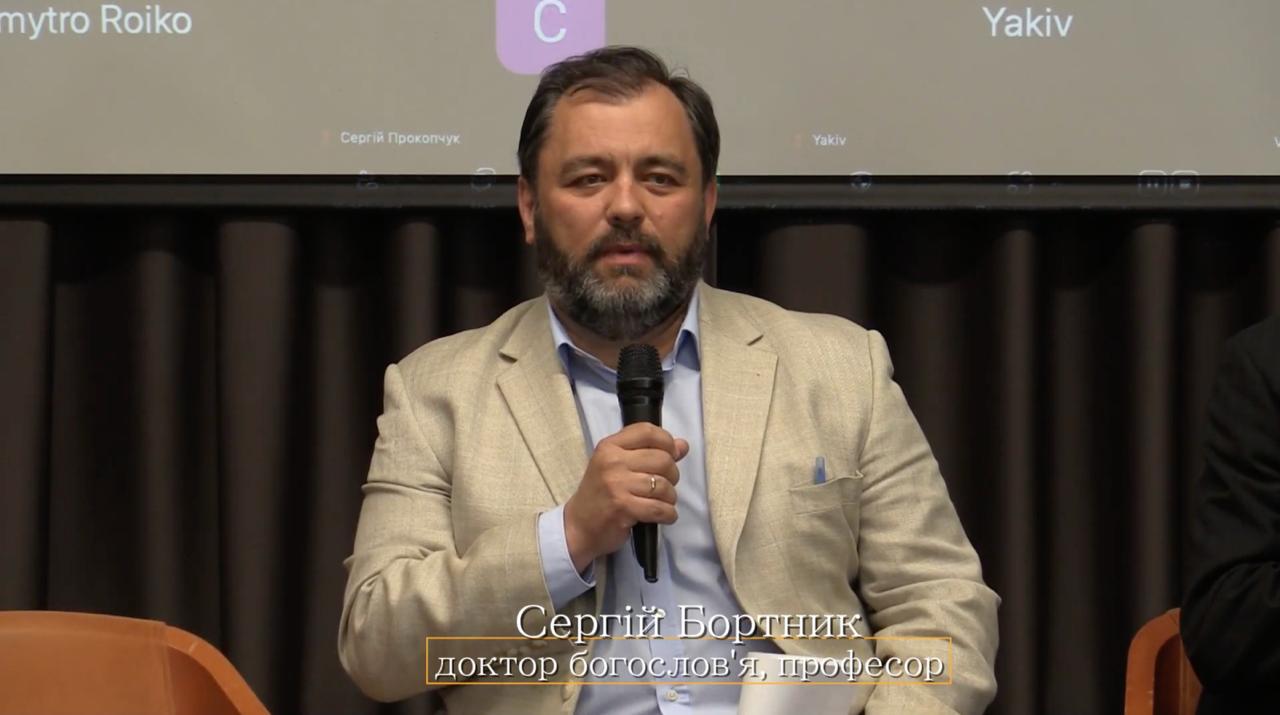
Serhii Bortnyk, Doctor of Theology, Professor, Head of the Academic Initiative Foundation
Dear Friends,
Before proposing “strategies for coexistence” — that is, plans for the future — I would like to briefly outline the current situation. To do this, I would like to share some figures from a survey by the Razumkov Center, published after its latest poll in October 2024. According to this data, over the past two years (from late 2022 to late 2024), the total number of respondents who identify as Orthodox decreased by 7.3% (from 62.7% to 55.4%). Other groups did not change as significantly. However, the group of those who do not identify with any religion increased by 6.7% (from 11.7% to 18.4%).
Additionally, the survey asked: “To which Orthodox Church do you belong?” Over the period in question, the following trends emerged: after a brief spike in 2023, there was an even steeper decline in those identifying with the OCU (36.4% in 2022, 42.2% in 2023, and 35.2% in 2024). The share of UOC faithful declined slightly — from 6.5% in 2022 to 5.5% in 2024. The largest drop occurred in the “just Orthodox” group — from 19% in 2022 to 13.7% in 2024.
From this data, I believe the following conclusions are appropriate:
- The information campaign against the UOC, because of its canonical connection to “a center in the aggressor country,” only briefly increased support for the OCU, after which it declined again.
- The number of UOC supporters, though relatively small, remains quite stable.
- The greatest decline was in the “just Orthodox” group — people with relatively low levels of church affiliation. Previous analyses show that many of them live in the south and east of Ukraine.
This data does not answer the question of the role of society and the media but shows the conclusions Ukrainian citizens draw from the massive information campaign in the religious sphere. The answer, to me, is clear: it’s no longer about changing confessions! A significant portion of believers is simply withdrawing from the religious sphere, which is perceived as too conflictual.
Secondly, I would like to propose a process for resolving the crisis in relations between the two Orthodox jurisdictions. My first experience of public teaching was in the 1990s at the Institute of International Relations, where I was then a student. The subject was “Conflictology and Negotiation Theory,” taught by Professor Anatolii Ishmuratov.
He proposed his own concept of conflict development — and accordingly, the return to peaceful coexistence — which, in my view, can be fully applied to relations between the two Orthodox jurisdictions in Ukraine. He argued that a conflict typically proceeds in four phases:
- The latent phase, when we seek to defend our own interests but find that the other side does not consider them, and so discontent grows.
- The active phase, when we engage in open conflict to defend our position and interests.
- A new latent phase, when, failing to convince the opponent, we begin to think about simply eliminating them — we think less about our own interests and more about how to get rid of the other side.
- A new active phase of conflict, where we seek to eliminate the competitor or rival — in the spirit of “No man, no problem.” At this point, neutralizing or even eliminating the opponent becomes more important than one’s own interests.
Professor Ishmuratov insisted that these phases must proceed gradually — without skipping steps. Likewise, the return to peaceful coexistence should also be gradual.
If we apply this framework to the current relations between the two Ukrainian Orthodox jurisdictions, we will see that in many respects we are in the fourth phase of conflict. That is, it’s no longer about the good of one’s own jurisdiction, but about eliminating the competitor. This is manifested first of all in the legal sphere, where there is an effort to eliminate the UOC’s dependence on the “center in the aggressor country,” up to and including the readiness to liquidate the UOC as an organization (and the Synod of the OCU has supported this law).
It is also evident in the sphere of physical violence, as we see conflicts surrounding the transfer of parishes from the UOC to the OCU. In my view, this has now become a fairly systematic process. Geographically, the most high-profile conflict cases today are in Chernivtsi and Cherkasy regions, while until recently it was primarily Volyn and Kyiv regions.
If we proceed from the general interest of preserving Ukraine as a culturally Orthodox country, then we should recognize that both Orthodox jurisdictions share a common interest in maintaining a shared field of interaction and development. The alternative today is not so much the strengthening of, say, the Greek Catholic Church, but the rapid growth of secularization and the decline of interest in religion as such.
Therefore, according to Ishmuratov’s model, from the fourth phase of conflict — open confrontation with the goal of eliminating the competitor — we should move to the third phase. Here, instead of active measures, there should be dialogues and discussions to clarify conflicting positions and the interests underlying them. The next phase would then be defending one’s own interests and, accordingly, the coexistence of the two jurisdictions.
Next, I would like to emphasize the principles of the “coexistence of jurisdictions in Ukrainian Orthodoxy,” which is the focus of my presentation. The key word here is “coexistence,” a principle that the State Service for Ethnopolitics and Freedom of Conscience (DESS) has upheld from the beginning — the principle of “unity in diversity.” This principle is highlighted in both the “mission” and the “values and principles of work” sections of DESS’s official page.
I would like to briefly outline a few points that could help pave the way for reconciliation between the Orthodox jurisdictions in Ukraine. I would highlight three aspects — tasks for the Ukrainian state and tasks for both Orthodox jurisdictions, namely the OCU and the UOC.
- For the State: Promote peaceful coexistence. Specifically, this means that unifying the Orthodox in one organizational and canonical structure is not the state’s task. When necessary, the state should exercise authority to punish those who have committed crimes. But it is important that this be individual accountability of specific persons, not collective responsibility of thousands of clergy and hundreds of thousands of believers — which is being demanded today, despite the personal patriotic commitment of many UOC faithful.
- For the OCU: Understand the importance of the assistance of the Ecumenical Patriarchate of Constantinople in legitimizing the status of formerly unrecognized structures through the granting of the Tomos of autocephaly. It is important to realize the fundamental shift in status — from non-recognition for several decades to the current partial acceptance by global Orthodoxy. In particular, this perspective challenges the popular myth of an eternal struggle by Ukrainians for recognition as separate from Russian Orthodoxy.
- For the UOC: Primarily, reflect on the possibilities of changing its canonical status so that unity with global Orthodoxy would not be realized through the compromised structures of the Moscow Patriarchate. With the help of other Local Churches, ecclesiological procedures for such changes must be found.
I hope that progress in this acute conflict situation is possible. For that, there must be, on one hand, a clearer distinction between the political and the ecclesiastical. But on the other hand, there must also be a partnership for cooperation, especially between the Church and the state. After all, the same Ukrainians are both church members and citizens of their country.
But above all, what we need today is a departure from the image of the enemy and a refusal to seek their elimination. In this case, the other jurisdiction should first be seen as a competitor and, over time — if things go well — as a partner. In such a case, the unification of Orthodox into one structure is not fundamentally necessary and may take a very long time — which, in a pluralistic society, should not be perceived as a problem.