
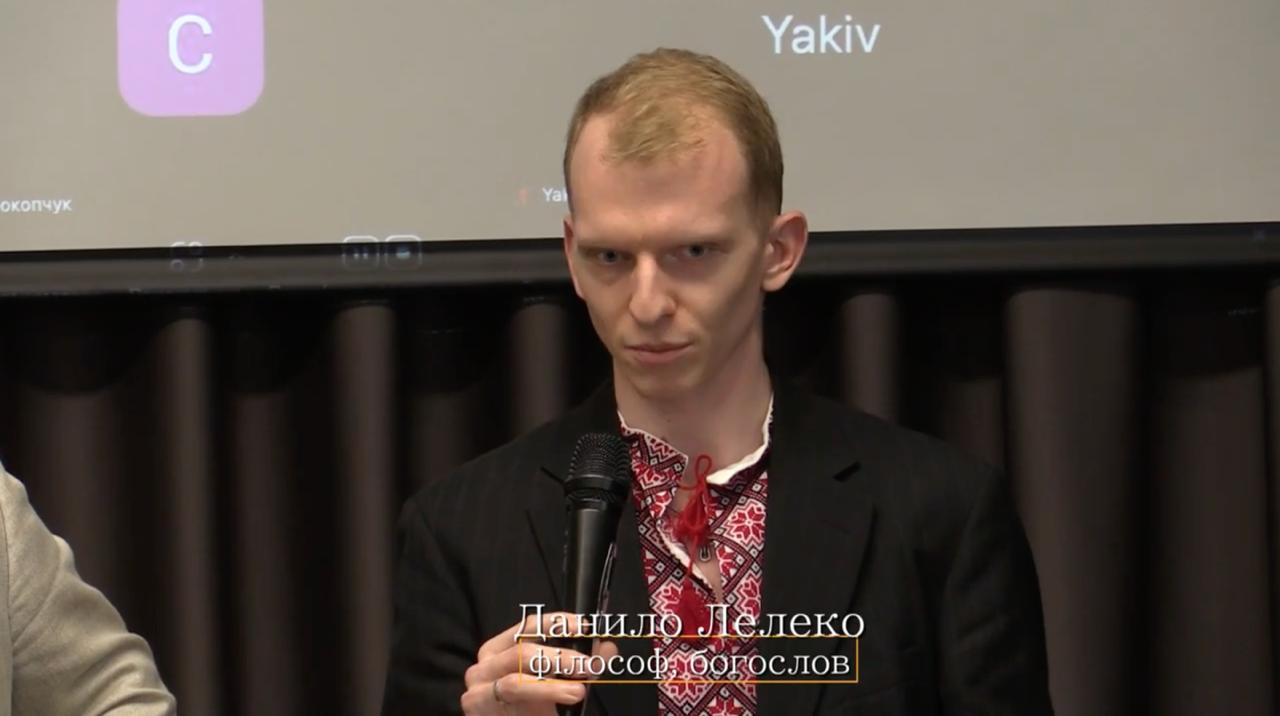
This presentation was delivered on April 29, 2025, during the Round Table “Contemporary Ukrainian Orthodoxy: Debunking Myths for the Sake of Reconciliation and Social Consolidation in Ukraine,” organized by the “Sofiyske Brotherhood” with the support of the Renovabis Foundation. The Sofiyske Brotherhood may not necessarily share the views of the speakers; likewise, individual opinions expressed within the project may not reflect the consolidated position of the Brotherhood.
Danylo Leleko, philosopher and theologian
First and foremost, I want to note that the strategy prevailing in modern ecclesiastical jurisdictional relations in Ukraine is fundamentally flawed. Very often, the focus is on defending borders – the borders of jurisdictions, identities, and the like.
Here, it is important to recall the traditional distinction between Christ and the world, which is especially significant for the evangelist John and the apostle Paul. This distinction suggests that the opposition between Christ and the world should impart a certain ethos to the life of the Christian Church.
If you remember, in John 18:36, Christ says to Pilate: “My kingdom is not of this world.” This, however, is immediately followed by a logical continuation: “If My kingdom were of this world, My servants would fight, that I might not be delivered to the Jews.” Thus, Christ’s “not-of-this-world” nature allows Him, on one hand, to be completely free from the need to defend Himself – the hallmark of life in the “sub-lunar realm.” Yet, on the other hand, precisely because Christ is not part of this world and is not limited by it, He can fully give Himself to this world: “The bread that I will give is My flesh, which I will give for the life of the world” (John 6:51).
In the same Gospel of John, this “trans-world identity” of Christ is explicitly inherited by His disciples – by the Church – which continues His presence in the world: “I have given them Your word, and the world has hated them because they are not of the world, just as I am not of the world” (John 17:14). Even earlier, the apostle Paul expressed this inheritance of identity even more radically and explained how the world should see Christians:
“…we have become a spectacle to the world, both to angels and to men. We are fools for Christ’s sake, but you are wise in Christ! We are weak, but you are strong! You are honorable, but we are dishonored… To this present hour we both hunger and thirst, are poorly clothed, are buffeted and homeless. …When we are cursed, we bless; when we suffer, we endure; when we are defamed, we entreat…” (1 Cor. 4:9–13).
Thus, Christ’s trans-world origin is passed on to Christians, who are now free from the world. Yet, this freedom from the world, according to Paul, is simultaneously the main basis for dedicated service to the world. The apostle himself says of himself: “Being free from all, I made myself a servant to all, that I might win the more” (1 Cor. 9:19).
Perhaps the most vivid reminder of this ancient truth in Christian communal life in the world is the experience of twentieth-century German Protestantism—the anti-Nazi Confessing Church movement.
But the most interesting aspect is not merely the existence of resistance, but who was its main critic – not the Nazis nor the “German Christians,” but Dietrich Bonhoeffer, the most prominent Christian figure in the resistance. He criticized the Confessing Church, which generally represented an important and correct image of Christianity in the modern world, precisely for beginning with defending its own boundaries and the boundaries of the Church in society. In response, Bonhoeffer emphasized the fundamental responsibility of the Church for the state of German society and the necessity of direct Christian involvement in social and even political life – especially in resisting Nazi dictatorship and its genocidal policy toward Jewish people. He famously said in 1938: “Only he who stands with the Jews has a right to sing Gregorian chant.”
The Orthodox Church of the twentieth century also gave us an extraordinary witness of maintaining this trans-world identity through its offering to the world. The primary martyr-witness of the Eastern Church – one who defended the contours of ecclesial life described above – was Saint Maria Parisienne (Skobtsova). She is not only a remarkable example of nineteenth-century Christian social activism but also one of the deepest thinkers of her time. Critiquing the moralism and superficial spirituality of the popular “social Christianity,” St. Maria saw the genuine spiritual foundation for Christian engagement with the world in Christ’s mystical self-sacrifice in the Eucharist – where He gives Himself to the world, giving His Body. By partaking of Christ’s Body, Christians truly experience ecclesial conciliarity in emulating this “self-offering” to the world. For her, the “churching of the world” is not about accumulating church “inventory” or merely attending services, but about cultivating a deep understanding of “extra-liturgical liturgy” – continuing Christ’s Sacrifice in the various dimensions of worldly life. More than her theological reflections, St. Maria Parisienne embodied this vision of “extra-liturgical liturgy” in her own life: by helping the poor, the unemployed, the addicted, and persecuted Jews during the German occupation of Paris.
A distinctively social dimension of church life, however, is not a “modernist tendency.” As early as 362 CE Emperor Julian the Apostate lamented to a priest of the restored pagan cult that “the Hellene is inferior to Christians in public service (λειτουργίας),” noting that Christians were first in aiding not only their own co-religionists but even Jews and pagans.
The history of the early Church also abounds with examples where social service was a natural extension – and a component— – spiritual life. A key example is the fourth-century ascetic community in Annesa, in Asia Minor – a notable center of the Cappadocian Christian family that included such luminaries as Saints Macrina the Younger, Basil of Caesarea, and Gregory of Nyssa. This community was one of the first proto-monastic centers in Asia Minor and simultaneously a site of early Christian practices: liberating slaves, charitable service to the starving poor in adjacent villages, forming a horizontal community structure, and even (to an extent) the liberation of women. Among these, Saint Gregory of Nyssa most eloquently articulated the theological importance of social service – claiming that through mercy and charity (or more broadly, social service), a person attains deification – the highest goal of spiritual life.
Therefore, from this articulated ethos of Christian communal life, several reflections emerge regarding inter-jurisdictional relations in Ukraine today:
- Resolving jurisdictional issues lies outside the limits of jurisdictional concerns. When the Christian community becomes overly preoccupied with defending boundaries, it departs from Christ’s primary “trans-world identity” and becomes merely “another sphere of society” – a separate spiritual domain protected by law but isolated. In this logic of protecting structures, the Church becomes entangled in “conflicts of interest” and power struggles within society.
- The logic of protecting borders (including jurisdictional borders) distances the Christian community from understanding itself as the One Body of Christ, which offers itself as a Sacrifice to the world – sacrifice that manifests in social life. Ultimately, in the seventeenth chapter of John’s Gospel, Christ speaks of his disciples’ unity as reflective of His unity with the Father – describing it as mutual love: “…that the love with which You loved Me may be in them, and I in them” (John 17:26). This love, accordingly, expresses itself in the Sacrifice Christ offers to the world.