This material was produced within the joint project of the “Sophia Brotherhood” and the German foundation “Renovabis” entitled “Modern Ukrainian Orthodoxy: Debunking Myths for the Sake of Reconciliation of Orthodox Christians in Ukraine and Consolidation of Ukrainian Society.” The Sophia Brotherhood may not share the views of the authors; likewise, some opinions of Brotherhood members expressed within the project may not represent the consolidated position of the Sophia Brotherhood.
How should the sacralization of the victims and heroes of the war take place? Is the “Ukrainianness” of the UOC a part of its genotype that will be passed on by inheritance? What is the key difference between Russian and Ukrainian identity? Why should propaganda of the “Russian World” be punished as high treason? Is it possible to heal a sick church institution? Why do meanings need a living language rather than a dead one? What stands behind Metropolitan Onufriy’s unwillingness to fight for Ukrainian citizenship?
“Religion in Ukraine” spoke with well-known scholar of religion and poet Oksana Horkusha on a broad range of issues related to the formation of religious identity in Ukraine.
Part 3
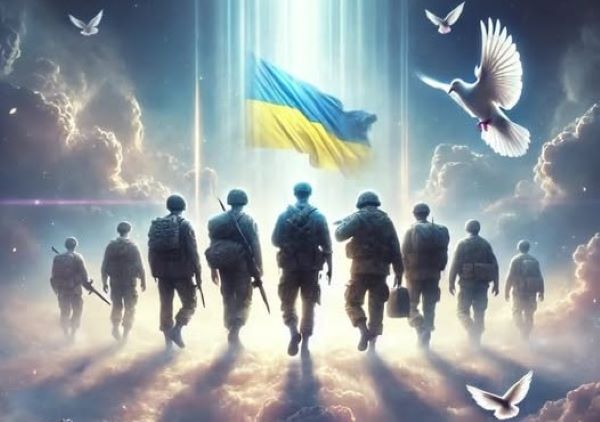
– “Ukrainian heroes go to Iriy – this can be our metanarrative”
– The Ukrainianness of the UOC – a situational phenotypical change in its identity or a stable “genetic mutation”?
– “The first step in treating any disease is the correct diagnosis”
– “Propaganda of the ‘Russian World’ as an ideology of genocide against Ukrainians must be equated with high treason”
– “To reach the consciousness of parishioners, you need a person they trust – an Orthodox priest”
– “We have no right to pamper anyone; we do not have this luxury. They have come to kill us”
– A return to Ukrainianness will return the Church to Christlikeness
– “Metropolitan Onufriy is fine with not having Ukrainian earthly citizenship”
“Ukrainian heroes go to Iriy – this can be our metanarrative”
Oksana Horkusha: Why, then, are Ukrainians capable of perceiving that our City of God is not the one we must build and recreate here, but rather that we can resettle there? Here the problem of the Ukrainian nation lies in the fact that we have been exterminated. And we have seen, and are now observing, a huge number of our heroes who are departing. Where are they going? They are going to Iriy. Iriy is that paradise, that place where the flower of our nation gathers.
Tetiana Derkach: This is something like Valhalla, as I understand it?
Oksana Horkusha: Yes. This is already a pagan narrative. The legend about Iriy can be transformed into our powerful metanarrative. Because from Iriy, heroes return and help. Angels who stand beside our soldiers at the front and help them. And all of this can actually be a powerful victorious metanarrative. The life path and position of a person – whether as an agent who relies on certain foundational values and therefore influences reality, or as a passive particle of an ecosystem in which other subjects act – depends on which metanarrative a person uses. It is an extremely necessary task to form a clear metanarrative on which consciousness can rely. We have said that society is fragmented. And today an understanding of what all the sacrifices of the Ukrainian people were for is urgently needed. This simply has to be formulated.
Tetiana Derkach: I agree with you; the sacralization of the sacrifices of the Ukrainian people somehow has to be given form. I just have a question as to how the metanarrative of Iriy will be received by, for example, the Orthodox Church. On the other hand, I see what is happening in the ROC: they are already forming something similar – “all the soldiers who came to the ‘SMO’ and died on the battlefield all end up in paradise.” We try to say: what kind of paradise, if they simply came to kill? So this must be some peculiar sort of “paradise,” and in the ROC they are already legalizing this concept. In Ukraine, I think, for example, the UOC will certainly be a point of resistance to such a metanarrative. In the OCU they may be able to accept it in some form, but then we really need to look at how the Church historically approaches the question of sacralizing the victims and heroes of war. The history of humanity is a history of wars, and the historical Church has also constantly been at the epicenter of wars and very often inspired those wars – what we call holy, sacred wars, crusades. And already in Genesis, when Abel killed Cain, it was written that “the blood cries out from the ground”; the blood of innocently killed people has its own “electoral influence,” its own “voice.” This is such a powerful metaphysical diplomacy not only in the country where these people died, but throughout the world.
I think that any sacralization is still the task of the Church, and then the state has two paths: either to inscribe the fallen Ukrainian soldiers into some civil pantheon, or to involve the Church, but then the state will have to accept the fact that the Church cannot include absolutely everything in this pantheon. Sometimes it seems to me that under current circumstances it is more advantageous for the state to have churches precisely as civic organizations, because they are understandable, law-abiding, negotiable, and so on. The churches you study, that are of interest to you, are communities of people with irrational consciousness, whose principles very often contradict, for example, the prescriptions of the state. And these people can even go down an anti-state path, completely neglecting the question of national security, neglecting what lies at the basic level of security of citizens according to Maslow’s pyramid, because they have some different “otherworldly” principles.
Oksana Horkusha: Regarding the ecclesial sacralization of our heroes in the form of Iriy. The OCU immediately organized a “wailing wall,” which has turned into a Wall of Glory. And when I walk toward St Michael’s Cathedral, I feel the sacredness of that place. And this is felt directly as angel wings embracing you. There is one danger, one risk – that we might turn our heroes into victims, and perceive this only as sacrifice, and not as a feat, a glorious feat of the one who gave his life. For there is no greater love than when you lay down your life for your friends. And this is a manifestation of divine love, when people are able to step over, as you already said, their natural instincts of self-preservation, in order to extend their love and conquer death with love for their neighbor, for the living, for their Ukrainian world, for their family, and for their land, ultimately. They pour this love from the abundance of the generosity of their hearts into this world – and thus they prolong our lives. Because if there had not been so much surplus of their love that they overcame their instincts of self-preservation as human organisms and sacrificed themselves, then we would no longer exist. That is, by their love we are literally redeemed from non-existence. It is our responsibility to regard them as effective co-creators of a free Ukraine from today into the future. If Christ redeemed each person from spiritual non-existence by His loving sacrifice – for He still loved the world, and God so loved the world that He gave His only-begotten Son – then the love of our heroes must become the basis of a civic metanarrative that will logically flow from the Christian one. For precisely thanks to this feat we are alive, and Ukraine is free, and the Ukrainian world will be a home filled with the love of our heroes for their children and ours, built by us with responsibility before them. This metanarrative is read in terms of meaning by every Ukrainian and every Christian. Supplemented by the image of Iriy, it is also readable for Ukrainian pagans. This is the culmination and quintessence of events that becomes a glorious legend for the formation of a worthy future.
You rightly noted that one church alone will not be able to encompass our entire Iriy. For among our heroes who gave themselves in love there are Muslims, Krishna devotees, representatives of different confessions. Yet we can form this civic cult of Glory, understandable and close to every Ukrainian, because for us the dignity of a free person is the highest value. I would make this pantheon specifically a national, multiconfessional environment – a place where representatives of all religions, all confessions present in Ukraine can come, because their heroes are there, who belonged to one or another confession, but all are Ukrainians (in terms of civic identity) and all gave their love so that we could continue to live. This Glorious Pantheon should emphasize the glory not of each sacrifice, but of each feat. It is not just sacrifice, but a human feat. At the same time, each church or confession can create its own pantheon, as the OCU, for example, has done.
The UOC simply has no such chance, because they view this not as a feat, but as a sacrifice. Even when they bury our soldiers, they speak about “a sinful person who has died,” and so on. They never highlight that this is the feat of a person who by his love has redeemed us and given us the possibility of life. On the contrary, we should not lament that “he, poor and unfortunate, died”; we should thank the Hero that we are alive thanks to his feat. This is the nuance that distinguishes a confession that is here by chance from a confession that is the full-fledged master in the Ukrainian home. That is, the “friend–foe” distinction: some say that “a poor person has died,” while others speak of “his feat, his love, by which he has redeemed me, and I am grateful to him.” These different approaches were immediately noticeable. And thus, when we speak about an institution that presents all this merely as individual sacrifices and offerings to some unknown god of war (for they try not to name this god, saying “some war is going on, some people are dying,” and so forth), at that very moment they devalue both this sacrifice and this feat.
Tetiana Derkach: I agree; in this way the meaning of this soldierly death is in fact nullified, transformed, deformed. It turns out that the soldier died for nothing, “for no good reason,” he simply died and that’s all – only in a violent way.
Oksana Horkusha: Exactly. This always pains me, and that is why I have such an attitude toward this institution. Because I understand that in the UOC the sacred dimension of this feat is nullified, erased. Whereas in reality we should place emphasis precisely on this and speak about it constantly. If we present this as the victory of love over death, then we immediately open the prospect for Christian values that live here. First of all, this is love of neighbor. We open the possibility for Christ to enter our world precisely in His status as the God of love, the Word that gives meaning to existence, meaning to life, and that enlightens any darkness, because love enlightens and reason enlightens. And we let in this enlightening sacred light. Therefore I believe that if our state is to exist, if Ukrainians are to live, then with the approach of an institution that nullifies this sacred dimension of love, it will simply not be needed here, because it is hostile, alien here. And its disappearance is a natural process.
The Ukrainianness of the UOC – a situational phenotypical change in its identity or a stable “genetic mutation”?
There is another negative nuance that I notice in such an uncertain position of this institution: when they constantly demonstrate this leveling of the feat of our heroes and the leveling of everything Ukrainian, of Ukrainianness as such, at the same time they cover themselves with the identifier “Orthodox.” In doing so, they discredit all Orthodoxy as a whole. So the next generations of Ukrainians will look at this and ask what the Orthodox were doing. And the answer will be that the Orthodox were those with beards and crosses who walked around and constantly spoke against the state, or stirred up the population inside the state instead of consolidating the people in defense against the external enemy. All of this leaves a thick black stain on all Orthodox. And we have several Orthodox churches as institutions…
So I think young people (and not only young people) will be wondering: is there really no alternative? Yet there is a normal and healthy alternative – the Greek Catholics. We have no problems with Ukrainian Greek Catholics, do we? No. Nor do we have problems with other confessions.
I believe that when in the UOC they try to hold people in the “Russian World” by this “Orthodox” identifier as a noose around their worldview, they harm Orthodoxy as a whole. For they substitute and discredit Orthodoxy itself.
Tetiana Derkach: In this regard, I have the following question. We have already said that from the beginning, different people gathered in the UOC – romantics, cynics, pragmatists. If we compare the Church to an organism, then in genetics there is a difference between phenotype and genotype. At the phenotypical level a being, an organism, changes under the influence of certain external circumstances. For example, a person can get a tan or build up muscles, but this is not passed on to descendants. There are genetic changes of two types – either recombination of genes or genetic mutations within the genome itself. In your opinion, what is the demonstration or declaration by the UOC of its Ukrainianness, which does indeed exist? There are certain pro-Ukrainian, pro-autocephalous trends, a movement of priests who do not commemorate Patriarch Kirill – that is, at present this is no longer a consolidated structure. Is this a phenotypical change, when individual Orthodox within the UOC are carriers of this Ukrainianness as long as they are alive, but then do not pass this Ukrainianness down by inheritance to the next generation of believers? Or is this already, after all, a recombination of genes with the Ukrainian national idea? Since they are Ukrainians, they have a certain mentality from grandfather and great-grandfather; they cannot simply take this genetics, cross it out, and say “we are Russian people,” and that’s the end of the story. Or is this already some sort of “genetic mutation” inside?
Why do I have such a question? Because we need to understand how to build relations with this institution, what the modality of this relationship should be – where the state should be more present and where less. If some recombination of genes is really taking place, and later the UOC will become more Ukrainian, and in a generation they will simply say: “The Russian World? What nonsense is that?” Or are we now dealing with the “tan effect,” and when the sun disappears the tan will vanish as well?
Oksana Horkusha: This is a very complex question, but let us try to sort it out. Identity is not monolithic; it is multi-layered and multi-level. There is a difference, for example, between Russian identity and Ukrainian identity. A Russian is hierarchized; Russians are used to hierarchized identities. For them, everything is simple: if we subordinate all identities to the Orthodox one, then all Orthodox Christians can be inscribed in the “Russian World,” and this is precisely what they exploit at the global level. You are Orthodox – therefore you are suitable for the “Russian World.” Previously it was the proletariat (“workers of the world, unite!”). Now it is “Orthodox of the whole world, unite in our Russian World.” This is very easy to implement when there is a hierarchical structure of identities.
By contrast, the consciousness of Ukrainians is ecosystemic. That is, we have many identities: I am a woman, I am a mother, I am a scholar, I am a human being, etc., and all of these are not hierarchized. Thus I need to make an effort to tie all of these identities into some coherent picture if I want to do so. Or I can use this or that identity as the occasion arises. When a situation arises, when there is a need – I use it.
You asked about Ukrainian and Orthodox identities. But we cannot say exactly what they are packaging there. In each individual church there may be a different worldview model that is being packaged into the consciousness of believers. Am I thinking correctly?
Tetiana Derkach: Judging by the fact that they have discussions among themselves, we can say that they do not have a coherent concept of identity at either the religious or civic level at all.
Oksana Horkusha: We do not know what kind of “broth” this is. I knew priests who were in the MP and then moved to the OCU, and they told me: “we are pro-Ukrainian, we help the army, we do not commemorate that Kirill.” So from the standpoint of the Ukrainian state it is actually good that they do not have this clear hierarchized model that they package in the church. So we have to look at what needs to be done to heal this institution and to return it to the state of a church that could call itself a Ukrainian church. To remove the harmful elements that turn the UOC not into a Ukrainian church but into an institution governed from the Kremlin. And when we remove these harmful elements – in simple terms, tumors that are malignant – and then track the result, it is possible that the organism will recover.
“The first step in treating any disease is the correct diagnosis”
Tetiana Derkach: That is exactly the point: this is too big an organism to simply dissolve in the air by means of the Law on affiliation, for example. I think that mechanism is ineffective.
Oksana Horkusha: Yes, but the state went down that path because we have to remove these tumors. We understand that slashing impulsively will not work here, because this is a large organism and it is alive – if it is alive.
Tetiana Derkach: It is alive; that is the point. If it were dead, one could simply remove it from the registry and there would be no problem.
Oksana Horkusha: And here we have to look. There is another way, and I have advocated for it more than once. In oncology there are various methods of treatment – chemotherapy, for instance. We have spoken about metanarratives: if we formulate the right metanarrative, it will make it possible to heal this organism.
The problem is that this organism is being charged to fight the OCU, to fight the state of Ukraine. Instead of being encouraged to understand the situation correctly and to clarify why it happened that we are in opposition to our people and our state, when we ought to be part of this state and this people, to empathize, to stand in defense shoulder to shoulder with Ukrainians who are protecting their Ukrainian world from an external aggressor. When we, who know best what the Russian Orthodox Church is, should become the bulwark, that boundary and frontier that the ROC will not cross – because we know the narratives they plant and the way they transform consciousness.
If only they stood as this bulwark and said: “No, there is no place for the ‘Russian World’ here; we are a Ukrainian church. The Russian language – farewell, for God knows Ukrainian. Our heroes are the heroes who (risk their lives, fight, die – ed.) out of love. We are at the front, we are in the hospitals, we support them, we clearly name who the enemy is. And the bloody Kremlin Patriarch Kirill is a heretic who tried to privatize God – and that is heresy”…
What is needed is a clear position on the part of this church, not just of one priest or a group of priests. And this position must be official, voiced aloud, and expressed in action. Then this chemotherapy will begin, which in principle can heal the entire organism. This, in my estimation, is the mechanism that should be launched for treatment – if there is something to treat, if we do not want to conduct surgical interventions. But surgical interventions are also needed: priests-traitors who worked for the aggressor state must be exposed; they must be convicted; it must be clearly articulated in what their crime lies.
It must be acknowledged and declared that propaganda of the “Russian World,” even with religious rhetoric, is a crime against Ukrainians. I, for example, am in favor of not hiding those little books that contain “Holy Rus’” and other myths, but rather of recognizing past mistakes and saying: “No, we no longer have this; we are against it; we condemn that bloody Patriarch Kirill, who has long ceased to be a Christian and serves the Kremlin and its war machine”… First and foremost, a clear articulation and corresponding position of each priest. And then, in the end, we will see the healing of this organism.
Tetiana Derkach: But then we come to a contradiction, because we have to say to this organism: we recognize you as an organism, we will not allow you to be a fifth column, a part of the Russian Church, but we recognize that you have a right to exist. In fact, many people on an emotional level say that this organism has no right at all to be recognized in Ukraine. The whole problem is that this organism is very visible; here the law of large numbers comes into play, and we cannot say that it is just a small group of marginals. Here the solution to this problem is to help the entire organism fit into the banks of normal Ukrainian Orthodox mentality. They did not all come here from Mars; they are descendants of people who have lived on this land for centuries. It is abnormal when they say that “this is Russian land.” But in order to change this, we must give them some signal that the state will tolerate them on certain conditions.
The Law on affiliation seems to be about this, but there are 999 words about one thing and the thousandth word is “liquidation.” We thereby motivate them for irrational and completely inadequate resistance. I am absolutely in favor of eliminating the growth points of tumors, but specifically the growth points, and not the entire organism.
Oksana Horkusha: The first stage of treating any disease is the correct diagnosis. We may talk as much as we wish about the state’s not understanding this institution, but this institution itself must acknowledge that it has problems. The institution does not simply fail to admit its problems; it actually deepens the process. There are people whose activities I have been noticing for a long time. This used to be the channel “Kozatskyi,” then “Pershyi Kozatskyi,” now it is “Virnyi,” yet they still function. We can say as much as we like that this is not a church institution and not part of the Church, but lying Russian propagandists; yet they are the Church’s mouthpieces, because the Church does not condemn them and uses their activity.
Tetiana Derkach: Yes, these are mouthpieces absolutely affiliated with the Church. That is, we cannot even remove fully affiliated mouthpieces of the Church, and we are speaking about removing the Church affiliated with the ROC.
Oksana Horkusha: And there open anti-Ukrainian propaganda is being conducted. The same Yan Taksiur, who left and slanders Ukraine… Here we are dealing with openly anti-Ukrainian activity. And this institution either tolerates such activity, covers it, or turns a blind eye to it. So how are we to understand this? We have already seen in Sloviansk how grandmothers with icons came out and knelt in front of Ukrainian tanks, not allowing them to pass to defend those very grandmothers. They would not let them enter Ukrainian territory! We have seen this with our own eyes. The same thing is happening now: under the cover of this institution, anti-Ukrainian subjects and propagandists who speak on behalf of this institution are being brought into Ukraine. For if they do not belong to you, then wash your hands and say: “No! They are liars and we have nothing in common with them!” But this does not happen. Either this organism does not want to acknowledge its disease and that it is terminally ill and in urgent need of treatment, or the tumor has already conquered its consciousness – one of the two, in my view. And in either case radical treatment methods are needed.
“Propaganda of the ‘Russian World’ as an ideology of genocide against Ukrainians must be equated with high treason”
I would note one more nuance. It was written into the Law (on affiliation – ed.), but little attention is paid to it – propaganda of the ideology of the “Russian World.” I would spell out that propaganda of the ideology of the “Russian World,” which is an ideology of genocide against Ukrainians, is a crime against Ukrainians comparable to treason against the Ukrainian state. Then we would at least make propaganda impossible. For a priest who mentioned this “Russian World” would know that he would be held criminally liable.
You might say that this is a restriction of a person’s freedom of conscience. Of course, but the freedom of conscience of fascists or representatives of fascist and other genocidal ideologies (such as the communist one) is also restricted. And the chauvinist imperial Moscow ideology has led to genocide of Ukrainians both in the last century and in this one. That is, it is an ideology of genocide against Ukrainians and we need to protect ourselves from it.
This is my personal opinion, and I stand by it: we must say that there is a church, religious functionality and there is a non-religious and extra-religious functionality. And when you function as a religion – when you glorify God, when you spread Christianity, when you spread Orthodoxy as such, then God be with you, all is well. But when you begin propagating the “Russian World,” an ideology of genocide against Ukrainians, then you are acting to the harm of all Ukraine and of me personally.
Tetiana Derkach: I understand completely and agree. In this context, I find the position of the UOC absolutely incomprehensible, a position that consciously or unconsciously does not want to acknowledge the viruses it let in at the beginning of the 1990s, which it spread in the 2000s and 2010s, with the peak in 2012–2013, when Vladimir Putin came to St Volodymyr’s Hill. As Andrei Illarionov, once close to him, has said, after July 2013 it was precisely then that Putin took the decision to seize Ukraine.
Oksana Horkusha: Yes, that was the time of worldview occupation, of reformatting the consciousness of Ukrainians. You used the term “virus” in a very appropriate way: they launched their metanarrative, but adapted to us, in order to digest us, transform us through Orthodox identity and a church that is part of the Russian Orthodox Church. I still remember how proudly “Moscow Patriarchate” signs hung on each of their churches. And I would walk around and ask: “Why do you need ‘Moscow Patriarchate’?” And they would answer: “We are the Moscow Patriarchate.” And now in the occupied territories they immediately put up a sign that it is the Moscow Patriarchate, so that no doubt remains.
They launched this mental virus or negative metanarrative that worldview-wise transformed Ukrainians into victims who would not resist, or into slaves, enslaved serfs of the “Russian World.” This was a deliberate transformation of Ukrainians through religious Orthodox preaching. And they came here to take in three days exactly this worldview ecosystem, which was supposed to have been transformed by this ideological (mythological) “pus,” so that it would be easy to occupy. Because it (the worldview ecosystem of the inhabitants of Ukraine) is already “ours,” only “our plants” already grow there, and everything else has been eradicated.
They only forgot to take into account a few nuances: our multiconfessionalism and our principled inability to accept hierarchized consciousness and a hierarchical model. Ecosystemic thinking presupposes that I refuse hierarchy, because it is a dead, artificial structure. In an ecosystem today one factor, tomorrow another, and the day after tomorrow a third factor will be the main or leading one, and I must reckon with one or the other. That is, this ecosystemic nature of Ukrainians and our multiconfessionalism and multivariability were simply not taken into account. Therefore things turned out as they did: Ukrainians, as usual, survived in this situation as well. For now, at least, we are alive. But those who are carriers of this “Russian World” virus must be treated; they must be cleansed of this ideology of genocide against Ukrainians. Yet first they must acknowledge that they are carriers of this virus, for a person agrees to be treated when he knows of his disease. How do you treat someone who considers himself healthier than all the healthy?
The Law (on affiliation – ed.) is, of course, imperfect. I repeat: I would tighten it precisely in the aspect of propaganda of the ideology of the “Russian World.” Because this is not religious activity; it is not about freedom of religion and freedom of conscience; it is about throwing a noose of harmful ideology onto the consciousness of our citizens, an ideology of genocide against Ukrainians.
“To reach the consciousness of parishioners, you need a person they trust – an Orthodox priest”
Tetiana Derkach: We are speaking about treating this organism, but the problem is that in the 2000s one remedy could have been used, in the 2010s – another, and from 2014 to 2022 – a third. The external environment is changing completely, and I, for example, now think that we have no developed protocols of treatment that would not simply imitate the process but lead to an effective result – a result as planned, and not the opposite. The state ought to approach this issue more systematically and involve specialists, rather than allow individual MPs to make hype or some electoral profit.
Oksana Horkusha: I completely agree. We have a big problem with the consciousness of those parishioners. We can work with the priests, but there is still a huge army of parishioners. And to reach their consciousness, there must be a person they trust – the same Orthodox priest who will tell them: “the ‘Russian World’ does not concern us; it is an ideology of genocide; we shall leave this to Putin and Kirill; Kirill is a criminal, while we are Ukrainian Orthodox. And Ukrainian Orthodox are obliged to defend their land, and we must be those very people who give both their souls and hearts for the defense and flourishing of Ukraine. This is our place; this earthly homeland has been given us by the Lord so that we glorify Christ.” And all this in Ukrainian. It is precisely the Orthodox priest who must do this. A person from outside cannot come and heal the consciousness of someone into whom harmful viruses were packaged via a religious or pseudo-religious institution or by means of religious instruments. That is the problem, of course.
And this cannot be cured by a single method. Polyfunctional treatment is needed, because on the one hand the organism must be treated, and on the other hand some positive vital forces must be supported. There must be Ukrainian education and Ukrainian enlightenment so that consciousness is not left alone at a crossroads without answers to key existential questions. So that consciousness is not left in this loneliness, this lostness. Because if from a person you take away what has always given her an answer to the question “what will be with me after death, I will go to paradise,” and all of a sudden it turns out that this paradise is Putin’s and is actually hell… They didn’t randomly burn the “eternal flame” in every city – it literally burns out their brains and they are, in fact, idol worshippers through this “eternal flame” of victory-mania. We, however, must not simply take away the answer in which UOC-MP parishioners have believed – “I will be in my own paradise, with my own church and with Onufriy” – but we must give them the opportunity to replace that answer with an adequate, truthful one: “yes, you will be saved, of course, and your contribution and your life resources have not been spent in vain if you served the Lord, and not the ‘Russian World.’”
Yet this must be done by a priest, not by me and not by you. And to do that, we must saturate the information field. Again: in higher educational institutions, in secondary schools, in junior schools the Ukrainian content must be strengthened. Ukrainian humanities must be strengthened. Ukrainian enlightenment must be strengthened. Because what happened, for example, in the 1990s in Ukraine? Ideology-forming and worldview-forming disciplines were removed, reduced, and people were left in this supermarket of ideas with a very limited range. Now we must fill this assortment with Ukrainian, high-quality worldview “products.”
“We have no right to pamper anyone; we do not have this luxury. They have come to kill us”
Tetiana Derkach: The key word is “quality.” And here there is a problem. I have spoken with UOC priests and have seen a certain desynchronization in what is happening at all levels. The bishops say: we cannot take this or that step toward Ukrainization, for example, because the priests will not support it. The priests say: we are ready to do so, but the parishioners will not support us. There have already been instances of priests trying to Ukrainianize the liturgy – they already have printed service books with the Ukrainian liturgy – but the parishioners do not want it! They say: “Father, we will simply drive you out of the church if you start chanting for us in Ukrainian.” This is the consequence of that simplification, that primitivization of thinking you spoke about. But here we have a big problem: where to find the point of chaos from which resistance to these changes comes? Because everything ultimately boils down to “the people will not accept this.” And any priest still depends on his place of ministry, and there have already been instances where a priest tried to introduce something progressive, to preach progressive sermons, and the parishioners began complaining to the bishop, saying that “our father is some kind of liberal, some kind of wrong father, he is trying to impose some sort of aggiornamento on us”…
And the same can be said about attempts to eradicate mental viruses in people’s heads by means of legislation. As a result of the legislative procedures adopted by our authorities, the carriers of these viruses become more aggressive; they are capable of resistance; they show greater survivability in this environment; they are able to transmit these viruses to a wider audience. In such moments these people display a certain “Khlyst” type of behavior – a typical Russian mentality, by the way – self-winding, self-suggestion in certain pseudo-religious concepts under conditions of pressure. Ukraine has not had a split like the Old Believer one; that is a typical story for the Russian Church. But in Ukraine this scabby rash of fundamentalism is being grafted onto us and instrumentalized for resistance to change, to progress. I am not talking about “progress” of the “woke” type – about bringing into the Church what is not inherent to it at all. It seems to me that even if we destroy the institution, we will not be able to get rid of the church people. If we take away their priests, they will become priestless, but they will continue to exist. My opponents constantly tell me that this institution will “dissolve” without a hierarchy and temples. What is your position?
Оksana Horkusha: The question is really complicated. I gave you an example already from 2014, when grandmothers with icons fell in front of our tanks, not allowing our lads to defend Ukraine. Let me ask you: what happened to these grandmothers? They remained in the occupied territories. I have now met a certain number of people who moved into free Ukraine from Donetsk and Luhansk back in 2014. They have not adapted very well in Ukraine, but they have the opportunity to compare different life contexts. These people radically changed their lives in 2014, when the occupation of Donetsk and Luhansk began: they left in whatever they were wearing and then survived as they could. They always complain that Ukraine did not give them something… But when they compare their situation with that of those who remained in the occupied territories, they have never once regretted leaving. Although those who remained there initially said: “we have pensions and payments…” Now they say: “we are third-class people.” Because there no one takes any account of the human being.
Tetiana Derkach: The censorship there is very strict. Yes, there are pensions, but if something happens you end up in a basement.
Oksana Horkusha: Yes, exactly. And no one there pampers them. There is no question at all there of what to do with representatives of the OCU or the Ukrainian Greek-Catholic Church. We are in an existential war. We either survive or we do not live. And if that grandmother wants to fall on her knees with an icon and shout “I am the bulwark of the ‘Russian World’ here and I will stand here,” let her stand where she stands. But without a priest! This is Ukrainian land and institutionally no one has the right to bring here this worldview occupation.
Instead, the priest is obliged to work with that grandmother as a psychologist or psychiatrist in order to free her consciousness from the yoke which was thrown on her via the institution. I do not like the term “totalitarian sects” – it is used often in Russia. But after the “Great White Brotherhood” children had to be treated to be returned to their families. Their consciousness had to be brought back and their worldview cleansed of what had been suggested, imposed, manipulative. We must likewise free the consciousness of UOC-MP parishioners from the deceit of the “Russian World.”
Tetiana Derkach: Yes, if they acknowledge that there is a problem. One cannot work with a person or an institution that does not acknowledge that it has a problem, that says: “I am right in everything; it is you who are wrong; the whole world is going the wrong way; I alone walk against the wind.”
Oksana Horkusha: You know, we can afford to pamper someone when we are in a comfort zone. But when we are in the epicenter of reality and a “Shahed” drone or a missile can hit you or me at any moment, then we do not have the luxury of pampering anyone.
Tetiana Derkach: Some in the Moscow Patriarchate will say, if a missile hits: God punished you. “God punished these Banderites.” Although they are also being killed and their churches are destroyed as well.
Oksana Horkusha: We suffer and it pains us deeply when the churches of the Moscow Patriarchate are destroyed. But do they remember that their churches are being destroyed because their bloody Kirill has directed this weapon toward Ukraine?
Tetiana Derkach: Some do remember. But if an institution wants to exist as an institution, it must declare certain principled things institutionally. Not just in the form of some statement by 33 bishops, or separately by Metropolitan Onufriy or some press-secretary of a steward. This must be not just a synodal but a sobornal (council) document.
Oksana Horkusha: Things must always be called by their names. Guile is not the path of Christ; it is the path of Satan, who throws a simulacrum over the world and wants to enslave the world by setting these simulacral snares for people in order to reel their souls into hell. That is why things must be called by their proper names. And it must be clearly said: “We are Christians, but Ukrainian Christians; we are a Ukrainian church.” And then articulated sincerely and honestly point by point.
We have no right to pamper anyone; we do not have this luxury. They have come to kill us, and we must speak about this – and also to them: “They have come to kill you as well. Or do you think you can sit it out in an institution that with one foot belongs to the ‘Russian World’ and with the other says: ‘I stand on Ukrainian land’?”
Yes, in Onufriy’s sermons there is talk about Ukrainian land, but he forgets to say “state of Ukraine.” We no longer have the luxury of lying either to ourselves or to others. We must speak honestly that we are Ukrainians. Yes, we can be Orthodox, but we are Ukrainians. And it is those who call themselves Orthodox but “Russian” who have come to kill us. Though in fact they are not Orthodox; they are idol worshippers.
A return to Ukrainianness will return the Church to Christlikeness
Tetiana Derkach: I fully agree that a return to Ukrainianness will return the Church to Christlikeness. The Ukrainian Orthodox Church must go through a demythologization from all those utopian apocrypha that were imposed by Russian reality. I am not speaking now about the concepts of the “Russian World,” which were formulated by those around Shchedrovitsky and the methodologists of Georgy Shchedrovitsky’s school. I see the task of Ukrainian scholars of religion and intellectuals to separate Ukrainian Christianity from the Russian utopian apocrypha formed in their taiga. Ukraine joined the Russian tsardom in the seventeenth century, and all these apocrypha were formed before the seventeenth century. Even the concept of “Heavenly Rus’,” in which they believe in the UOC, is a scabby berry, or better said, cloudberry from the Russian taiga. But on our fertile soil it has taken root, and if in the taiga it is scrawny, here it can bloom luxuriantly. I also see our task in this: that a return to Ukrainianness is a return to Christianhood, even though in the ROC they categorically claim that such a return is satanization, uniatisation, de-Orthodoxization, and so on. But I think that these scarecrows are specially created in order simply to instill in people a reflex: do not go there, because you will fall into the hands of Satan. In fact, precisely there you will find Christ, because you will not clog your mind with absolutely these marshy concepts, utopian mythologies with which the Ukrainian people have no connection.
Oksana Horkusha: I fully agree, because the living God is the living Christ. We have touched on the topic of sacred language. Scholars of religion know the answer to the question of what language Christ actually spoke. And we understand that it was Aramaic, that is, the living dialect of the people among whom He preached. Because for meanings to be expressed, a living language is needed. Meanings must be expressed in certain significations; Christian meanings must be clothed in Ukrainian senses and Ukrainian definitions. They are alive; they illuminate the context, including the context of this war. This is living Christianity, living Orthodoxy, and what you are speaking about is the return of true meanings into a living body. Ukrainization means returning the living Christ into the living world. He must speak to us here in Ukrainian, just as He spoke in Aramaic to His followers. And that language is no longer used; instead, Old Church Slavonic is used. But the Ukrainian language makes it possible for Christ to speak to the Ukrainian world, and for the Ukrainian world and the Ukrainian soul to speak directly to Christ, without guile, without distortion of meaning, without distortion of sense. Sense must be expressed in a living language. Christ must penetrate our context through Ukrainian meaning.
Tetiana Derkach: Yes, we must close these holes in our self-defense, these problems of our immunity. But the modus operandi of the churches is that in churches, which are still hierarchical structures, they cling to their hierarchical nature as a means of self-preservation. And creative thought that produces meanings is born in freedom, when you are outside the pressure of that vertical structure, when you build up the muscles of your own critical thinking that will sooner or later lead to some intellectual point of crystallization.
We are all trying to solve the church issue very chaotically. I am against the neurotization of the process; I am in favor of having it done by intellectuals with a cool head and a warm heart, competent people with knowledge who could say to the Church: “Church, you are going the wrong way; you are stepping beyond the bounds of religiosity. And therefore do not be offended that you will be treated as a civic organization that can be cut back, forbidden, and so on.”
“Metropolitan Onufriy is fine with not having Ukrainian earthly citizenship”
We have been saying that there is religious consciousness and there is this attachment to institutions. Metropolitan Onufriy said that nothing should be done in connection with the suspension of his citizenship. People are having their hands tied even for consolidated activism in their own defense. This is cognitive dissonance and disorientation that is taking place in their heads: on the one hand they hired the American lawyer Amsterdam, who caused a lot of trouble; on the other hand Onufriy says: well, I have no citizenship, and nothing needs to be done about it; just pray and fast.
Oksana Horkusha: On the contrary, he abstracts and “relocates” his parishioners and followers beyond Ukraine, as if it were normal for him not to have Ukrainian earthly citizenship. In doing so, he underscores that they too should not belong to Ukraine. And he removes them from this reality.
Tetiana Derkach: You see, he does not give orders; this is not some invective. But by his own example, taking advantage of this status of “spirit-bearing elder,” he demonstrates how one should act in reality – by not belonging to this Ukrainian world. This is such an indirect influence – a kind of example or model.
Oksana Horkusha: Yes, by this he devalues Ukraine itself; it is not a value for him. He shows his followers that everything is fine. And on the other hand, note that they consolidate them to fight for the church building, for the Church as institution: “lay down your life for this church,” but not for citizenship.
And we understand how many people have already been thrown on Moloch’s altar by these examples. I think that in hell there must be reserved for them not just a special place but a particularly cruel one. Because so many Christian souls will not find salvation and will not receive it owing to the fact that they have substituted an artificial simulacrum and a lie for the sacred in the consciousness of their parishioners. I hope they receive retribution for their sin.
Tetiana Derkach: You see what a stony lack of sensitivity this is: they do not see sin in this.
Oksana Horkusha: Denys Targonskyi (Ukrainian church publicist and writer – ed.) has written extensive explanations that for Onufriy the highest identity is primarily the ecclesial one; that he is accustomed to “single-mindedness” and obedience; that for him the ecclesial institutional identity is more important than the religious one, which is substitution. That is, he belongs to the Church – the ROC. He is flesh of the flesh and bone of the bone of the institution itself. There is no room left for Christ. This is my conclusion as a scholar of religion.
So in the consciousness of a believer there is a certain hierarchy: in first place should stand religious identity; in second, confessional identity; and only in third place – ecclesial identity. In exactly that sequence. And imbalance occurs when these identities change places. They have replaced civic, national, and religious identity with ecclesial identity.
Tetiana Derkach: Yes. Thank you, Ms Oksana, for this substantive conversation.
Oksana Horkusha: And I thank you as well for the conversation.