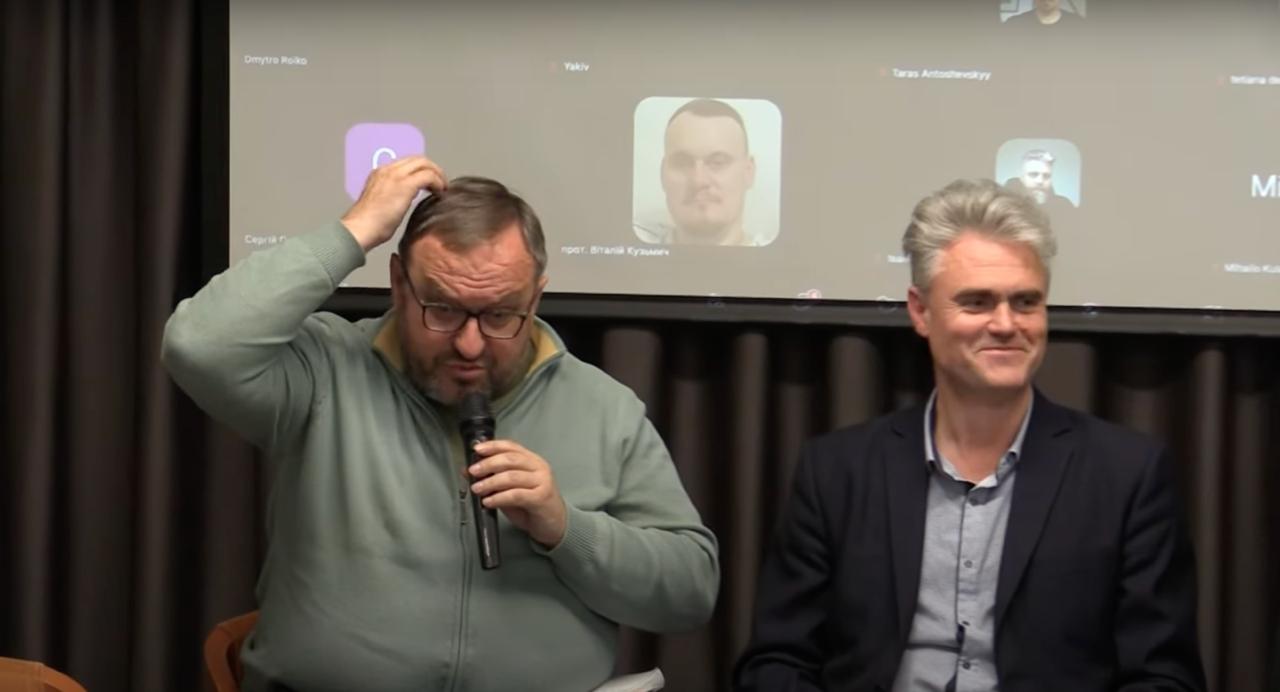
Response given during the panel discussion at the Round Table “Contemporary Ukrainian Orthodoxy: Debunking Myths for the Reconciliation of Orthodox Christians in Ukraine,” held on April 29, 2025, in Kyiv as part of the enlightening-analytical project “Contemporary Ukrainian Orthodoxy: Debunking Myths for the Reconciliation of Orthodox Christians in Ukraine and the Consolidation of Ukrainian Society,” organized by the Sophia Brotherhood with support from the Renovabis Foundation.
Volodymyr Bureha (UOC): I would like to make sure one important point isn’t lost. On the one hand, the title of today’s panel includes “Debunking Myths.” What the St. Sophia Brotherhood understands by this was more or less expressed in the words of Hennadii Khrystokin. But Oleksandr Filonenko said he does not believe in debunking myths — it came across as a thesis. Therefore, a natural question arises for Oleksandr Semenovych: could he expand on this idea? Because here we see a clash of two approaches. Should myths be dismantled or not? How should we approach them?
Oleksandr Filonenko: Today, my barber told me he wanted to become a sommelier. His friend said to him, “Zhenia, that’s very risky — you’ll end up drinking only expensive wine.” It’s the same with myths. I teach the theory of myth and understand how dangerous it is to use the word “myth” as a synonym for prejudice. We already went through that in the 20th century. One of the problems of modern culture, as I see it, is that we have destroyed our myths. Contemporary Europe has no myths — and that’s a serious issue, because there’s no meta-narrative. When we try to do the important work of deconstructing all myths, we end up deconstructing our foundational narratives as well. And that is a worldview crisis. “Let’s dismantle worldviews and see what happens.” Nothing will happen — we will only see ruins.
So for me, the intention is quite sincere, but the response is lacking. In other words, the path of overcoming myths is not very constructive. For me, a more constructive path is the path of witness. When each jurisdiction, each community demonstrates something of value — not only for Christian communities, but for the entire world. If we have nothing to show to others, nothing to bear witness to, then that community has no reason to exist. We are all meant to be witnesses, not carriers of myths, prejudices, or closed worldviews. And that is a very, very serious issue.
Hennadii Khrystokin: What did we mean by “myth” and “overcoming the myth” in the concept of this roundtable? Of course, we are by no means talking about dismantling the foundational Christian narratives. No, they remain, and each Orthodox confession should preserve them. But when we talk about destructive, harmful, exclusivist narratives, we have chosen — for ourselves — to call them “myths.” In this case, “myth” refers to distortions of reality, to cognitive biases, to prejudice. And in that sense, such myths at the very least need to be identified.