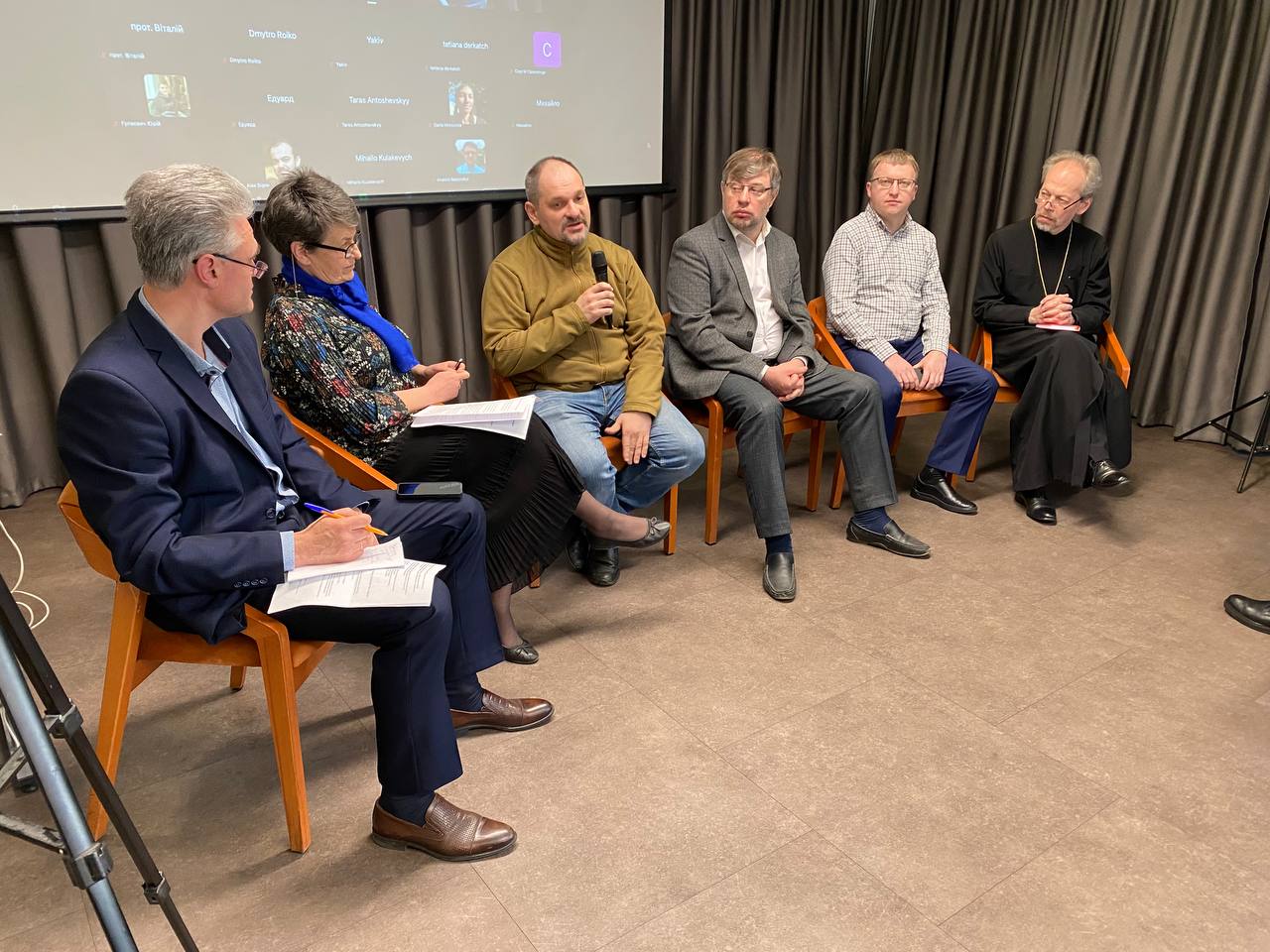
The most significant event of the Easter period in the socio-religious life of Ukraine was undoubtedly the Round Table and panel discussion within the framework of the project “The Contemporary Ukrainian Orthodoxy: Myth-Busting for the Reconciliation of Orthodox Believers in Ukraine and for the Consolidation of Ukrainian Society”, organized by the Sophia Brotherhood.
It is a rare occurrence nowadays that representatives of the Ecumenical Patriarchate, the Ukrainian Orthodox Church (UOC), and the Orthodox Church of Ukraine (OCU) (clergy, civil servants, scholars, journalists, and ordinary laypeople) gather together to discuss, among other things, the challenges and prospects of Orthodox reconciliation in Ukraine and the overcoming of inter-jurisdictional prejudices (some participated remotely). The presence of representatives of all branches of Ukrainian Orthodoxy made it impossible for the event to turn into a collective condemnation of one jurisdiction alongside the glorification of another. Participants spoke honestly and openly about current problems in the Ukrainian Churches — both common issues and those specific to individual jurisdictions.
The first problem, common to both dominant Orthodox Churches in Ukraine, was voiced by the Rector of the Volyn Orthodox Theological Academy (OCU), Archpriest Volodymyr Vakin. According to him, “all jurisdictions suffer from the phantom pains of administration in the Moscow style.” This, in Father Volodymyr’s view, threatens to transform Ukrainian Orthodoxy into “the Russian Orthodox Church version 2.0.” As one example, he referred to the Statute of the Orthodox Church of Ukraine, which prescribes, among other things, the procedure of the Synod’s work — the discussion of documents, formation of the agenda, consideration of candidates for the episcopacy, and procedures for the approval of decisions. However, he noted, these rules are difficult to implement in practice, because the model itself is not inherent to Ukraine. At the same time, the priest emphasized, the culture is growing. And precisely here, the role of theologians, clergy, and laypeople is especially important.
The problem of the discrepancy between theory and practice in our Churches was further developed by the Head of the Department for Religious Affairs of the State Service of Ukraine for Ethnopolitics and Freedom of Conscience, the religious scholar Viacheslav Horshkov:
“The Churches have created in the rest of society the image of the ‘ideal church.’ But the problem is that they themselves do not correspond to this image. And if a community that claims to be the bearer of high values, at a critical moment, when it must not only declare these values in the form of beautiful medieval formulations but practice them at the proper level, fails to do so, then it effectively acknowledges that it has hopelessly fallen behind its own standards. And very often we see that people who belong to other worldview traditions (not only religious ones) are, even by biblical standards, more righteous… In the course of my official duties, I have to communicate with various representatives of different religious communities. Especially after the full-scale invasion, you hear of such cases that you think: if such a person had lived ten centuries ago in the Christian Church, most likely he or she would have been canonized. And this may be a member of the Society for Krishna Consciousness, or a Muslim, or a Jew, or someone else.”
Professor of the Kyiv Theological Academy (UOC) Serhiy Bortnyk reminded that, according to sociological surveys, within two years the number of Orthodox believers in Ukraine decreased from 62% to 55%, while the number in other denominations almost did not change. Instead, the number of those who do not consider themselves religious at all increased by almost 7%. This leads to the sad conclusion that the increase occurred precisely at the expense of former Orthodox believers.
Although, religious scholar Viacheslav Horshkov arrives at completely different conclusions:
“When we talk about the decline in sociological data regarding the Church, to be honest, I do not believe in a real decrease in the number of Orthodox believers. For me, it is simply a sign that the number of sympathizers of Orthodoxy, or supporters of one or another Church, is decreasing.”
The absence of internal Church sociology, according to the scholar, is a serious problem:
“Protestants, if asked how many members they have, can give an exact number down to a single person. But when we talk about the Orthodox, we rely on data from the Razumkov Center or from other specialists. For example, when there are festive liturgies, who provides the figures for how many people attended the Christmas or Easter service? The police! But does the Church really not know how many people come to them? And how many of these people are occasional visitors, and how many are parishioners? How many members are there? For a long time, it was advantageous for someone that there was, excuse me, this mess in Orthodoxy, no order. And now we are faced with these scandalous situations. Because it is not the state that should have ensured order in the Church. The Church itself was not interested in ensuring that there was order within it.”
The acute contemporary issue of two parallel jurisdictions was raised by Professor Hennadii Khrystokin (Kyiv). However, he himself does not consider this fact to be a major problem:
“In Ukraine there is almost no religious confession that does not have several branches, several internal confessions. When does the problem arise? The problem arises when we begin to forcibly construct one Church, one confession. It seems to me that this typical Ukrainian situation of diversity, pluralism, openness, and coexistence — the parallel coexistence of different movements, confessions, groups, religions — is an absolutely normal experience for Ukraine. Therefore, we must preserve these two identities without those destructive actions that actually prevent them from being the Church of Christ. They each have the right to their own interpretation of the Ukrainian Orthodox tradition. With the sole condition that it is not such an interpretation that produces conflict, dispute, internal information warfare, and clashes.”
Although most participants of the meeting consider the current “two-Church situation” in Ukraine abnormal. In particular, one of the representatives of the UOC raised this problem:
“Both structures (the UOC and the OCU – editor’s note) perceive themselves as self-sufficient, within which everything is fine. Neither of these structures internally feels the need to join someone else or unite with someone else in order to become complete. It is like: ‘we are fine, we live a full Church life, and the issue of unity is something external to our self-sufficiency. It is something optional.’ And, in my view, this clearly shows that the biblical understanding of the Church is displaced in both jurisdictions. Because if we turn to the New Testament and read the Gospel of John, Christ’s high priestly prayer, then we hear there: ‘as You, Father, are in Me and I in You, may they also be one in Us, so that the world may believe that You sent Me.’ So what do we see? The witness of the Church about Christ as the Son of God becomes impossible if there is no unity among Christians. Christ says: if there is no unity among you, then the world cannot believe that I am the Son of God. Thus, the question of unity is not optional, it is a matter of the very essence of the Church.”
The problem of conflicts related to parishes transferring to another jurisdiction and the re-registration of Church property was only touched upon briefly, but participants repeatedly emphasized the inadmissibility of such actions in contemporary interconfessional relations.
Much more frequently, however, criticism was directed at the passive policy of the leadership of the UOC in the conditions of war. The first to raise this problem was Professor Yurii Chornomorets (Kyiv):
“The Ukrainian Orthodox Church must return to realism. Either autocephaly is proclaimed unilaterally, or as a result of consultations moderated by the Ecumenical Patriarchate. Canon law and the real situation do not allow for other paths… Any Orthodox people, if we look at history, in such circumstances proclaim autocephaly — and that is all. A genocidal war is being waged against the people, and you are the jurisdiction of the Ukrainian people, of the Orthodox of Ukraine… Why have you not proclaimed autocephaly? Everyone understands: if the UOC had appealed to Constantinople, even for some clarification regarding a canonical resolution of this question, perhaps a way out could have been found… The Ukrainian Orthodox Church declares that it has somehow distanced itself from Patriarch Kirill. And then, for example, Metropolitan Feodosii of Cherkasy appears, who not only commemorates him, but who says explicitly, clearly, during his sermon, that our duty is to preserve the single spiritual and canonical space that has existed here for a whole millennium, whose center was initially in Kyiv, then in Moscow, and that we must preserve this unity. The reaction of the Synod? Zero. Is a Council of Bishops convened? Is he suspended? Nothing of the kind happens.”
The appropriateness of maintaining any connection at all with the Russian Orthodox Church, as well as the permissibility of commemorating the Primate of the Russian Orthodox Church during worship (which, unfortunately, still happens in some UOC parishes), was commented upon by one of the UOC representatives:
“If the public statements of the leader of the Church contradict Christian morality — one must not appeal to the canons, one must appeal to the Gospel. He loses legitimacy. If statements are made that clearly contradict the Gospel, then we do not need to search for the canon of a council under which this falls. The canons are in this case secondary. They regulate our Christian life, if we are Christians. Therefore, in my opinion, the question of commemorating the Patriarch, of obeying him — that question was already settled long ago, in the first two weeks of the war, when his position of supporting the war became clear, he lost his legitimacy as a pastor for us. This question, one might say, is settled.
If the Church, in wartime conditions, submits to a person who clearly, unambiguously, publicly expresses anti-Gospel ideas, then that Church puts itself at risk of losing itself as the Church. That is to say, it is not about preserving canonical connection. On the contrary, if we preserve the connection, then we lose the connection with the Gospel.”
Especially interesting were the thoughts of both the speakers and other participants during the discussion when the conversation turned to the contemporary Church: what it should be, and what, unfortunately, it is not.
“In the twentieth century, places where the Orthodox were a minority became those where the Orthodox manifested themselves most actively — in the sphere of social or academic activity. For example, America, France. The Orthodox in France are a minority of minorities, but in fact, they contributed to the influence of Orthodoxy in the world far more than all the Christian peoples where ‘50 plus’ percent of the population are Orthodox.”
— Danylo Leleko, philosopher
“If we look at the whole history of Christianity, the communities, the religious movements, the dialogues that have been alive are those aimed at common service. Orthodoxy suffers from such a disease — it is characteristic of all Christian confessions, but in Orthodoxy it is very, very intense — the disease of closing in on itself. The Gospel imperative is forgotten, that the Church is the community of Christ’s disciples who are called to serve people in this world.”
— Yurii Chornomorets, philosopher
“In most traditional historical confessions, a person who comes to a worship service as if to some concert or performance says to himself: I am coming to church to relax. I am not ‘gathering as the Church,’ I am ‘coming to church,’ because there I rest, I enjoy the atmosphere. I compare my psychological states when I ‘rested’ at a liturgy and when I ‘rested’ in a philharmonic hall under high-quality music — and it becomes practically identical. But the same thing can be done in nature, in the forest, and so on. Only that charisma will be missing which is revealed precisely in the community, precisely in communal fellowship.
I decided to conduct such an experiment — I suggested to a group of my volunteers, with whom we went for social ministry, to pray not with a formal prayer, but to express prayer in their own words. Those volunteers who joined our movement from Protestant churches (yes, this is an interesting experience, because our ministry brings together believers from the UOC, the OCU, and Protestant denominations) had no difficulty in expressing prayer in their own words.
But simply to say even a few words (for example: ‘God, I thank You, I love You, I deeply care for our soldiers’) — not one of the Orthodox believers was able to do so.
It seems to me that we are missing a certain component that was present in the fellowship of the first Christians, who were able to gather as the Church — not to come to the church, but to gather as the Church. To recognize these gifts, to discuss them, and to explore them.”
— Priest Oleksii Kulakovskyi, UOC
“I look at the UOC with great hope, because it is a multitude of living parishes, living priests, laypeople. And that is why I am puzzled why there is no break with Moscow. The Church is very healthy, very wonderful, very full-blooded, but it constantly ties its own hands and begins to push itself into this Moscow well and drown itself there in that swamp.”
— Yurii Chornomorets, philosopher
“I have friends, there is a priest who entrusted his children to the Salesian Sisters in a Catholic school. And do you know why? Because the Orthodox have not managed to create even a single school in the city of Kyiv. And this is a very vivid sign that we are losing the essential nerve that should exist among the Orthodox — mission.
Our parish a year ago fully switched to Ukrainian-language worship, fully reformatted itself. But now former parishioners walk around the neighborhood spreading information that we are graceless because we serve in Ukrainian. We are not open. Society does not see in our churches a space of safety, a space of inspiration, a space of ordinary human openness where we could speak on any topic. And we must talk about this. We must not stop. We are in a terrible crisis — all of us. And in order not to be finally atomized on the land of our native country, we must talk and work. There is no other way, no other path anymore.”
— Archpriest Ioann Tronko, UOC
“In fact, any dialogue, even if it is based on some very distant prospects — there is a great need for it. Why? Because the first thing dialogue does now is inoculate against that very exclusivism, which we talked about, that it is one of the reasons for the division of Ukrainian Orthodoxy. That is, we are in fact implementing the second commandment — and in this lies the law and the prophets.”
— Tetiana Derkach, journalist
Of course, today the Ukrainian Orthodox community is experiencing far from the best of times. Not having internally recovered after the atheist epoch, throughout the entire post-atheist period it has suffered from internal division, devoting almost all of its physical, material, intellectual, and spiritual resources to fighting with its fellow believers. In words, all Orthodox hierarchs love to speak about peace and concord among brothers in faith, but beyond words this process never advances.
The Sophia Brotherhood is the first organization in Ukraine that has begun to take, albeit small, but concrete steps in this direction, holding inter-Orthodox meetings, round tables, and seminars. And although events such as the present one remain almost unnoticed even among Orthodox Ukrainians, yet as one of the participants of the current Round Table noted: “A soldier who shoots from a trench also seems to have no impact on the defeat of the enemy. Yet it is precisely from such soldiers’ feats that our victory is forged.”