This presentation was delivered on April 29, 2025, during the Round Table “Contemporary Ukrainian Orthodoxy: Debunking Myths for the Sake of Reconciliation and Social Consolidation in Ukraine,” organized by the “Sofiyske Brotherhood” with the support of the Renovabis Foundation. The Sofiyske Brotherhood may not necessarily share the views of the speakers; likewise, individual opinions expressed within the project may not reflect the consolidated position of the Brotherhood.
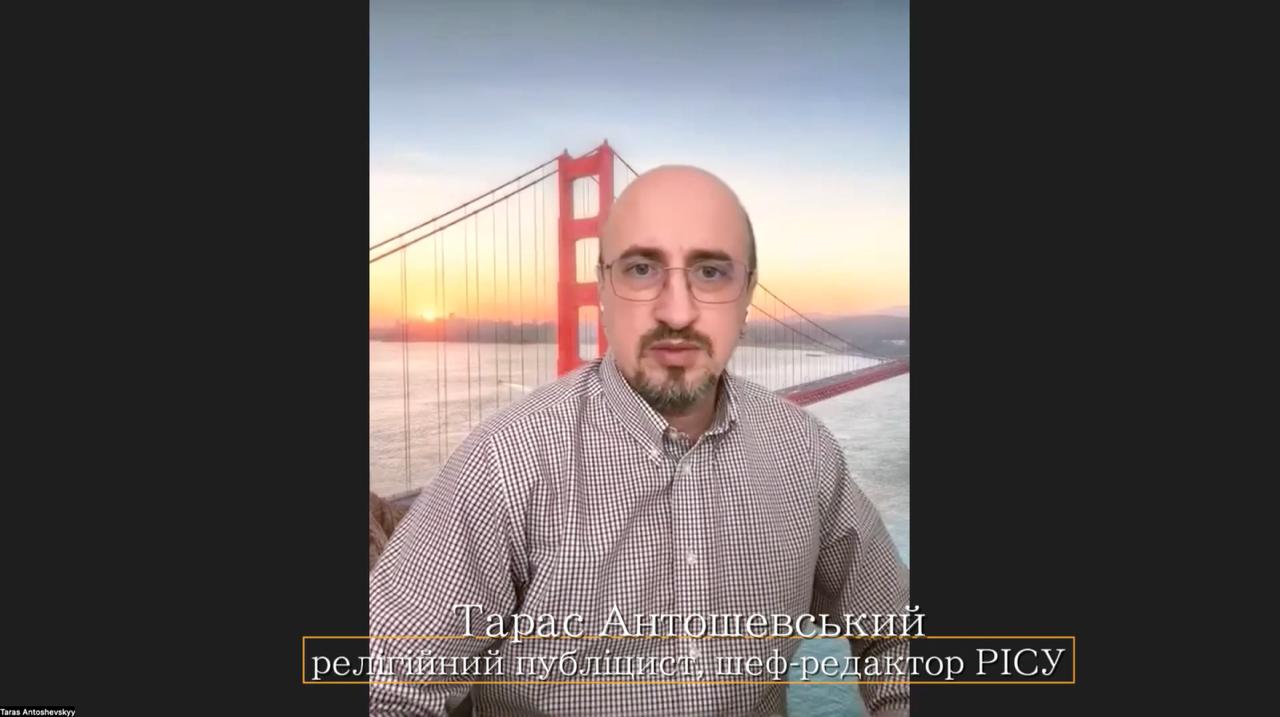
Taras Antoshevskyi, Religious Information Service of Ukraine
In the classical understanding, the media is meant to reflect what exists, as seen from the outside — a neutral gaze. The principle of the mirror: it is not the mirror’s fault if the image is unappealing. The principle of diagnosis: the doctor is not to blame if the patient does not like the diagnosis. This latter principle resonates more with me, as it implies an active role for the one making the diagnosis, not just passive reflection.
Unfortunately, the real world doesn’t function this way. Media can fail to represent reality, instead shaping perception — offering a version not as it is, but as someone… needs it to be. Social, anonymous, and biased media often intentionally construct an information bubble rather than a true depiction of reality. On one hand, we see a focus on trends, artificial sensations, and popular societal demands (often artificially fueled) — a visible side, a mass phenomenon. This has always existed. On the other hand, it’s about forming a worldview split into “us” and “them,” crafting a distorted reality, perpetuating prejudice and new myths. All for the purpose of manipulating audiences — sometimes, quite literally, in Orwellian fashion.
And what do media representatives see in the religious world? Some church figures strive to be an “open book,” some ignore the media altogether (believing they exist in a non-public realm), while others approach the media with prejudice or avoid open conversation. As a result, prejudices are formed about them. Can journalists trust church newsmakers, believe both official and unofficial spokespersons — especially those who speak obvious falsehoods, manipulate, falsify, etc.? Some may be indifferent and report it “as is”; others professionally document the falsehood; and some focus intently on exposing it. This last approach often appeals most to me — for when someone tries to hide the truth, to manipulate, the instinct is to expose them. Sometimes it is done so crudely that uncovering it is not difficult — and that’s exactly what investigative journalists, including social media channel authors, do. Their work may be unpopular, but they serve the truth.
For a journalist, it is a professional obligation to speak the truth — not what may be liked or disliked by the subject in question, regardless of their status, methods, or the nature of public institutions tasked with national security.
At the same time, mixing the righteous with the sinful in religious circles — which are still perceived as models of holiness — results in the whole sphere being seen as corrupt: “they’re all the same.” Sociological studies show a decline in trust toward the Church, despite its active social and public involvement. Moreover, there is a decreasing percentage of people identifying as Orthodox Christians.
Thus, it becomes vital to follow the rule of “separating the flies from the cutlets.” No matter how negative the environment, it is important to find a redeemable part — like in the story of Lot in the Old Testament — that can still be saved. If there is a part of the body that must be separated from an infected, damaged part that is ruining the whole — it must be done to prevent self-destruction. In the context of inter-Orthodox dialogue, adhering to this principle helps identify those with whom dialogue is still worthwhile — rescuing them from a toxic environment.
Conversely, it is impossible to engage in dialogue with, or sincerely accept, those who are carriers of the “Russian world” and work for its benefit. This is not just an ideology promoted by the Russian Orthodox Church, but a broader concept: a Russian model of church-state relations, a historical-cultural view of past and present, and an information-manipulation toolkit. This is an intrinsic evil, regardless of denominational affiliation.
So, what can be done? Awareness of who we truly are, readiness for change and self-purification, and openness to the world of information may yield results. The principle of building trust. Overall, journalists are generally on the side of good — but they must be convinced that honest dialogue is good.
There is a problem with perceiving dialogue as unproductive or insincere. Dialogue used for its own sake, or as a method to freeze the current situation. This is how some in society view the activity of the Brotherhood of Saint Sophia — as a dialogue intended to “talk through” inter-Orthodox issues without real effect, preserving the status quo. And this perception does not originate in the media alone — it comes from different perspectives. Some argue that dialogue with representatives of the UOC-MP is unnecessary if the Church should be banned and its buildings taken.
To “talk the issue to death”:
- We can talk and talk, but without the desire to change anything, to reach understanding, to be willing to sacrifice something or simply to hear and understand the other;
- When the foundation of dialogue lacks sincerity and the will to find common ground;
- When the goal is to preserve one’s position and the dialogue is merely a smokescreen to delay.
If dialogue does not extend beyond “dialogue for the sake of dialogue,” it will be perceived just as such. Like the collection of signatures to appeal to the leadership of the UOC — with no consequences and no break with those who ignored those appeals and protests.
The media world is, first and foremost, a reflection of societal trends. So the mirror is not to blame if you don’t like what you see in it. Perhaps it’s time for a cold shower? Or maybe one prefers to seek themselves in another world — the “Russian world.” The media, like society at large, expects sincerity and openness from participants in the inter-Orthodox dialogue — real results, not empty words; tangible steps toward social unity.