
This material was created within the joint project of the Sophia Brotherhood and the German foundation Renovabis titled “Contemporary Ukrainian Orthodoxy: Breaking Myths for the Sake of Reconciliation Among Orthodox in Ukraine and the Consolidation of Ukrainian Society.” The Sophia Brotherhood may not share the views of the authors, and certain opinions expressed by members of the Brotherhood within the framework of the project may not represent the consolidated position of the Sophia Brotherhood.
Kateryna Shchotkina
Why do parishioners remain in the UOC-MP? Despite the horrors of the Russian invasion, which has shifted from a war of attrition to a war of extermination. Despite the role that the Patriarch of Moscow, Kirill – the head of their church – has chosen for himself in this story. Despite the death of the argument about the “non-canonicity” of the OCU. Is the UOC-MP made up solely of “FSB agents”? Are they waiting for “their own” to arrive, or at least biding their time until the “others” leave? Is it about not being able to divide churches, sees, personal powers, and other perks? Of course, that plays a role. But these reasons cannot explain the phenomenon on a mass scale. That is why cancel culture does not work in the case of the UOC-MP. Deep in the shadows of high ecclesiastical politics are fairly large groups of believers who are breaking ties not only with the MP but often with the UOC as well, and yet are in no hurry to change jurisdiction – to join the OCU. They are ready to leave the church structure to which they belonged. But they cannot abandon their “heavenly homeland.”
Empires do not die simply because they have formally broken apart into independent states. They find ways to survive as a “shared space” – cultural, spiritual, linguistic. After their “end,” neither the Roman Empire nor even the Byzantine Empire truly died (the latter being a less successful project, though the conditions it faced were harsher). They survived as networks of spiritual ties that quickly spread across the space of the former empires – now a fragmented territory of partitions, conflicts, unstable political alliances, and blurred borders. They bound together this variegated fabric because they possessed a universal language, relied on a universal law, and offered a shared ultimate goal in the form of the Kingdom of Heaven. Only by detaching from the earth did empires gain the ability to preserve themselves as “soft power,” uniting in Heaven what had split apart on earth.
Moscow tried to follow this “Roman” path. The MP’s success in Ukraine in the early years of independence – its ability to preserve unity with Moscow and survive the defection of Metropolitan Filaret – is often attributed to “political mistakes” by one side and the massive influence of the security services of the other. That played a part, of course. But mostly it was the faithful of the UOC-MP who supported the Kharkiv Council rather than their former church leader – because here they were offered a “heavenly homeland” which, unlike the earthly one, fragmented and in crisis, had preserved its integrity, its stability, and had not been swayed by the gusts of changing political winds.
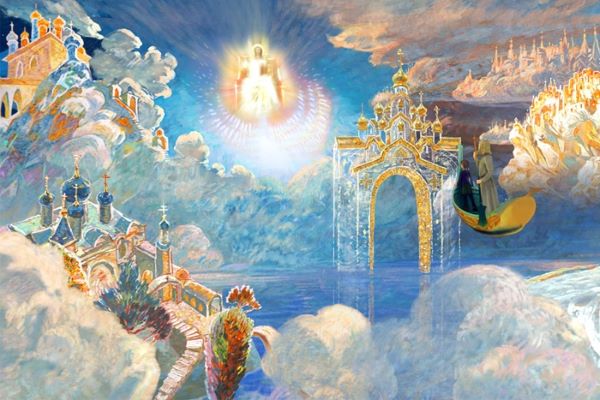
The myth of the “heavenly homeland” – Holy Rus’ – contained everything that many people found painful to lose in reality: the universality of empire, the preservation of ties, a shared language, the feeling of belonging to some great project aimed at a “bright future.” All of it lavishly seasoned with chosenness, the “special path,” and other Russian Orthodox self-admiration. And “apoliticality,” of course. The word “politics” was spoken with such disgust as if it were the name of the devil’s beloved mother-in-law.
The “heavenly homeland” shields one from “politics” – from the need to make choices and bear responsibility for earthly affairs. This is why it is valued. Within this mythological consciousness, earthly reality appears merely as an illusion, a mirage, an attempt to knock the citizen of the heavenly homeland off the “true path.” Even the dirty and tragic daily reality of war cannot seep into the borders of the “heavenly homeland,” because it is “not of this world.” The adherents of “canonical Orthodoxy” often use that biblical phrase describing the Kingdom of God in reference to their church. And thus – in their myth – canonical church, Holy Rus’, and Kingdom of Heaven become synonyms, merging into something single and indivisible.
Holy Rus’ has many markers by which one can verify one’s own and others’ belonging to the sacred space, untainted by “worldliness” (and by war as well): language, calendar, the pantheon of “our” saints, hagiographic folklore, pilgrimages to “places of power.” And since we are dealing with mythological consciousness, it is almost impossible to undermine these pillars through rational argument. The logic of myth resists formal logic, and attempts to break through to rational thinking rebound as if they were attacks by the very prince of this world. Rational thinking is treated as an assault on divine truth. For example, in one interview, Metropolitan Volodymyr (Sabodan) of Kyiv (UOC-MP) explained attachment to Church Slavonic this way: a sacred language is needed – one in which (you can be sure) no one swears. As if language were a single piece of fabric, and no matter how vast, it would be entirely soiled if someone blew their nose in one corner.
But unlike other “heavenly empires,” the Holy Rus’ project is neither self-sufficient nor truly spiritual – it is instrumental and entirely political. Muscovites are not Greeks. And not Romans. They cannot hold their face, their pause, or their distance. All “spirituality” (and indeed any “soft power”) in Russian hands quickly deflates and shifts to the more familiar and comprehensible mode of physical violence. Thus, the ethereal construction of the Holy Rus’ myth is repeatedly shattered because the reigning tsar – whether stupid, petty, malicious, or simply an undiagnosed psychopath – does not want or is unable to play with sophisticated toys. The problem with the Holy Rus’ myth as a Heavenly City is that earthly Russia (unlike either Roman Empire) actually exists. And its possession of nuclear weapons makes this myth even more hopeless. Why would one need “soft power” when one has the “Kuzka’s mother”?
After 2014, attempts to convince the world of “apoliticality” became simply laughable. Though the UOC-MP tried – and continues even now during full-scale war – to insist that the “conflict” has nothing to do with “Holy Rus’.” Everything is only bad here on earth – because here there is politics. But in Holy Rus’, there is no politics. Like there was no sex in the USSR. Whether or not there is politics in Holy Rus’ is beside the point, so long as politics contains Holy Rus’. When Patriarch Kirill linked the doctrine of the “Russian World” (Russkiy Mir) to Holy Rus’, he essentially came out of the closet. By working to promote the imperial geopolitical concept, the head of the ROC “brought down to earth” the heavenly homeland to show how the boundaries of the Russian imperial Heaven coincided with the boundaries of his, the Patriarch of Moscow’s, canonical territory. By preserving the integrity of Holy Rus’ – which exists only in the spiritual dimension, only in Heaven – the Patriarch preserves the empire in its earthly equivalent, claiming that the preservation of this empire within these borders has nothing less than divine sanction. The next logical step is to bless a war to carry out this “will of God.” And the Patriarch took that step.
Patriarch Kirill collapsed the dome of the “heavenly homeland” with the grace of an elephant in a china shop. It was so blatant and clumsy that when the time came to fully activate the Holy Rus’ mythology – in 2014 – the hit songs “Orthodoxy is apolitical” and “Holy Rus’ is something else” failed to impress the broader public.
Inside the UOC-MP, however, they did not lose their popularity. They continued to be performed with greater enthusiasm, the fewer reasons there were to believe in the shriveled myth. This was greatly aided by the fact that the primate at that moment was Metropolitan Onufriy – a kind of otherworldly “ideal monk,” a true citizen of the heavenly homeland, capable of utterly ignoring everything that happened on earth. He proved a real find for all who wished to believe in “apoliticality.” For him, resisting political reality so as not to “contaminate” church affairs was entirely natural. And he could inspire others by example: hold on to your “heavenly homeland” – it alone is worthy of trust and sacrifice! Some of the most “zealous,” having heard the A, rushed on to the rest of the alphabet, calling on Ukrainians not to take up arms, to refuse to participate in the “fratricidal war.” From the perspective of their “heavenly citizenship,” the war launched in 2014 was indeed “civil.”
Even now, when the myth of the heavenly Holy Rus’ is being blown to bits by every explosion, its adherents are in no hurry to part with it. One would think that the full-scale invasion should have destroyed it once and for all. But even if that is happening, it is far slower than expected – and not in the way one might wish. Not only because the myth adapts and mimics. But also because those leaving the spiritual ghetto called “Russian Orthodoxy” have no adequate replacement. Refugees from Holy Rus’ seek what they are accustomed to – another Heavenly City that could receive them. One just as universal, “not of this world,” yet familiar in language, content, and ritual.
Obviously, they cannot be offered a Heavenly Ukraine in place of Heavenly Rus’ – such a myth, even if it could be formulated, would not work as a substitute. And it could not really be formulated – what happens when “Heaven” is nationalized is evident in the ROC’s own example, which has turned Christianity into the religion of the “Great Victory” (this could serve as a warning to the OCU, though it will likely not hear it). Adapting Christianity to a national myth leads to its displacement in favor of a civic religion – in other words, total “earthliness,” against which the “refugees from Holy Rus’” protest.
Ukrainian Orthodoxy has historically been rooted in the community – this protected it from detaching completely from earthly life, from flying off into escapism. By contrast, the OCU has no safeguard against becoming a civic religion.
Thus, the “transition” for the “migrants of Holy Rus’” means having to descend from Heaven – where they had always felt entirely comfortable and could even look down a bit patronizingly at those bustling about earthly matters without ever looking up. That is why they often choose to be “just Orthodox,” not connected to any specific church institution – this way they avoid involvement in a “political church project.” For them, politics remains an unacceptable, insurmountable obstacle on the path to the Light – even when the “apolitical” place no longer exists.
The dialogue problem that arises here is simple. The “Holy Rus’ migrants” accuse the OCU of being “politicized,” “politically biased,” or even of being a “political project.” This is unacceptable to them. On the other side, the accusation is that “Holy Rus’” is an even worse political project. That charge is not without merit. But it does not work. Not only because reason does not work against mythological consciousness. First, there is no point in measuring who is more or less politicized – there is no point in measuring at all if one truly wants to reach agreement. Second, it makes little sense (apart from noise-making), because these accusations are usually aimed at people who have already severed their ties with “Holy Rus’” or are at least preparing to do so.
As for those still clinging to their myth, we currently have no peaceful means of persuasion. Why look for and invent a spiritual antidote when you can simply throw them out of the churches?..