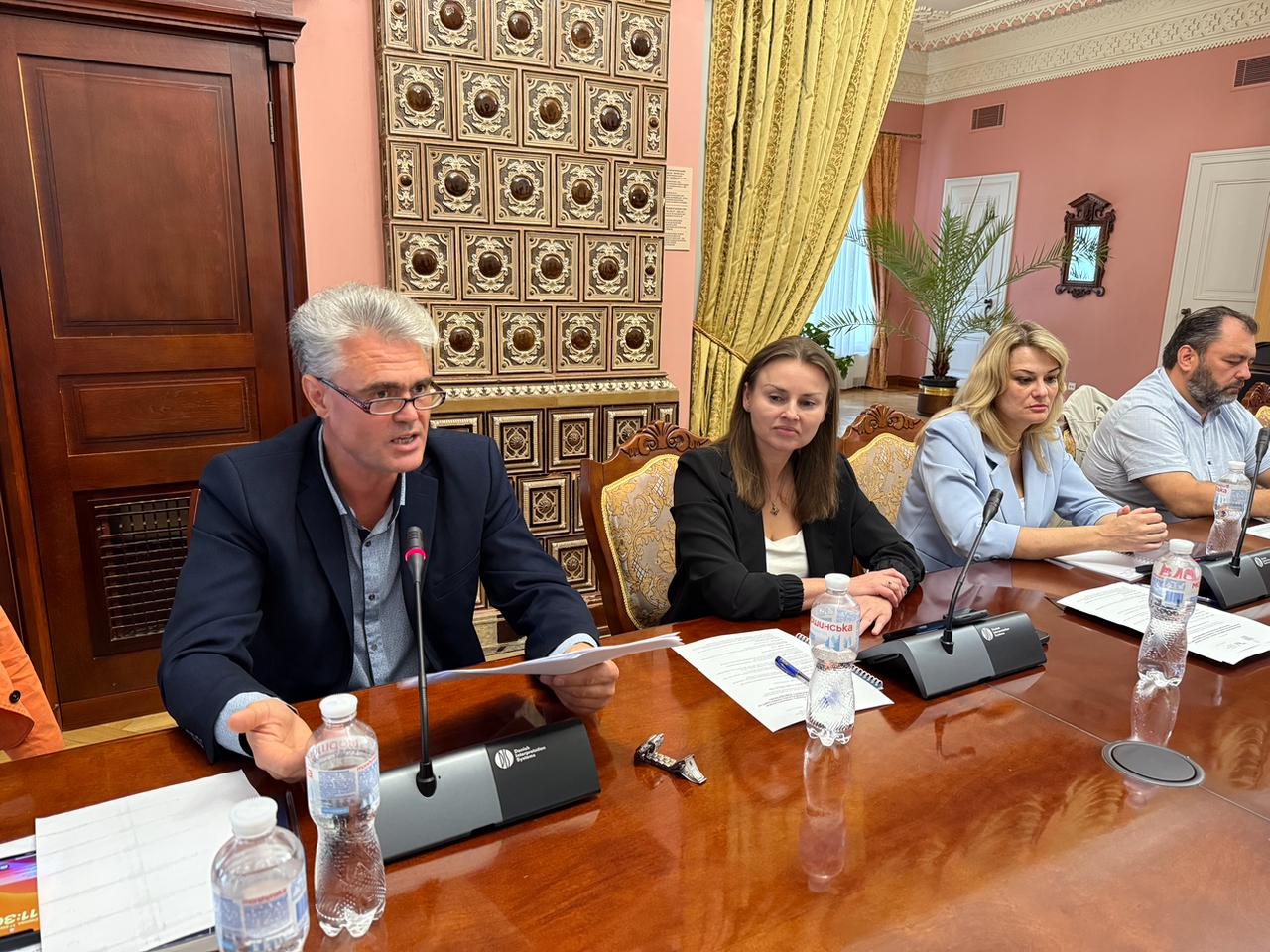
Paper presented on 17 September 2025 at the Round Table “From Debunking Myths to Seeking the Common Good: Contemporary Dialogue Initiatives in Ukrainian Orthodoxy and Prospects for Post-War Renewal”, organized by the “Sophia Brotherhood” with the support of The Centre for Humanitarian Dialogue (HD), held within the joint project of the “Sophia Brotherhood” and the German foundation Renovabis, “Modern Ukrainian Orthodoxy: Debunking Myths for the Sake of Reconciliation of the Orthodox in Ukraine and Consolidation of Ukrainian Society”. The “Sophia Brotherhood” may not share the positions of the speakers; likewise, some views expressed by representatives of the Brotherhood within the project may not reflect the consolidated position of the “Sophia Brotherhood”.
Hennadii Khrystokin, Doctor of Philosophical Sciences, Professor at the State University “Kyiv Aviation Institute”
I would like to sum up, to some extent, the work carried out by the Sophia Brotherhood over the past six months, which has been devoted to “debunking the myths” of Ukrainian Orthodoxy. I would also like to outline the perspective for further work and offer a kind of introduction to the next project that we would like to initiate and are currently thinking about. It concerns the role of Orthodox and, more broadly, of Christians in shaping the idea of the common good for Ukraine. In our view, these two themes are internally connected, and I will try to demonstrate this.
When we organized the “struggle against myths” project, we were not naïve; we saw that Orthodox believers live in their own worlds and do not hear or understand one another. Each side and each participant threw into the media space all their pain and their desire to defend themselves and their structure. Therefore, an important step and condition for establishing dialogue must be the awareness and overcoming of prejudices, attempts to think critically about one’s own position. This is a normal step and a normal requirement: if you want to achieve a result, put aside what hinders you, try to take into account criticism of your own position, listen to the other. This is a normal intellectual and Christian stance.
The Sophia Brotherhood “provokes” dialogue
A tremendous joint effort has been undertaken by the Sophia Brotherhood and its friends, for which I would like to thank everyone. This work has a visible result: we are demonstrating an example of constructive dialogue, offering paths toward mutual understanding; we have given all sides an opportunity to speak at all levels; we have invited to conversation representatives of various jurisdictions and experts with very different positions; we have not avoided acute problems; we have not shut ourselves off from uncomfortable questions. We ourselves initiated discussions and sometimes even provoked the Orthodox milieu into sharp reactions. There was no other way. It was necessary to lead the opposing camps out of a state of open quarrel, when emotions are off the scale, to shift the focus from polemics aimed at victory and the defeat of the opponent, and to bring them into a shared field of, first, discussion and then dialogue. We ourselves have shown real examples of dialogue on the “Viche” channel, in panel discussions, on social networks and in personal communication.
It is obvious that representatives of the Ukrainian Orthodox community are beginning to hear one another. Although slowly, more and more participants are becoming aware of the complexity of the situation and the impossibility of overcoming it without mutual concessions and mutual understanding. And although passions at the poles are raging no less violently, we see that more and more reasonable and balanced people, who are in pain but are interested in dialogue, are being drawn into the middle space between the extreme positions.
The position of the Brotherhood is indeed moderate and balanced. In fact, there is no single “party line” within the Brotherhood. Internal discussion, searching, and research are constantly taking place. We are developing, we are changing. Let me immediately note the particularity of the status of the Sophia Brotherhood: it is an interjurisdictional dialogue platform. And this is its uniqueness. As a rule, brotherhoods have always represented one jurisdiction and promoted its interests. The Sophia Brotherhood is an exception; it unites representatives of, in fact, three jurisdictions—in other words, it unites all Orthodox believers who support the idea of a Ukrainian, conciliar Orthodoxy in the Kyivan tradition. The Sophia Brotherhood is a civil society organization not subordinated to church structures; it serves as a kind of model of the Church of the future.
Anti-church myth-making by the Churches
Let us return to the overcoming of myths. It is not hard to see that freeing the Ukrainian Orthodox community from prejudices and stereotypes is very difficult. After all, myths in the consciousness of Orthodox Ukrainians form a multilayered imagined reality, where one myth flows out of another and passes into the next. To give an example: some representatives of the OCU (Orthodox Church of Ukraine) believe that the entire UOC (Ukrainian Orthodox Church) is an “FSB project” and that all faithful and clergy of the UOC are “agents of the Kremlin”. This is clearly a destructive myth that transfers onto the entire Church real cases of collaboration with the enemy by certain traitors. But this myth, in turn, is rooted in another, deeper myth, namely that the whole UOC is a bearer of the “Russian world”, and that it is a completely non-Ukrainian and hostile political organization. This is not true. Constant communication with the faithful and clergy of the UOC shows that among them there are very many completely adequate, pro-Ukrainian, patriotic people who care about Ukraine and fight for Ukraine.
And this is not the end of the conditional mythology of the OCU. Within the OCU there is a narrative that it allegedly has a historical mission and calling to create a “Ukrainian” Church in Ukraine that must oppose the “Russian world”. Here the Church is perceived as an organization that builds its own ideology on opposition to a hostile one. Besides, the Church appears here as a territory that supposedly has its own Ukrainian borders similar to those of the state. In reality, the Church has no borders; it should not be national (and even less ethnic), but it is local, a territorial community of the Church of Christ, present in the civic space of Ukraine just as it is present throughout the whole world. From an ecclesiological point of view, strictly speaking, there is no separate Ukrainian, Romanian, Bulgarian, or even “Russian” Church. The Church is one, catholic, but there are indeed jurisdictions, organizational and canonical frameworks of the one Body of Christ. The problem is that today the leaders of the jurisdictions often forget this, perceiving the Church instrumentally—as an extension of the national tradition or an attribute of the state. This widespread nation-centered and political myth is closely connected with another narrative, namely that the OCU has received the Tomos and is therefore the only canonical Church in Ukraine, to which the representatives/parishes of the UOC must or should be “attached”. According to this narrative, the OCU supposedly “possesses the Tomos” by some special historical and canonical right and in the name of historical justice. Yet in reality, as Patriarch Bartholomew recently noted in an interview for the France.tv channel and as Metropolitan Grigorios Papathomas wrote in his very important book Canonical Amorphisms, the Tomos does not belong to one jurisdiction; it has been given to the entire fullness of Ukrainian Orthodoxy. And indeed, at present it is the OCU that has accepted the Tomos and has a lawful autocephaly, but it does not own it, because potentially the Tomos is also addressed to the UOC, which is called to unity. As we can see, these myths are very intertwined, structural, and far too politicized.
In the UOC, in turn, there is a destructive myth about Holy Rus’ and the end times, which many believers and hierarchs profess. And this myth is closely linked with another, namely that the UOC, in the last times, is allegedly “persecuted by the power of the Antichrist”, with which they identify the Ukrainian state. The UOC as the “true Church” is supposedly destined to pass through the path of persecutions in order to be purified and attain salvation. In fact, no one in Ukraine persecutes the UOC on the grounds of Christian faith; every person has the full right to his or her own religious beliefs. However, the state cannot allow the existence of political convictions that threaten national security, and therefore a certain pressure on the UOC from society and the state is the consequence of its affiliation with the Russian Orthodox Church (ROC). Such demonization of the role of the Ukrainian state is synchronized with the perception of the OCU as a political organization that allegedly “is not a Church” and has not received real autocephaly. In reality, the OCU does have autocephaly and today it is the only Orthodox jurisdiction in Ukraine that has received autocephaly in a canonical way. Yet, as we have already noted, the UOC is also invited to autocephaly, and it depends on the UOC whether it will accept it or not. Therefore, we should not exaggerate the role of the aforementioned mythologies in the life of the Church, which is currently represented by two canonical jurisdictions performing their primary calling: to be a koinonia (communion) of the human person and the Church with God. At the same time, both jurisdictions clearly have pathological narratives; they support elements of a political, exclusivist mythology that closes them off to any dialogue. For this is the nature of a destructive myth: it shuts its bearer and the community off from reality, prevents them from seeing all the possibilities, and creates an illusion of the truth of one’s own imagination. That is precisely why it is appropriate to overcome destructive myths.
The ideologization of myths as part of semantic wars
In Ukrainian media and social networks the conflict of destructive narratives is extremely widespread. The discussions of supporters of both jurisdictions appear fully mythologized and ideologized. They use rational arguments, present logical reasoning, cite historical facts, but in fact, in the overwhelming majority of cases, they thereby only reinforce their own and their opponents’ exclusivist positions. The narrative conflict forms a closed-type rationality, within which the other appears as an enemy; all seemingly reasonable arguments become distortions and prejudices that only intensify mutual rejection. In reality, both rationality and facts always require interpretation; they are always woven into a context, into a particular “truth” of each side. And a person always proceeds from his or her own faith, truth and imagination, to which logic, facts and arguments are then added. Accordingly, the main problem of mythologically oriented thinking is not only the confusion of myth with reality and the lack of a sense of distance between them, but also the loss of understanding of the difference between myth and ideology. That is, the ideologization of myth—the notion of its non-alternativeness and truth—becomes one of the sources of religious conflict and, more broadly, of cultural and semantic wars.
Analysis and evaluation of the positions of the jurisdictions shows that in the OCU the ethno-centric myth of the Church-Nation (to use G. Papathomas’ terminology) is quite widespread, while in the UOC we encounter an eschatologically oriented myth of the Church-martyr of the last times, which nurtures the idea of a “return to the ideals of Holy Rus’ in the unity of the three brotherly peoples”. In fact, these are two versions of mutually opposite, closed, exclusivist mythologies, which violate the foundations of healthy canonical consciousness, do not correspond to the essence of the Gospel ideal, and destroy the basis of tolerance and civic peace in Ukraine. By its nature, the Church is open to the world, accepts cultural pluralism, and treats the positions of others with patience. Any attempts to politicize, ideologize, and instrumentalize the Church amount to forgetting its vocation. The discussion between the Ukrainian jurisdictions and attempts to demythologize it lead us to the realization that the Orthodox jurisdictions of Ukraine are in a state of a kind of ecclesiological illness. Grigorios Papathomas calls them ecclesiological and jurisdictional illnesses, which, unfortunately, are very widespread among Orthodox Churches. Ideologization and politicization, fundamentalism and ethnophyletism are widespread in many local Churches.
The mythologies of both jurisdictions were shaped from the very beginning as antipodes, and it is precisely for this reason that their bearers find it so difficult to enter into dialogue. As long as these mythologies actively confront one another and engage in conflict, they will only grow stronger, become more nourished, and the division will deepen. For the logic or dialectic of the struggle of mythologies is as follows: the more pressure is exerted on a myth, the stronger it becomes. The more we are convinced of the rightness of our own myth and insist on our myth as the truth, the more our opponent is convinced of the truth of his or her own myth. All our actions only confirm his or her rightness. For example, whatever representatives of the UOC may do in self-defense, for radical supporters of the OCU this will be proof of the actions of the “Moscow Church” seeking to defend the interests of the ROC. And whatever supporters of the OCU may do will be seen by radicals within the UOC as further proof of their gracelessness and politicization. I will go even further: one of the conclusions of our project is that pressure on a myth, the attempt to overcome it, strengthens it. To repeat, we do not deny the need to debunk destructive myths, but we recognize that by methods of direct, escalatory struggle the myth is not destroyed; on the contrary, there arises the temptation to overcome it with an opposite non-constructive ideology or to set up an opposite polarized “mirror myth” instead. Therefore, overcoming destructive mythology lies in a productive stance—returning to the Gospel, engaging in dialogue with the contemporary world, encouraging jurisdictions to serve society, inviting the Church to take part in shaping the idea of the common good.
The common good for Ukraine
I would now like to touch upon the theme of the common good for Ukraine and the role of the Church in shaping the idea of the common good. Today Ukraine finds itself in conditions of war, social transformations and the search for new ideas and projects aimed at the renewal of the country. We all sense crisis, despair, apathy; we see the disorientation of our citizens, and alongside this we see the heroism, courage and mobilization of the Ukrainian community, which is searching for reference points, ideals, virtues and values around which survival, victory and development become possible. The search for the idea of the common good is especially urgent for us. Therefore, it is so important for the Church now to show a civic position, to demonstrate responsible leadership and to offer its reflections on the healing of society, on the common good and on the future of Ukraine. The whole Church must manifest itself here, regardless of jurisdictions and confessional divisions; we all are the Church of Christ in Ukraine.
The idea of the common good is an important, one could say central theme already since ancient times. For Aristotle, the common good (koinon agathon) is not merely the sum of private interests, but the highest goal of politics, consisting in creating the conditions for justice, virtues and a dignified life for all. That which is common is the good aimed at cultivating civic attitude, solidarity and virtues. The common good surpasses individual benefits but does not negate them. It presupposes the unity of just conditions for the development of each person. The common good presupposes a space of solidarity in which the interests of particular groups do not destroy the integrity of society. It is worth recalling that the common good entails: overcoming divisions (regional, linguistic, religious); mobilizing society around defense, reconstruction and reforms; justice and trust—support for the state. The common good becomes such when citizens see that the authorities work not for “their own”, but for everyone; the common good is also integration, where each citizen feels protected. In essence, the common good for Ukraine today is the preservation of people’s lives and dignity, victory and rebuilding based on justice and solidarity.
Conditions for the peaceful coexistence of Ukrainian Orthodoxy
In addition, we need to speak about the real foundations for dialogue and unity of Orthodox believers in Ukraine. Under what conditions are dialogue and peaceful coexistence, and in perspective also the unity of Orthodox believers, possible? We are convinced that the Church’s active social and civic stance can contribute to dialogue and reconciliation within Orthodoxy. Dialogue and peaceful coexistence of Ukrainian Orthodoxy are possible on the basis of three main axes: the canonical, the state-legal, and the social-civic. All these axes are currently not fully accepted by the Churches, the state or society, and therefore there is no understanding among the main subjects of the conflict regarding the paths to unity. Without accepting these preconditions, Ukrainian jurisdictions will remain in a situation of conflict for a long time.
- Overcoming the instrumentalization of the Church.
- The Tomos as a space of unity and dialogue.
- The formation of the idea of the common good as creative cooperation of jurisdictions.
- Equal legal opportunities and freedoms for citizens and jurisdictions.
Let us elaborate these points in more detail:
- The Church is not an instrument of politics and ideology, just as ideology should not substitute for the theology of the Church. The tasks of the Church are not identical with the tasks of the state (empire) or the nation; therefore, the Church does not preach faith in the state, the people or the nation. The Church is the eschatological presence of Pentecost and the Kingdom, which is radically open to the world. The Church is a space of love and service.
- The Tomos as a space of unity and dialogue. It so happened that the Tomos, intended to overcome division, has deepened it. Yet here it is worth noting that it was not the Tomos itself that divided Orthodox believers, but its incorrect reception. We need to rethink our attitude to the Tomos. The autocephaly granted by the Ecumenical Patriarch must become a space for the unity of all Orthodox believers. This is exactly how Patriarch Bartholomew understands it: he opposes the privatization of the Tomos by a single jurisdiction and emphasizes that the Tomos proclaims autocephaly for the entire fullness of Ukrainian Orthodoxy, and therefore it constitutes a canonical space of unity for Orthodox jurisdictions. That is, potentially, the Tomos belongs equally to all Orthodox Christians of Ukraine, and the Patriarch has no intention of revoking it.
The Patriarch notes: “Our goal is to unite all Orthodox Churches of Ukraine, both Metropolitan Onufrii and Metropolitan Epiphanius, so that they might come together on the theological level and in everyday life, become one local church and be recognized by the other Orthodox sister churches.” The jurisdictions must gradually mature toward unity, for this is a process that presupposes mutual recognition and gradual rapprochement, not annexation or absorption. And this mutual recognition, which today appears rather problematic, must begin from below—from parishes, from personal contacts. Peaceful coexistence must become the norm for citizens at the everyday level; only then will unity become ripe and inevitable for the episcopate. Only thus can we become one Local Church, and only after that will we be “recognized by the other Orthodox sister Churches”.
- The idea of the common good for Ukraine. Besides the canonical dimension, the Church has an important social mission: to formulate an idea of the good that is in tune with the needs of society and the moral positions of Christianity. And since the Church is a space of freedom, dignity and responsibility, it is important to society through its moral authority. The Church is a prophetic voice, the conscience of the people. It is a social, not a political actor that influences politics while remaining outside the struggle for political power. It is a guide of civic activity and solidarity.
What kind of good capable of uniting society can the Church propose? Among the principles the Church is called to cultivate and defend, the Council of Crete in 2016 named as decisive: the dignity of the human person, freedom and responsibility, peace and justice, overcoming discrimination among people, and so forth. The social doctrine of the Ecumenical Patriarchate For the Life of the World: Toward a Social Ethos of the Orthodox Church (2020) proclaims the reality of civil order, freedom, human rights and democracy, and recognizes the priority of the human person over the state or nation. No interests of states, peoples or empires can outweigh the interests of the human person; no armed aggression or force is above the dignity of the individual. The wealthy must contribute to the common good; the state must create conditions for fair distribution, protection of rights and equal opportunities. The “common good” cannot be used as a pretext for imposing religious pressure or coercion. In that document, the common good is linked with concrete actions: fair taxation, fair wages, access to social services, and a system of social security.
So around which shared social goods can Ukrainians be united? Let us name the most fundamental among them:
– Human dignity and freedom (protection of life, rights and dignity of every person; non-interference of the state in the personal sphere; solidaristic freedom).
– Cultural pluralism and religious tolerance (rejection of hate speech; openness toward the experience of the other; freedom and diversity of cultures, confessions, religions and civic associations; unity in diversity).
– Healing and reconciliation (overcoming enmity; mutual forgiveness; memory without hatred; acceptance of the other’s traumatic experience).
– Responsibility for history (healing of historical memory; acceptance of the plurality of the past; responsible acknowledgement of past tragedies; multi-dimensionality of the past; responsible politics).
– Solidarity (mutual assistance; service to one another; care for the weakest).
– Depoliticization of the Church and society (de-ideologization of the Church, society and citizens; rejection of “leading ideologies”; rejection of exclusivism in politics and in the Church).
- Ukraine is our common home. It is no less important to unite Ukrainians around socio-political and state foundations. Here it is important for us to актуалізувати / bring to the fore the idea of a social doctrine of the Church, which we currently lack in Ukraine but which has been proposed by the Ecumenical Patriarchate in the document For the Life of the World. The documents of the Ecumenical Patriarchate positively evaluate the termination of the old pact between the state and the Church (the so-called “symphony” between them), because “the Church is interested in ensuring that the institutional connection of Christianity with the interests of the state be as weak as possible” (II, 13). The Church is not entirely apolitical; it “does not interfere in politics in the narrow sense of the word. Yet its witness is essentially political—as concern for the human being and his or her spiritual freedom” (VI, 16). Having no political tasks of its own, the Church is interested in direct and active “cooperation with the political and civil authorities and with state organs in the work of achieving the common good”.
Which state-legal and civic principles can and should the Church uphold? Such principles include:
– Justice and civil society (civic equality—no division of citizens into categories; just civil peace);
– The rule of law (justice, equality before the law, restoration of trust in the authorities);
– Subsidiarity (delegation of decision-making to the lowest effective level);
– Reconstruction and well-being (housing, work, a sense of protection by the state, security, development prospects, combating corruption, the feeling of Ukraine as the common home of all citizens);
– Growth of the country (development, project-mindedness and achievements of the country; the state as guarantor of rights and freedoms; responsible and lawful business; focus on the future, on achievements, on perspective).
Conclusion
The foundation for dialogue, peaceful coexistence and unity in Ukrainian Orthodoxy may be the position expressed by the Ecumenical Patriarchate: both Orthodox jurisdictions are equally canonical and, in the ideal dimension, already constitute the one Church of Christ. The refusal to accept this ecclesiological fact prolongs the conflict, the causes of which each jurisdiction sees in the other. The jurisdictions do not necessarily have to urgently form a single structure; the real history of Ukraine has always been plural. Religious diversity and the pluralism of different traditions, cultures and confessions are characteristic of Ukraine.
We propose looking at the relationship between the UOC and the OCU as a typically Ukrainian situation. History has produced dissimilar but valuable versions of Ukrainian Orthodoxy. Today these structures are in a state of painful conflict caused by the ideologization and politicization of the Church. Yet overcoming these illnesses and an important factor of dialogue and religious peace in Ukraine is the active participation of both jurisdictions in public discussion, in shaping and implementing a positive social ideal based on the values of civil society: dignity, freedom, responsibility, solidarity, law, and the common good. Only such joint, productive work can overshadow the conflict of myths and prejudices, foster dialogue and lead to peaceful coexistence and, in perspective, to the unity of Ukrainian Orthodoxy.