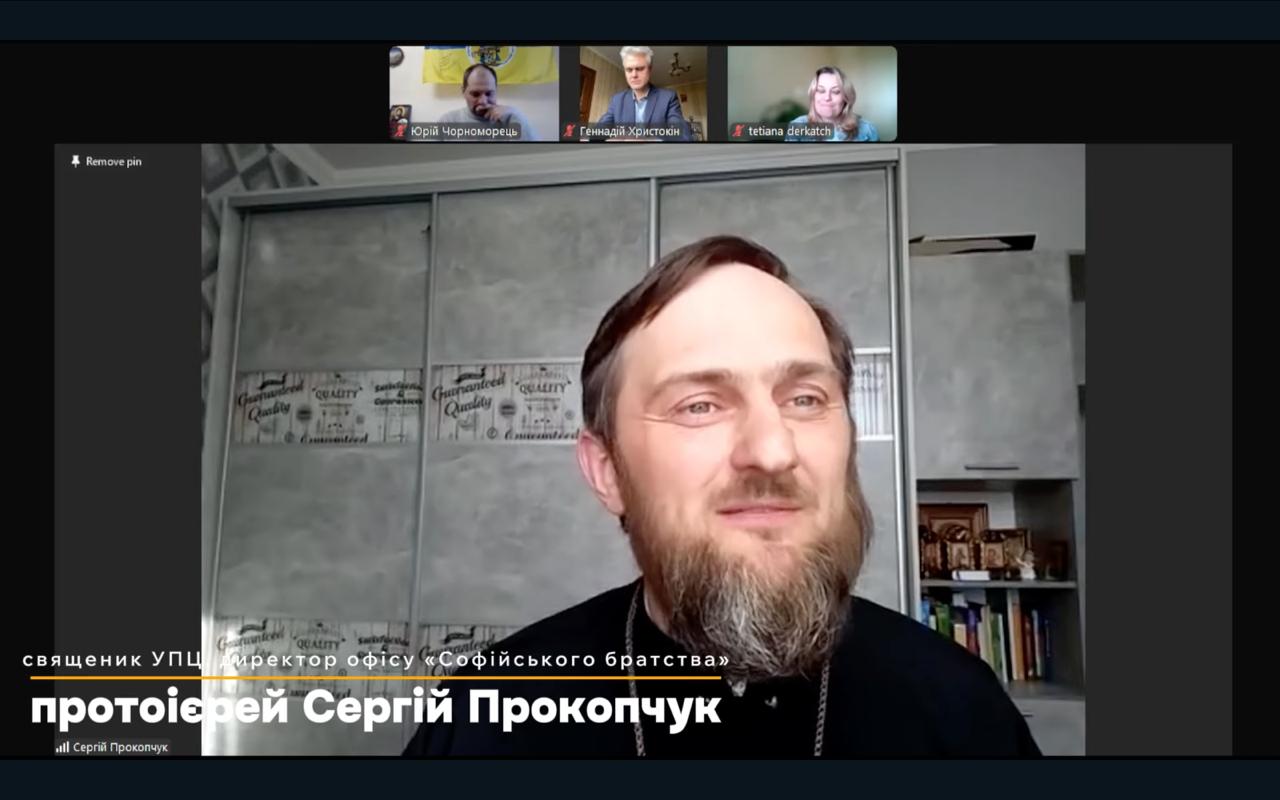
The presentation was delivered on April 9, 2025, during the webinar “Myths and Prejudices as Obstacles to the Unity of Ukrainian Orthodoxy”, held within the joint project of the Sofia Brotherhood and the German foundation Renovabis: “Contemporary Ukrainian Orthodoxy: Debunking Myths for the Sake of Reconciliation and Social Consolidation.” The Sofia Brotherhood may not necessarily share the views expressed by speakers, and some opinions voiced by members of the Brotherhood in the framework of the project may not reflect the organization’s official position.
Archpriest Serhii Prokopchuk, Director of the Sophia Brotherhood Office, Rector of St. Nicholas Parish of the UOC in Stara Rafalivka
The topic we are addressing in this webinar — “Myths and Prejudices as Obstacles to the Unity of Ukrainian Orthodoxy” — is of great importance for understanding the roots of the conflict that exists among Orthodox Ukrainians. In fact, it is essential for all of us to understand the essence of the “myth” phenomenon, to explore its origins and its influence on religious consciousness. We are encouraged that today we can analyze the mythologization of the religious environment at such a high intellectual level. We are grateful to everyone participating in the realization of our project.
As a parish priest, like many other clergy, it is very important to identify and investigate how myths influence parishioners, and what factors play a key role in shaping the religious mindset of Orthodox Ukrainians.
When a young, educated priest is assigned to a parish, he often faces the reality that what he was taught in theological schools does not match the actual life of the Church at the parish level. He observes how much real church life diverges from the idealized image of truth and piety he encountered through high-quality theological literature and relationships with educated and spiritual people. Ritualism, formalism, and mythological thinking are often dominant in parish life. Frequently, they are also the root causes of conflict within Orthodox communities in Ukraine.
Where do believers acquire this perception of the Orthodox faith? What are the most influential factors in shaping the religious environment? These are questions we all seek answers to.
There are many such factors. In my presentation, I will briefly examine one of them — the influence of the most popular information resources, which undeniably shape the worldview of specific church communities in the Ukrainian Orthodox Church (UOC), the Orthodox Church of Ukraine (OCU), and civil society.
Information Resources and Social Media Linked to the Ukrainian Orthodox Church
First, let us focus on resources affiliated with the UOC.
Well-known platforms such as SPZh (Union of Orthodox Journalists) and “Pershyi Kozatskyi” (First Cossack) have already been widely analyzed and criticized for their influence on UOC believers. These outlets have been banned in Ukraine due to editorial and journalistic ties to the aggressor state — Russia.
However, today I would like to draw attention to other platforms actively used by UOC clergy and laity — specifically Facebook-based resources.
There are several thematic public and private groups on Facebook, interconnected in various ways, with a combined following of nearly one million users — mostly UOC believers and clergy. I will list what I consider to be 15 of the most popular Facebook groups, and then offer a content analysis of the types of information being shared, as well as the patterns that unite these communities in the digital sphere.
These resources can be provisionally divided into three categories:
Group 1 – Directly Affiliated with the UOC
These groups explicitly identify with the Ukrainian Orthodox Church. Their names or admin profiles clearly indicate connections to UOC clergy or offices:
- “Ukrainian Orthodox Church” – 130,000 followers
- “Orthodox Faith. UOC” – 18,000 followers
- “Holy Trinity. UOC” – 33,000 followers
- “Orthodoxy with Onuphrius. UOC” – 14,000 followers
- “Pochaiv Leaflet” – 150,000 followers
- “Support Group for Orthodox in Ukraine” – 33,000 followers
These six platforms collectively account for around 400,000 subscribers.
Group 2 – Ukrainian-run Orthodox Communities for Local Audiences
These are groups run predominantly by Ukrainians, aimed at a Ukrainian Orthodox audience:
- “Spiritual Tuning Fork” – 166,000 followers
- “Glory to God for All Things” – 125,000 followers
- “Faith Eternal, Glorious Faith, Our Orthodox Faith” – 20,000 followers
- “Of His Kingdom There Shall Be No End” – 34,000 followers
This second group also includes a combined following of approximately 400,000 users.
Group 3 consists of resources administered by both Ukrainian citizens and individuals from Russia and Belarus. These groups are equally widespread in Ukraine, Russia, and Belarus.
- “Wise Advice of Orthodox Elders and Holy Fathers” – the largest group – 586,000 followers
- “Orthodox Wisdom” – 86,000 followers
- “We Are Orthodox” – 17,000 followers
- The total number of followers in this third group is approximately 700,000.
I would also like to highlight a recently emerged Facebook resource associated with communities of the Ukrainian Orthodox Church. This page is called “The World of Orthodoxy.” It currently has just 600 followers but is rapidly gaining popularity. It is entirely anonymous: no owner is identified, and all posts are published anonymously. Each day several text posts are published, often accompanied by bright images with eye-catching captions. The content typically focuses on topics such as: “Schism,” “Canonical Orthodoxy,” “Autocephaly,” “What is the True Church?” The tone of these texts reveals open aggression toward other confessions and jurisdictions. They denounce the actions of the Ecumenical Patriarch and representatives of the OCU. The posts are manipulative in nature, often containing false or distorted information about Church history and emotionally charged language. Though the number of followers is relatively small, each post is shared dozens to hundreds of times.
All of the above-mentioned platforms have a huge combined audience—over one million followers—and undoubtedly exert significant influence on both the faithful and the clergy of the UOC. Content travels freely from one group to another. A closer look at these pages reveals strong interconnections, shared content patterns, and even overlapping administrators. I would like to examine these patterns in greater detail, and I will attempt to do so briefly in the form of conclusions.
First, it is important to note that these platforms publish a very high volume of content daily. Each resource produces dozens of posts every day, which are quickly shared across other pages. This represents a high saturation of material.
Second, approximately 80% of the content on most of these resources is actually of a positive nature and emotionally resonant for believers. These include images of icons with quotations from Church Fathers, appealing religious illustrations, spiritual teachings of elders, and sayings of well-known figures from the Ukrainian Orthodox Church and global Orthodoxy, including the Russian Orthodox Church. Much of this content easily resonates with the hearts of the faithful.
Third, part of the content is focused on glorifying prominent religious figures. Leading the list is, of course, Metropolitan Onuphriy. Among other authorities celebrated in these posts are certain UOC bishops. They are held up as examples of steadfastness in faith; their teachings are shared and their sermons quoted. Posts also often feature figures from the Russian Orthodox Church or saints not universally accepted in Ukraine, such as the martyred Tsar Nicholas II, Prince Andrei Bogolyubsky, Alexander Nevsky, or Admiral Fyodor Ushakov.
Fourth is the anonymity of post authors. Even when administrators’ names are visible, examining their profiles reveals that other individuals may actually be behind the posts. In some cases—such as the group “Orthodoxy with Onuphriy. UOC,” with 1,400 followers—the content is managed by a person displaying signs of mental instability. This raises an important issue of accountability: who is responsible for the content shared in such groups?
Fifth, about 70% of the materials published on these platforms are in Russian. Ukrainian is used rather infrequently.
Sixth and finally, amid the large volume of spiritually positive content, certain posts stand out for their aggression, outrage, and harsh judgment. The information is often false or manipulative. A noticeable emphasis is placed on defending the faith against enemies and on “standing firm in the faith.” The emotional tone and judgmental rhetoric diverge sharply from the usual spiritual discourse that is constructive or uplifting.
So, let us try to analyze these facts and understand how these resources can influence the formation of conflict-prone mythological thinking.
Today, every person is exposed to an overwhelming volume of information available through various sources. This diversity of content—often emotionally charged and contradictory—causes many ordinary believers, and even priests, to feel completely lost and confused. That is why trust becomes the primary concern for the consumer of information. People ask themselves: “Which source can I trust? Who or what is an authority for me?”
If we analyze the resources mentioned above, we will see that they are dominated by content associated with figures who are highly authoritative for large segments of the faithful, primarily Metropolitan Onuphriy. When someone sees teachings, photos, or videos of their Primate on a platform, they are immediately more inclined to trust that source. Similarly attractive is content related to Church life—icons, sermons, quotations from the Church Fathers, and so on. It becomes very difficult for a person with a low level of analytical thinking to distinguish, amidst this sea of comforting spiritual material, information that may be false, aggressive, hateful, manipulative, or outright deceptive. The identity of the author or content owner fades into the background. The information consumer in such an environment does not usually ask who is responsible for the content or how it is curated. This kind of information ecosystem is ideal for spreading fakes and for shaping narrow, narrative-bound thinking.
Information resources connected to the OCU
Let us now focus on analyzing the information resources related to the Orthodox Church of Ukraine (OCU). These can also be divided into several categories:
- Official OCU media platforms
- Information resources and social media groups with anonymous ownership and administration
- Public social media pages of well-known figures in the OCU—popular priest-bloggers, chaplains, or active clergy members
We will not delve into the official OCU resources in this study. As with the official UOC platforms, these outlets typically do not stand out in terms of emotional or dramatic presentation. Their distinguishing feature is a generally one-sided interpretation of ecclesiastical or ecclesio-political events, especially those involving their own jurisdiction.
Special attention should be given to platforms where the authors or owners of publications remain anonymous. These typically feature content that is sensational in tone and emotionally intense—particularly attractive to readers who are drawn to dramatic and provocative material.
Information from such resources quickly spreads across the vast spaces of the internet. Often, these platforms contain a great deal of biased, judgmental, and even offensive material directed at their ecclesiastical opponents. Commenters frequently express anger, threats, and even calls for unlawful actions. One such example is the Telegram channel “Монолог.Здесь” created as a counterpoint to the well-known UOC platform “Диалог.Тут”
However, in our opinion, the most influential and widely followed platforms among representatives of the Orthodox Church of Ukraine—and even among those distant from the Church—are the information channels of popular church bloggers, priests, and activists. A particularly vivid example of information manipulation in recent times can be found on the Facebook pages of Fr. Roman Hryshchuk and associated groups of priests and activists from Bukovyna. He is a priest of the Orthodox Church of Ukraine who devotes special attention to what he calls the “holy mission” of “liberating Ukrainian land from the Moscow church yoke.”
He has been involved in most church property conflicts in Bukovyna. His social media pages have thousands of followers, and his video reports are widely shared. It is typical for him to label all Orthodox Ukrainians who do not belong to the OCU as enemies of Ukraine or agents of the Kremlin. In his view, they are to blame for the deaths of thousands of Ukrainian soldiers.
Such rhetoric is usually delivered in the context of funeral services for Ukrainian military heroes or during public meetings held to facilitate parish transitions to the OCU. Fueled by patriotic slogans and emotional appeal, this messaging easily resonates with listeners and leaves a lasting imprint on Ukrainian public consciousness.
Undoubtedly, this type of information provokes conflict within society and contributes to the formation of a narrative-based mythological mindset among church members and believers across jurisdictions.
Analysis of Secular Media
Unfortunately, the activities of secular media are heavily influenced by the position of the state and the messages voiced by its top representatives. The articulation of the state’s position by its various officials becomes the key theme picked up by the media. While in 2022, this theme was a call for unity in the religious sphere, by 2023–2025 it had shifted to a desire to identify the guilty and punish them. Instead of seeking out actual collaborators in cassocks or covert Kremlin agents, entire communities of Ukrainians belonging to a particular jurisdiction are labeled as such. This narrative is both reflected and amplified by secular media.
At times, it seems that certain media outlets attempt to facilitate dialogue between representatives of the two jurisdictions. But what comes of this? For example, a seemingly important public discussion was recently organized on “Suspilne. Bukovyna” between clergy of the UOC and OCU. The video on Suspilne’s YouTube channel has been viewed by over 200,000 people. Unfortunately, from the first minutes, the discussion devolved into a battle. The outcome was perhaps best described by artificial intelligence (as I myself struggled to find appropriate words):
“The dialogue reveals a deep chasm between the positions of the OCU and UOC representatives, rooted not only in theological and canonical differences, but also in mutual distrust, resentment, and the use of manipulative rhetorical techniques.
Both priests exhibit bias and an unwillingness to hear the arguments of the other side, turning the dialogue into a battlefield rather than an attempt at understanding. Manipulation, selective use of facts, emotional pressure, and inappropriate behavior are present on both sides, though expressed in different ways.”
These words reflect the real—rather than mythologized—state of affairs. And together, we must work to change it.
Video of the presentation: