This presentation was delivered on April 29, 2025, during the Round Table “Contemporary Ukrainian Orthodoxy: Debunking Myths for the Sake of Reconciliation and Social Consolidation in Ukraine,” organized by the “Sofiyske Brotherhood” with the support of the Renovabis Foundation. The Sofiyske Brotherhood may not necessarily share the views of the speakers; likewise, individual opinions expressed within the project may not reflect the consolidated position of the Brotherhood.
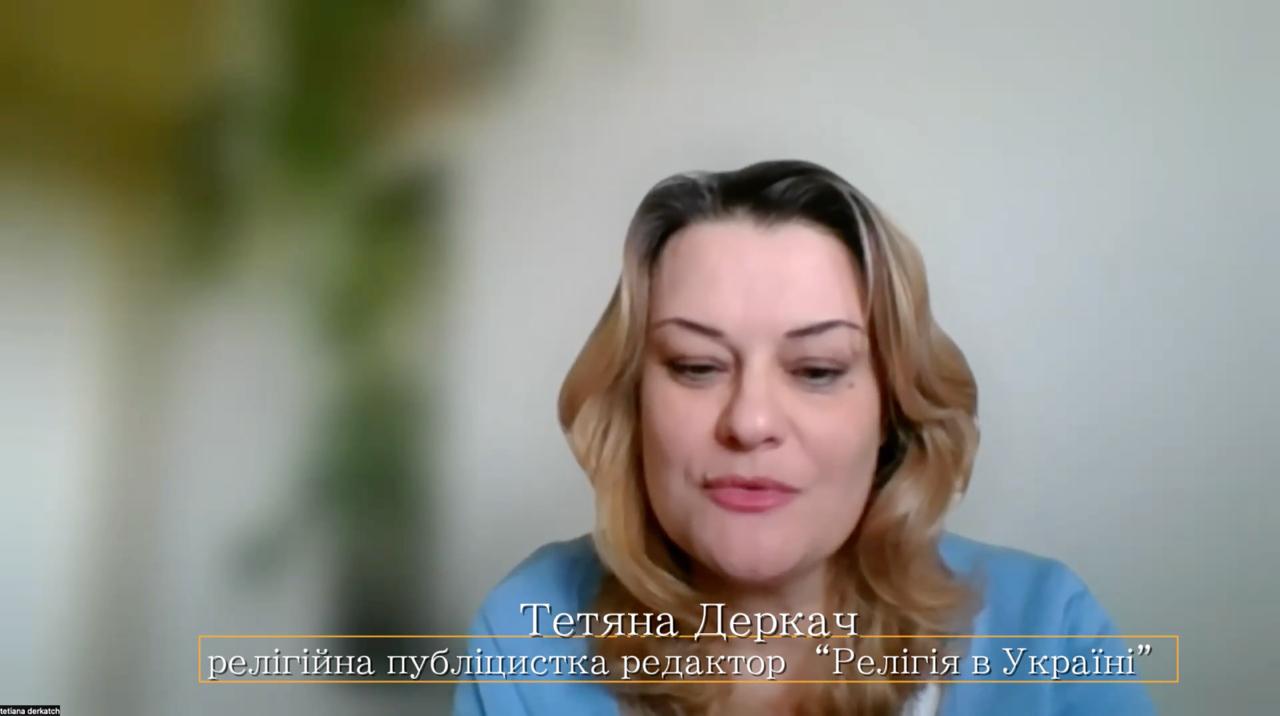
Tetiana Derkach, Editor of the “Religion in Ukraine” Portal
In Ukraine, religious topics are covered by three types of media: secular, jurisdictional (i.e., church-affiliated), and non-jurisdictional religious outlets. This creates two axes of contrast: between jurisdictional and non-jurisdictional religious media (both being specialized), and between secular and religious media.
Ukrainian media have often played multiple roles—being the third leg of the table, the fourth estate, and at times, the fifth column. Their role in covering religious events is significant. Media can catalyze important processes or, conversely, disrupt lives.
Choosing an Editorial Policy from a Vulnerable Position
Drawing from my experience as editor of the non-jurisdictional religious portal “Religion in Ukraine,” I was invited to develop a policy that would break from the traditional paradigm where religious media focus narrowly on church interests. The primary goal was to move away from the typical rhetoric employed by secular media.
Secular media often approach religious topics not as a core focus but as opportunities for sensational headlines and clickbait, which can be destructive. I was tasked with shaping the portal’s policy amidst a church conflict in Khmelnytskyi.
We decided to occupy a somewhat non-mainstream niche, placing us in a vulnerable position. However, I felt strong enough to consciously take this stance. The first step was straightforward: we refrained from appending “MP” (Moscow Patriarchate) to the name of the Ukrainian Orthodox Church (UOC).
This decision was risky and met with criticism. Some believed we were legitimizing the hidden presence of the Moscow Patriarchate in Ukraine. My rationale was the opposite: to legitimize the Ukrainian identity within the UOC, which is canonically linked to the Moscow Patriarchate. Having been part of the Kyiv Patriarchate since 2005, I observed that “MP” served as a counter-label to “KP” (Kyiv Patriarchate). With the establishment of the Orthodox Church of Ukraine (OCU), it seemed appropriate to refer to the UOC by its self-designation.
We also chose to avoid derogatory epithets like “Gundyaev’s priests” or “FSB sect.” Instead, we used formal titles for clergy and hierarchs, even for controversial figures like Patriarch Kirill, whom we did not refer to by his secular surname, Gundyaev. Our rhetoric aimed for academic neutrality and lexical balance, though we did not shy away from justified criticism of both conflicting jurisdictions.
Other media adopted a more confrontational approach. Personally, when I encounter headlines like “Gundyaev’s priests unlawfully seized a church that had declared a transition to the OCU,” I question the presence of manipulation or emotional bias.
We are currently facing a crisis in journalistic standards, evident even in how reputable Western media cover the Russian-Ukrainian war. There’s a lack of accountability for epithets, facts, interpretations, and predictions. I believe that presenting news neutrally, without manipulative language, is a basic sign of respect for the reader. Sensationalism in news reporting hinders critical thinking, which I view as a fundamental human right in the 21st century. Media today, at a semantic level, not only legitimize division but also entrench a state of hatred, leaving a challenging legacy for future generations.
I recall the aphorism by philosopher Grigory Pomerants: “The devil begins with the foam on the lips of an angel who enters the fight for a holy cause.” This seems apt in our context, where media cover inter-Orthodox conflicts. While our approach at “Religion in Ukraine” isn’t mainstream, over the past two years, readers have become accustomed to seeing “UOC” without the “MP” suffix in media not affiliated with the UOC.
However, circumstances can change. Recently, Russian Foreign Minister Sergey Lavrov included the preservation of all things Russian, including canonical Orthodoxy, among the conditions for peace negotiations. If such a condition becomes part of a “Grand Agreement,” it may necessitate the official renaming of the UOC, aligning it more explicitly with the Russian Orthodox Church. In that case, we would adjust our terminology accordingly.
I believe our chosen tone in covering religious news contributes positively. It doesn’t yield immediate results, as people need time to accept that a bishop of the OCU isn’t referred to in quotation marks. We often marginalize each other, which I find both inhumane and un-Christian.
The Need for Inter-Church Dialogue
When discussing dialogue between the UOC and the OCU, we face challenges. On one hand, there’s significant solidarity in society; on the other, it’s situational. The war has united people in support of the front lines, but for lasting societal solidarity, which underpins statehood, we need a shared vision of the common good. Currently, without dialogue, we risk forming a fragmented country where each group sees the nation as a means for its own existence, enrichment, and space, viewing others as outsiders or competitors.
We must look ahead, even just one step, to consider the post-war landscape. Despite declining trust in the church, as surveys indicate, churches should contribute to forming a shared cultural code for the nation. Presently, we have two churches with identities that exclude each other. Therefore, we need a third identity with shared components.
In this regard, the “Sophia Brotherhood” could serve as a foundation for this third Ukrainian identity. Without dialogue, we place our country in a globally vulnerable position. Even if we maintain territorial integrity and sovereignty (full or limited), Russia will not relent in five or ten years. Thus, we must eventually develop a common cultural code with the UOC, necessitating dialogue.
There are three stages of global development: war, competition, and partnership. While we’re not yet ready for partnership, we should at least progress from war to competition and establish rules for fair competition. Currently, we’re in a stage of ruleless competition, akin to placing nails in ballet shoes. We must pursue a more civilized path to avoid regressing through modernity to pre-modern times and the Middle Ages.
Furthermore, we must integrate the urgent need for dialogue into the global transformation that is already upon us. We need to study it, as the world will no longer be as it was in 2022, 2023, or especially in November 2024.
Is There Value in Dialogue for Its Own Sake?
Despite the complexities of inter-church relations, I advocate for dialogue as a value in itself.
There’s a significant need for any form of dialogue, even if its prospects seem distant. Why? Because dialogue serves as an inoculation against exclusivism, which is often cited as a cause of division within Ukrainian Orthodoxy.
Engaging in dialogue helps us fulfill not only the first but also the second commandment, encompassing the law and the prophets. We begin to see the person we’re conversing with as a neighbor, not an outsider.
Consider how metal balls are made: square rods are cut into cubes and placed in a barrel that spins at high speed. The cubes rub against each other, and eventually, we get uniformly calibrated balls. Similarly, people develop the habit and skill of dialogue through interaction.
We don’t need dialogue merely for its own sake, as it pushes us out of our comfort zones and forces us to refine ourselves against other rough “cubes.” There are various methods of conflict resolution, including shared positive experiences and rituals based on them. Look at local churches that engage in theological dialogues with different communities for years without visible results. Yet, the real outcome is that churches learn to befriend each other. Therefore, I support dialogue, even if only for the sake of dialogue itself.