This interview with the head of the Kherson Diocese of the Orthodox Church of Ukraine, Bishop Nikodim Kulyhin, is dedicated to the recent anniversary of Kherson’s liberation—November 11, 2022. Additionally, December 4 marks five years of Bishop Nikodim’s service in the episcopal rank. The Sophia Brotherhood congratulates Bishop Nikodim of Kherson and Tavriia on this upcoming milestone and thanks him for an open and heartfelt conversation.
The interview was conducted by Fr. Oleh Horbovskyi, a member of the Sophia Brotherhood.
A Brief Introduction to Our Interviewee:
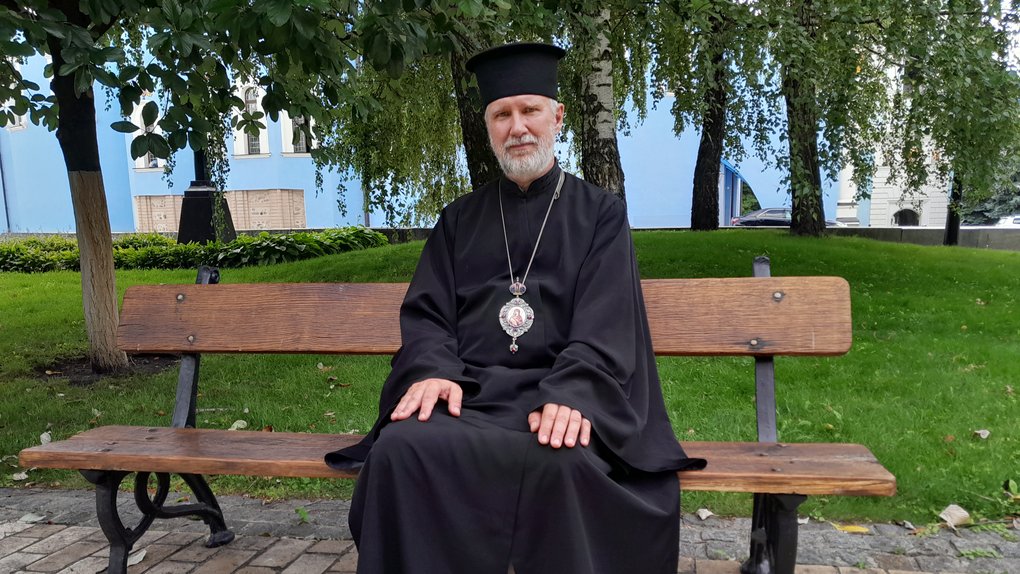
Bishop Nikodim Kulyhin (OCU), head of the Kherson Diocese, was born in 1968 in the city of Oleshky, Kherson region, into a military family. In 1986, he enrolled at the Moscow Institute of Physics and Technology (MIPT), graduating in 1992 with honors. However, he consciously chose a spiritual path as the focus of his life.
After completing his studies at MIPT, he returned to his native Kherson region, where he served as a subdeacon to the then-Bishop of Kherson and Tavriia, Ilarion Shukalo.
In 1993, he was ordained as a deacon, and in 1994 as a priest. In 1997, he earned a diploma from the Kyiv Theological Seminary. In the Kherson Diocese, he headed the chancery and served as secretary. Starting in 1997, he was part of the clergy of the Donetsk Diocese of the UOC, where he served in the cathedral, managed the chancery, and was the personal secretary to Metropolitan Ilarion Shukalo.
In 2005, he returned to the Kherson Diocese, where from 2007 to early 2019, he served at the Holy Spirit Cathedral of the UOC. For some time, he also acted as the spokesperson for Metropolitan Ioan Siopko of Kherson and Tavriia.
Bishop Nikodim became the first UOC priest in the Kherson region to join the Orthodox Church of Ukraine. He was also the first former UOC clergyman consecrated as a bishop in the OCU and the first diocesan bishop consecrated after the Unification Council.
During the difficult period of occupation, Bishop Nikodim made three attempts to leave Oleshky for Kherson. He survived the destruction of the Kakhovka Reservoir, which flooded his home. Acknowledging the challenging front-line conditions under which Bishop Nikodim continues to serve in Kherson, we extend our deepest gratitude for his willingness to share his reflections in this interview.
– Your Grace, many see you as a role model. Please tell us, where do you find the strength for your service? You spent, if I am not mistaken, a year and a half under occupation in Kherson and Oleshky. You are now in your second year as head of the Kherson Diocese, remaining under constant shelling while never abandoning your flock. Do you feel a special kind of strength within you? After all, not everyone could endure what you have gone through and continue to serve under such difficult conditions.
– “Not to us, Lord, not to us, but to Your name give glory, for Your mercy and Your truth.” (Psalm 115:1, Ukrainian Bible Society translation).
It is better to share my experience rather than present myself as an example. I am who I am. Inner balance, a sense of freedom, and peace come to me when I act according to the call of my heart and my convictions. This motivates me and gives me strength—whether it is for service, perseverance, or standing my ground to defend what I consider a personal privilege.
I serve God and the Church by vocation. Over the past 30 years, I have learned that when the Lord calls someone to serve, He also provides the strength for that service.
Yes, 508 days of my life were spent under Russian occupation. Before this, I saw such an occupation as one of the worst horrors that should never happen to me. I neither could nor wanted to prepare for it.
From the first hours of the invasion, we were occupied. It felt unreal—a stupor. It became impossible to plan anything, even deciding whether to stay or flee. Leaving would have been shameful for me while my flock remained amidst such suffering. If the Church is with its people, it must be so not only in peaceful times.
News of the Armed Forces of Ukraine pushing back the enemy eased the panic. I entrusted myself to God’s providence and entered the dark labyrinth of a 508-day occupation.
Most of our clergy also stayed with their congregations and continued to serve as best they could. My presence was important to them. We communicated, endured this together, and my words of encouragement or advice did not sound like empty slogans from someone disconnected from the reality they faced.
In Oleshky, I conducted regular services. For the people there, my presence was equally important. Knowing that I was doing something meaningful for people before God gave me a sense of purpose, which helped ease the burden of thoughts about my own safety.
On November 11, 2022, Kherson was liberated. We expected the swift liberation of the Left Bank, but this did not happen.
It became increasingly clear that staying in Oleshky too long could have dire consequences. Leaving behind my parishioners in Oleshky, with whom I had endured so much, was deeply painful. Yet, I needed to return to my episcopal duties in liberated Kherson, where my seat as bishop is located.
Amid discussions about the impending liberation of the Left Bank, it was challenging to plan my return to Kherson. I feared the scenario where I might leave Oleshky, only to be stopped at the border with Russia and unable to return. This would have left me stranded in still-occupied territory, cut off from both sides.
After enduring hours of interrogations, I realized there was no time to lose. With God’s mercy, I managed to escape. Crossing into Estonia marked the end of my time in occupation and the beginning of freedom.
I returned to Kherson for the same reasons that kept me in the Kherson region during the occupation. This is not just a combat zone—it is my diocese, my flock, and our clergy. As long as God allows, I will serve. Should that no longer be possible, God will guide the way forward.
– It seems you have had profound spiritual experiences that enable you to connect with people of diverse views and preferences. What principles guide your life, and what do you value most?
– Every person who is spiritually aware has a personal experience of their relationship with God. “To the one who is victorious, I will give some of the hidden manna. I will also give that person a white stone with a new name written on it, known only to the one who receives it.” (Revelation 2:17). This “new name” signifies the unique and intimate relationship between God and the individual, reflecting their special spiritual journey.
My guiding principle is to work where you are and with what you have. Engage with everyone God sends your way. I rely on my ability to sense people and my habit of treating them carefully and respectfully. In communication, I value sincerity and authenticity rather than mere diplomacy—but not to be confused with rudeness or vulgarity.
What I hold dear in life are God, the Church, family, Ukraine, human dignity, the beauty of God’s creation, and manifestations of human virtues, talents, and integrity. Material comfort has its place but comes only after all these.
I am satisfied when I manage to treat others as I would wish to be treated myself. I prefer the role of an advocate over that of a prosecutor.
However, I do not seek common ground with those who trample on human dignity, act deceitfully, or behave dishonestly. When kindness is mistaken for weakness, I first observe and then cease to be accommodating. Seeking common ground has its limits, defined by my principles and values.
– Your Grace, how do you understand the phrase “open Church”? What does it mean to you, and can this concept of an “open Church” be observed in the Kherson Diocese of the Orthodox Church of Ukraine?
– Christian faith is rooted in divine revelation: “I no longer call you servants, because a servant does not know his master’s business. Instead, I have called you friends, for everything that I learned from my Father I have made known to you” (John 15:15).
– Openness is inherent to Christ’s Church. The Church, understood as the closest grace-filled union between the living God and humanity, is “the pillar and foundation of truth.”
“No one has ever seen God, but the one and only Son, who is himself God and is in closest relationship with the Father, has made him known” (John 1:18). A Church centered on Christ cannot help but be open.
When we speak of the Church as an organization or denomination, we must not forget that God is holy, while we, as humans, are fallible.
No one can close the Church to a person except the person themselves. The key that locks it is on our side of the door. When we forget that Christ is the cornerstone of the Church, we risk blocking the entrance to the Church for those who might enter: “Woe to you, teachers of the law and Pharisees, you hypocrites! You shut the door of the kingdom of heaven in people’s faces. You yourselves do not enter, nor will you let those enter who are trying to” (Matthew 23:13).
Church life includes each of us living in the Church. Building an open Church starts with oneself. This requires personal experience of Church life, repentance as a reorientation from earthly priorities to heavenly ones, and understanding both one’s own and others’ frailties, with hope for God’s help. Without this, we risk creating a parody of the Church, reflecting all our internal flaws and distorted tastes.
I do not deny the importance of systematic factors, but they are not decisive. Consider the Synodal period of the Russian Empire, with all its peculiarities—it didn’t necessarily encourage personal spiritual growth. We are still dealing with some of its negative consequences. Yet few would deny that St. Seraphim of Sarov, who lived during that period, embodies the ideal of an open Church. He didn’t play soccer with students, join flash mobs, or strive to be modern. He simply was himself, wholeheartedly loving God and his neighbor.
Discarding Church traditions at one’s discretion will not transform a closed Church into an open one. Revisions must be reasonable. Traditions arise, evolve, and sometimes fade during the Church’s journey through time and space. I compare them to walls and partitions in a building that structure space for life. These can be wisely reconfigured to meet the needs of the time or recklessly torn down, risking the collapse of the building. And then, there will be nothing left to open.
It is not modernization that fosters an open Church but renewal, which continues and enriches the living Church experience of previous generations. Through preaching, worship, and service, it should become easier for our contemporaries to draw closer to God. This requires sincerity, engagement, education, personal experience of Church life, openness to people around us, and above all, God’s help.
If you wish to build an open Church, prepare for hard and meticulous work, and arm yourself with patience.
All this applies to the Kherson Diocese. During my time as bishop, especially over the past five years, I have reflected deeply on these issues. To me, the Church has never been an open-air museum. Arguments for the immutability of traditions never justified, for me, the use of the old calendar or the artificial Church Slavonic language in worship, as these fail to bring awareness to living relationships with the Creator. Faith must become a part of our daily life, expressed in our language and within our time—just as the Lord incarnated among us rather than waiting for us to ascend to Heaven.
– How has the Kherson Diocese changed since before the full-scale invasion? Do you maintain contact with members of your flock still under occupation? What is the mood among clergy and laity in both parts of the Diocese—those in temporarily occupied areas and those in liberated ones?
– Kherson has fully felt the devastating consequences of Russian aggression—occupation, torture, terror, rape, looting, destruction, shelling, missiles, bombs, drones—everything. Alongside the region, our Diocese has suffered the full impact of the war.
During the occupation of Kherson, more than half the clergy remained at their places of service, while others fled. After the occupiers were pushed from the right bank, they began relentlessly shelling the liberated territories from the left bank, targeting civilians. Living and serving in the coastal areas of the right bank is now nearly impossible. Churches have been destroyed or burned down. For instance, the church in Zmiivka, Berislav district, rich in history, was reduced to ashes after multiple strikes. In Kherson, some churches remain closed due to safety concerns. After the liberation of the right bank, even more priests were forced to leave due to the danger.
The population of Kherson and the liberated part of the region has decreased dramatically, with even more fleeing from the occupied left bank.
Almost all our clergy have left the occupied areas. We’ve lost contact with some. One priest remains, but communication is difficult. It has been a year and a half since he was banned from serving in his church. Yet, he somehow continues his pastoral work to the extent possible, though it is incredibly difficult for him.
On the Left Bank of the Kherson region, people suffer greatly under occupation. In both parts of the Diocese, people await the liberation of the Left Bank and the end of this nightmare. Those from the Left Bank speak cautiously, fearing surveillance. I know what they are enduring and how they cope.
– You may be the only bishop in the OCU (correct me if I’m wrong) who practices the audible reading of the Eucharistic Canon. Could you share more about this practice?
– In the Kherson Diocese, this tradition has been observed for 25 years. It was introduced under Archbishop Damian Zamaraev. I fully support it and hope it will gradually become a tradition throughout our Local Church.
This practice is crucial for the Eucharistic renewal the Church needs. My journey to understanding this began before joining the Local Ukrainian Orthodox Church after it received the Tomos. As a cleric at the Holy Spirit Cathedral in Kherson, I worked hard to encourage regular communion, both there and in other churches of the Diocese. I published materials by authoritative spiritual writers in the diocesan newspaper I edited, emphasizing that receiving the Eucharist during the Divine Liturgy is the norm. Everything else is not.
I explained during confessions that it is good for parishioners to commune on Sundays. This effort required patience and persistence. Over time, the number of communicants at both the early and later Sunday Liturgies grew to over 100 at each service.
Encouraging widespread participation in the Eucharist at Pascha was another focus. I made announcements during services, encouraging those who had received communion on Palm Sunday to return without confession if everything was in order—for Maundy Thursday, Holy Saturday, and Pascha. Those who communed at Pascha were also encouraged to do so throughout Bright Week, and similarly for Christmas and other feasts.
This gradually broke down rigid stereotypes around confession being tied to each communion and the associated fasting and prayer rules. Parishioners understood the truth and were moved by it, though it took time to overcome ingrained habits.
This change spread from the Cathedral to other churches. Working with the bishop, we engaged priests who had previously limited access to the Chalice on Pascha. Within a few years, they were encouraging communion on Pascha themselves, and things settled into a proper rhythm.
I always hoped to see the audible reading of the Eucharistic Canon in our churches, as it should be. When I couldn’t do it openly, I would read it in a low voice, ostensibly to cue the choir. That’s my backstory on this issue.
Here, in my current ministry, I’ve found my calling. I consider this diocesan tradition one of our most precious spiritual treasures. When people hear the prayers of the Eucharistic Canon, the remembrance of Christ’s life-giving death on the Cross and His Resurrection becomes deeply tangible. Who could remain unmoved by the words, “Take, eat…” after hearing the full Eucharistic prayer? This practice inspires conscious participation in the Eucharist through communion.
During the COVID pandemic, it became evident that Eucharistic communities—where people actively partake in the Liturgy—did not experience a decline in attendance. By contrast, traditionalist parishes saw catastrophic drops, as prayer alone can be done at home, even in front of a TV.
From my experience, the audible reading of the Eucharistic Canon must be done thoughtfully, attentively, and consciously. It requires the celebrant to act as the community’s representative before God and before the congregation. If it’s treated as a mere formality, it risks becoming a mockery, doing great harm. But this holds true for any service.
– You participated in a pro-Ukrainian rally in occupied Oleshky. I’ve seen photos of you in your cassock addressing the crowd. Do you remember that day? Can a clergyman remain apolitical, and how should they build relationships with the authorities—specifically with legitimate authorities, not occupiers?
– It was a powerful human stream with Ukrainian flags, and even the air seemed to tremble. At the head of the procession, there was a cross taken from the church, held high, alongside a large national flag. The people of Oleshky came together from their hearts to say “NO” to Russia. It was a sight to behold.
The significance of that rally was that every attendee felt reassured: Oleshky is truly a Ukrainian, pro-Ukrainian city. The pro-Russian contingent was a marginal minority. Along with similar peaceful protests in Kherson and across the region, it made it clear that the residents of Kherson Oblast saw the Russian occupiers as alien invaders and enemies.
Neither then nor later did I take my safety lightly. It was simply that God gave me a sense of when the road was open for me and when it was time to step back into the shadows. I listened with both my heart and mind to the world around me, relying more on intuition than rationality. My relationship with God, my beliefs, ideals, and sense of duty served as my internal compass. It felt like surfing: navigating a turbulent sea of life, trying to stay above the waves and harness their energy. The fear was like the possibility of falling and starting to drown.
Can a clergyman be apolitical? The word “politics” can mean different things. Imagine a schemamonk on Mount Athos—it’s perfectly normal for him to stay away from political fuss. That’s why he chose Athos and took the schema. So yes, he can.
But if a clergyman serves in a town or village, has a citizen’s passport, and lives among the people, he inevitably engages in some aspects of public life. As a citizen, he has his own views and voting rights. He understands the lives and struggles of those around him and, based on his ministry and beliefs, builds relationships with people and promotes his views on specific issues. This interaction—does it count as politics or not?
Let’s narrow down the discussion to politics understood as the sphere of power relations aimed at achieving ideological goals or serving the interests of specific societal groups. And then let’s consider whether Orthodox clergy should participate in such politics.
A clergyman’s personal preferences, including political ones, should not limit the universality of his ministry. They should not be brought into the altar or onto the pulpit. A priest is Christ’s servant for everyone who comes to him—not just for his political like-minded supporters. The Apostle Paul tried to be “all things to all people, so that by all possible means, some might be saved.”
People don’t expect political commentary from the pulpit. They come seeking reconciliation with God, not reflections on power struggles or the pursuit of earthly interests by specific societal groups.
Political topics are acceptable in private conversations, provided the interlocutor does not object. But political campaigning from the pulpit is prohibited by law, and rightly so. Speaking about political issues in a sermon is appropriate only if it helps people view the problem from the perspective of the Gospel and morality. Whenever one feels tempted to discuss politics from the pulpit, one should first ask oneself: how does this relate to Christ and the Gospel?
A clergyman must rise above politics to maintain a strong position. If he tarnishes his reputation, it will likely be because he got involved in politics, which will eventually expose him publicly, often before he even realizes it.
Religion and politics serve different purposes. Politics is not about the eternal salvation of humanity in Christ or the eschatological perspective of a new heaven and new earth where all old things will pass away. Reducing the universality of religion to earthly concerns leads to anti-Christian, unchurchlike, and corrupt outcomes. The current state of the Russian Orthodox Church is a vivid example—a clear answer to these questions.
The Church is not a political movement, a civic organization, an ideological structure, or a social welfare service. Therefore, the absence of these functions in a priest’s ministry is not critical. So what is critically necessary in a clergyman’s ecclesiastical activity?
I’ve established a simple threefold criterion: Gospel, Eucharist, and Piety. In other words: preaching, worship, and pastoral care. Or put another way: Christ, the sanctifying grace of the Holy Spirit through the Sacraments, and the reconciliation of humanity with God. Through preaching, a priest must lead people to Christ. Through worship and Sacraments, he must open the channels of sanctifying grace so that individuals can grow spiritually and morally.
This is why people come to a clergyman. Everything else can be found elsewhere.
If any of these three elements is lacking, the life of a church community will be incomplete. No humanitarian missions, patriotic events, or civic activism can compensate for this deficiency. However, if the community possesses this fullness, as defined by the criterion I propose, then all additional efforts by the clergy and congregation will make their mission more impactful and successful.
Regarding relations with the authorities, my first advice is: do not become their servant. It’s good when there’s constructive dialogue and mutual respect. Collaborative church-state or church-community projects can be meaningful and beneficial, provided they serve societal good, including for the Church, rather than personal benefit for individual clergy members.
Relationships with the authorities are not a panacea. Every Sunday during the Liturgy, we sing the words of the psalm: “Do not put your trust in princes, in human beings, who cannot save.”
Does patriotism draw the Church into politics? No. Love for one’s homeland is among the universal human values, alongside faith, family, and justice. An independent state is a guarantee of the freedom and prosperity of one’s nation and homeland—a gift from God that we must cherish. Politics may appeal to such values, but reducing patriotism or statehood to politics or ideology is wrong. People defend their homeland, even at the cost of their lives, not for politicians but for the nation.
I deeply agree with the words of our Primate, His Beatitude Metropolitan Epiphanius of Kyiv and All Ukraine, who said that we are a nation-building Church, not a state Church. The difference is that a state Church is about politics, while a nation-building Church is about ideals.
– We now see clashes between Orthodox believers near church buildings. Who is responsible for these conflicts, and is there a way to prevent them?
– I’ll share my thoughts on who is to blame later. But in terms of accountability, in our context, no one usually bears responsibility. When the state loses its monopoly on force, and issues are resolved through uprisings and riots, it’s a deeply troubling sign.
The root cause lies in the unclear state policy on regulating religious life, which has persisted for over 30 years. Politicians also share the blame, as they often exploit church-related issues for their own interests.
Let’s recall the clashes between Greek Catholics and Orthodox Christians in the 1990s, or the titushky who for years eagerly seized churches for the benefit of the UOC-MP whenever the opportunity arose. They prevented parishioners from exercising their legal right to self-determination, effectively holding them in the ROC in Ukraine (ROC-U) like serfs. Who was held accountable for this?
Now we see events unfolding against the backdrop of monstrous statements by so-called Patriarch Kirill Gundyaev, who remains the patriarch for the UOC (ROC-U). Let’s set aside the nonsense about their independence from the Moscow Patriarchate and Gundyaev, because for the entire Orthodox world, they are part of the ROC on Ukrainian territory. No one recognizes them in any other status.
Add to this their history of collaborators at various levels and their inability to take a clear stand on issues over which tens of thousands of Ukrainians have died. On top of that, we sometimes see unclear reactions from local authorities. As a result, people resort to uprisings and fights, trying to achieve justice this way because they no longer believe it can be achieved through the law.
I don’t condone brawls near churches, but I do assert that these unfortunate events have systemic causes. I’ve never heard any of our bishops incite violence or suggest that force is desirable. On the contrary, I could share an interesting story about how Metropolitan Ilarion Shukalo—recently portrayed as a martyr for Ukraine—organized a sadistic beating of Patriarch Filaret during his visit to Mariupol and Donetsk.
Imagine an angry crowd expressing overall legitimate demands. They’re not being heard. They approach me, as a bishop, stating their desire to transfer to our jurisdiction. My initial reaction would be: hold a meeting, file the necessary documents, and ensure everything is done legally. But if they encounter inexplicable obstacles, a fight might break out. I would, of course, sincerely say that this is not the right way. But would people, driven to rebellion, listen to me? Priests present at such moments often side with the people and share their frustration. Should I, as a bishop, take over the role of officials to enforce legality?
Later, let’s say the crowd successfully defends their truth through such actions. They come to me and say, “We want to join your diocese.” If their paperwork is in order, should I punish them or turn them away? Perhaps it’s not even their fault.
This can be prevented if the state system—courts, law enforcement—functions properly. If the state finally clarifies what it aims to achieve with its religious policy. But I have a feeling such favorable conditions won’t arrive by next week.
When I hear that the OCU is supposedly militant and problematic, I interpret this as either deliberate manipulation or nonsense unworthy of attention.
– A quick question from the “Sofiyske Brotherhood” NGO: What have you heard about this organization, and do you support such initiatives?
– From what I understand, the Sofiyske Brotherhood declares a commitment to dialogue among Orthodox believers in Ukraine. This is a commendable goal—I, too, support dialogue and unity. I always have, even before joining the OCU.
Dialogue, however, requires willingness from the other side, and I don’t see it. It seems that the other side can’t settle down and behaves like a princess on a pea. Their structure has consistently opposed unity throughout Ukraine’s independence, focusing on the theme of schism rather than preaching unity in Christ. To this day, they adhere to this stance, except for a few individual clerics.
As a former clergyman of the UOC (ROC-U) who joined the OCU following the Tomos, I still see no reasonable explanation for avoiding unity on the platform of the OCU. Did they brainwash people for years about our uncanonical status? That’s what repentance is for. If they want to discuss special statuses and paths, let them do so without me—I see no point in it.
I respect the participants of this Brotherhood. As for my support, it’s too early to say.
– How is life in the controlled part of Kherson Oblast now? What challenges do residents face, and is the Kherson Diocese managing to fulfill its social mission under such difficult conditions?
– Controlled Kherson Oblast is living under conditions of active hostilities. For those who understand what that means and have some experience of it, this says everything. For those who don’t, it’s like describing the scent of lilies of the valley to an Alaskan who has never left their territory.
Regarding the social mission of the Kherson Diocese: it continues. But I would not limit this mission to the diocesan administration or individual parishes. Our diocese consists of the administration, the bishop, the parishes, and the parishioners—many of whom are actively involved in this work. The diocese is not just the clergy. It’s good when experienced people professionally handle this kind of work.
It’s strange to hear compliments from civil servants like, “It’s great that you’re doing this work and not just swinging incense.” It’s amusing because the diocese is not a social welfare department, and priests can’t and shouldn’t replace volunteers. Often, volunteers are our parishioners. Just as volunteers can’t replace a priest, no one expects a government official to serve a memorial service, because that’s not their role.
Otherwise, the conditions determine the scope of the social mission. If external help arrives, we try to distribute it. The region is in ruins, the people are impoverished, and the priests who remain to conduct services barely survive, often relying on moral reward to sustain them in these extreme conditions.
– Are you personally tired of the war? Should Ukraine cede territory to join NATO? Do you have a message of comfort for your flock, especially those in temporarily occupied areas of the left bank of the Dnipro?
– War is both morally and physically exhausting. People adapt to war, but it requires inner mobilization and extraordinary effort. How could war not be exhausting?
But this fatigue is no reason to surrender to the aggressor. We endure the fatigue, summon our strength, and do everything possible not to yield. We are tired, but we are free. And we have much to lose.
Should we cede territory for promises of NATO membership? Empty promises—like an old Ukrainian saying goes: “Promises are sweet to fools.” If we demonstrate such shortsightedness, our chances of joining NATO will be even slimmer—why would they want such allies? I consider foolish not us, but those who gave us “three days” and now come with such proposals.
The deepest “war fatigue” is seen in those who haven’t truly experienced its horrors or tragic losses, who haven’t stared into the abyss.
It’s difficult to find words of comfort for those under occupation on the left bank of the Dnipro. I remember when people tried to console me over the phone—it was both heartwarming and painful. Most here can’t imagine what they’re enduring there. Yet they persevere. So, as before, I would say to them: where you are, there is Ukraine. Where your hope lives, the enemy has already lost. We are with you, we love you, and we are worse off without you. We cannot be happy while you suffer. Someday, together in better times, we will look back on these days as a past that changed us, made us stronger, and taught us that God is found not in force but in truth. Let us do all that depends on us, and God will add His help to our efforts.