
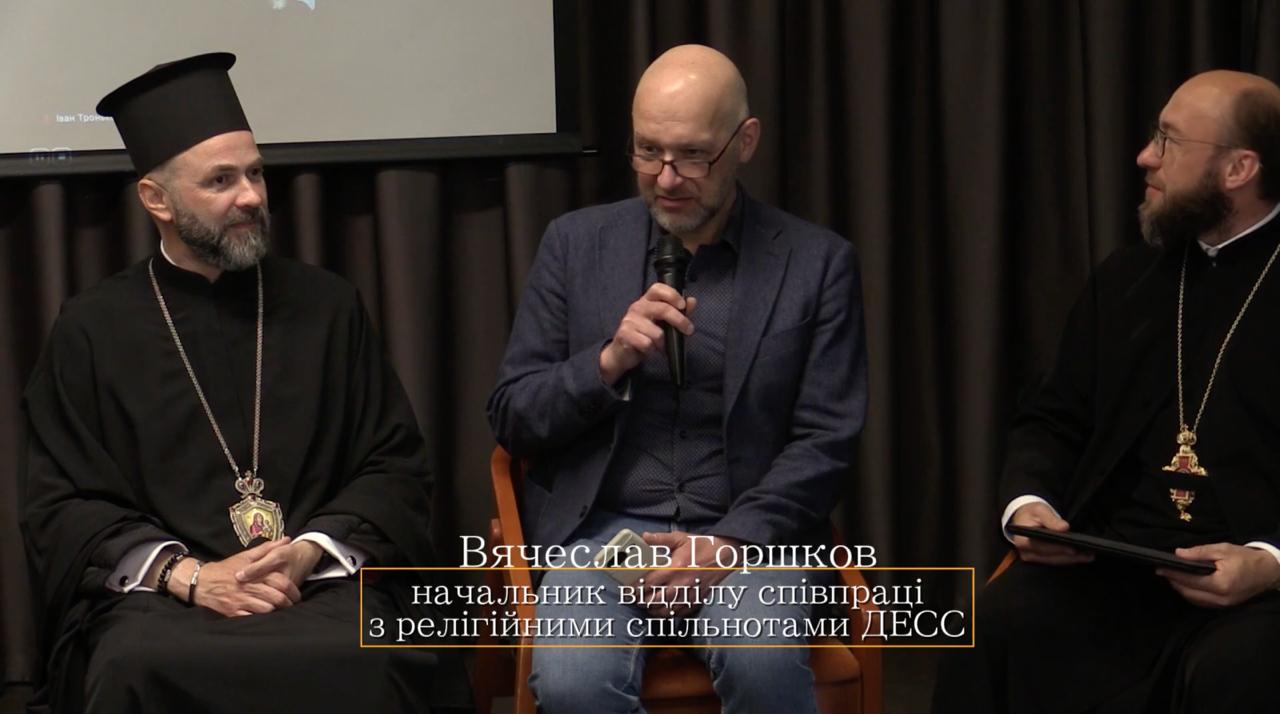
This presentation was delivered on April 29, 2025, during the Round Table “Contemporary Ukrainian Orthodoxy: Debunking Myths for the Sake of Reconciliation and Social Consolidation in Ukraine,” organized by the “Sofiyske Brotherhood” with the support of the Renovabis Foundation. The Sofiyske Brotherhood may not necessarily share the views of the speakers; likewise, individual opinions expressed within the project may not reflect the consolidated position of the Brotherhood.
Viacheslav Horshkov, Head of the Department for Religious Affairs, State Service of Ukraine for Ethnopolitics and Freedom of Conscience
The painful history of Ukraine is a story of emerging from under imperial influence — a process that continues to this day. Right now, we are experiencing, without exaggeration, a Great War for our independence.
This process began more than a hundred years ago, following the Revolution of 1917, when the Fourth Universal of the Ukrainian Central Rada, in January 1918, proclaimed the Ukrainian People’s Republic as “independent, not dependent on anyone, a free, sovereign state of the Ukrainian people.” Unfortunately, this history was not properly taught in schools; we know it poorly. At one point, I was very interested in studying archival sources to understand what kind of Ukraine was being envisioned back then, what kind of state was being built.
At that time, the processes of state-building were moving in a direction that resonated with the Kyiv tradition, which has already been mentioned today. With which city has Kyiv always been compared? Kyiv never tried to be the third or any such Rome; Kyiv has always been compared to Jerusalem. That is, from ancient times, Kyiv followed the Jerusalem model, and unlike Rome, Jerusalem was not an imperial city, thus offering a completely different model of relationships and interactions for its inhabitants.
Before I turn to biblical texts, I want to emphasize this: when we refer to our theological tradition, we often fail to consider that it, like other theological traditions of the old churches, was formed under a very powerful imperial influence. And we often do not realize how deeply imperial our beloved native theology actually is.
However, biblical theology is thoroughly anti-imperial. The entire Bible, from Genesis to Revelation, is fundamentally an anti-imperial book. It is quite surprising that biblical texts have been and continue to be used to justify aggressive imperial policies.
So, if we recall what task, according to biblical texts, is set before humanity — because here we are speaking not only about Orthodox churches but also about Ukrainian society in general, about its unity — then Paul’s sermon in Athens points to the unity of all humankind, since all are descended from one person created by the One God.
This is closely tied to monotheism because it refuted the widespread henotheism of that time, where each nation traced its origin to a separate god. As a result, people from different nations were seen as fundamentally different beings, and hostility toward the “other” was considered normal. But when the realization came that we are all from the One, then we become brothers and sisters, and our attitudes and relationships toward others must change.
However, while Christianity has had a strong influence on interpersonal relationships, it has had almost no impact on international relations or on the relationships between large groups of collective identity — which may be religious, cultural, or ethnic.
Therefore, in my view, our churches (and not only Orthodox ones) do not fully understand the unity that should exist among them. They do not pay attention to the goal that God set before all nations, before all groups of people.
As Paul says in his sermon in Athens, the purpose of all these groups is that people should seek God — and perhaps feel their way toward Him and find Him. Thus, if this process of knowing and feeling God takes place, it should influence the life of that specific group. And the result of this knowledge of God should be that the group attains glory.
One text that is almost never preached on in churches is Revelation 21, which speaks of the time when the nations will enter the New Jerusalem. Here we find references to prophecies from 750 years before Christ — those of Micah and Isaiah. We see that nations enter Jerusalem, but they do not come empty-handed (see Revelation 21:26).
They bring their glory and honor. If honor can be understood as dignity — the Greek word used here can be translated as “dignity,” and we understand a bit about that, especially after the Revolution of Dignity.
But what about glory? Glory is always the result of a group’s interaction with other groups. Glory is not something that a particular group can invent for itself. One cannot simply make up glory. But when we interact with others, we inevitably earn glory. If we interact poorly, it’s bad glory. If we build good relationships, it brings good glory. And it is precisely this good glory that is not shameful to bring as a gift to the New Jerusalem.
It seems to me that if we all come together around these texts and work toward attaining the glory of our particular group — the glory of Ukraine — then we will have a common denominator for our actions. Then we will be able to overcome our corporate interests that hinder full dialogue and unity.