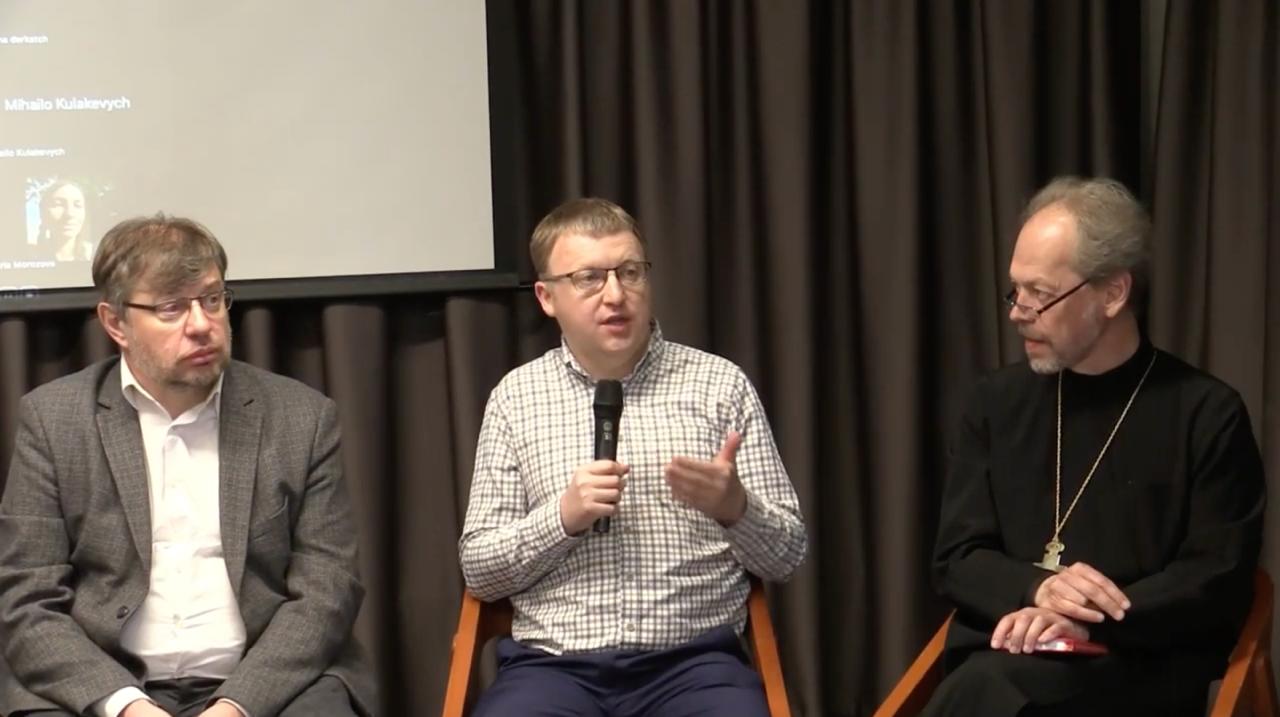
Response given during the panel discussion at the Round Table “Contemporary Ukrainian Orthodoxy: Debunking Myths for the Reconciliation of Orthodox Christians in Ukraine,” held on April 29, 2025, in Kyiv as part of the enlightening-analytical project “Contemporary Ukrainian Orthodoxy: Debunking Myths for the Reconciliation of Orthodox Christians in Ukraine and the Consolidation of Ukrainian Society,” organized by the Sophia Brotherhood with support from the Renovabis Foundation.
Hennadii Khrystokin: “The way jurisdictions interpret canon law and the role of the Tomos in this process does not unite us—it divides us.”
Doesn’t it seem to you that the way different jurisdictions interpret the canons, how they understand canon law and the role of the Tomos in that, actually serves not to unite, but rather to divide us?
And what about Fr. Kyrylo Hovorun’s idea of the open Tomos—that the Tomos is given with a forward-looking perspective, as an invitation for future unification, meant to become the foundation for an integrating ecclesial movement—isn’t that a potentially productive vision? Can we look at the Tomos this way?
Andrii Smyrnov: “The Ukrainian Church must choose a certain matrix or methodology for interpreting the canons.”
Certainly, it’s an interesting point, and we should examine the canons from different angles. But I think there’s a fundamental issue here—a methodological one. When we talk about canon law, there are two major interpretive matrices within the Orthodox world.
One is the Russian matrix, which, unfortunately, still dominates in the Ukrainian Orthodox Church (UOC). This is the interpretation of the sacred canons as understood in Moscow.
The other is the Greek matrix. The Greeks were the ones who authored the canons, and they interpret them somewhat differently, from their own perspective. There are numerous works written by Bishop Grigorios Papathomas (Metropolitan of Peristeri, Church of Greece) and other Greek canonists, who aim, firstly, to purify the Orthodox corpus of canon law—which includes approximately 770 sacred canons—from apocryphal texts, and secondly, to interpret them in the spirit of the Holy Fathers. This is a different perspective, which, for some reason, Moscow is unwilling to accept.
Therefore, the Ukrainian Church, too, must choose a certain interpretive matrix or methodology for working with the canons. Only then will the ecclesiastical puzzle start to come together for us.
Returning to the Tomos: I find myself more in agreement with the position of the Exarch Bishop Mykhailo of Komana, who has repeatedly emphasized that through this Tomos, the Ecumenical Patriarch granted ecclesiastical “citizenship” to all Orthodox Christians in Ukraine. Here we can use the word “passport” as a metaphor. The passport has been issued to all Orthodox believers—it’s there, waiting to be claimed. Some have already accepted it, others have not. But the passport is there.
In other words, each person makes their own individual choice. In this lies human freedom: to accept the Tomos or to reject it. The Tomos is a gift to all Orthodox Ukrainians. Some have chosen to embrace this opportunity, and others have not.