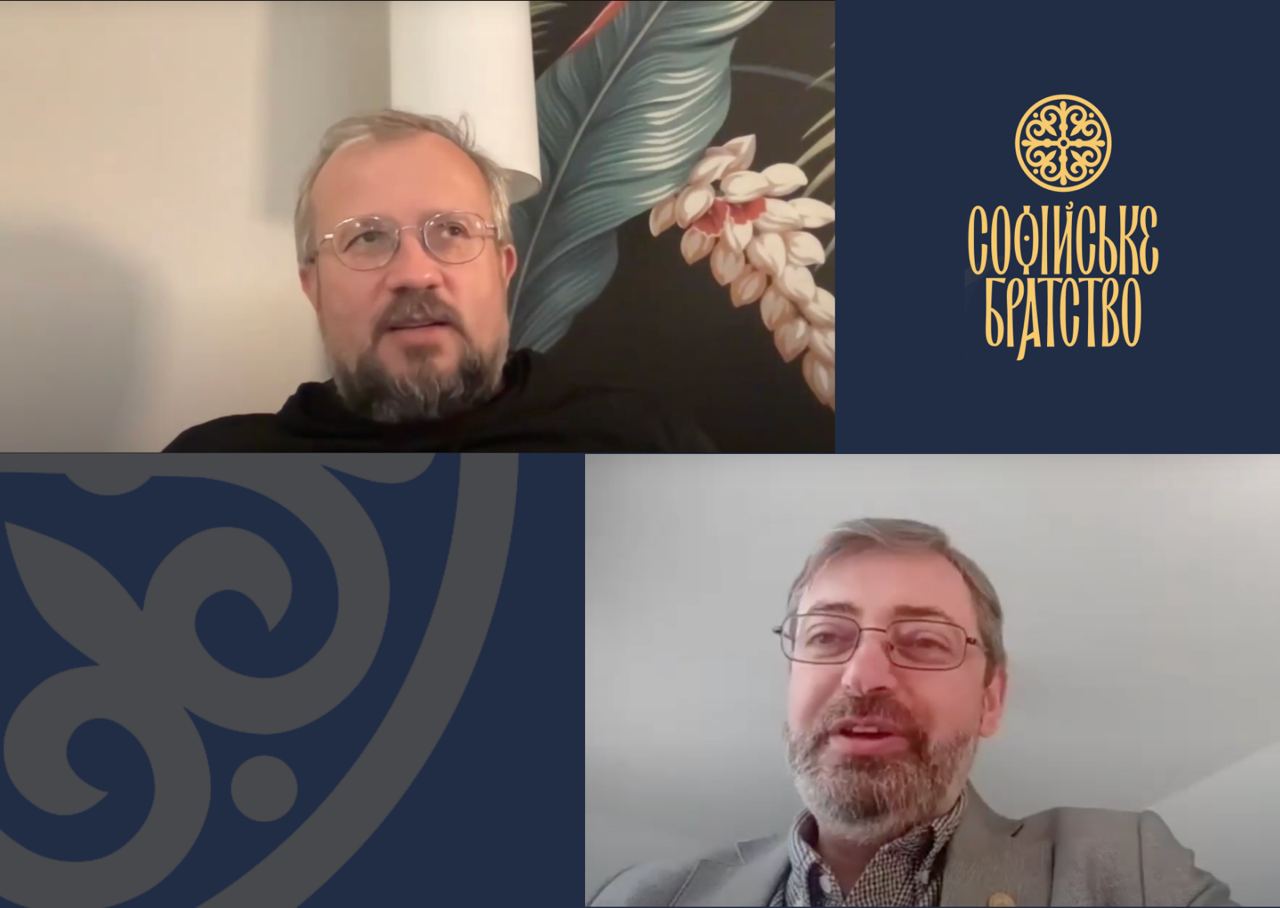
On April 25, Sophia Brotherhood organized an online meeting of members and friends of the Brotherhood with Rev. Dr. Cyrill Hovorun and Dr. Serhiy Shumylo on the topic «“Russian World” – Heresy or Anti-Christian Ideology?»
The meeting was held in view of the important discussion on this topic that has been going on for a while among Orthodox theologians who seek to find ways to counter Russian aggression in a theological way. In addition to these speakers (Dr. Shumylo’s article on this topic is particularly noteworthy), they include Sister Vassa (Larin) and Rev. Dr. John Behr, who insist that the “Russian world” should be considered a heresy. On the other hand, Rev. Dr. John Chrysavgis believes that it is stronger and more effective to call Kirill a “war criminal” than a “heretic” from inside the church today.
In his report, Fr. Hovorun pointed out that the difference between phenomena that can be characterized as heresies in the modern era and classical heresies that emerged in the pre-modern era is the contemporary secular context in which aggressive anti-religious ideology and religious rhetoric may paradoxically cooperate in favor of evil. Thus, the “Russian World” as defined by the “Edict” of the World Russian People’s Council is a complex, postmodern, hybrid “epiphenomenon”, which includes features of different heresies and which should be viewed in a nuanced way in order to adequately combat its influence on the souls of people. Fr. Cyril compared the situation around this completely new modern “heresy” to the doctrine of monophyletism in the seventh century, which had a political background and required half a century of theological work of accumulating arguments and texts to be finally condemned at an Ecumenical Council. Likewise, Ukrainian theologians today should accumulate evidence to uncover the anti-Christian nature of the Russian World “from below”, even if it will take many years to condemn it at the institutional (episcopal) level.
Dr. Shumylo, as a church historian, pointed out that the “Russian world” is not so much a “Byzantine servility” or a post-imperial legacy, but a post-Soviet and post-communist phenomenon that had religious origins, and that its foundation lies in the Soviet phenomenon of Sergianism. It was within Sergianism – and not so much within the Byzantine “symphony” and the later Russian Empire – that the Church was paradoxically subordinated to the state, which identified itself as God-fighting and opposed itself to the collective West. Dr. Shumylo described the 2024 World Russian People’s Council as a follow-up of the basic ideas of the “Ecumenical Council” planned in Moscow in 1948 but disrupted and renamed the All-Orthodox Meeting. In general, the Russian world that serves Putin’s regime today has the same foundations as Sergianism under Stalin. Its main feature is a God-fighting substitute instead of Christian theology.
Among the issues discussed by the participants of the meeting were ways for Ukrainian priests to work with parishioners infected with the ideas of the “Russian world,” the possibility of Ukrainian influence on the situation in world Orthodoxy in view of the recent “Edict”, the potential reaction of the Pope to the “Edict”, the possibilities of different conceptual languages to describe the phenomenon of the “Russian world” for church (“heresy”) and secular (“crime”) audiences, the reasons why the “Russian world” has formed into a clear doctrine now and, in this regard, possible war scenarios for Ukraine, among others.
Online meeting recording: