This material was created within the framework of a joint project of the Sophia Brotherhood and the German foundation Renovabis, entitled “Modern Ukrainian Orthodoxy: Deconstruction of Myths for the Sake of Reconciliation among the Orthodox in Ukraine and the Consolidation of Ukrainian Society.” The Sophia Brotherhood may not share the positions of the authors, and individual opinions of representatives of the Brotherhood expressed within the project may not represent the consolidated position of the Sophia Brotherhood.
How do believers think? Why do two Orthodox identities exist in Ukraine? How does the “exclusion from reality” mechanism work, and what happens when religious identity is replaced by loyalty to an institution? Why do churches need scholars of religion more than scholars of religion need churches? How does Ukrainian identity differ from Russian identity, and is it possible to “decode” the believers of the Ukrainian Orthodox Church of the Moscow Patriarchate?
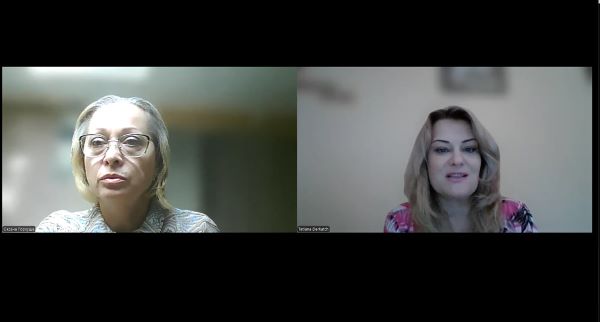
“Religion in Ukraine” spoke with the well-known scholar of religion and poet Oksana Horkusha on a wide range of issues related to the formation of religious identity in Ukraine.
Part 1
– What is religious consciousness
– Three types of identity: religious, confessional, jurisdictional
– How the instrumentalization of religion affects religious consciousness
– “Am I a trembling creature, or do I have the right?”
– “Do not plant goldenrod within yourself—you will not be able to get rid of it later!”
– “Uniformity of thought and obedience as tools for renouncing personal identity”
– What semantic field is formed by a dead language
What Is Religious Consciousness
Tetiana Derkach: Dear Ms. Oksana, I sincerely thank you for agreeing to this interview, because, in fact, we currently lack the theoretical foundation. We are all trying to resolve the Ukrainian church crisis, and in this topic at present there is the state, the key competitors (the Ukrainian Orthodox Church and the Orthodox Church of Ukraine), other religious organizations, both religious and non-religious society… And the state is on the front pages of these news. But it seems that we do not truly understand what religious consciousness is in principle, how it differs from non-religious consciousness or from secular rational logic, whether they can be opposed to one another, and what role mythology plays in religious consciousness. Please explain it to us in simple words.
Oksana Horkusha: I have studied this issue and ultimately came to the conclusion that consciousness can be spoken of as two entities: as a locus (a place) and as a subject who is aware of oneself. Consciousness is that by which I perceive reality and the place where I find myself. In order to orient myself and tell myself who I am and where I am, I need maps, means, tools—that is, a worldview. A worldview is the totality of all the tools that our consciousness uses to understand who I am, where I am, where I am going, how I will act, according to what I will decide whether something is right or wrong, and so on. That is, a worldview is precisely the set of instruments used by consciousness in order to attest my life, to be me, so to speak.
Consciousness, on the one hand, is subjective, but this subjectivity can be both individual and collective. Because I always define myself, in any case, by the parameters known to me; I identify myself with those to whom I am more or less similar, and with those from whom I distinguish myself. This concerns consciousness in general. Individual consciousness is like a fish swimming in a river of experience and information. Collective consciousness is a school of fish in which the individual fish submits to general rules and orientation points.
What distinguishes religious consciousness? Here we must first understand what religion is. Religion is the connection of a person with God or with a supernatural source of life, the sense of one’s kinship and one’s involvement in the world-creating process. That is, first and foremost, it is my connection with the source of being or with God. This is an anthropic, classical definition of religion for academic scholars of religion, given by Anatolii Mykolaiovych Kolodnyi. It fully satisfies me, because it provides the main parameter necessary for religious consciousness: there must be another subject. This must be God, the Creator, with whom I am in constant interaction in my consciousness. This is what is called religious consciousness. Even in polytheism, for example, there are still these subjects in a person’s consciousness with whom they are in constant communicative connection. Therefore, my religious consciousness as a person presupposes that I live with the awareness that I do not live in emptiness, not in dry matter, but in constant communication and connection with other subjects—subjects that are beyond the bounds of my reality, before whom I am accountable, and so on. That is, religious consciousness presupposes the presence of God or my involvement with God in my consciousness, a constant connection with Him.
Three Types of Identity: Religious, Confessional, Jurisdictional
Tetiana Derkach: Does God necessarily have to be a person here?
Oksana Horkusha: We can speak about other religions, for instance Buddhism, where God is impersonal. But even there He has certain reincarnations, and these reincarnations, as the embodiment of divine powers, are still present—either as a subject or as absolute truth with which you constantly try to connect. It is a verification—we can speak about subjective consciousness or about absolute consciousness, the absolute idea.
That is, we are speaking about the existence of a sacred connection. The main thing is that this reality and this subject are the source of life for me. He is the source of life for my world; He is the creator of this world—that is religious consciousness.
Then we approach the fact that the identifiers concerning religious consciousness differ. I say that there is religious identity—how I relate myself to God and to which God I relate myself. Religious identity, for example: I am a Christian, I am a Muslim, and so on.
There is church identity—when I relate myself to a community of co-believers. I say: “I belong to such-and-such a church,” that is, I belong to an institution that unites a group of people, because the church is, after all, a community of people who believe in one sacred reality, in one transcendent source of existence, in the same ontological, metaphysical, anthropological model of reality. That is, they believe that the world is arranged in such a way, that God is such-and-such, and so on. But this is a community of co-believers, and I associate myself with this community; I belong to this community.
There is another identity—confessional identity. It is connected with church identity but is not identical to it. There I associate myself not so much with the community and the institution as with worldview parameters. That is, there is a doctrine, and I have some basic knowledge of this doctrine: God is such-and-such, the world is such-and-such, time unfolds in such-and-such a manner, spirits are such-and-such, our fate is such-and-such, eternity is such-and-such.
And this is my confessional conviction; I live according to this confessional prescription. If we return to our church problems, I would say that these are not inter-church problems. We have an Orthodox confessional identity according to doctrine. And there are two institutions or more institutions that claim they are Orthodox churches. That is, they profess the same confessional doctrine. But in reality, if we go deeper and look at what the parishioners of one institution believe and what the parishioners of another believe, we will see a great difference.
Tetiana Derkach: Indeed, we do have Orthodox—and Orthodox. We already acknowledge this. Roughly speaking, what we have today is a kind of post-Soviet development of religious consciousness. Why are we actually so different? Perhaps we can first define for ourselves that we are all children of some post-Soviet trauma and that at some point, in the 1990s for example, our paths diverged. The Orthodox Church of Ukraine (then still the Kyiv Patriarchate) went one way, and the Ukrainian Orthodox Church went another way, and different systems of values began to develop, first of all different attitudes toward the surrounding world. Why did this happen? How did it happen? Where was this bifurcation that resulted in the existence of two different historiosophies, two different church identities?
Oksana Horkusha: The issue is not even that. We all share this ancestral trauma. My youth took place in the Soviet Union; I remember all of this, and perhaps this is an advantage of our generation. I always say that if we compare this with Old Testament situations and models of behavior, we emerged from Egyptian captivity—and we know why we left it. We know what we left and where we went. It was our decision to leave that Egyptian captivity in order not to remain slaves. But the generations born later do not remember that slavery in which we were, and which generated internal resistance within us.
I spoke with Orthodox believers, in particular I was very interested in the opinion of Father Heorhii Kovalenko. And he went to the Church in the 1980s precisely as to a concentration of spirituality. That is, it was an alternative, perhaps another way of perceiving the world and genuine service to the sacred and the truth, and not to all that darkness that surrounded him (and all of us in the Soviet system). And not everything in the Church is homogeneous. Some people went there, forgive me, as to a workplace where you work carelessly and earn good money if you know how to manipulate people’s consciousness and worldview. Others truly went there to serve God and the people, bringing the Word of God into society. Therefore, not everything is unambiguous here either. But this institution united precisely those people who had different reasons for going there—and, one might say, different identities. Because some went precisely in search of connection with God, in order to become bearers of God’s Word and God’s truth here, to become the hands of God, to become the salt that would permeate this world. And others went there for other specific reasons, including professional ones. We know that this institution, which was revived in 1943 by Stalin (after having previously been destroyed), united not only those romantics who went into it for spirituality, but also those pragmatists who served the earthly authorities. And this gave them certain privileges.
Tetiana Derkach: Not only pragmatists, but also cynics. That is, there were romantics, pragmatists, and cynics.
Oksana Horkusha: And we understand that in this institution the possibility of reaching certain heights was not so much for romantics or idealists, but precisely for those who were pragmatists and cynics. Because they are not guided by certain moral principles; for them there are no moral barriers. To step over something or to commit a sin is much harder for a person who is accountable before God—this religious identity stands in the way. But church identity (“I belong to this church, I am in the hierarchy of this church”) does not stand in the way. And this is where they diverged.
I reviewed one piece of material where the question was raised as to why the world today does not pay attention to how deeply genuinely believing Christians are being discredited precisely in the Russian Federation. Because the Russian Orthodox Church has nothing in common with Christianity anymore. It is an idolatrous church!
Tetiana Derkach: An apostate church, yes…
Oksana Horkusha: They serve an earthly idol: for them the Kremlin itself is what is sacred, which they sacralize. The “Russian world,” which they interpret as both “paradise” and “oikoumene” at once (“Holy Rus’” for them is both paradise and oikoumene, that is, what they have fastened onto, what they have grown into, and what they intend to restore—or “liberate”)—this is, in fact, a completely idolatrous institution. And in this institution there is no place for those who have religious consciousness proper, that is, those who are accountable before God, who are meant to be the eyes, the hands, the consciousness of the Lord God Christ. There is no place for Christians there; there is only a place for idolaters and for prepared sacrifices—there are human sacrifices there, you understand. We have the full dark aggregate of this pagan cult of worship of power and authority, which calls itself an “Orthodox church.” That is the great problem.
And the church that remained in Ukraine as the Orthodox Church was also not homogeneous. We do not have that hierarchical structure and that tradition of subordination of the Church to secular power. This made it possible, nevertheless, to preserve the religious identity of the majority of priests. However, not everything is homogeneous here either. You understand that our churches changed their subordination. The Kyiv Patriarchate freed itself immediately from Moscow’s shackles, and that was right, in my opinion. Because we needed an institution that was not subordinate to the institution that was becoming idolatrous and was, in fact, serving the Kremlin authorities.
You are speaking about the trauma of the Soviet Union. Undoubtedly, it was, is, and will be. Because the Soviet Union revived this Church precisely in order to have it as an instrument. The instrumentalization of the Church was needed for possible control over the consciousness of those marginal groups that were not controlled by the Communist Party, that is, over the consciousness of potential freethinkers. That is why we saw violations of the seal of confession there. Thus the KGB controlled these groups of freethinkers through the Church. And all of this remains. That is, this interconnection, this close cooperation—or, as they say, the “symphony” of Church and state—in reality turned the Church into merely an instrument of secular power.
In Ukraine, such traditions did not exist. In Ukraine, the Church was treated as an equal partner.
We usually say that Ukraine is traditionally polyconfessional. We are not speaking about poly-churchliness, but precisely about polyconfessionality. Why? Because in this or that confession and church we nevertheless paid attention to the fact that there were people there who believed in God. And this religious identity was more important than church identity. On the other hand, the Church was a subject with whom the civil community interacted. A priest was always with the people, alongside the community; he was one of us. And thus we became accustomed to trusting these institutions. They did not enter into some hierarchized structure and did not control the people; on the contrary, they helped people survive, freed them from this same secular power, gave them this outlet (an exit into the spiritual dimension). If we recall, for example, the Greek Catholic Church, the underground Church, it gave an exit into the spiritual dimension and a person’s connection with God, not subordinate to secular power.
And therefore Ukrainians, in principle, are not inclined to treat the Church as an instrument of state power; moreover, we are not inclined to sacralize some state authority or some state. For us this is not sacred—today there was one empire, tomorrow there was another empire. But we remained autochthons, and we had a direct connection with God—through certain spiritual institutions that were present here. And we were on our own land, we lived in our own home. And we had, accordingly, a direct connection—this is the ecological consciousness of Ukrainians—with our land, with our nature, with our family. We are хозяїни (masters, stewards), because the Lord settled us here. And He gave us the right, and moreover gave us the duty to care for this locus of reality. We have never been conquerors. Accordingly, everyone who is in our home is our kin. And this openness to different confessions also lies in the fact that they are in our home; they are our kin, because they, together with us, care for our Ukrainian world.
We see completely different models of relations between the community and religion, and between the state and the Church. Accordingly, the Ukrainian state has also not been homogeneous; we have seen various politicians who tried in different ways to relate to the churches. It must be said that here there are indeed differences in models, but in general a partnership model of relations between the state and the Church was built.
How the Instrumentalization of Religion Affects Religious Consciousness
Tetiana Derkach: Then let me ask the following question: please tell us, how does the instrumentalization of religion affect religious consciousness? Does it begin to displace it somehow, to deform it?
Oksana Horkusha: Undoubtedly, the instrumentalization of religion leads to the fact that my religious identity is closed off or erased by church identity; the connection with God is erased by my belonging to a certain institution. Belonging to the institution determines my “quality”—not so much the connection with God, but affiliation with the institution. And accordingly, what happens next? Idolatry—the substitution of God or the veneration of God with the idol of this state or “gosudarstvo.” Thus, for example, the Russian Orthodox Church in fact substituted God with the Kremlin, and imperial power stands in first place there. And then, in the end, they came to the point where the Kremlin, Holy Rus’, all these earthly manifestations, in fact, became idols.
And here (in religious consciousness—ed.) approximately the same thing happens: God is replaced, and when I go to a church that is instrumentalized by a certain “state power,” what is sacred for me is not the Lord God Himself (and I am not accountable personally before Him), but the system that this institution has sacralized. If we speak about the Russian Federation, then it is their “Russian Empire,” this chauvinistic vision, and so on. Accordingly, this is a substitution of identities.
If we want to speak about the Orthodox specifically, then there is a big problem here, which you have surely seen more than once. Because with Orthodox identity (“we are Orthodox”) they substitute both national identity and civic identity. Today the parishioners of the Ukrainian Orthodox Church of the Moscow Patriarchate say: “We are Orthodox.” For them their identity as citizens of Ukraine or their nationality—that “we are Ukrainians”—is in fact pushed into the background.
Tetiana Derkach: Why do they see a contradiction with Orthodox identity in this? It seems to me that in the modern world these identities—civic, national, religious—can coexist quite harmoniously, in a kind of harmonious ecosystem. Why are Ukrainians unable, or unwilling, to create a harmonious ecosystem of absolutely different manifestations, different emanations of themselves as individuals? Why do people, especially religious ones, fixate on just one identity, while all others they reject, oppose, or demonize in such a Manichean, black-and-white manner?
Oksana Horkusha: You are speaking absolutely as a Ukrainian. You have applied parameters that are key for Ukrainian consciousness, such as “ecological consciousness” or “ecosystem.” Ukrainians perceive the world that way. But you yourself started with the fact that our trauma comes from the Soviet Union. Do you remember what was happening in the Soviet Union? Through schools, through all mass media, a single worldview model was being imposed, and it was hierarchized. So, for Russian consciousness, precisely such a single rigid hierarchized worldview model is characteristic, where everything is prescribed. In first place stands this “Gosudarstvo” or the “Russian world” or “Holy Rus’,” and so on point by point. And this Orthodox identity covers everything.
Unfortunately, the state of Ukraine did not take care of the worldview development of its citizens over the course of all these decades. And I will tell you this as a scholar in the humanities who at one time, while still a postgraduate student, had the opportunity to teach even at four universities simultaneously. That is, there was such a demand for the humanities, although even then that demand was already crumpled and distorted. But I saw that beginning, when all the humanities disciplines began to be reduced. And then they were so crumpled altogether that the humanities in our country were practically excluded from educational processes. And our people, the inhabitants of Ukraine, do not have the opportunity and do not have access to a broad array of humanitarian information and knowledge from the humanities. Instead, if this component in a person is underdeveloped, if they were not given sufficient information, if they were not provided with the tools so that their worldview could orient itself in reality through various and diverse parameters—because the humanities were cut in universities—and instead such institutions as the church were “slid in,” where a person does not use their own mind, not their own consciousness, not communication with Christ, but listens to a priest who may tell them, for example, whom it is better to vote for during elections… I think this was, after all, a calculation, because politicians who came to power in Ukraine nevertheless had electoral needs. And they saw the church as their human resource.
“Am I a Trembling Creature, or Do I Have the Right?”
Tetiana Derkach: That is, do you think that outsourcing a person’s thinking to other institutions was some kind of deliberate policy? For the purpose of control? Considering that usually systems fight romantics and fanatics—two such opposites—in order simply to bring under control people for whom principles and values are higher than everyday values like material wellbeing? You are saying that people were not taught the humanities, they had no skill in thinking, in building cause-and-effect relationships, and so on. And what were our authorities engaged in? In what is called “wellbeing.” People consume “buckwheat” very well during elections—wellbeing. And, in principle, who could provide us with that wellbeing then? Everyone was sitting on the pipeline and, as they say, “pumping oil,” and that oil was Russian.
There is such an activist in Russia, Kirill Frolov, and he had an article where he said that Gazprom’s gas pipelines, like the roads of the Roman Empire, would contribute to the promotion of the Gospel and the “Russian world” (for them these are absolutely identical things). They consider themselves civilizers. They believe that everything beyond their borders, defined also by language, is all some kind of barbarians. By the way, their concept of the Third Rome is a certain tracing of the Byzantine world, in which there are Greeks—and there are barbarians. And the Russians considered all the surrounding peoples to be barbaric, who needed to be civilized. We will not now speak about how exactly they “civilized” them and what they turned them into. That is, for them even destruction is, in principle, also such a means of civilization. Those who survive will be ours and will join our “great race.” I recall the same Helena Blavatsky, who had a theory of “higher races,” in particular the Americans, and as far as I understand, Russians were also considered one of the higher races. Even popular theosophical movements that emerged from Russia absolutely do not reflect on themselves as Nazi ideologies.
And here is the difference between the religious consciousness of Ukrainians, who never had a fixation on the state—you are absolutely right—and Russians, for whom the state was a sacred entity. And even Berdyaev (“On the Power of Space over the Russian Soul”) once wrote that for the Russian person Mother Earth is one of the incarnations of the Most Holy Theotokos. And therefore, just as modern Chinese do not understand how Confucianism shaped their consciousness, in exactly the same way Russians do not understand why they need this Ukrainian little piece of land—to capture a bit more. Wherever we throw a soldier’s boot, that is ours. They simply do not understand where this comes from.
But look, on the other hand, Christianity nevertheless grew out of an empire. And it is paradoxical that the modern Orthodox Church lives by rules and norms that were developed in the empire of Late Antiquity and the Early Middle Ages. And even today, in the 21st century, in the matter of even resolving or regulating the Ukrainian crisis, again and again we appeal to these norms of Late Antiquity and the Early Middle Ages that were developed in an empire. Why, then, do Ukrainians not fit into this imperial paradigm?
Oksana Horkusha: Thank you, that is a very extensive reflection in general—there is much to build upon. You know, while you were speaking, I had just formulated several additions. First of all, I recalled their “Shaman”: “I am Russian, I go to the end.” Well, you understand, right? “I am Russian, I go to the end.” Then they have: “Am I a trembling creature, or do I have the right?”—this I have remembered since childhood.
Tetiana Derkach: By the way, all Russian literature is about this, well, in the majority of what I studied in my childhood, because I also come from the Soviet Union, and Russian literature was in first place for study. This question, “Am I a trembling creature, or do I have the right?” If you read anyone—Saltykov-Shchedrin, Chekhov, Leskov, whom I loved very much, Turgenev—this is, in principle, the main question: “Am I a trembling creature, or do I have the right?” Whether I can go beyond some moral taboos and become a superhuman. And I can become a superhuman only when I, so to speak, maim or destroy another person—that is, it is some kind of initiation.
Oksana Horkusha: Absolutely right! Here we see these animal instincts—“I am Russian, I go to the end.” All resources—for me, and I go. The goal is simply “to go to the end.” And then: “We will destroy the whole world to its foundations, and then we will build our own, our new world—he who was nothing will become everything.”
Tetiana Derkach: A kind of ouroboros…
Oksana Horkusha: That is all of Russian civilization. That is what they stand on. Ukrainians have a completely different mentality. I am a хозяин (master, steward) who is obliged to take care of my field, take care of my family, feed my children; I have responsibility, I have duties—and in this is my dignity. Dignity in that I am accountable before the Lord, who placed this right and this duty upon me—to take care—before my nature, because if today I do not weed my little garden bed, weeds will choke it, and so on. That is, this is a completely different mentality; this is my personal responsibility before God, before my family for what I do, for the consequences of my activity. I do not need to push somewhere to prove something to someone; I have хозяйство (household, stewardship)—this is the Ukrainian mentality.
Tetiana Derkach: I, for example, derive this from the fact that Ukrainians are an agrarian nation, while Russians, the Finno-Ugric peoples, practiced slash-and-burn agriculture. These are absolutely different types of economic activity in principle, and from this absolutely different types of state administration were formed.
Oksana Horkusha: And we also recall their subordinate traditions. They advance “to the end” — the steppe is wide, and they went to conquer this steppe, to seize resources for themselves. But we did not. Why should we go there when we, in principle, have good land here, here is my little river, here is my little church, right? I have a direct connection with God here — direct or mediated, of course through the church, but still my connection is direct. The Lord gives me the fruits of my labor, and I use these fruits to feed my children. They broke our consciousness — recall the Holodomor, how they tore out this Ukrainian “mine,” “my land,” “my grain” — they destroyed precisely this.
And then what happens? I once found a very good analogy — from ecological farming — to describe what happens on the level of consciousness and worldview when the roots of identity and the ability to access the humanities are erased, as we discussed earlier. Imagine that throughout these decades Ukrainian schools, universities, and various educational institutions had taught and communicated information from Ukrainian history, Ukrainian literature, that Ukrainian culture, Ukrainian art, Ukrainian spirituality had been allowed to develop and had been actively promoted, instead of Russian cultural content. In our reality, everything connected to the humanities — not only in education, but also in the informational space, the cultural sphere, mass media — was suppressed or erased. Everything Ukrainian was marginalized, while space was opened for everything Russian. Why? Because we have parallels in agriculture: invasive species, aggressive plants that are not native to our land, to our ecosystem.
There are several such plants, for example, goldenrod. It is a very good example because it was brought here as a decorative plant: “It is so pretty, it blooms with nice golden flowers.” But if it gets into an ecosystem, after a few years, because it has no natural pests here, because it tolerates drought and frost, and because it reproduces both through roots and through seeds — and its seeds number in the millions, and our soil is fertile — this goldenrod overwhelms the entire ecosystem. And ecologists cry out and warn: “People, do not plant goldenrod on your land, you will never get rid of it later!”
Now imagine what happened during the Soviet period and then during independent Ukraine: everything that enabled Ukrainians to form their Ukrainian identity and Ukrainian consciousness was continuously removed. Culture, art, literature, Ukrainian spirituality — all of this was marginalized and erased, while space was opened for sowing the idea of the “Russian world.” Through the church, through mass media, through pop culture. We saw the sowing of this goldenrod of the “Russian world” into the consciousness of Ukrainians. And this happened also in the church sphere. Recall that it was the Russian Orthodox Church in Ukraine, which calls itself the “Ukrainian Orthodox Church of the Moscow Patriarchate,” that received privileges from local authorities: they were given land, and nearly every hospital had a chapel of the Moscow Patriarchate…
Tetiana Derkach: Not only hospitals — all state and security institutions. There was even a chapel in the Verkhovna Rada of Ukraine… I absolutely agree that this was an invasion. It can indeed be classified as an invasion.
Oksana Horkusha: Exactly — they were literally given the opportunity to sow this seed. And the problem here is not purely ecclesial, because a person seemingly came to God, but ended up in a locus that had been already conquered and occupied by the “Russian world.” Directly or indirectly — whether through the fact that they explicitly pray for Patriarch Kirill and commemorate him, or through the fact that they simply “forget” to mention who exactly attacked Ukraine today. And instead, at the end of the sermon, they say: “And let us pray for our authorities and for our armed forces,” forgetting to say which authorities and which armed forces they mean, and which army they are grateful to. Perhaps they are grateful to the Russian army — I do not know.
Tetiana Derkach: I am not sure whether you agree with this idea — that there is a basis and there is a superstructure. The question is what constitutes the basis. From a Marxist perspective, these are the economic relations in society, and everything else is the superstructure. If we assume that this invasion took place in the Soviet Union, and since they thought in Marxist paradigms, why did they try to change our superstructure if they understood that the basis of the Ukrainian people is fundamentally different from that of the Russian people? How can they say that we are “one people” if we, so to speak, have different constitutions in our very nature? We can speak their language, but we remain Ukrainians. And I find it very unfortunate that many Ukrainians, especially those in the Moscow Patriarchate, simply do not understand that their nature remains Ukrainian. It is like receiving a liver transplant — you have to take medication that suppresses your immune system so that the liver will not be rejected. And people are willingly taking such “medications” to suppress their Ukrainian essence.
I do not hide the fact that I am half Russian, half Ukrainian. How do I experience this internally? There is a natural phenomenon when two rivers of completely different colors flow side by side without mixing, because they have different densities and different chemical compositions. And they do not mix — at all. Like the black Aragvi and the white Aragvi. And in the same way, my Russian essence does not mix with my Ukrainian one. Here there is no diffusion whatsoever. For me personally, in order to become Ukrainian, I simply had to reject the Russian essence. And that was my inner decision, although I myself was formed by Russian culture, Russian literature, the environment in Russia where I spent many years visiting relatives. I see that watershed — and when I hear that Ukrainians and Russians are “one people,” something explodes inside me. We, Ukrainians, are such a freedom-loving nation!
In Russia, one can draw a certain parallel with the Great Don region, where people fled from tsarist oppression. And you know how the story of the free Great Don ended in the Russian Empire. First, the Cossacks made treaties with the tsars; then it all ended with the simple fact that the Don ceased to exist. They attempted to revive the Great Don in 1918. They even tried to revive it after 2014 — the “Great Don Host,” whose Cossacks came to Ukraine to fight for their freedoms. How did it all end? With “thank you all, you are all dismissed.” Their fanaticism, their romanticism was exploited — and then you know what happened to those leading Cossacks — Driomov, Babai, and others. Where does this romanticism come from in Ukrainians who sincerely believe they can be part of an empire, like Feofan Prokopovych or Stefan Yavorskyi, contributing an element of “high art” to the Russian Empire, somehow diluting its civilizational barbarity? I am simply astonished by such naïveté.
“Uniformity of Thought and Obedience as Tools for Renouncing Personal Identity”
Oksana Horkusha: Look at how they break our boys — the process of “mankurtization,” the transformation into slaves, the erasure of identities. That is, they must break a person completely so that they renounce their human identities, formed over a lifetime, and bring them into an animalistic state, where the only instinct is survival. And that is enough to make a slave. They must break a Ukrainian and turn him into a slave. That is what they did to us during the Soviet Union, and that is what they are now trying to do again. They need slaves. “Russian” means “slave who belongs to the Russian world.” And you are absolutely right: Ukrainians are freedom-loving. It is easier to kill us than to turn us into slaves. Mankurtization is what they are trying to do. And here lies the difference between Ukrainian and Russian Orthodoxy. What are the two pillars of Russian Orthodoxy? Uniformity of thought and obedience.
Uniformity of thought — meaning, renounce your personal identity, your personal subjectivity, and accept that you are merely part of a collective, of a collective consciousness.
And obedience — this is that slavish submission, when through ritual practices they attempt to make a person into a slave. At the very least, they accustom the person to this obedience. You must crawl on your knees, kiss icons, without thinking about why and for what you are doing it. That is, you must venerate objects without thinking, and without asking yourself whether they are worthy of your veneration.
Tetiana Derkach: For me it is a revelation that icons, the veneration of the sacred, can become a tool for turning people into slaves…
Oksana Horkusha: Remember the iconoclastic heresy, which was provoked by the opposite abuse — when the content and the true meaning of what is sacred was replaced by the veneration of material objects. In fact, the same thing is happening in Russian Orthodoxy, when artificial simulacra replace the meaning of what is sacred behind the icon. And veneration of these icons, veneration of the church building, veneration of the priest replaces the veneration of God.
Tetiana Derkach: Veneration of the institution once again… You have just put many dots over many “i’s” concerning why we have such a problem with unifying even the Orthodox. That there is religious consciousness, and there is an identity that forces a person to become part of some collective unconscious.
What Semantic Field Does a Dead Language Form?
Tetiana Derkach: I also have a question about Church Slavonic. There is a known constant that language forms the semantic field. Church Slavonic is generally considered one of the dead languages. What semantic field does it form in the consciousness of believers? It is a beautiful language, but it is instrumentalized. For what? Scripture says: “Go and preach the Gospel to all nations.” And what kind of consciousness is formed in the 21st century by means of a dead language? Regardless of how beautiful it is, it is dead.
Oksana Horkusha: Dead. It is an exclusion from reality. Let us return to the Gospel. Why is Christianity a world religion? Because Christ addresses each person, each consciousness personally — not a herd united into a certain church, but personally the human being. And here is where Christian religious consciousness is personal. And what did He say? “Go and preach to all nations in their languages.” That is, our Ukrainian identity can become a semantic field for Christian proclamation, in which the meaning will be Christian but expressed in the Ukrainian language, and accordingly the Word of Christ can live a full life.
What happens when meaning is replaced and they say that only Church Slavonic is sacred? They actually remove the consciousness of a person from the real context and transplant it into an artificial linguistic space, and in this artificial linguistic space they capsule it. At the same time, they impose the belief that everything Ukrainian is unworthy of prayer. That is, does God not understand Ukrainian? But I always say: “It is your god who does not understand Ukrainian — because he is not a global God, he is not God, he is a little god of the Russian world.” If their god does not understand Ukrainian, then he is not a universal God, he is not a Christian God. It is a pagan idol of the Russian world. There are different variants of Church Slavonic. And the one used in the Russian Orthodox Church is the Moscow variant. The Ukrainian variant of Church Slavonic also exists. But in any case, if the God is living, He addresses a living human consciousness. He does not need a dead language that becomes an additional barrier and prevents consciousness from understanding God and responding to God in a way that God understands the human being.
Tetiana Derkach: Then I have a question: would the Church’s abandonment of Church Slavonic not free its potential for evangelical mission?
Oksana Horkusha: Absolutely! It would be much more convenient and logical. But that is precisely what they do not want to do. In order to keep a person in submission, it is better to make them understand that they are incapable of understanding on their own, that they are unworthy of communicating with God on their own. That their language, their identity, is unworthy of being connected to God and of being a co-creator of the world together with God. And they impose on Ukrainians this inferiority complex, this sense of insufficiency, which restricts the human consciousness, restricts human action through the conviction that “you are not good enough,” “you are defective.” The sacred becomes that which is artificial and imposed. It becomes, in fact, a noose, handcuffs — something that prevents a person from being free and from being themselves.
Tetiana Derkach: Well, in fact, it is terrifying when sanctities, the achievements of spiritual thought, the language of prayer, where words were very carefully chosen — all of this becomes a tool for enslaving people. I believe that this is a great sacrilege and a great sin before God — to use His instruments, everything He has given humanity for its development, in order to make a person not free but a slave. And a slave of earthly systems. I believe that the Russian Church will answer before God for this crime. It is a crime before God.
To be continued
Source: religion.in.ua