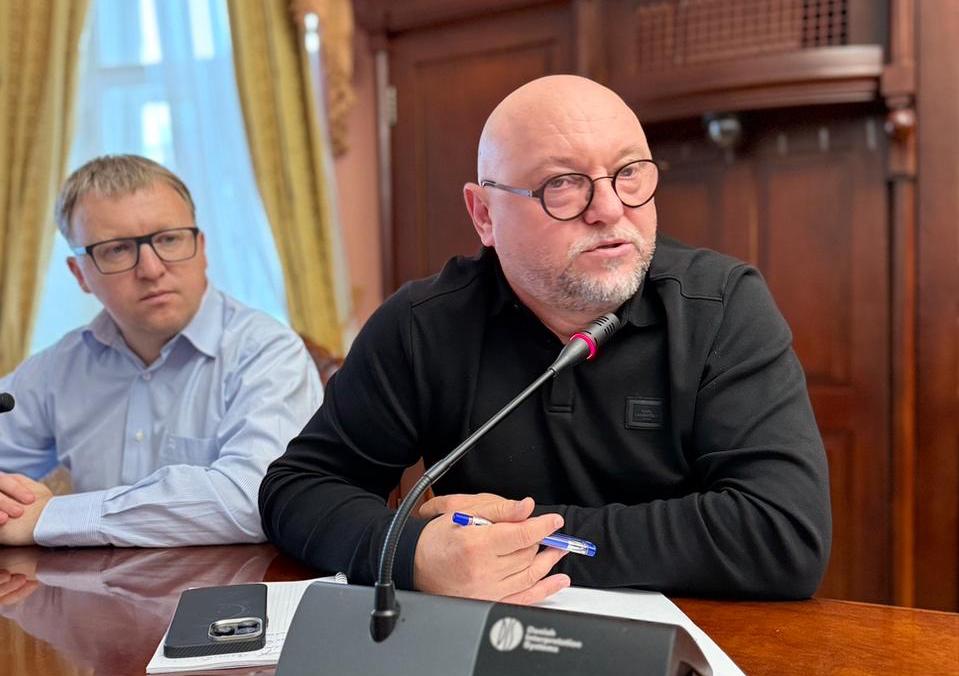
The report was presented on September 17, 2025, at the Round Table “From Dispelling Myths to Seeking the Common Good: Contemporary Dialogue Initiatives in Ukrainian Orthodoxy and Prospects for Post-War Renewal”, organized by the Sophia Brotherhood with the support of The Centre for Humanitarian Dialogue (HD). The event took place within the joint project of the Sophia Brotherhood and the German foundation Renovabis titled “Modern Ukrainian Orthodoxy: Breaking Myths for the Sake of Reconciliation among Orthodox Christians in Ukraine and the Consolidation of Ukrainian Society.”
The Sophia Brotherhood may not necessarily share the opinions expressed by the speakers. Individual views voiced by members of the Brotherhood within the framework of the project may also not represent the consolidated position of the Sophia Brotherhood.
Fedir Raichynets, Head of the Department of Theology at the Ukrainian Evangelical Theological Seminary, Doctoral Candidate in Practical Theology at the Vrije Universiteit Amsterdam, Pastor of the “Bethany” Church (All-Ukrainian Union of Evangelical Christian Baptists)
Source: Official YouTube channel of the Sophia Brotherhood
Dear friends and colleagues, thank you very much for being here today. I would like to continue the ideas that have just been expressed and show their resonance. I would also like us to reflect together on three statements of Jesus — or rather, to outline a direction for thought that we may later discuss further. What I am about to say is also found in my published article.
There are three statements, and they, in some ways, support what has already been said — namely, that there is no such thing as a “post-war condition.”
The first statement of Christ is: “You will hear of wars and rumors of wars…” Since I wrote a commentary on the Gospel of Matthew, I delved into the meaning of this text. It should not be translated as “you will hear of wars and rumors of wars,” but rather as “you will hear of wars that are far from you and wars that are near you — wars that happen with you.” This is part of the so-called eschatological discourse of Jesus, in which He says that we have entered a time that theology calls eschaton — “the last time.” This time, He says, will be marked by various cataclysms, one of which will be constant wars.
And I want to ask you a simple question: think of your own life — however long you have lived — and name one day when there was no war somewhere in the world. There has been no such day. Therefore, there is no “post-war” or “after-war” condition; rather, we live in a state of continuous war. I lived twelve years in the Balkans — five during the war and seven in what was called the “post-war” period — and I could tell you many so-called “post-war” stories. There is no end to war!
The second statement of Jesus is this: “Blessed are the peacemakers.” And He says this to people living in a state of war. Who are these blessed peacemakers? They are people whose core value is Shalom. And what is Shalom? It is not the absence of the negative; it is the presence of the positive. The prophets who speak of Shalom say that Shalom is absent not only when there is war — it is absent when certain things are missing:
- When there are no mature leaders — that is, when leadership is corrupt. And how is it corrupt? It uses people for self-enrichment instead of limiting itself for the sake of human good, thus producing poverty.
- When there is no justice in the judicial system. I think everyone here has lived long enough to understand that justice is first and foremost absent in systems of judgment — when judges rule not according to what is right, but according to what is advantageous. Justice is available not to everyone, but only to those who have influence, power, connections, or money.
- When leadership, instead of providing people with good, provides for itself — it steals, and the common good ceases to be shared and accessible.
At such a moment, according to the prophets, Shalom is absent. The reverse side of Shalom in the Bible is justice. Thus, we cannot speak of peace without speaking of justice, and we cannot speak of justice without speaking of peace — they come together as one.
Therefore, when Christ says that amid ongoing wars there exists a community that bears peace — this is the community that proclaims justice, or within whose territory justice becomes possible. For if there is no justice within this community, where can we expect to find it — in individuals? Clearly not in the system of judgment, right?
And now we come to the third and most difficult statement of Jesus: “There will be wars,” “Blessed are the peacemakers,” and yet “I did not come to bring peace, but a sword.”
How can that be? There are wars; Christ calls us to peace — yet He Himself says, “I did not come with peace but with a sword.” As has already been mentioned, everyone seems to have “their own truth,” but there is also interpretive truth. We turn to interpretation: what does Jesus mean by “the sword”? Is it a symbol of violence or of division?
That is, He divides. “I have come into this world, where war is the normal state — where peace is achieved only through war.” In this world, as we know, if you want peace, you must always be ready for war.
And here comes the question that Oleksandr Filonenko raised: “Is there another way? Or is this the only way imposed upon us by the dominant culture or worldview?”
Jesus says that no — there is another way to peace, a way not through war but through social justice. This brings us back to the notion of the common good. Professor Hennadii Khrystokin, in his presentation, outlined the main principles of the common good — and the dominant one among them is justice.
Therefore, Christ says: “Wars will continue — do not live under the illusion that one day they will disappear. Yet there exists a community unafraid to call itself Christian and unafraid to embody its values — and one of those values is peace, which means justice. And I have brought this worldview division.”
Thus, the sword divides: there is one vision of peace — and another. There is a peace achieved through war, through violence, through sowing hatred and destruction. And there is another peace — more lasting, one that requires maturity from all of us — peace through social justice.
If you read the Gospels carefully, they use the terminology of the Roman Empire but fill it with different meaning. This is what we call “semantic warfare” — the redefinition of meaning. Rome promised the same thing that Christ promised. The synonym for the “good” was “salvation.” We can reach peace in one way or another. And the vulnerable Christian community in the world strives to live by these value-based virtues.
I will conclude with a story. The year was 2004, in Tuzla — a city in Bosnia and Herzegovina. I was sitting in my office when the phone rang. I answered, and on the other end was a man who introduced himself as a war veteran and the president of the veterans’ association of Bosnia and Herzegovina. It was the ninth year after the war.
He said: “We have a serious problem.” It is important to note that he was a Muslim — and he was calling a Baptist church. This surprised me greatly. He continued: “We have a huge rate of suicides among war veterans. We have knocked on every possible door, but everywhere we are either refused or silenced — because if this issue becomes public, who will control it?” And he said: “We have called everyone, and now we are turning to you.”
I, a person with no experience in working with war veterans, sat there thinking: “I do not know how to help this man, but I know that I cannot refuse him.”
This is what we will face in that time which we now imagine somewhere on the horizon — a time that will not be “post-war” or “after-war,” but simply a time when the intensity of war ceases.
And lastly: do you know when people in Bosnia and Herzegovina began to lose their sanity? When the fighting stopped. Why? Because silence came. And in that silence, people lost their sense of orientation — they no longer knew where the enemy was. And that silence began to drive people mad.
Thank you.