Transcript of the program created on the initiative of the NGO “Sophia Brotherhood” and with the support of the German foundation “Renovabis”
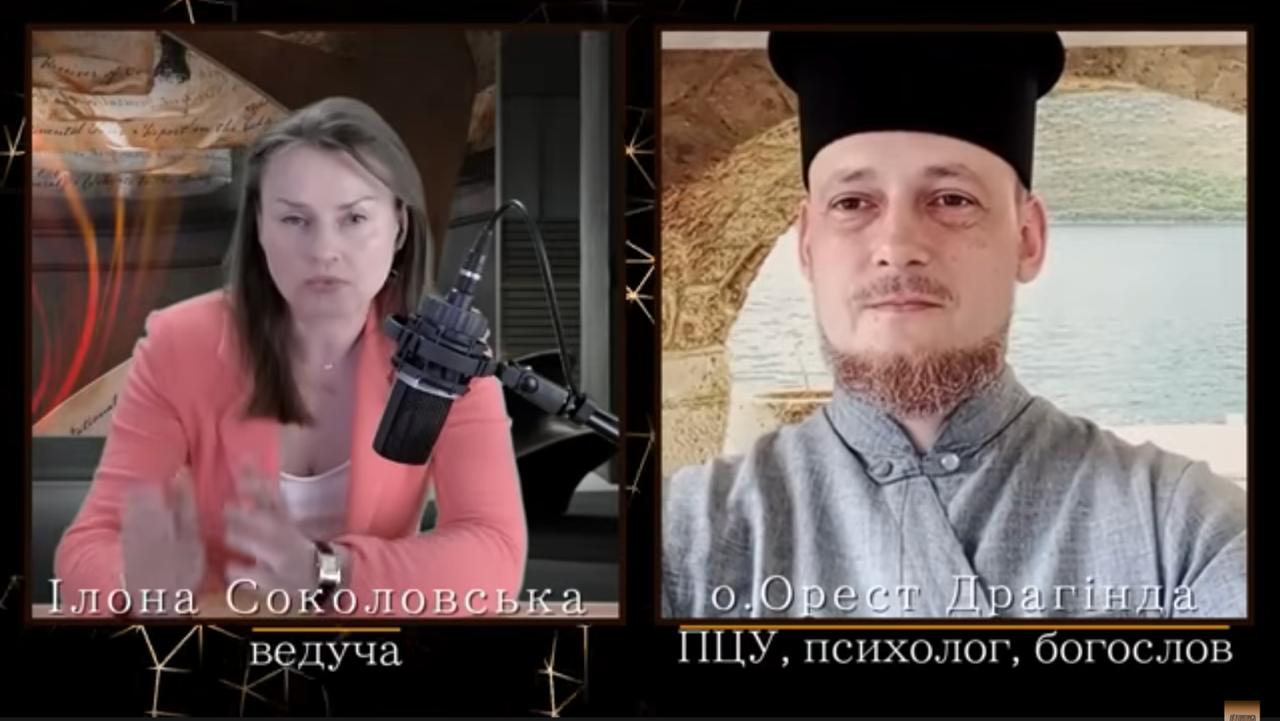
Host – Ilona Sokolovska
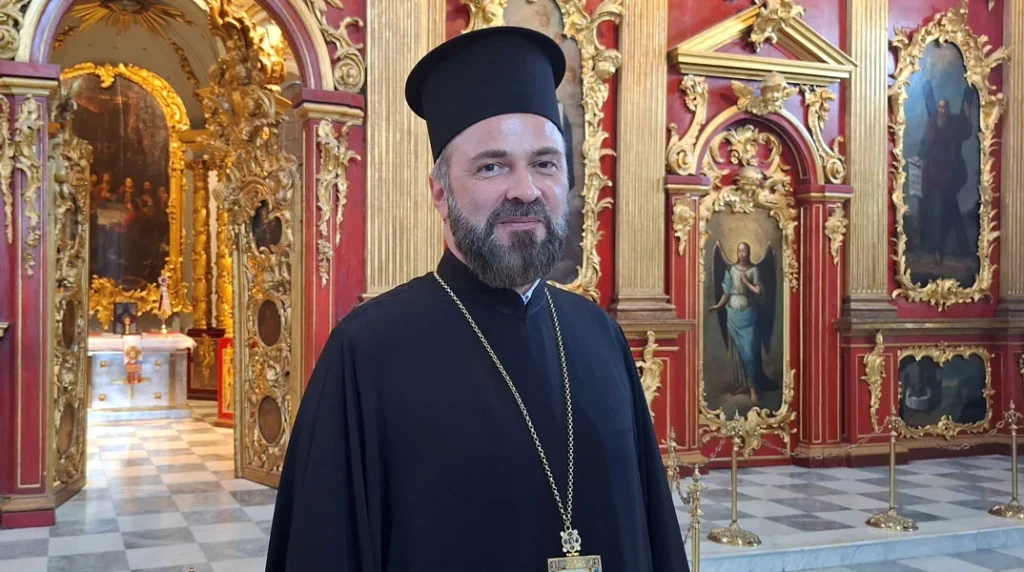
Guest – OCU priest Orest Drahinda
Christ said: “Those who are well have no need of a physician, but those who are sick.” Is contemporary Ukrainian Orthodoxy ready to look in the mirror and acknowledge its illness? Why do the majority of UOC believers want a break with the ROC, yet do not accept the OCU? What psychological mechanisms keep them in this inner conflict? What prevents bishops from taking decisive steps? And is not the same spiritual split already lurking within the OCU itself?
In the new episode of the program “Viche” there is a painful conversation about the unhealthy states of Ukrainian Orthodoxy. Our guest is a theologian, a professional psychologist, and a priest of the OCU, Father Orest Drahinda, who himself went the path from a UOC priest to the OCU.
We discuss:
– the fear of bishops, nostalgia for the Soviet past, and the ROC’s “canonical trap”;
– why believers do not go to the OCU even while understanding the evil of Russian aggression;
– how morally acceptable the actions of OCU faithful are in forceful “transfers” of churches.
Ilona Sokolovska: Greetings, dear audience, on the YouTube channel “Viche.” In response to yet another indignation of the Pharisees toward the scribes regarding His actions, Christ answered them that He came not to the righteous, but to sinners, and that those who are not well have need of a physician, but those who are sick. The topic of our program today is unhealthy Ukrainian Orthodoxy.
Therefore our guest is a very multifaceted person—a professional psychologist, a theologian, and a priest. I am pleased to present to you, until recently a priest of the Ukrainian Orthodox Church and now of the Orthodox Church of Ukraine, Orest Drahinda. Welcome, Father!
Fr. Orest Drahinda: Greetings, Ilona, and viewers.
Ilona Sokolovska: Let us begin, then. The reality is that the overwhelming majority of the faithful of the Ukrainian Orthodox Church want their church to be definitively separated from the Russian Orthodox Church, that the ties with the ROC be completely severed. Yes, there is a certain small segment of people who live by faith in some strange canonicity, a mystical role that allegedly belongs only to the ROC. Nevertheless, the majority favor an exit and a break with the ROC. At the same time, that same majority—the very same people, the faithful of the Ukrainian Orthodox Church—categorically do not want to move over and unite with the Orthodox Church of Ukraine. How is this phenomenon to be explained? How do you regard this majority? For surely, over the years of your priesthood, you have come to understand the logic of the faithful of the Ukrainian Orthodox Church.
Fr. Orest Drahinda: I would say this: there are, in my view, two main grounds for this. First, deep in the subconscious of church people of the Ukrainian Orthodox Church there are notions that the former Kyiv Patriarchate, the Autocephalous Church, and now the Orthodox Church of Ukraine are illegal, self-appointed, graceless organizations.
That is the first. And the second is that they rely on authorities in their spiritual life. His Beatitude Metropolitan Onuphry of Kyiv is such a great authority.
A great number of believers, at least in the Chernivtsi-Bukovyna Diocese, look to him. They are guided by his instructions, and they follow him. Many even say this: “We are for His Beatitude; wherever His Beatitude goes, there we go.”
It even happens—and I have spoken with people more than once—earlier, when I was not yet in the Orthodox Church of Ukraine and did not intend to go there, and it was necessary to remain in the UOC, yet I still defended the position that the Church is one, that these divisions are temporary, these are human things. I even spoke with such people who are associate professors, scholars, lay people. They say, “We understand you; we accept all this. But inwardly we cannot accept the fact that we would move somewhere into the OCU.” I think that this simply lies in the subconscious. Social ties among people—godfather, matchmaker, brother, acquaintances, relatives, loved ones… It is comfortable for people to live, to understand, to feel that “we are in the right.” And if one accepts the fact that in the Orthodox Church of Ukraine there is grace, there is salvation, then what? Does it turn out that all these years before we were mistaken? We spoke, and heard, and told others, and proved that there is no grace there. And now what, has grace appeared there?” Therefore this is quite an interesting contradiction. Even if our hierarchs were to reach an agreement among themselves on some wonderful day and were to tell the faithful, “Yes, we are uniting, we are reconciling,” it would be very difficult for very many people to accept this. They have boxed themselves into such a dead end.
Ilona Sokolovska: This is an interesting thought to me, because we ourselves in the programs, speaking with the brothers of the Sophia Brotherhood and with our expert guests, somehow reached the conclusion that people still hold on more to the episcopate, to their spiritual mentors. But you express the opinion that perhaps even if the bishops wanted to move, for the faithful it would be difficult to do so. That is, it would be a morally difficult choice for them. Do I understand you correctly?
Fr. Orest Drahinda: Yes. I will give you an example even from my own life. My last place of service was the church of Venerable Seraphim of Sarov. I, together with the people, built that church from the ground up and organized the community. This was already our twelfth year of serving there.
There were many people, many parishioners; I had quite a great authority. And when I took the step that I took (I moved from the UOC to the OCU), then probably one fifth, or even fewer people remained who accepted this step and followed me. There are some who also sympathize, some even congratulated me, but for the time being they are not in the church.
I explain it to myself this way: social ties are at work here. If a husband wants to go, the wife does not allow it. If the husband and the wife want to go, their relatives will take offense at them, and they do not want to spoil those ties…
Ilona Sokolovska: Well, I would say that this is a new challenge both for educators and for the clergy—to explain in the future why one cannot remain in the UOC which today, like it or not, is part of the Russian Orthodox Church; legally this is unequivocally so…
Let us move on. You were the secretary of one of the metropolitans of the Ukrainian Orthodox Church. This is a high position—such closeness to a bishop. I think that you understand well the logic of at least one bishop. Now we often hear this incomprehension of the inactivity of UOC bishops, their fear of responding to the challenges of the present in our Orthodoxy, especially against the background of war. Tell me, please, in your view, how does the picture of Ukrainian Orthodoxy look in the understanding of UOC bishops—perhaps using the example of Bishop Meletii—from the standpoint of their choice and this inactivity?
What do we most often hear directed at them? First, the so-called “unity of the Orthodox brotherly peoples,” that is, the “Triune Holy Rus.” Second, the metropolitan’s small principality as such, and in that way he defends his, excuse me, church-financial business.
Third is personal antipathy, which you have already partly mentioned, which can be reinforced by certain canons toward so-called “schismatics.” That is, those old resentments, stereotypes when the UOC KP and the UAOC were despised. And perhaps fourth, the fear of finding themselves in a schism, for they are afraid to leave the ROC and arrive at nothing, because the OCU is presently not being considered.
I would like to understand the motivation of these people. In your opinion, what is the principal problem of the UOC episcopate?
Fr. Orest Drahinda: I was not a secretary, but a referent of Metropolitan Onuphry of Chernivtsi-Bukovyna, now His Beatitude Metropolitan of Kyiv and All Ukraine, from 2001 to 2007. That is, for about ten years I worked closely with Bishop Onuphry and with Bishop Meletii, who for a long period of time was my spiritual mentor. I know them very well.
Answering your question about their motivation: these men—Bishop Meletii and Bishop Onuphry—are very close to each other. They have been together for nearly three decades. But they are very different. If Bishop Onuphry is, it seems to me, a more direct, straightforward person. He was born in 1944; all his conscious youth and mature life took place during the Soviet Union. He received monasticism in the Trinity–St. Sergius Lavra; his ministry there (he was the abbot’s assistant of that Lavra) was—so to speak—native to him. Even if one listens to his recent recollections, before the full-scale invasion, he says plainly that he would like to complete his life precisely where he began his spiritual life—in the Trinity–St. Sergius Lavra. Therefore everything is clear here.
As for Bishop Meletii, he is a diplomat. He is a very flexible, intelligent, educated person. I think that he understands the situation perfectly.
I will say even more: when Patriarch Bartholomew accepted into communion—restored—Metropolitan Filaret Denysenko and other signatories who appealed to him, there was a period of a certain indeterminacy on the part of the ROC and the UOC regarding the actions of Patriarch Bartholomew. In our Holy Spirit Cathedral in Chernivtsi there was a gathering of the clergy. And after that gathering I approached Bishop Meletii and said, “Well then, Your Grace, does this mean that baptism performed in the Kyiv Patriarchate, is it valid?” He said, “Well yes, it is now valid.” I do not know whether he would say the same now.
Although for me baptism had been valid even before that, because if we take the ancient canons, there is a rule of Basil the Great; there everything is clearly laid out, and those baptisms were valid even then. As to what the motivation of these people is, it is very difficult for me to say. Perhaps Bishop Oleksandr Drabynko, who was at the very pinnacle of that Olympus, knows much more than I, a small person, and he could say more about this.
I shall add that when, as a young man at the age of fourteen, I came under the spiritual care of these two bishops, I had one set of notions. I realize that those monastic ideals of mine, my worldview, which I formed from reading the holy fathers, the lives of the saints—I projected them onto these people. And when I, twice a week over the course of years, ran to confession and tried to fulfill absolutely everything, perhaps they looked at me as some sort of odd simpleton. But accordingly, I looked at them as some kind of spirit-bearing elders. I watched even in which direction they looked. That is, I ascribed to them, perhaps, things that they were far from thinking, and which in fact were not even there in reality. Therefore about them I perhaps at one time, decades ago, thought one thing, then I thought another, and what I might even now think may be very far from the truth.
That is one thing. I will also say that the cult of Bishop Onuphry among the Chernivtsi-Bukovyna Diocese, among such churchgoing parishioners, is something similar to what I had in my youth. I hang on his every word; what I read in the holy books about spirit-bearing elders I transfer onto specific people. And each time before going to confession I pray, “Lord, give me an answer through this wise elder.” And I receive that answer, and I do not even doubt whether this answer is from God or not from God. I know that it is an answer from God. Although it may simply be an answer from a human being. And a very great number of people, precisely of churchgoing believers in the UOC, still think exactly in this way. Therefore they say, “We are with Onuphry to the end.”
Ilona Sokolovska: You have raised a very interesting topic, Father. It is true: we really do seek authorities, all the more so if this is our spiritual father. In the Church, when a person received baptism from a priest and the various sacraments, when a person’s life is connected with this—if this is a believer who regularly attends church—then how is it? Against what are we to check our inner accents, our inner moral norms? We check them with our priest, with our spiritual mentor, but it turns out that this is not always to be done; it is not always correct for a Christian?
Fr. Orest Drahinda: In my life I received the following answer for myself, and I adhere to it: to study the Gospel of Jesus Christ deeply first of all; this must be the summit, along with the teaching of the holy fathers—the ancient teaching, not some little brochures by unknown “elders” male or female, but precisely those authorities of the Orthodox world for everyone. To read, to try to put into practice, to partake of the sacraments constantly, and to be constantly ready for the fact that I or another person, even one in holy orders, can make mistakes: only the Lord God is without sin.
To ask God for enlightenment, always to understand that I can be mistaken, to understand that the spiritual father to whom one appeals is also a human being.
I think that the Lord leads a person along his own path. And even the step that I took: in fact, I did not have any special inner “break.” Some people write to me and say, “Repent, return to the bosom of the UOC.” My answer is this: I can repent of sins, of that in which I understand that I have committed sin. But here I do not see sin. I understand that the Church is one. The UOC, the ROC, the OCU, the Church of Greece, or others—these are simply temporary divisions.
Ilona Sokolovska: You already mentioned this a little. If we compare the situation with the faithful and with ordinary citizens, then indeed a large part of both are people who come from the Soviet Union. When a person recalls “sausage for two-thirty” and a “quarter-bottle for one ruble seventy,” most often it is simply about youth, about the path those people have walked. It is natural to remember those times with warmth and nostalgia, when you were healthy, young, and beautiful. There is a similar parallel with Orthodox believers in Ukraine. Both the OCU and the UOC, in their overwhelming majority, essentially emerged from the ROC. Yes, in 1991 part of Orthodox Ukrainians moved to the Kyiv Patriarchate (the UAOC is another story). But both major jurisdictions still have a Soviet past.
Some have managed to overcome nostalgia and live in the present. But the majority of the faithful of the Ukrainian Orthodox Church, it seems, still cannot let go of that past.
What do we observe today with regard to UOC Orthodox? A person understands with the mind that one must leave the ROC—it is evil, Russia truly wants to destroy Ukrainians. But the heart cannot do it and does not do it. One part of the consciousness says, “We must break off,” while the other says, “No, I will not move to the OCU!” How can this be explained? Is this a split, a kind of psychological instability? What diagnosis is this? Father, as a psychologist by education and as a priest who himself has walked the path from the UOC to the OCU, what advice would you give to the faithful? Are there any professional psychological mechanisms that will help change the situation?
Fr. Orest Drahinda: The issue is that the person who can change is the person who wants to change, who wants change. It seems to me that for a very large number of people who are in the UOC—I am not speaking about everyone, but about a large number of people—everything is fine for them.
They do not like that they are being persecuted, that they are called “the Moscow church,” but they feel fine being together in that community with those priests and those bishops. For example, if in this community there were a large-scale movement—parishes, dioceses, together with their bishops—toward rapprochement with the OCU, then perhaps a greater part of the people—I say “perhaps,” because I remember what I said earlier, that at the subconscious level lies the idea that the OCU is a “different faith”—but then perhaps it would be easier.
But for a person to reach on his own the point of “I want to transfer,” “I am ready to transfer,” it is necessary that the person think much, reflect, analyze; that in his life, not only in matters of faith but in life in general, he be able to go against the current, that he have willpower, that he have character.
The fact is, as it seems to me, that people are not seeking where the truth is. People consider: “We have the truth because it is ours,” “We are right because we think so, and our opponents are not right because they are our opponents.” In my view, one must always be ready to acknowledge one’s own mistakes and to see certain positives in others, in one’s opponents, even in one’s enemies. This is the path of growth, the path of rapprochement, the path toward the positive, toward building. The path of self-enclosure is a path of degradation.
Ilona Sokolovska: Let us now talk a little about the OCU and about Father Roman Hryschuk as a kind of generalized figure, because he is indeed a striking personality. When Father Roman Hryschuk preaches, explains, and carries out educational work about patriotism, the homeland, the necessary break with the ROC, about how “Russkiy Mir” was imposed in Ukraine for centuries, I understand this.
In his videos he shows books from those churches (the UOC—editor’s note) and says, “You UOC believers so love Church Slavonic, but look at all these books—they are all in Russian.” The greatest problem is that there one often encounters, as if in passing, unctuous phrases about the “mystical unity between Ukraine and Russia.” As though nothing is being loudly imposed on you, but like a worm it penetrates consciousness. Then Father Roman enters the church and shows: here is an icon of Matrona, a Russian saint; here is the tsar’s family on the wall; here is Alexander Nevsky. And of course he is right, because, as I understand it, it works in the following way: when you pray to these saints, you are inwardly already ready for “we are one, because we pray to the same saints, and therefore we are brothers.” And now it seems not so frightening to be in unity with that ROC. This is one side that Father Roman is trying to convey.
The other side, Father, is the use of force, in which Father Roman in particular takes part. This is inadmissible in Orthodoxy, in Christianity, and within any moral-ethical coordinates. Father, you yourself were a witness when on 17 June the gates of St. Nicholas Church in Chernivtsi were opened with some tool. Yes, for the sake of a noble purpose, for prayer. Father, is this not also a kind of split on the part of the OCU? How can one preach love while committing violence?
I think perhaps one must begin with oneself, to recognize the problem, to accept it, and to take a step toward purification. Perhaps both churches need to repent, as you say, and to carry out a certain reset.
Have you not had the feeling in your soul that right now Christ is looking at the UOC and at the OCU and saying, “Depart from Me, I do not know you”?
Fr. Orest Drahinda: I was not a participant in the event of 17 June. I later saw it in recordings. Speaking with Bishop Theognost, the ruling bishop of the Chernivtsi-Bukovyna Diocese, I was even in the diocesan office when someone called him and said that “the cathedral has already been freed from the Ukrainian Orthodox Church.” As I understand it, those who called were not representatives of the OCU. I then heard his reaction; he told me personally and other priests about the events that took place there. I heard the reaction of very, very many priests of the Orthodox Church of Ukraine, and they, as one—I say this honestly—condemn such forceful methods, such cruelty, the beating of priests and people, and the fact that even law enforcement officers were beaten. This does not fit into any evangelical measure whatsoever. That is one thing.
Another thing you mention—the inconsistency of such behavior (forceful methods) with Orthodoxy—I will say something perhaps shocking: this does not correspond to the Gospel, but it does correspond to the history of the world Orthodox Church. If we read the history of Byzantium, the history of Rus’, about church relations—what cruelties there were. For example, an Orthodox emperor comes to power in Byzantium; he convenes councils at which heresy is condemned. Those who do not wish to agree and adhere to heretical teachings—what happens? Torture, exile, beatings, capital punishment.
The situation changes, heretics come to power—they do the same. We can look at what the Orthodox did in Rus’—both princes and bishops: the same cruelty. There is a saint who suffered greatly during the reign of Catherine II, a man who was canonized at the Jubilee Council in 2000 in the Russian Church—this is Arseny Matsiyevych, Metropolitan of Rostov, who spoke out against the policy of Catherine II regarding the secularization of church lands.
His lawful synod of bishops of the Russian Church deprived him of his rank, he was sent into confinement, and then he was even stripped of his monastic state and forbidden to receive Communion until his death. Later his rank was restored at the Local Council of 1918, and in 2000 he was canonized as a holy hierarch. But if one historically studies what this holy hierarch was like in life… Perhaps he was canonized because he humbled himself in those very heavy, inhuman conditions, and after his death words were found written in his cell: “It is good for me that Thou hast humbled me” (Ps. 118[119]:71). He humbled himself greatly under those sufferings. But in life he showed the same cruelties toward heretics and schismatics and even toward ordinary Orthodox priests who had transgressed in some way—they were beaten to death. And this same Metropolitan Arseny Matsiyevych, later canonized, once personally tortured an 80-year-old abbot.
You see, when you say that this does not fit into Orthodoxy, at first glance—if one does not know the history of Orthodoxy—it does not fit. But, to our great regret, the entire history of Orthodoxy both in Rus’ and throughout the world is permeated with this cruelty.
The teaching that the Lord brought to people on earth, which ought to change people, does change people. But very often among many believing people and clergy it remains, perhaps, as a signboard, and does not penetrate the soul. People envy, people deceive, people betray, people take revenge, people harbor grudges within, and people commit horrors.
Therefore those events that took place near the cathedral are very unpleasant, very painful. And I, knowing the history of the Church, understand that there is nothing new here. As wise Solomon said, there is nothing new under the sun. This is a great problem.
Ilona Sokolovska: So the main message that I hear from you is that one must look into one’s own heart and at the very least reset oneself, because otherwise what, should one leave Orthodoxy?
Fr. Orest Drahinda: The situation will not be better there—let us go to Catholicism or let us go to Protestantism—but there the history is the same as well. You know, there was a priest who, when he had just become a priest, had great ideas and aspirations, that “I want to save the whole world when I become a priest.” Years passed, and he had already served for 10–20 years, and he thought, “If only I could save my parishioners,” and in old age he thinks, “If only I could save myself.”
Ilona Sokolovska: A very instructive story. In conclusion I want to quote our viewers. There are even viewers who have begun recording their questions on video. Vasyl Chubuka, I understand your countryman, addressed you personally with the question: “Who is Alexander Nevsky, since you were in the brotherhood named after Alexander Nevsky and after Seraphim of Sarov.” Your community from which you moved to the OCU is the community of Venerable Seraphim of Sarov, a Russian saint who carried out his monastic obedience in the Tambov Governorate. How should one distinguish which saints of Russian Orthodoxy can be venerated in the OCU and which cannot?
Fr. Orest Drahinda: I will begin with Seraphim of Sarov. Venerable Seraphim of Sarov is known throughout the Orthodox world; he is venerated not only in Ukraine and Russia—he is venerated in Greece, in Romania, in the United States of America, in France, and everywhere the Orthodox Church is present. He is an indisputable, unquestionable authority, a righteous man, and a model monk.
A person who is at least somewhat versed in church life will not even say that he is a Russian saint who does not need to be venerated, and so on. By the way, Saint Seraphim of Sarov, if one reads his life and studies his biography in detail, had conflicts at the end of his life with the monastic church authority, with his ruling bishop.
And, by the way, that trench in Diveyevo about which it is said that the Antichrist will not cross this trench—meaning the Antichrist who is to come at the end of the world as the universal ruler in whom Satan will dwell—in fact this was not said about that Antichrist. The “Antichrist” was that local bishop who persecuted the community of nuns for whom Saint Seraphim cared. And Saint Seraphim said that indeed that bishop, that “Antichrist,” would not pass over that trench. That concerns Saint Seraphim.
As for Alexander Nevsky, knowing his biography, I would say this: my attitude toward him is like that toward the Good Thief, who a few hours before his death on the cross repented before the Lord, and therefore he was the first to enter paradise. Saint Alexander Nevsky led the sort of life that practically all princes and rulers of those times led. There were plunder, brigandage, violence, and a great deal of cruelty. We now condemn the Russians who have come to us and rob us and destroy us and kill us—but that same Prince Volodymyr the Great and those same Byzantine emperors whom the Church canonized also engaged in similar things. World history is like this.
But Saint Alexander Nevsky, before his death, repented of his sins and took monastic vows; there is also information that during his life the Pope of Rome proposed to him that he accept Catholicism. By the way, the father of Saint Alexander Nevsky also accepted Catholicism. Saint Alexander did not accept Catholicism, and therefore the Church canonized him—perhaps because he became a monk before his death, and because he preserved himself in Orthodoxy.
Until the times of Peter I, Alexander Nevsky was depicted on icons in monastic garb. Only beginning with the times of Peter I was the prince depicted as a warrior, and his person was politicized. Therefore, if one says that Alexander Nevsky should not be venerated, then questions may also be raised about Prince Volodymyr and about the Equal-to-the-Apostles Emperor Constantine who, by the way, did not receive baptism until his death; he was baptized before his death, and that at the hands of a bishop who was an Arian heretic. And in the biography of Constantine the Great there were such cruelties toward his relatives that it is better not to bring this out for general discussion.
Ilona Sokolovska: As I understand it, now the issue is that these are Russian holy figures, and today we seemingly do not want to connect ourselves with anything Russian.
Fr. Orest Drahinda: The fact is that in Russia the state apparatus uses certain saints as political figures. Taking this into account, one can, accordingly, be more cautious about this, perhaps place more emphasis on certain neutral saints, or those who lived far away, long ago, who are not now connected with Russia, because we are engaged in such a difficult war with Russia, and all this is now traumatic.
I will simply remind everyone of the example from the life of the Apostle Carpus. The Apostle Carpus had a disciple whom a heretic led into temptation, and the disciple departed from the Apostle Carpus. The Apostle Carpus began a long, constant prayer that the Lord would punish both his former disciple and the heretic. One day he saw a vision: hell, the abyss, a serpent opened its mouth, and above, two people—the heretic and that former disciple of the Apostle Carpus—were falling into this abyss. The Apostle Carpus rejoiced greatly. But how surprised he was when he saw Christ descending from heaven like lightning; He extended His hands to these people and drew them out of there, not allowing them to fall into hell. Turning to Carpus, He said, “If it were necessary to save even one more person, I would come to earth once more and be crucified for them.”
Therefore such things as we can encounter in the lives of the saints—if we study the works of the holy fathers about evangelical love—contain the key, the answer to the questions that we have now. We must love other people; we must look at other people through the prism of God’s love. Then much will fall away and everything will take its proper place.
Ilona Sokolovska: I cannot disagree, Father. Thank you, and goodbye!
Fr. Orest Drahinda: Goodbye. Thank you.