The presentation was delivered on April 9, 2025, during the webinar “Myths and Prejudices as Obstacles to the Unity of Ukrainian Orthodoxy”, held within the joint project of the Sofia Brotherhood and the German foundation Renovabis: “Contemporary Ukrainian Orthodoxy: Debunking Myths for the Sake of Reconciliation and Social Consolidation.” The Sofia Brotherhood may not necessarily share the views expressed by speakers, and some opinions voiced by members of the Brotherhood in the framework of the project may not reflect the organization’s official position.
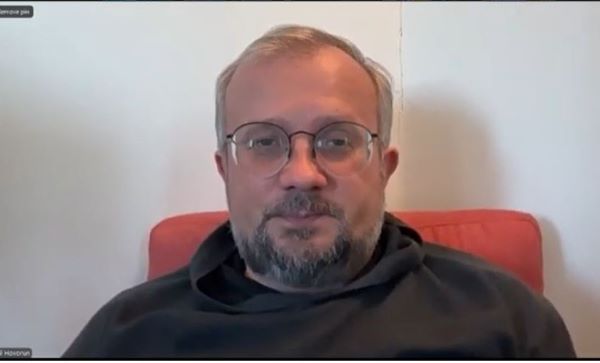
Archimandrite Kyrylo Hovorun, Doctor of Philosophical Sciences, Candidate of Theology, Professor at Loyola Marymount University, Professor at the Stockholm School of Theology, Ecumenical Patriarchate
America is changing profoundly. It is a kind of kaleidoscopic change, such that you do not recognize the America that existed even two weeks ago. I have personal experience. Three weeks ago I was returning from South America to North America. There were no problems at all when crossing the border. This time I was returning from Kyiv literally the day before yesterday, and I was additionally interrogated in a special room. This has changed in the span of two or three weeks. I was forced even to clean up some posts on Facebook where I criticized Donald Trump and wrote about his ideologues. I hid those posts on Facebook, as they say, to keep out of harm’s way.
I will not speak about how attitudes toward Ukraine are changing, but I want to say how attitudes are changing toward the problem of our intra-Ukrainian quarrels. In America this takes place in the context of discussions about freedom of conscience. This is a foundational and mythologized theme. Americans believe in the myth of their original support for the idea of freedom of conscience, although in reality this was not the case. At the beginning, America was just as intolerant of other religions as everywhere in Europe.
I compare the American situation of the era of the first colonies with the situation of the Thirty Years’ War in Europe. The Thirty Years’ War was religious and the bloodiest in Europe until the twentieth century. At that time from four to eight million people died as a result of conflicts between states that were inspired by Protestant and Catholic churches, that is, the churches wound up governments and peoples to destroy one another, which led to mass loss of life. After this the Peace of Westphalia was concluded in Münster and Osnabrück in 1648, and the situation in Europe changed politically.
There was something similar in America. The only difference is that there was not the same kind of war between the states, but within the states there was quite a high level of intolerance. There were states in which one could belong only to a single confession—usually these were radical Calvinists who did not tolerate others. To be in the New England states as some kind of Mennonite or, God forbid, a Catholic, was in fact like a death sentence. And only at the beginning of the nineteenth century did freedom of religion actually begin to be recognized in America. And it became a foundational myth of America. This idea remains important to this day, although in reality many different things are meant under it.
I had the opportunity several times to speak about my personal experience of being in Washington at the beginning of February, where a major summit on freedom of conscience took place, at which Vice President Vance spoke, as well as representatives of the new administration and of the old Washington establishment. Everyone spoke about the necessity of freedom of conscience, but obviously they had many different things in mind—from a rather radical symphony of the Russian type to freedom of conscience proper. The topic of freedom of conscience is now very idealized and politicized in America. It has to a large extent become a political instrument, as perhaps it was before as well, but not as obviously as it is now.
Therefore, when in America people speak, or when from America they speak about the situation of freedom of conscience in Ukraine, this has certain political dimensions and subtexts that need to be understood when we hear words of criticism or words of approval concerning the Ukrainian situation. It is necessary to understand this American context and the driving forces that move these messages in the American environment.
By the way, the current Secretary of State, Marco Rubio, previously played an active role in this process. This is connected with his Cuban background. He is a devout Catholic. Things are complicated with the Catholic Church in Cuba, since only relatively recently did the Cuban government allow it to exist there. For Rubio, the political program of freedom of conscience flowed from his Cuban background. The defense of the rights of the Catholic Church in Cuba was his principal driver, and he transferred this set of issues to the global stage. Now on this stage, from the American point of view, the principal problem is China. The principal problem is not Russia. Although, at the summit in Washington, those who took part in it emphasized in every possible way that the greatest violator of rights is Russia. And I built my presentation in such a way as to show that Russia has outstripped China in violating rights and freedoms when it comes to religion. In Washington this message was not received—because of the aforementioned political engagement and bias. There China remains the number one problem, and Russia remains in the shadow of that problem.
We can, of course, speak about this subjectively, as Ukrainians, and say: what do we care about China when Russia is destroying us. I go to China quite often and, comparing the policies of China and Russia regarding freedom of conscience, I consider that China does not behave as harshly as Russia.
Now as concerns Ukraine. The summit in Washington took place two months ago, and in two months many things have changed: in attitude, in treatment, in the understanding of what is happening in Ukraine—despite the colossal efforts that Ukrainian Evangelicals are making first and foremost. They really are doing colossal work, gathering materials and disseminating these materials about persecutions and oppression by Russia against Ukrainian communities, primarily in the occupied territories, and disseminating this information in America. They are lobbying and trying to reach their American brothers and sisters.
But I see that the fideism that is characteristic of Donald Trump’s entourage in the religious environment cannot be broken through with these arguments. The Greek Catholic Church is also doing a great deal, in particular Archbishop Borys Gudziak personally, who is making colossal efforts to convey messages about oppression by Russia. From time to time Major Archbishop Sviatoslav Shevchuk comes to America and he also does a lot. The Ukrainian Church within the Ecumenical Patriarchate in America is also making a great effort to convey this information to the American environment. But this is very difficult to do, because the people who now make decisions on the issue of freedom of conscience are often driven not by objective reality, but by a political program, and this is a characteristic feature of the current political regime. In view of this, I foresee that attention to Russian crimes on Ukrainian territory, particularly in the occupied territories, will not be sufficient for us and will not be significant in the American establishment.
Instead, also because of this political engagement, attention to the conflict between the Orthodox Church of Ukraine and the Ukrainian Orthodox Church in Ukraine is growing. On the one hand, the reactions of the new political establishment in Donald Trump’s entourage to this conflict between the Orthodox Church of Ukraine and the Ukrainian Orthodox Church are not as great as I expected. I thought that people in Donald Trump’s entourage who deal with issues of freedom of conscience would pay much more attention to this conflict. For now I primarily see the efforts of Robert Amsterdam, who is trying to push this topic again and again, giving interviews to Tucker Carlson, and in the same way, at the summit in Washington he was the only one who spoke unambiguously with criticism of the Ukrainian government and with criticism of Ukrainian policy toward the Ukrainian Orthodox Church. Others, even from Donald Trump’s entourage, did not speak about this—I at least did not hear such critical speeches.
But we recently saw a report by the Department of State in which our controversial law was criticized (the Law on Affiliation No. 3894—editor’s note) and in which criticism of the policy of the Ukrainian state was voiced gently but firmly, as the saying goes. This is not as strong as I expected, but it is still criticism, although it is not always guided by objective reality, and is inspired by political programs and by the messages that are generated and circulate in Donald Trump’s entourage.
I would also like to say something about the attitude of Orthodox churches in America toward the conflict between the Ukrainian Orthodox Church and the Orthodox Church of Ukraine. Those churches that have their origin in the Russian tradition take the side of the Ukrainian Orthodox Church in this conflict. They do not enter into communion with the Orthodox Church of Ukraine, they do not recognize the Tomos, they do not recognize the decision on the autocephaly of the Orthodox Church of Ukraine, and they consistently criticize precisely the Orthodox Church of Ukraine and the Ukrainian government in a single package, promoting narratives of persecution against the Ukrainian Orthodox Church. The “champion” among Orthodox churches of the Russian tradition in this question is the Russian Orthodox Church Outside of Russia. Somewhat unexpectedly, the Orthodox Church in America (OCA) is taking a rather one-sided position. Although earlier it was more neutral and moderate, now it takes a position that gravitates toward the Russian Orthodox Church Outside of Russia—not as radical, but quite close. There are different explanations for why this is happening. To a large extent this is the personal position of the primate and of some bishops in the Synod. Although the Synod of the Orthodox Church in America is quite divided as well. I know members of the Synod of the Orthodox Church in America who are unambiguously on the side of Ukraine and who, if it were up to them, would recognize the Orthodox Church of Ukraine. But they do not constitute a majority in the Synod, and they do not possess the informal weight that earlier belonged to such people as, for example, Father Leonid Kishkovsky, who died and with whom the visions that the Orthodox Church in America had since the time of Alexander Schmemann and John Meyendorff departed. Now there are no figures who would be comparable to Leonid Kishkovsky and who could informally influence policy as he informally influenced the policy of the Orthodox Church in America.
As for other jurisdictions. The Antiochian jurisdiction, although it declares independence from the Antiochian Patriarchate (they even wanted to go the way of their own autocephaly from Damascus, but they did not succeed), nevertheless correlates its vision with the vision of Damascus. The Greek Archdiocese formally supports the Orthodox Church of Ukraine, and in this sense it is in the mainstream of the Ecumenical Patriarchate. But informally from its side there is also a certain amount of criticism concerning the interreligious situation in Ukraine. The Ukrainian Church within the Ecumenical Patriarchate is the most pro-Ukrainian and the strongest advocate for the Orthodox Church of Ukraine, but its voice is rather weak within the American Orthodox environment, which in and of itself is rather weak.
Therefore we can say that the attitude on the part of American Orthodoxy—if one may generalize this attitude—toward the situation in Ukraine ranges from cautiously critical to engaged-critical and sometimes even illogically critical. And this is the reality with which we must deal.
I see that in the future there will be growing criticism of the policy of the Ukrainian state in church matters on the part of the administration of Donald Trump and of those people who deal with religious issues and issues of freedom of conscience in America. And the aforementioned law, and the policy of the Ukrainian state, can be both a reason and a pretext for American policy toward Ukraine. A reason—for those who sincerely care about the Ukrainian theme and are not led by the mythology that is currently growing around Donald Trump. And those who, on the contrary, are guided by that very mythology will use this law and the conflict between the Orthodox Church of Ukraine and the Ukrainian Orthodox Church as a pretext to reduce or to stop aid to Ukraine.
Therefore, I think that strategically for Ukraine now it would be important to strengthen dialogue between the Orthodox Church of Ukraine and the Ukrainian Orthodox Church. That is, the path of confrontation, the path of fencing themselves off from one another, which both the Ukrainian Orthodox Church and the Orthodox Church of Ukraine are following, the path of their own exclusivity, is not constructive; it is harmful for Ukraine, especially now. It was harmful before, even prior to Donald Trump. But now it is especially harmful, because it gives a pretext to those who are looking for a pretext to harm Ukraine in some way or simply to ignore Ukraine.
Therefore, I think that the tasks of the Brotherhood are strategically important for the Ukrainian public, for the survival of Ukraine as a state and as a people. Because the path of dialogue, the path of finding points of contact between the two churches—the Ukrainian Orthodox Church and the Orthodox Church of Ukraine—will neutralize or reduce pressure from the American administration on Ukraine and will be an important contribution to ensuring that Ukraine continues to survive and continues to fight, despite the change in attitude toward it on the part of the American administration.