By Daria Morozova, St. Sophia Brotherhood
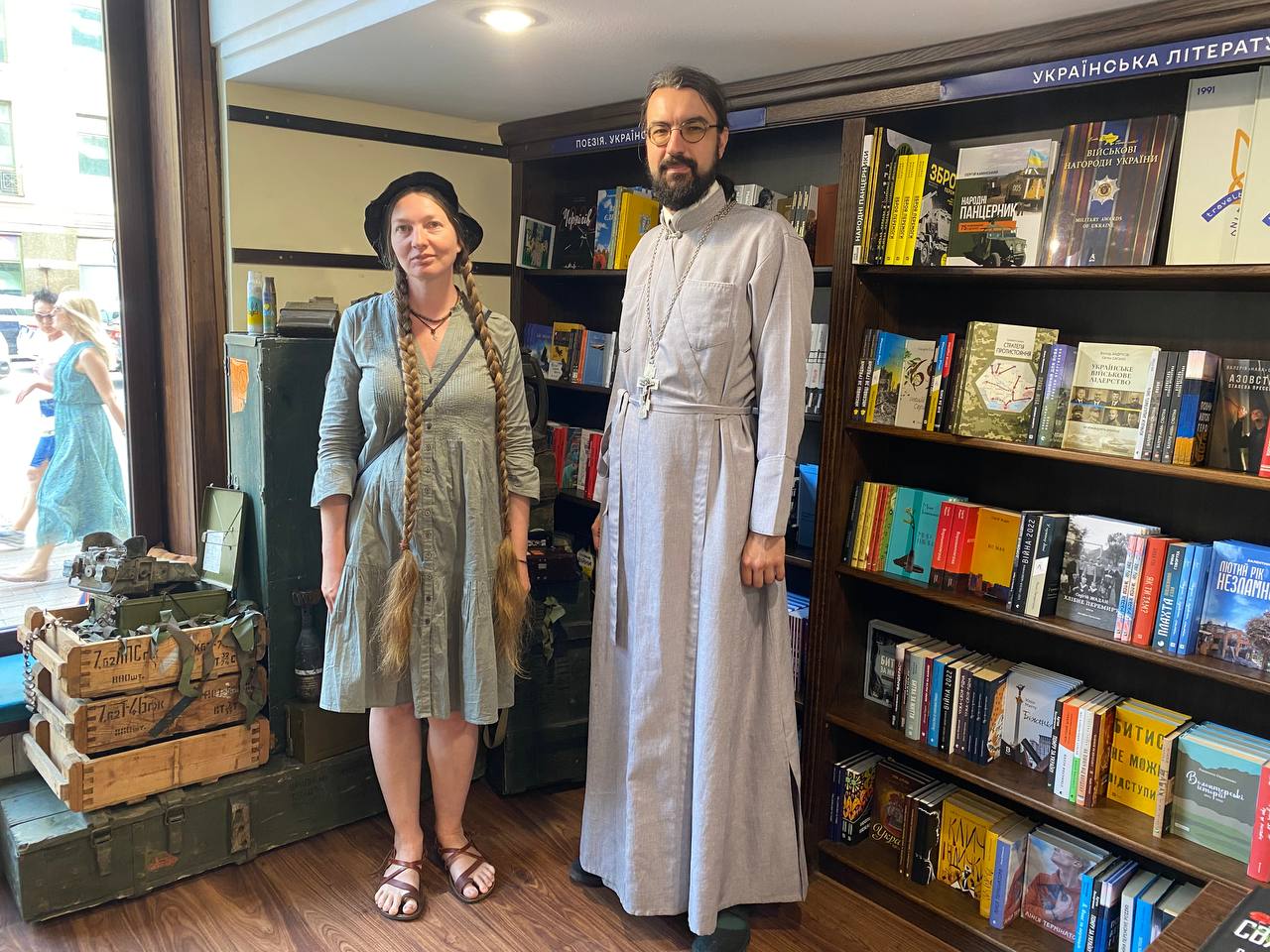
Fr. Yaroslav Yasynets, priest of the Kyiv Diocese of the Orthodox Church of Ukraine, chaplain of the 225th Separate Assault Regiment, Master of Theology. He studied at the Chernivtsi Orthodox Theological Institute, the Ukrainian Catholic University (Lviv), the International Academy of Philosophy (Granada, Spain), and remotely at Holy Cross Hellenic College (Boston, USA).
– To start with, I’d like to ask about the meaning of studying ancient liturgies in modern Ukraine. I have a suspicion that most of our priests and faithful – even the most devout – know that there’s the Liturgy of St. John Chrysostom and the Liturgy of St. Basil the Great, and that’s about it. Why do we need some other obscure rites from antiquity that, as they say, you can’t spread on a slice of bread?
– That’s the best-case scenario: that they know at least those two liturgies exist. In the worst case, they only know that there’s “a liturgy,” or “a church service,” or simply “a worship.” People come there and try to understand what’s going on. Right now, it’s not uncommon to hear from OCU parishioners that “the Moscow priests used to pray in Russian” (because they don’t distinguish between Russian and Church Slavonic). And they say: “Back then, when they prayed like that, we understood nothing. But now, after our parish joined the OCU and we started praying in Ukrainian, we understand everything.” You ask them just three questions, and it turns out – they understand nothing. For example: what is “mercy of peace, a sacrifice of praise”? In your own words? Or what is the Cherubic Hymn? What do these words mean? People respond: “We don’t know, but it’s supposed to be that way.” That is, even the faithful don’t try to understand it.
I don’t think everyone must be great theologians – although that’s a debatable point too. Because we, as Christians, are “God-taught” (theodidaktoi, 1 Thess. 4:9), and we should understand the meaning of our faith. Look at how Protestants study the Bible. They know it chapter by chapter, verse by verse, because it’s their life – they’re interested in it. How well do monks know monastic rules? Well, let’s leave the monks alone – they devote their entire lives to this. But Protestants have jobs, families, lead regular lives – and they still know the Bible inside and out. How deeply do Muslims study the Quran? They also know it thoroughly. How much do Jews read, especially rabbinical students? By the age of 30, many of them already wear thick glasses – they lose their eyesight from constant reading. And many of them also have large families and secular jobs. So, the whole issue is desire. It’s about how much we love our faith, how much time we’re willing to dedicate to it, and how much we live in it.
So, if you live by it, you may start to wonder: What does our Liturgy mean? Where did it come from? Why is it the way it is and not otherwise? And when you begin to delve into it, you realize that it didn’t fall from heaven. Just like the Bible didn’t fall from heaven either. There are different books in it, written at different times, by different people, under different influences. And what percentage of it was inspired by the Holy Spirit – you can’t measure that with any device or calculate with calipers. It’s the same with the Liturgy. When a person becomes interested in it, they first begin by studying the types of liturgy most commonly used among us.
They begin to notice, for example, that the Liturgies of St. John Chrysostom and St. Basil the Great are mostly similar, but differ in the priest’s prayers. This becomes especially obvious when the priest reads these prayers aloud so that people can hear them – that’s what I do. On a deeper level, you begin to see that there are many liturgies. For instance, it’s easy to observe that Catholics serve differently. What we’ll be talking about further is often labeled as a “Catholic” service. Catholics indeed celebrate differently. But why is that? After all, both Eastern and Western rites originate from the life of the early Church. When a person starts to ask such questions, it creates a desire to try, to touch, to come into contact with this tradition of antiquity, to see what is similar and what is different.
The very words we say during the Liturgy should attune us to our personal prayer. I always tell people: prayer is not what you mumble from a prayer book. It’s your communication with God. When you look at the prayer book, all the texts in it are the words of those who dedicated their whole lives to communion with God. They’ve left us beautiful examples. Just as if a young man wants to charm a girl, he might read Petrarch, Shakespeare, or Goethe, find refined epithets, metaphors, poetic turns of phrase, and borrow them to express his own feelings. He might even learn some beautiful poems, or sing a serenade beneath her window. That is, he looks up to what is beautiful. We do the same in the realm of communion with God. Of course, I’m not talking about the kind of prayer when you’re rushing to a meeting and whisper, “God, help me make it on time!” When we’re truly attuned to the wavelength of communion with God, we look up to what is beautiful, to the highest examples. And these prayerful texts, including the texts of ancient liturgies – they are beautiful.
In our Church – both in the East and West – until the age of modernism, there was always the idea that the Church doesn’t progress but rather declines. And it is preserved in being only by the grace of the Holy Spirit. Saints of all ages always said: we are no longer capable of bearing such spiritual feats as our predecessors, our teachers. We are not capable of praising God so beautifully, of praying so long, of performing such miracles. There was always a reference to the great ones before us. We do not have an image of some perfect Christian who will appear in the future, someone we must evolve into. We have only one ideal – Christ. And then there are those who followed Him – and with each generation, this following fades.
– Of course, all the saints loved to refer to their own weakness and unworthiness – but at the same time, they brought ever new treasures into the Church’s Tradition. Isaac the Syrian referred to Chrysostom, he in turn to Ignatius the God-Bearer… We can see the saints pointing to one another across the centuries.
– And still, it’s not development – it’s more like leapfrogging. You can imagine a descending line that leads from Jesus Christ and the early Church gathered at the Last Supper to our days. Then came the Day of Pentecost, when the Holy Spirit descended on the apostles – the higher reality entered ours and transformed it. This lifted the apostles to a new level. Then little by little, decline began again. Of course, the great Fathers of the Church brought in something else – something beautiful. One of my teachers once said that all the history of theology is a collection of small personal revelations. That is, the Holy Spirit teaches a person who seeks this knowledge and is ready to receive it. Under the influence of the Holy Spirit, the person rises and transmits this experience to their surroundings. Someone may receive it – but even then, the reproduction of another’s experience is already secondary.
This becomes especially apparent in the field of liturgics. How beautifully they used to serve the liturgy in former times! Now many say it’s no longer needed, that it’s no longer important. Some things are simplified, shortened, minimized – unfortunately. Even in our Byzantine tradition – or rather, the Synodal tradition – many no longer understand why the solemn moments of a hierarchical liturgy are necessary: the vesting at the kathedra, the omophorion, the eagle rugs (orlets).
– Yes, it’s not always obvious…
– Many say: why do we need this drawn-out singing in cathedral services? We don’t understand it. But cathedrals are where people come who, by default, should already know what the liturgy is about – people who come to enjoy this high art. Because glorifying God is also art. And it is this art that gave rise to our Kyivan-Rus’ civilization, and Western European civilization as well. This is the art of glorifying God – the learning that comes from Him. It is what transforms us, our minds, our surrounding reality, and inspires people toward greatness.
The ancient liturgies are one of the beautiful manifestations of this ancient civilization. We can’t now go and build Gothic cathedrals or the majestic Byzantine churches that once stood here. We won’t rebuild them – the Kyiv authorities won’t allow it. But even in small chapels, we can still touch the beautiful – for those who seek it. It doesn’t bring money; it’s not monetizable. But the Divine Liturgy is not about money. Today’s priests often see themselves as service providers: to baptize, to marry, to bless, to bury – for which they’re paid directly. Sometimes even according to a set price list. The grand Liturgy brings no profit. And so many think: why should I spend time, effort, learn something? So ultimately, it all depends on interest – and on how deeply we live our faith, and how important it truly is to us.
– The Greeks say that in a small church there is more grace. There’s something to that.
– The Sacraments always have the same fullness. Regardless of whether they are performed by a priest burdened with sins or a priest who is struggling with his passions with all his strength, the grace of the Sacraments remains the same. This is our dogmatic teaching. And whether we celebrate the service underground, or at the front for soldiers, on a portable altar—as I often have to do—the grace of the Sacraments is the same.
– Of course. At the same time, people feel that every community has its own vibe—some call it an “aura.” Some gather out of obligation: “the bishop is serving, we must be here, it’s our duty.” And elsewhere, people come simply because they feel with their heart that something special is happening there.
– That’s also true. Ideally, people should come to metropolitan or patriarchal services already understanding everything, and simply wanting to enjoy the beauty of the worship. I used to love those services—I loved coming to them at St. Volodymyr’s Cathedral, at St. Michael’s—but later, unfortunately, I too was tempted (“caught a temptation”), seeing that many people were coming just to tick a box. By the way, in the UOC (Moscow Patriarchate), which we’re so eager to criticize, I personally saw hierarchs during major feast days in the Lavra come out onto the kliros during the all-night vigil and sing and read. It would be a shame if we pulled over all the worst from the Moscow Patriarchate, and neglected everything that was best.
For example, the celebration of ancient liturgies in the Western Rite was practiced even in the Russian Church. The Liturgy of St. James and the Liturgy of St. Gregory (in the Western Rite) were served by Metropolitan Nikodim (Rotov), who was deeply interested in these things (leaving aside his moral qualities for now). Since then, the Liturgy of St. James is still served at the St. Petersburg Theological Academy. And in the Antiochian Church in America, there’s a whole branch that celebrates according to the Western Rite. I would even call it a “reverse unia.”
– If I may, a biographical question. How did your personal encounter with these ancient rites begin? When did you start studying and implementing them?
– I can’t remember exactly what year it was. I first became interested in this topic when I was a theology student at the Ukrainian Catholic University. I saw the Catholic Mass—specifically, the modern novus ordo. And I was told that before the Second Vatican Council, the Catholic Mass was different—more similar to our Byzantine Liturgy. I started watching videos and saw how beautiful it was. Then I found information about the use of this rite in the Russian and Antiochian Churches. They adopted the tradition of celebrating in the Western Rite, primarily in the United States, so that Catholics who were disappointed with the reforms of the Catholic Church would come to Orthodoxy. Later, it was celebrated by the well-known saint John Maximovitch, the Bishop of Shanghai. So it really was conceived as a “reverse unia.”
At that time, I asked myself: is it possible for us to do this too? And I realized—it is. I began to research the history of this liturgy. Since it is a rite that existed before the division of the Church, before the 11th century, it does not contradict the Orthodox tradition. I’m speaking about the Gregorian Mass. Today it’s often called the Tridentine Mass, but the Council of Trent (1545–1563), which fought against the Reformation, merely standardized this ancient rite and made it uniform for the entire Catholic Church. But the service itself dates back to the 6th century, and is attributed to St. Gregory the Great—though, I believe, just like with the Liturgies of St. John Chrysostom or St. James, at best he simply refined and beautified it. But it is traditionally ascribed to him.
What do I like about this service? It pays great attention to detail. Its prayers are in many ways similar to the prayers of the Liturgies of Basil and James. But it’s the details that matter. How the priest stands, in which direction he turns, how he holds his hands, the specific order of the liturgical vessels on the altar. One moment I particularly love: during the consecration of the Body of Christ, the priest holds the host between the index and thumb fingers of both hands. After the consecration, he does not separate these fingers until after the communion of both priest and faithful, during the ablution. In other words, the fingers that have touched the sacred—the Body of Christ—must remain joined and not touch anything else. For holding the chalice or the veils, the priest uses the remaining six fingers.
– So it’s a kind of choreography, down to the level of fine motor skills. Not everyone could probably manage that?
– It’s a matter of practice. It’s like driving a manual car. The more you practice, the easier it becomes. After five celebrations of this service, I’m already able to reproduce all these elements without difficulty.
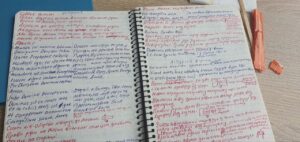
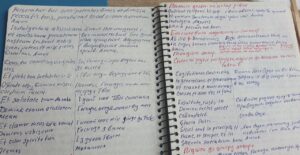
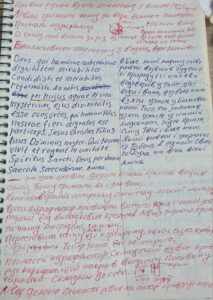
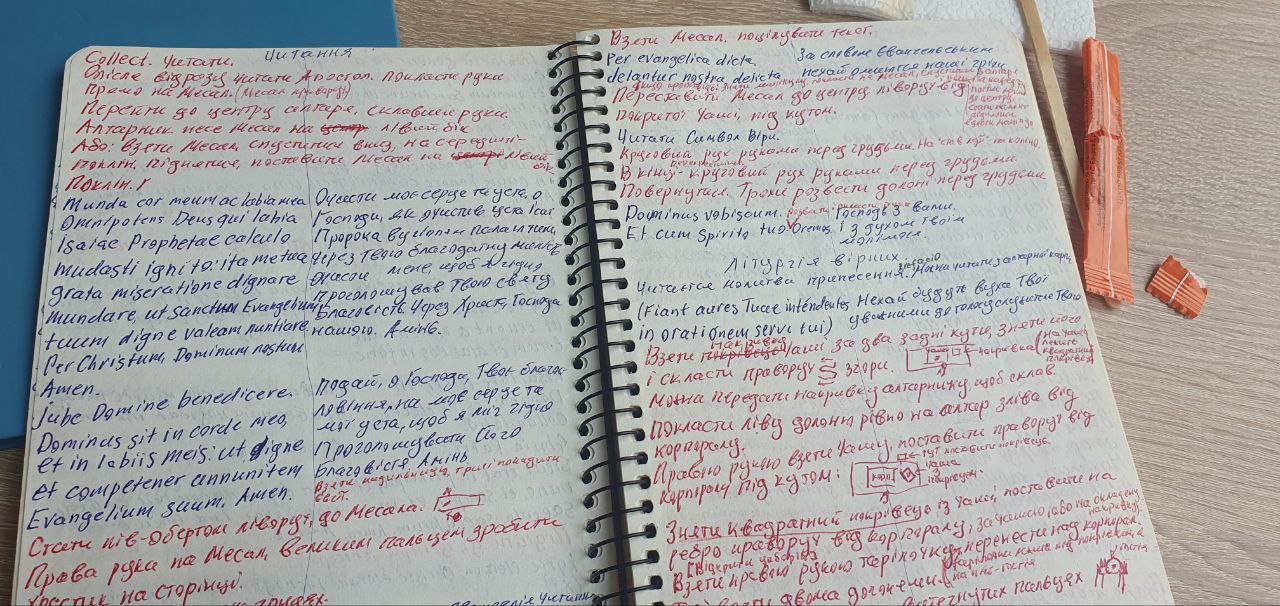
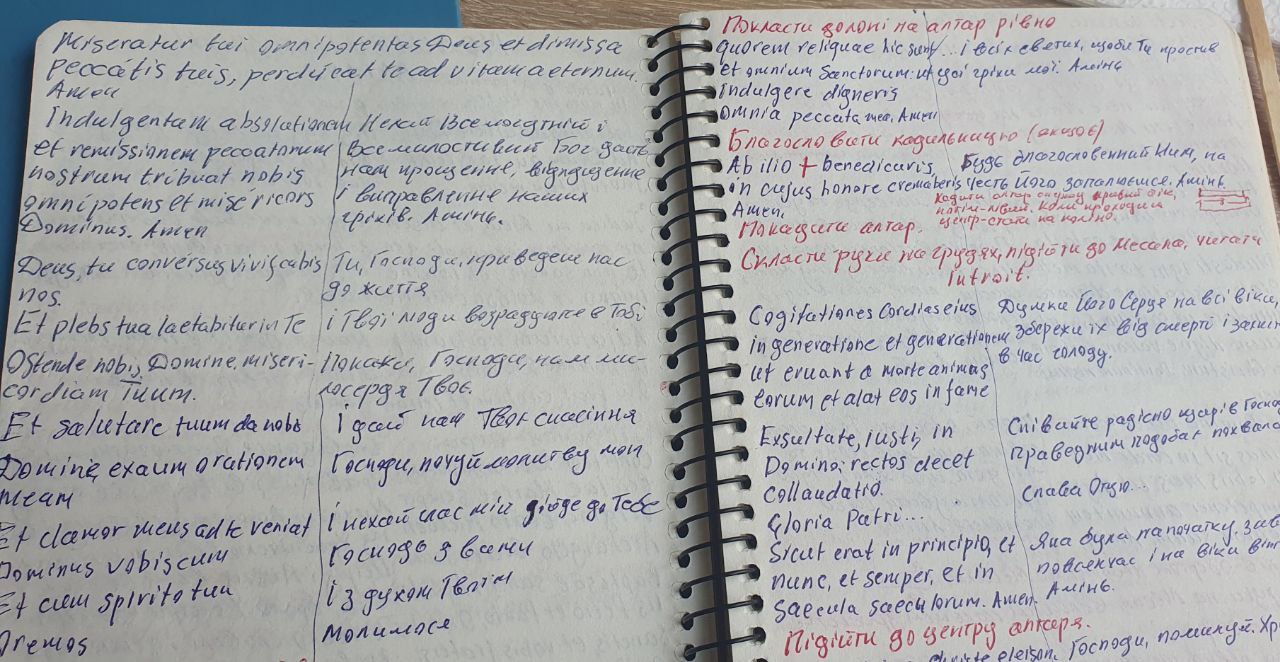
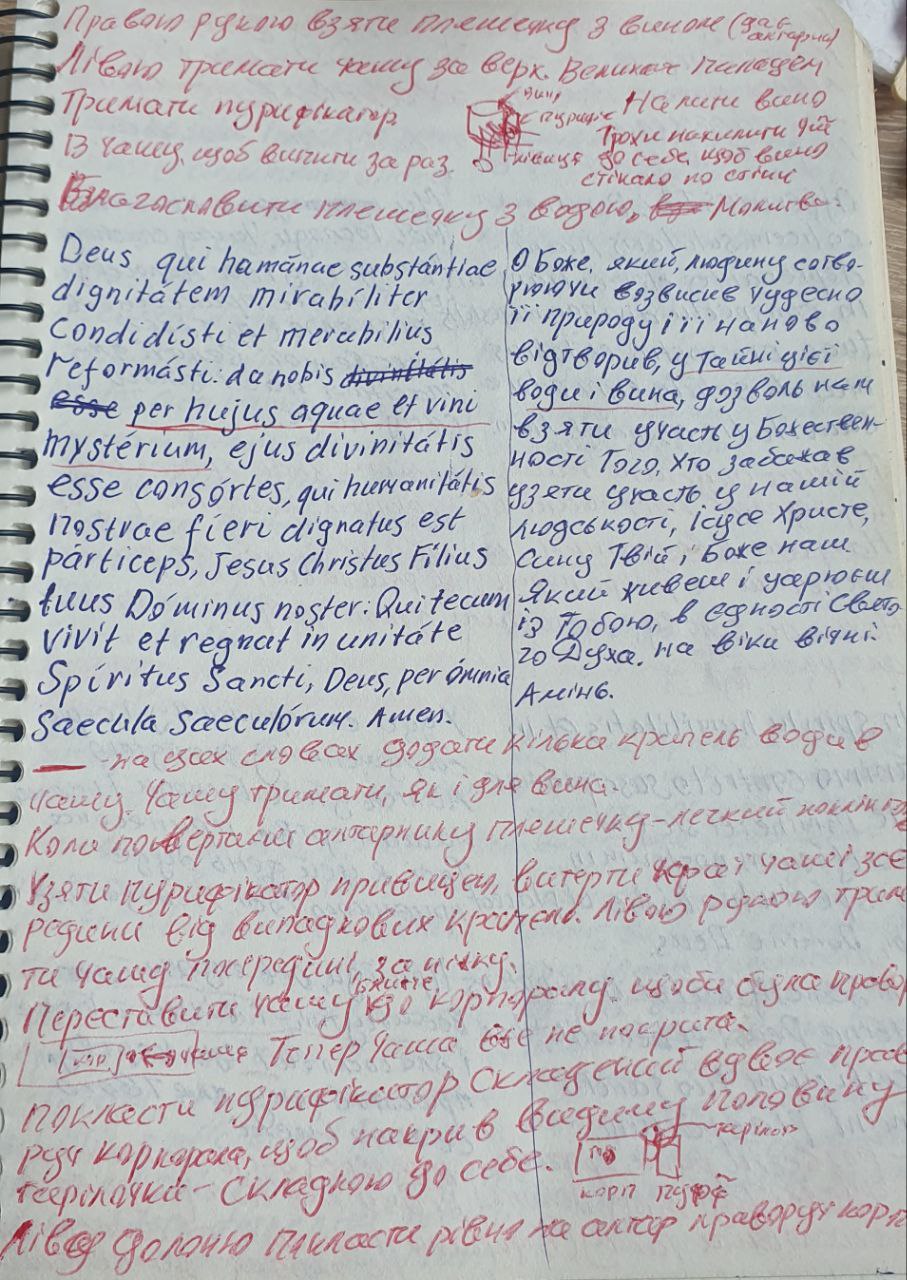
This is a handwritten missal of the Gregorian Liturgy that I made for my own use. On one side is the Latin text, and on the other side – my own rough Ukrainian translation. It contains primarily the priest’s parts, because this is a simplified, spoken version for when a priest serves alone. There are other variations, for when there’s a deacon, various subdeacons, and torchbearers – there can be up to ten of them, each with their own function, especially during a hierarchical service. There can be two choirs that alternate with each other. In contrast, in the Gregorian Mass, there is no concelebration. That is, the Liturgy is celebrated by one priest, assisted by a deacon. There is no practice of multiple priests celebrating together: if they are present, they serve as deacons or subdeacons. Only one priest celebrates, and he communes his fellow clergy together with the laity.
– Oh, that’s exactly what our fellow Odesan, Nikolai Afanasiev, emphasized – that there should not be some ontological divide between clergy and laity, as if there were first-class and second-class Christians. There should be only one bishop or priest presiding at the Liturgy, and everyone else participates equally.
– This principle is intrinsic to the Gregorian Liturgy: one priest – one Sacrifice. There is no concept of concelebration. And when it’s a hierarchical service, there is the chief hierarch, and the others assist in auxiliary roles.
– What are these red ink notes?
– The red ink highlights all of the priest’s movements and actions. Everything is written out: where to stand, what to place where, diagrams are drawn – how to do things, how to vest, and so on. Because in the Gregorian Mass, vesting happens in a particular way, especially in a hierarchical service. The bishop does not vest at the kathedra, he sits in the northern part of the church, reads prayers, is vested there, and then proceeds to the altar… By the way, at the moment I don’t have authentic Western priestly vestments, so I serve in Byzantine ones. Authentic ones are hard to find – partly because, for example, in Europe, in Germany, after the Second Vatican Council, many of those beautiful embroidered vestments were simply thrown in the trash, not even burned – just dumped into the garbage.
Authentic early texts of the Gregorian service are also not easy to find. So I’m forced to use the Roman Missal – that is, the one after the Council of Trent, where some editorial changes may have been introduced. But the core remains the same. The theology of this liturgy is interesting in that it includes only the anamnesis, not the epiclesis. This is an early conception – part of the heritage of the undivided Church.
People sometimes ask me: “Why don’t you get a blessing to serve this liturgy?” I say: “Should I?” If it’s the heritage of the undivided Church, why should I need some special permission? I’m not inventing anything new. We use different kinds of chant – early and late. We don’t get a blessing for every specific chant. It’s the same with liturgical rites. If it’s all part of our tradition, why should we have to ask about it separately?
– There are those who love asking for blessings. Some even believe you need the ruling bishop’s blessing to say the Our Father in Aramaic – the language of Christ. That’s a bit ridiculous.
– That’s exactly how the Catholic administrative apparatus is being pulled into our Orthodox tradition. We’ve always had the principle of sobornost, of conciliarity, the communal principle, which our Church was meant to be built upon. But the Russian Church emulates the rigid verticality of the Catholic administrative system.
– Since you mentioned chanters, how do they manage when you celebrate something so unfamiliar? I assume they have to learn completely unfamiliar melodies?
– If they want to, that’s great. The early Western liturgy has several forms. There’s a simple version, a solemn one, a spoken version, and a sung version. So far I’ve only celebrated the spoken version. Because I haven’t found any chanters who know how to sing it, nor any teachers who could teach me. They say Taras Kompanichenko knows how to sing this liturgy. If I find people capable of singing Gregorian chant, that would be wonderful.
– In the West there are groups like Ensemble Organum who reconstruct early Gregorian chant and even pre-Gregorian melodies. They’re very similar to Byzantine chant – you can clearly feel the shared tradition of the undivided Church. Have you ever encountered the Gallican Rite?
– I’ve heard from knowledgeable people that very few original texts from the Gallican Rite survive. Some are currently trying to reconstruct that ancient French rite. There was also the Celtic Rite, but there’s even less reliable information about it. So what’s being reconstructed now is mostly modern imitation.
– The Gallican rite was reconstructed by people like Yevgraph Kovalevsky and other theologians from Russian émigré circles in France…
– There was one very interesting bishop – now departed in the Lord – Bishop Vigile Morale, a Frenchman. He belonged to the so-called Milan Synod: a lineage that came from the Greek Old Calendarists, but in 1993 our Kyiv Patriarch Volodymyr Romaniuk formally recognized that church, and so they were in communion with the Kyiv Patriarchate until 1996 or 1997. Bishop Vigile knew the Gallican rite thoroughly – at some point he even reconstructed it. There are many photos of Bishop Vigile taking part in the enthronement of Patriarch Filaret in 1995. The entire Milan Synod came to Kyiv for it. They were led by Bishop Eulogius Hessler, a former Catholic and Benedictine monk brought into Orthodoxy by Metropolitan Anthony of Sourozh. He continued to serve in the Gregorian rite – that’s how worship was done in all his parishes. A lot of interesting people were drawn to him – Bishop Gregory, Bishop Vigile – and at one point they entered communion with the Kyiv Patriarchate. God granted me the grace to meet Bishop Eulogius just six months before his death in Milan. He combined the traits of a German aristocrat and an Orthodox elder.
I highlighted some of the history of that church in my book The History of the Ukrainian Autocephalous Orthodox Church from 1979 to 1995 Based on Eyewitness Accounts (written in English). It contains about 25 interviews with people who witnessed those events, as well as many archival documents and photographs. There’s even a photo of the Tomos of autonomy granted to that jurisdiction by Patriarch Volodymyr.
– If we may, let’s speak more specifically about certain rites. For instance, I’ve always been curious about the Liturgy of St. James. It’s often seen as somewhat scandalous, because, as I understand, in that liturgy, the laity receive Communion the same way as the priests?
– Not exactly the same: they don’t enter the altar to the holy table. But the priest brings out the diskos from the altar, and the deacon brings the Chalice (or the priest does it himself if serving alone – first the diskos, then the Chalice). Then the priest gives the Body of Christ into the hands of the laity, and afterward they come up to the Chalice and take three sips. Essentially, this is an ancient Church tradition, which existed up until the Fifth or Sixth Ecumenical Council. Chrysostom was forced to introduce Communion with a spoon because people stopped approaching the Holy Gifts with proper reverence. In earlier times, the Body of Christ was kept in believers’ homes. They could take a portion home and place it in a tabernacle in the corner of the house – and, for example, before a journey, or even during travel (say, on a ship), they could communicate themselves after reading what is now known as the Typica service. Sometimes, the father of the household (pater familias) could commune his family and household.
– So later on, the Church stopped trusting the laity with the Gifts, and clergy started to ensure no one smuggled the Holy Gifts home. Even the zapivka was introduced so that no one could hide a particle in their cheek…
– Exactly. Because the Gifts began to be used for sorcery. It was a real threat of sacrilege—of black magic being performed over the Holy Things. To protect against this, the practice of communion with a spoon, followed by the zapivka and other precautions, was introduced. Today, one could revive these earlier traditions—but only with extreme caution, and only among truly faithful Christians. Because we are once again facing Constantine’s problem of mass baptism. Church has become trendy, part of the mainstream, and so the Church is filling up with very nominal Christians. Just like in the 4th century, we are again searching with a lantern at noon to find true Christians among “Christians.” As absurd as it sounds, baptism used to be something one had to earn.
Now we often talk about combating sects. Yet the early Church bore all the marks of a modern sect. To become a Christian was a feat, an honor that had to be earned. One had to go through a long period of testing. Baptisms were only done once a year – at Easter – and the newly baptized wore white garments until Pentecost. It had to be earned; one had to suffer for it. And now we think it’s good enough to show up to church once a year. This indifference of the baptized toward Christ – that is a great tragedy.
So once again, we are finding Christians among “Christians.” And for those people who truly live by faith and are not afraid to suffer for it if needed, we can begin to revive ancient liturgical practices. I believe it’s a tremendous privilege to receive Communion in such a manner.
– As I understand it, there won’t be a need for three security rings around this church, since not everyone would want to attend some ancient liturgy, and it’s not clear to everyone why it’s even needed. I suspect the older rites are longer than those currently practiced?
– It depends on how you sing them. Take the Liturgy of St. James, for example. There are specific chants that no one here really knows how to sing, so I had to serve it as a spoken version. But the prayers are very beautiful and quite long – even more ornate than those in the Liturgy of St. Basil. Everything is prayed for: the whole world, all professions… I read it in about two hours. That’s not much, actually. I love liturgies that last three hours or more. The Liturgy of St. James, according to the Typikon, should be served several times a year at minimum – but there are no restrictions against celebrating it on other days. It originates from Jerusalem, not the West. Typologically, it belongs to the earliest forms. It resembles the Chrysostom Liturgy but follows a slightly different order: it begins with praise, then the Great Litany, three Old Testament readings, then the Gospel, and then the Epistle – following the order of our canon of Scripture. Then comes the full Great Entrance, as in Greek usage.
– I’d love to hear more about the Syriac liturgies.
– There is a liturgy preserved under the name of Nestorius. Fr. Theognost Pushkov sent me his Russian translation of it. So, following in the footsteps of Patriarch Filaret, I translated it into Ukrainian – just as an experiment.
– The name of Nestorius, condemned at the Council of Ephesus, may sound scandalous to some – although that condemnation clearly involved politics, biases, and linguistic misunderstandings between Syriac, Coptic, and Greek-speaking believers.
– There’s an opinion that both sides simply misunderstood each other…
– We can also talk about the purely political clash between the Antiochian and Alexandrian parties, with the latter being more influential and seeking to discredit the Antiochians by condemning their leaders. So it’s worth asking: should Nestorius’ stained reputation influence the liturgy associated with his name?
– Clearly, this liturgy existed already at the time. Even if Nestorius standardized or supplemented it, he did so before his condemnation. So his condemnation shouldn’t affect the Antiochian liturgy. After all, the law is not retroactive.
I liked this liturgy. The prayers are very beautiful. You can even begin it as you would a usual liturgy. It has the most distinct Eucharistic canon. The Proskomedia is essentially not performed – as in the Liturgies of James and Gregory. A different kind of bread is used, which then becomes the Body of Christ.
The Proskomedia is a later addition. The trimming of the bread began because people brought regular loaves to church, which would often have a burnt crust on the top, bottom, or sides. This crust was simply cut off with a prayer and placed on the diskos. Wine was poured into the chalice with a prayer – that was the entire Proskomedia. All the triangles and commemorative particles for the living and the dead came much later. Actually, the first specially-made liturgical bread appeared in the West – the so-called wafers, which have long been used in the Gregorian Liturgy. The wafer or host is the sacrificial bread.
– So the Catholic wafer originates in the early Middle Ages.
– Yes. In Byzantium, people just brought loaves to church. Sometimes they were even laid directly on the altar. The priest would read the prayer over one main loaf, but all the surrounding loaves were considered consecrated as well. The Gregorian Liturgy has a similar moment. One host – large or small – is consecrated, but if many communicants are expected, a ciborium (a vessel containing other hosts) stands nearby. At the moment of consecration, when the priest says, “Take, eat, this is My Body…” he first looks at the main host he is holding, then at the hosts in the ciborium, intending their consecration. Since this liturgy is based on the principle of anamnesis, the priest is seen as acting in persona Christi (in the person of Christ).
So in the Western liturgy, the Words of Consecration are central. Byzantine liturgics operates with the concept of “permanent epiclesis” – meaning from the very first blessing (“Blessed is the Kingdom…”) to the final dismissal, there is no single central moment. Even the Eucharistic canon is not isolated. Just as in Christ’s earthly life, one cannot say that His Nativity, Baptism, Preaching, Crucifixion, or Resurrection is more important than the others – they are all equally necessary for our salvation – so too in the liturgy, every part is equally important. In the Western rite, it’s different. There, the Words of Consecration are paramount, and in fact, it was held that in a situation of mortal danger, a priest could take bread and wine, recite only the Words of Consecration, and communicate himself or someone else in need.
– I imagine Orthodoxy allows similar minimalism under extraordinary circumstances – like when prisoners in camps served on the chest of a living confessor…
– Yes, those are extraordinary cases. For example, who said you can’t serve without an antimension? It’s commonly accepted that you must have one. And that’s generally good, because it cultivates an awareness of God’s presence. In Western theology there’s the concept of “in persona Christi” – the priest as a representative or icon of Christ. In our tradition, the emphasis is more on the community and the place of divine presence. If there’s no church, the antimension creates that “place,” and it can be carried with you. Still, the sacrament of priesthood is not performed over an antimension but over a man being ordained. So I strongly doubt that under extreme conditions, consecration cannot occur without one.
– You’ve already touched on the present situation. Let’s look to the future. Under what conditions could interest in ancient liturgical rites emerge in our churches? What would it take?
– I think this movement must come from below. There must be more active priests and faithful who are genuinely interested. More theologians need to turn their attention to this. That could spark a revival of these liturgies. It doesn’t take much: just one priest or group of laypeople raising the question – perhaps in the context of some movement or brotherhood. If there is interest, the rest is easy. All the texts are available. Information exists. Just take it, study it, and practice. This initiative is unlikely to come from the top. For Orthodox parishes in the West, this would be an excellent path…
– After all, the OCU has a Chaplaincy Mission in Europe…
– And the Kyiv Patriarchate has parishes around the world. There, a kind of “reverse unia” could emerge – inviting Roman Catholics. There are many Catholic groups who aren’t interested in the Novus Ordo with guitars and pyrotechnics, but who are drawn to the ancient vision of the Liturgy. It’s a great way to introduce people to Orthodoxy.
– I think that’s a very organic and healthy path for mission in the West. Not imposing Moscow-style onion domes or even Byzantine aesthetics foreign to the local culture, but helping people rediscover their own song. Today every Orthodox Church brings something of its own to the West and says: “We have grace, so you must do everything as we do.” But what’s good for diaspora communities – Greek, Bulgarian, Ukrainian – isn’t necessarily appropriate for locals.
– It’s a vast field for work. It’s sad that almost no one is doing anything in this direction. Maybe only Fr. Andriy Dudchenko is interested in ancient liturgies. He sometimes celebrated the Liturgy of St. James at the Transfiguration Cathedral on that saint’s feast day. I concelebrated with him, and then began practicing it myself.
– It would be ideal to find an intellectual bishop who would be interested in reviving this beauty.
– I actually have a dream – that we might be given one of the Catholic altars somewhere unused. Maybe just one of the side chapels of a cathedral, which could be dedicated to a lesser-known Western saint like St. Januarius or St. Dymphna. People are beginning to hear about St. Patrick thanks to the efforts of the clergy at the Transfiguration Cathedral.
– Saints like these are well represented in the Synaxarion that we publish at “Dukh i Litera.” It’s the work of Fr. Macarius from Simonopetra, an Orthodox monk from France, who included many Western saints in his Lives of the Saints – every day includes at least one or two Western saints. We supplement it further, as this topic greatly interests us.
– Wonderful. May God bless you in this work. I believe it is very important and necessary. On the feast days of such saints, we ought to celebrate the Western Rite. I have served in honor of Martyr Dymphna, for example. She was a sixth-century saint venerated in Belgium, and later in the U.S. where some of her relics were transferred. Her sanctuary attracts large pilgrimages. She is invoked for the healing of mental and nervous illnesses. I personally witnessed a miracle of healing through her intercession and promised to do everything I could to glorify her among our people. I dream of building, if not a church, then at least a small altar in her honor. For now, I celebrate the Western Rite on her feast day.
– What you’re talking about is very relevant right now, because, as they say, everyone’s been shaken up — both on the front and in the rear… So I think it’s very important to honor the memory of such saints — both in a mystical, symbolic sense and in more practical ways. It would be good to simply have a place where people who feel vulnerable or traumatized can come, and know that they will be accepted just as they are, that they will find help and support there. This is a very timely initiative.
– Yes, St. Dymphna truly helps — of course, if one believes.
– I believe that the topic of reviving ancient liturgical rites — especially the early Western rites, which are essentially still Orthodox — is very pressing. Brotherhoods like ours, for example, the St. Sophia Brotherhood, would be an ideal environment for this, because we have thinking, creative people who might be genuinely interested in it. Thank you for the fascinating conversation!
Fr. Yaroslav’s book: Theology for Crusaders.