This material was created within the joint project of the Sophia Brotherhood and the German foundation Renovabis titled “Contemporary Ukrainian Orthodoxy: Breaking Myths for the Sake of Reconciliation Among Orthodox in Ukraine and the Consolidation of Ukrainian Society.” The Sophia Brotherhood may not share the views of the authors, and certain opinions expressed by members of the Brotherhood within the framework of the project may not represent the consolidated position of the Sophia Brotherhood.
Hegumen Nestor Nazarov, UOC-KP
I would like to present three real-life examples of when people – and sometimes entire parishes – for various reasons decided to leave the Ukrainian Orthodox Church of the Moscow Patriarchate (UOC-MP) and move to the Ukrainian Orthodox Church of the Kyiv Patriarchate (UOC-KP).
The first example is my own, so to speak – autobiographical.
When in my youth I realized that life consists not only of material things, but that there is something higher, immaterial, spiritual, after several years of searching among all sorts of pseudo-spiritual rubbish such as esotericism, Eastern religions, and other trends typical for the truth-seeking youth of the 1990s, I decided to turn to Orthodoxy – the faith in which I had been baptized – and try to find answers to my questions there. At that time, I did not divide Orthodoxy into denominations – just as I do not now. And so it happened that I came to the UOC-MP.
According to the law of probability, it was unlikely I could have ended up in any other Church, such as the UOC-KP or UAOC, because for a good thirty years the UOC-MP held the status of a state church in our country, and the authorities handed over to it almost all architectural monuments and standard churches. Thus, the UOC-MP held a privileged position, while others served somewhere in clay huts or in premises converted into churches. That’s the immediate answer to those who might say: “But you were in the UOC-MP and then left.”
In the UOC-MP, I learned a great deal and discovered much. I opened for myself the world of worship, Orthodox asceticism, the holy fathers, the Jesus Prayer, and the lives of the saints. But alongside this, I also saw a great deal of harsh negativity, which I prefer not to speak about publicly before an unprepared audience – especially since statistics from recent years show that the Church’s authority among Ukrainians is steadily declining. I don’t want to add more negativity.
However, beyond everyday negatives, once the so-called “beginner’s grace” had passed – that period when a neophyte, under the influence of highly spiritual literature, lives in idealistic notions – I began to notice that our beautiful Church contained far too much politics.
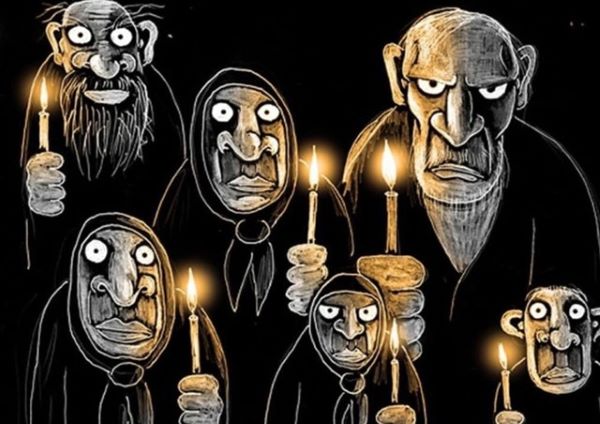
And politics of a foreign, Russian kind. They glorified Fyodor Ushakov, a Russian admiral; then again the Russian Tsar Nicholas II with his entire family and his occultist wife, who was a student of Gérard Encausse (Papus) – a mason, Martinist, Kabbalist, Illuminatus, and author of many occult books, whose works she spread throughout the Russian Empire. By the end of the USSR, reprints of his books could be found in nearly every aspiring witch’s home. Then there were cults of dubious “old women” – various “Matronushkas,” “Pelageyushkas,” “Agafiyushkas” – who quite successfully displaced the holy fathers with their ascetic feats and high theology.
As Deacon Andrei Kuraev aptly wrote, “a cloud of witnesses” had obscured the Sun of Righteousness, and through this fog of occultism, primitive superstition, and imperial cult, it became ever harder to reach the Truth. More and more people simply got lost there, losing their spiritual bearings and turning into an army of hostile “little zombies” who considered only themselves to be the true, canonical, grace-filled believers, while everyone else were subhumans doomed to hell.
Over time, I began asking many uncomfortable questions. For example, why in all UOC-MP publications – both official and unofficial – was there more written about a neighboring country, worrying about its fate, while Ukraine either did not exist or was seen as a temporary construct doomed to dissolve into the “Russian world”? Around that time, I wrote an article, “Archaeology of the Russian World”, in which I exposed this ugly propagandist phenomenon – like a Trojan horse being dragged into the Church. For example, I once asked the creators of the magazine “Otrok.UA” at the Ioninsky Monastery why they named it that when there was almost nothing about Ukraine in it, and if there was, it was from the perspective of a Russian colonialist. Wouldn’t it be more honest to call it Otrok.RU?
I began to realize that our Church – and I as part of it – were simply being deceived and used in dirty political games. So the question arose: what to do next? Continue, with full awareness, as a passive extra in someone else’s play against my own people and state? At that time, I could not yet move to the UOC-KP or UAOC because the long-standing idea that they were “wrong,” “non-canonical” churches was still strong, and I also had many friends whose opinions were important to me.
So I decided to stay in the UOC-MP but step aside, ceasing any active role. I had, for example, been co-chair of the Chernihiv Orthodox Brotherhood and engaged in missionary work. After my disillusionment with the UOC-MP, I read more, prayed more, and devoted myself to spiritual practices, but without formally breaking with this religious organization – although people half-jokingly hinted to me that patriots of Ukraine didn’t belong there, that they gathered in the UOC-KP, and that’s where I should be.
This lasted until 2014. The final straw was the reaction of many of my friends and acquaintances to Russia’s military aggression – ranging from mild support to open joy: “Soon ours will liberate us from the cursed Banderites.” At that point, I understood clearly – it was time to choose. You cannot, knowing exactly where you are, go against your own conscience and pretend everything is fine. That was the last drop, and without hesitation, I moved to the UOC-KP.
(Some theologians from the UOC-MP try to plaster over the fact of their Church’s rampant politicization with Bible quotes such as Matthew 5:11 or John 15:18, about the opposition of the faithful and the world. But in our case, such an opposition doesn’t exist. No one is asking our brothers and sisters from the UOC-MP to renounce Christ and worship Belial. Quite the opposite – our society and state ask them to break ties with Moscow and its heretical and inhuman doctrine of the “Russian world.” And no amount of clever wordplay will help now.)
The second story concerns the parish whose rector I became after moving from the UOC-MP to the UOC-KP – and which had left the UOC-MP long before me, back in 2009. This caused a real stir at the time, as it was during the height of the Moscow Patriarchate’s influence in Ukraine.
The story is banal: the parish was dissatisfied with its rector, who committed various improprieties. Parishioners complained to the ruling bishop, but there was no reaction, because the bishop was a corrupt man who imposed fines – paid directly into his pocket – for the misdeeds of his clergy. This happened here: the rector was fined, and the parishioners were told to be patient “because Christ suffered, and we must also.”
After endless banging their heads against this wall of corruption and indifference, someone told them there was also the UOC-KP. The tired parishioners held a meeting and unanimously voted to move. Of course, later came the buses with “canonical titushkas,” whom the villagers threw over the church fence, the howls about “persecution” and “violent seizures of churches,” and a bearded corrupt bishop lying to journalists about “schismatics seizing this bastion of canonicity and grace.” But nothing could reverse the decision.
The third story is about the founding of the parish where I now serve.
Our small town of just over 10,000 people, located a little over 30 km from the Russian border, had only one large church at the start of the 2000s. It had been built in the late Soviet era, used as a club, and then returned to the community during Perestroika. Everyone had taken part in its restoration.
However, by the time of the 2004 Orange Revolution, a national awakening was underway, and it became clear that our UOC-MP parish was accepting generous donations from pro-Russian political sponsors – at a price. Eventually, these “sponsors” demanded the distribution of political propaganda right inside the church. This disgusted the patriotic citizens, who decided such a politicized church was not for them. They formed their own community and asked the UOC-KP bishop to send a priest. After long bureaucratic hurdles, the community was registered and given the former district library building for services, where we worship to this day.
The moral of the story: everything has a price. That’s why we treat sponsors with caution and rely on our own resources, so as not to end up like our less prudent brothers in the UOC-MP, who traded their integrity for handouts and lost both their flock and credibility.
In conclusion, it’s a good thing we are not Russia, and that we have an alternative to the “state church.” Alternatives prevent any one church from becoming a totalitarian organization. Some “Soviet man” types in embroidered shirts call for a single state church, thinking it would be a blessing – forgetting that in the civilized world, diversity is the basis of progress and prosperity. That’s the kind of world we aim to join – not the post-Soviet swamp where our northern neighbors wallow.