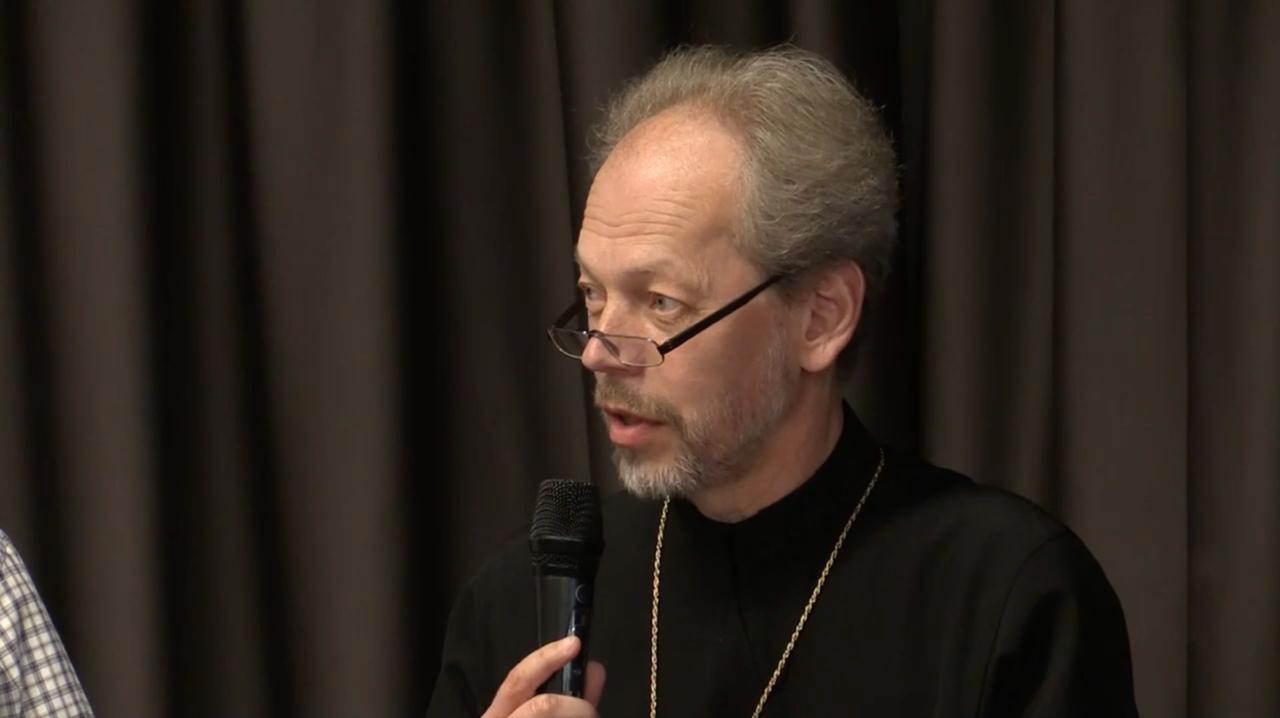
Response given during the panel discussion at the Round Table “Contemporary Ukrainian Orthodoxy: Debunking Myths for the Reconciliation of Orthodox Christians in Ukraine,” held on April 29, 2025, in Kyiv as part of the enlightening-analytical project “Contemporary Ukrainian Orthodoxy: Debunking Myths for the Reconciliation of Orthodox Christians in Ukraine and the Consolidation of Ukrainian Society,” organized by the Sophia Brotherhood with support from the Renovabis Foundation.
Hennadii Khrystokin: “What are we to make of the silence coming from the UOC?”
What do you think we are to do in a situation where change is clearly overdue, where society is expecting this change, and yet the leadership of the Ukrainian Orthodox Church (UOC) remains silent, unresponsive, withdrawn into isolation? We’ve spoken today about the universality of the Church, about returning to the Gospel—but isn’t such silence, in a way, a betrayal of God? What is the role of the laity here? Could this initiative come not from the hierarchy, but from the laity, from theologians, from active groups who might break through this circle of silence and isolation? How are we to respond to this silence from the UOC?
Heorhii Kovalenko: “I see a great number of UOC faithful who calmly attend Orthodox Church of Ukraine (OCU) churches.”
One must become someone who has their own “autocephaly”—that is, their own head—and act accordingly. In truth, these decisions are being made at every level. There are cases where people did not break communion with the Ecumenical Orthodoxy for the sake of unity with Moscow Orthodoxy—an Orthodoxy that itself wanted to break communion with the broader Orthodox world. Some people have remained in communion, continuing to extend an open hand. Everyone must walk their own path, and we should stop pointing to leaders “up there” who have failed to make any decisions.
As for the faithful—I see a great many UOC parishioners who freely and peacefully come to OCU churches. On Easter at St. Sophia, while I was blessing the baskets, I heard more Church Slavonic “Christ is Risen – Truly He is Risen” than the Ukrainian “Khrystos voskres,” which is more typical for our parish. There were a lot of people, and I could see clearly that many of them were from the UOC.
More than that—these people come to confession and begin by repenting for attending churches of the Moscow Patriarchate. And we tell them: “There’s no need to repent for that. But if you’ve come to us—welcome, our doors are open.” This opens the path to a personal encounter with Christ, to an encounter with Christ in the church, in the Eucharist—when fear is replaced with faith.
And these people have been deliberately intimidated. They’ve been confined to a kind of jurisdictional ghetto—under a jurisdiction that is cutting itself off from the Ecumenical Orthodox world, led by a man who spreads un-Christian messages, who has become, essentially, a servant of war.
So the first step is this: simply step outside those boundaries, walk into a church, pray together, receive Communion…
And you know—miracles happen with these people! Later, they ask: “Are we even allowed to go back to a Moscow Patriarchate church?” And we respond: “Yes, if you’re praying to God there and not just listening to political briefings.” This is an important answer: mutual recognition—recognizing that Christ is present in the sacrament, wherever Christians gather for His sake. And this applies not only to Orthodoxy.
This is something many refugees have experienced during the war. And I believe this openness to Christ—this personal autocephaly of experience—this is what truly matters. After all, the “head” must be wise, discerning, and filled with Sophia—divine wisdom.