
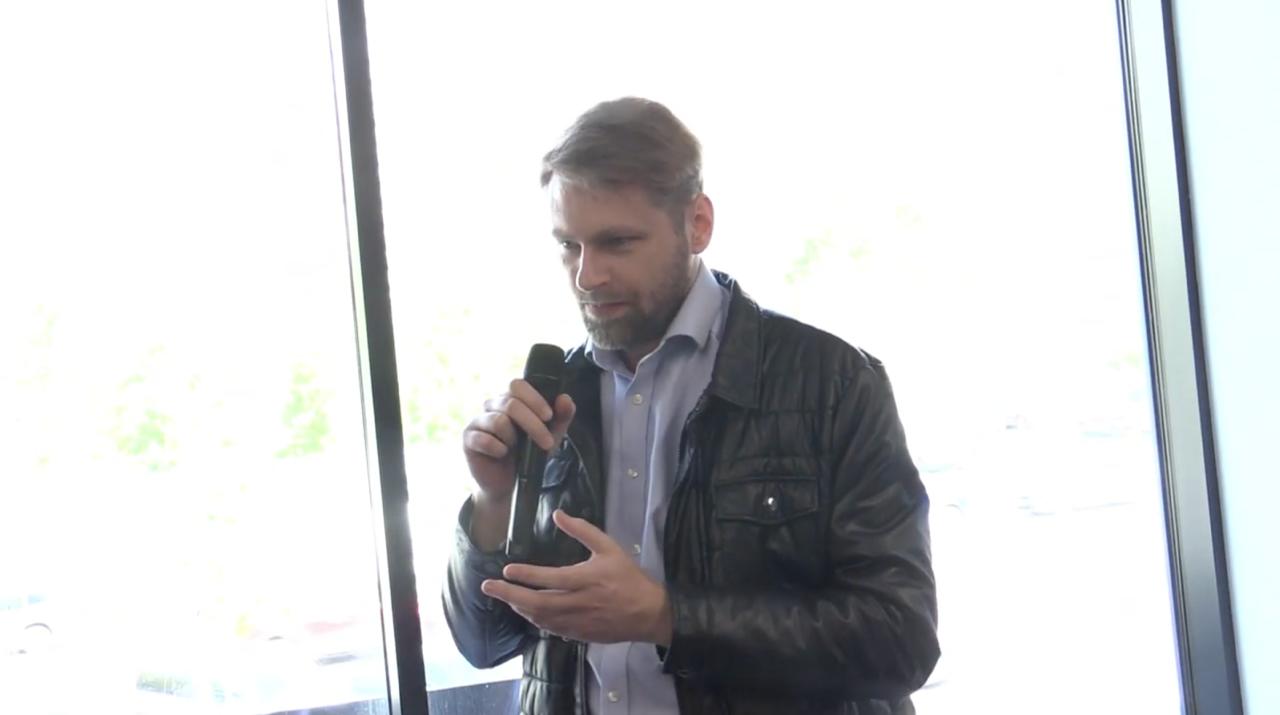
Response given during the panel discussion at the Round Table “Contemporary Ukrainian Orthodoxy: Debunking Myths for the Reconciliation of Orthodox Christians in Ukraine,” held on April 29, 2025, in Kyiv as part of the enlightening-analytical project “Contemporary Ukrainian Orthodoxy: Debunking Myths for the Reconciliation of Orthodox Christians in Ukraine and the Consolidation of Ukrainian Society,” organized by the Sophia Brotherhood with support from the Renovabis Foundation.
Fr. Maksym Shkolnyi, UOC, St. Sophia Brotherhood
We cannot live without myths altogether. But some myths must, and can, be dismantled. At the same time, certain people — opinion leaders — have the power to create new myths, new ideas that ignite thousands, sometimes even millions. In that sense, the creation of a myth is a powerful and serious opportunity to influence the course of history.
That’s why I would say the St. Sophia Brotherhood, as a leader of new thought, creates such an opportunity — a new perspective, a new idea of unity and interaction. And this very idea is unsettling to radical forces in both the Ukrainian Orthodox Church (UOC) and the Orthodox Church of Ukraine (OCU).
Each radical side tends to look at the other and sees things very clearly. For example, a person with a pro-Moscow mindset sees a patriot and thinks: “This is not my friend — that’s obvious.” But what is the St. Sophia Brotherhood? It’s something strange, ambiguous. It’s a new idea, and it’s not immediately clear whether it’s a friend or foe.
And precisely for that reason, the St. Sophia Brotherhood could become a leader of thought. It could shape a new myth. How far-reaching this myth becomes — we’ll see. Everything starts small. Anyone who has launched a YouTube channel knows this: the hardest part is gaining your first 100 subscribers. Once you’ve got thousands, tens of thousands, hundreds of thousands — it becomes easier. But the first hundred are the hardest.
So the St. Sophia Brotherhood is starting from the minimum: a new idea that Orthodox Ukrainians, regardless of jurisdiction, can talk to one another — and can live in peace. But I would like to offer a caution, especially to members of the Brotherhood: we must be careful in how we criticize those with opposing views. Within the Brotherhood, we try to be delicate, because we sense how risky it is to lose unity. Harsh criticism of opposing opinions is dangerous because it could ruin our chance to build something new together. It could divide us.
If the most thoughtful Orthodox believers today cannot preserve peace among themselves, how can we expect it from others, many of whom already see the world in black and white? It is harmful when we start saying how bad the bishops or parishioners are in another jurisdiction, how terribly they behave. Each person has far greater moral authority to critique their own jurisdiction than one they do not belong to.
We need to preserve this unity — first among ourselves, and then share it with all Orthodox Ukrainians. And when a portion of people begin to accept this idea and this example of unity, that is when all of us in the St. Sophia Brotherhood will feel that we are truly fulfilling our mission.