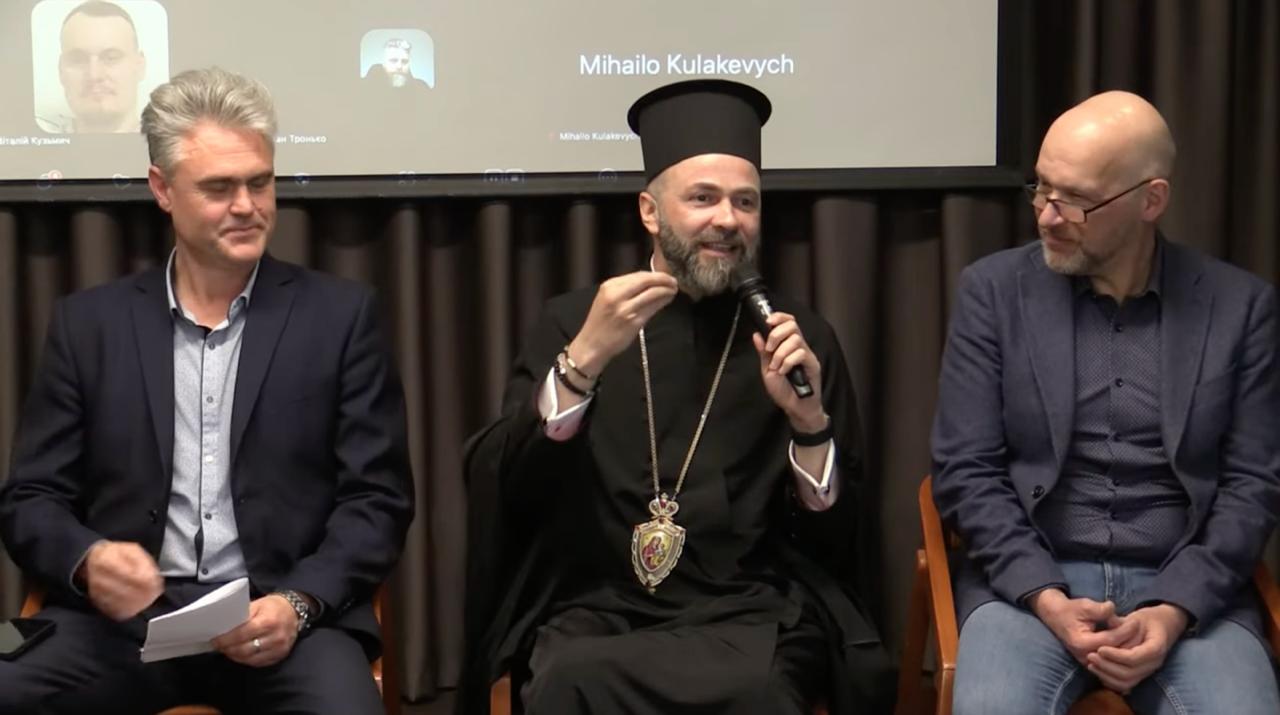
Statement provided during the panel discussion at the Round Table “Contemporary Ukrainian Orthodoxy: Debunking Myths for Reconciliation of Orthodox in Ukraine,” held on April 29, 2025, in Kyiv within the educational-analytical project “Contemporary Ukrainian Orthodoxy: Debunking Myths for Reconciliation of Orthodox in Ukraine and the Consolidation of Ukrainian Society,” organized by the Sophia Brotherhood with support from the Renovabis Foundation.
Oleksandr Sahan (OCU), Religious scholar, philosopher, publicist; Doctor of Philosophy, Professor: Is there not a sense that the Sophia Brotherhood is gradually forming a third jurisdiction? Three bishops might come here and say, ‘See, we are forming the ideal church and this is how it will be.’ Logically, it is heading in that direction. I already feel that this idea is floating in the air and taking shape. At least that’s my sense.
Exarch Michael of Komania, Exarch of the Ecumenical Patriarchate in Ukraine: The thing is, bishops never act unilaterally. Yes, we can meet for coffee. But these things do not get implemented simply by gathering together and deciding something. For what purpose are we forming this? If we go down that route, we end up with authoritarianism. Bishops cannot decide independently of the Church—they must consider the reception by the people, the reception by the Church. So when bishops act with the mentality of ‘We’ve gathered here, so now we will do better,’ I have questions about their ecclesiology, about their awareness. And to dispel accusations—especially those directed at the Sophia Brotherhood—that we are a ‘third jurisdiction,’ let me clarify: we are a civic organization.