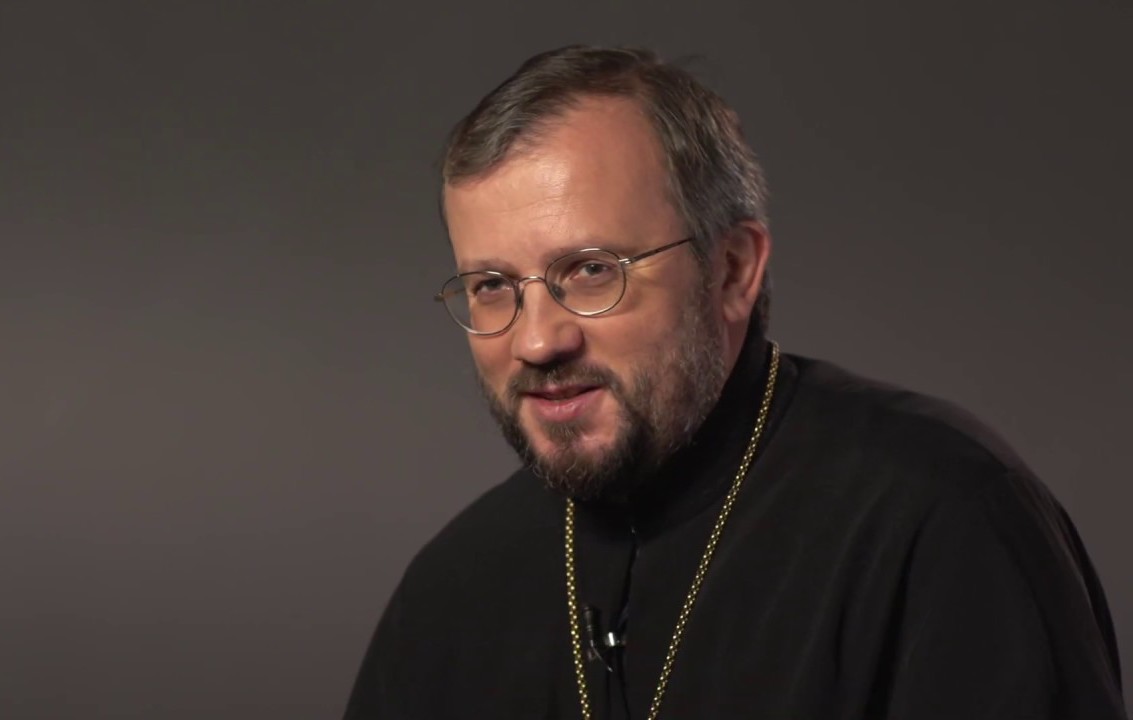
Archimandrite Cyril Govorun
1. Introduction
For a believer in the church as theandric unity it is also important to acknowledge its socio-political aspects and ramifications. Not focusing on both sides of this coin but only one of them reduces the church’s phenomenological reality. Either over-romanticizing the former or being cynical about the latter can lead to grave consequences that affect not only the church but also what is beyond. Both reductionisms fuel culture wars and are capable of even inspiring real wars. It is probably not a coincidence that all the wars fought on European soil in recent decades, in the Balkans, Georgia, and Ukraine, featured Orthodox churches as protagonists. Orthodoxy, as it has been imagined since the dawn of modern thinking about the church, has been characterised by a strong romantic ecclesiology and simultaneously has been cynically used by its political partners.
A mixture of romanticism and cynicism culminated in Russia’s war against Ukraine. It rides on the assumption that whatever the church does and says is immaculate and infallible. This assumption is amplified by the idea of Orthodoxy as the purest interpretation of faith, including faith in the church. As an indirect result of such thinking, the Russian Orthodox Church has turned into one of the main engines of the State’s war machine. Neither this church nor many of its allies in global Orthodoxy and Christianity have even noticed such a transformation. They still romantically counterpose the ostensible Russian longing for everything right and righteous versus assumed Western heretical doctrine, post-colonial sinfulness, and moral decadence. This romanticism feeds warmongering resentment among Russians, including their elites. The latter have instrumentalised the church, with the full consent of its governing bodies, using it as a weapon of mass destruction of minds and souls, which has the collateral effect of destroying bodies.
One of the first steps to avoid such destructive scenarios would be acknowledging the gap between the church’s theory and practice. What follows delineates, without being exhaustive, such an acknowledgement within and outside Orthodox ecclesiology by such authors as Hans Küng, Edward Schillebeeckx, Roger Haight, Sergiy Bulgakov, and Maria Skobtsova. Therefore, what follows in this article criticises attempts at romanticising the church that go back to the era of idealistic and romantic ecclesiologies of Johann Sebastian von Drey, Johann Adam Möhler, and Aleksey Khomyakov.
Theological insights of individual theologians became institutionalised in official confessions and conciliar documents. They reflect the entire gamut of ecclesiological opinions, including those embedded in Reformation and Trent, Vatican I and II, the Moscow councils of 1917–18, 1948, and the Pan-Orthodox council of 2016. Differentiations and tensions between these ecclesiological events are underpinned by the tensions between romantic ecclesiologies from above and pragmatic ecclesiologies from below. However, one should not oversimplify this scheme, as there is always a grain of pragmatism in the former and a grain of romanticism in the latter.
2. The Gap between the Church’s Theory and Practice
Many scholars studying the phenomenon of the church come to the conclusion that there is a wide gap between the church’s theory and practice – between the church as it is believed to be and as it appears. In this vein, Hans Küng distinguished between “an ideal Church situated in the abstract celestial spheres of theological theory” and the “real Church,” which “is first and foremost a happening, a fact, an historical event” (Küng 1967:5). For another prominent Catholic ecclesiologist, Edward Schillebeeckx, the singular reality of the church is often described in two incompatible languages. The one is the theological language that conceptualizes the church in its relationship to God, and the other is a language whose vocabulary is largely historical and sociological (Schillebeeckx 1990:210–213).
Both Küng and Schillebeeckx were reproached for their theological ideas by the Roman Magisterium, which also prosecuted Roger Haight who elaborated even more on the distinction between the church’s theory and reality. He describes the gap presented here as being between ecclesiologies “from above” and “from below.” The former is “abstract, idealist, and a-historical,” while the latter is “concrete, realist, and historically conscious” (Haight 2004:4–5).
Ecclesiology “from above,” for Haight, tends to transcend any given historical context; to remain confined within the limits of one given tradition; to build its self-understanding on authority; to increase the distance between the church and the world; to keep the doctrine about the church separated from the church’s history; to be Christ-centric; and to base its ministry on hierarchical principles (Haight 2004:19–25). The latter feature is of particular importance for ecclesiology “from above.” It implies that,
the levels of power and authority [in the church] have their foundation in God. This structure in some measure reflects or corresponds to the monarchical structure of the universe, or reality itself. […] A hierarchical structure such as this is concomitant with a hierarchical imagination. […] The church as institution is willed by God, informed by God in Christ and as Spirit, so that the church is holy in its institutional forms. The institu- tions of the church enjoy a certain sacrality: scripture is holy, sacraments are holy, but so too are the bishops and priests who administer them. The word of God is holy, but so too is the sacred authority with which the leaders of the church speak. One objective state or way of life may be considered holier than another. (Haight 2004:23–24)
In contrast to ecclesiology “from above,” ecclesiology “from below,” for Haight, is “concrete, existential, and historical.” It implies “going back to Jesus to find the origins of the church.” It takes seriously the church’s sociological and historical realities, without which one cannot understand properly the church’s “full reality.” At the same time, such an ecclesiology should not be reduced to sociology or history; it must remain a theological discipline (Haight 2004:4–5).
Haight clearly prefers ecclesiology “from below” to ecclesiology “from above” and explains why. First, the former suits the mindset of post-modern societies better. A post-modern person can better comprehend what the church is without developing cognitive dissonance through this sort of ecclesiology. Second, whereas ecclesiology “from above” is usually driven by the spirit of confessionalism, ecclesiology “from below” tends to deal with the “whole Christian movement” (Haight 2004:58). It is, therefore, ecumenical par excellence and encourages “an effort to imagine ecclesial forms that are open to and accommodate other perspectives on the church” (Haight 2004:4–5). While ecclesiology “from above” heavily relies on intellectual conceptualizations, third, its counterpart refers to experiences. These experiences are not so much individual as they are communal. Communities are believed to be the main source of ministry, according to the same ecclesiology (Haight 2004:63).
Unlike ecclesiology “from above,” which authoritatively imposes itself, ecclesiology “from below,” fourth, “does not take its suppositions and premises for granted” and explains “them in a critical or self-reflective way” (Haight 2004:59). Speaking more generally, in its social implications, ecclesiology “from below” is more flexible in accepting the world as it is. Therefore, as Gerard Mannion summarizes Haight’s concept, it is “more readily responsive to the challenges posed by globalization and pluralism, to the reality and value of other churches, other religions and the ‘world’ beyond religions. It will be all the more able to hear and respond to the anguished cry of the unparalleled human suffering in the world today” (Mannion 2008:21).
Most Western ecclesiologies have acknowledged the gap between the church of faith and the church of empirical observations. Such an acknowledgment, for example, was one of the driving forces of the Reformation. As is known from church history, in early modernity, only a part of Western Christianity accepted that there was such a gap. Another part had refused to do so. Two hardly reconcilable approaches to the ecclesiological gap have contributed to a schism, which continues to our days as a divide between the Protestant and Roman Catholic churches. Only in the process of the Catholic aggiornamento, which was endorsed and encompassed by the Second Vatican council, the remaining part of Western Christianity at least partially acknowledged the gap and, also partially, reoriented itself towards ecclesiology “from below.” Restrictions imposed by the Roman curia upon the protagonists of this ecclesiology, such as Küng, Schillebeeckx, and Haight, demonstrate that the process of its reception is not smooth. Nevertheless, it keeps going.
3. Orthodoxy from above
Even more partial has been the acknowledgment of the gap between the two approaches to the phenomenon of the church across various local Orthodox churches. There were attempts at an Orthodox aggiornamento, such as at the council of Moscow in 1917–18 (see Destivelle 2015) or in the process of preparing for the Pan-Orthodox council (see Hovorun 2016). However, these attempts were successful only partially. The modernizing agenda of the Moscow council could not be implemented in Communist Russia and was only partially practiced outside it, in the diaspora. After the fall of Communism, the Russian Orthodox Church preferred to ignore it and, when possible, even to reverse it. The Pan-Orthodox council, as it has been envisaged since the 1960s, was supposed to address discrepancies between the church idealized and the church practiced in our time. However, the Great and Holy Council that was convened in Crete in 2016, mostly failed to address them. Instead, it effectively endorsed Orthodox ecclesiology “from above.” In the aftermath of the council, the Ecumenical Patriarchate promulgated a social doctrine titled “For the Life of the World: Towards a Social Ethos of the Orthodox Church” (Ecumenical Patriarchate 2021). This doctrine features some elements of the ecclesiology “from below” (see Hovorun 2022).
One of the discrepancies that modern global Orthodoxy fails to acknowledge is the incoherence between jurisdictional order (taxis) shaped by the Roman and Ottoman empires, and the current postcolonial situation, when many local churches that have emerged from the empires have most of their flock in the so-called diaspora. Another discrepancy relates to the canons of the church, which used to be imperial laws mandatory for everyone. Nowadays, without empires, they are applied selectively and often on the whim of the church authorities. Otherwise, they can be easily ignored. This has led to the systemic abuse of canons and their relativization. From the instrument of safeguarding justice, canons have turned into pretexts for disciplining disloyal clergymen. Another discrepancy relates to how Orthodox churches nowadays deal with the reality of separation from the state. Most of them cannot accept this reality. They still imagine themselves living in the Byzantine world, where the church and the empire were indistinguishable from each other (see Hovorun 2017b). Many tend to ignore the reality of the civil society around them and do not intend to engage with it. This has led and continues to lead some churches to support oppressive political regimes and dictatorships, which promise them privileged relationships. As a result, most dictatorships during the last one hundred years were partially or completely endorsed by the churches driven by ecclesiology “from above.”
The Pan-Orthodox council was supposed to address these and other issues. Speaking more generally, when the preparation for the council started, the original unspoken intention behind it was to acknowledge the gap between Orthodoxies from above and from below, and to make this gap narrower. When the council finally gathered in 2016, it acknowledged the gap only in some points, and in many other points, the gap grew even wider. On top of that, some local Orthodox churches decided not to participate in the Pan-Orthodox council. They wanted to undermine its legitimacy as a Pan-Orthodox conciliar event by doing so. Without wanting it, however, they undermined and questioned the basic identity that global Orthodoxy had adopted with the emergence of Modernity – that of conciliarity. This identity was appropriated by the Orthodox churches as a unique marker for their confession in the era of growing confessionalism. This era began in the aftermath of the Reformation (see Van Lieburg 2006). Christian groups developed their distinct identities as “confessions” – in accordance with their basic creeds or confessions. For the Orthodox, conciliarity became the core of their modern creed. However, it failed to serve as a marker of Orthodoxy when four of the invited churches did not show up in Crete and when the Great and Holy Council gathered there did not deliver what it was supposed to. This failure revealed another gap between what the Orthodox believe about their church and how it really functions. The Orthodox Church is believed to be intrinsically conciliar, yet it was unable to demonstrate its conciliarity in practice.
4. Orthodoxy from below
Even though ignoring the gap between the tenets and practices of the church has become almost a feature of Eastern Christianity, some critical ecclesiological voices that utter concerns regarding this discrepancy have emerged. One of such voices belonged to Fr. Sergiy Bulgakov (1871–1944). He, for example, was among the first to clearly acknowledge the gap between the church of faith and the real church. He presented this gap as a counterposition between the “ontological and institutional” aspects of the church (Bulgakov 2002: 262). He was also among the earliest advocates of the separation between the church and the state. According to him, such a separation would be more beneficial for both than staying in a symbiotic relationship:
Separation of Church and state, under different forms, has replaced the ancient alliance. This separation, at first imposed by force, has been accepted by the Orthodox Church also, for it corresponds with its dignity and its vocation … The liberty … is now the regime most favorable to the Church, most normal for it; it frees the Church from the temptations of clericalism and assures its development without hindrance. Doubtless this system is valid only provisionally, depending upon its historic usefulness … New dangers, new difficulties arise in this way, analogous to those which existed at the time of the alliance between Church and state. The Church may be led to interfere in party politics: the latter, in its turn, may divert the Church from its true path. But an essential advantage remains: the Church exercises its influence on souls by the way of liberty, which alone corresponds to Christian dignity, not by that of constraint. (Bulgakov 1988:162–164)
Instead of symbiosis between the church and state, Bulgakov promoted synergy between human freedom and God’s will about the church:
The Church as Divine-humanity, as the body of Christ and the temple of the Holy Spirit, is a union of divine and creaturely principles, their interpenetration without separation and without confusion. In this sense, the Church is a synergism, where the divine principle descends to penetrate and attach itself to humanity, whereas the human principle ascends to the divine. Therefore, in practical terms, this synergism is a giving and a receiving of divine gifts. Combined, these gifts are fullness, whereas in their appropriation by personal reception, in their separateness, they represent different ministries. The growth of the body of the Church (Eph 4:16), each member receiving his growth, is thereby accomplished. (Bulgakov 2002:262)
Bulgakov, thus, advocated for the freedom of the church from the state and the freedom of its individual members. Both kinds of freedom can be seen as the markers of the ecclesiology “from below.” “Orthodoxy from below,” promoted by Fr. Sergiy Bulgakov and his confederates, faced fierce resistance within the modern Orthodox churches, on all levels of their hierarchy, including lay people. Many Orthodox look at Fr. Bulgakov suspiciously and sometimes openly reject his ideas. His thought (though not the ecclesiological aspects) was condemned by the Moscow Patriarchate in 1935, while the Russian Orthodox Church outside Russia in the same year condemned him personally as a heretic. Sixty years later, in 1995, Bulgakov’s books were demonstratively burned at a churchyard in Moscow. The first vicar of the Patriarch of Moscow Alexiy II, bishop Arseniy of Istra, was reportedly present at this auto-da-fé (see Verkhovsky 2010).
There were also other burnings of books in the Russian Orthodox Church, with the blessing of its hierarchs. Thus, bishop Nikon of Yekaterinburg organized such performances in his diocese in 1994 and 1998 (see Verkhovsky 2010). Among the authors whose books were burned then are Fr. Nikolay Afanasiev (1893–1966), Fr. Alexander Schmemann (1921–1983), and Fr. Alexander Men (1935–1990). It should be noted that these books continue to be read widely in Russia and even taught in theological schools there.
The common denominator of these authors is not only that their books were occasionally burnt in Russia but also that they criticized the church’s realities in striking contrast with prevailing ecclesiological theories. They clearly acknowledged a wide gap between the two. This acknowledgment seems to be irritating for the highest ecclesiastical authorities in Russia.
These authorities also blocked the canonization of nun Maria Skobtsova (1891–1945) by the Russian Orthodox Church. In Nazi-occupied Paris, she helped Jews escape arrest and was herself arrested by the Gestapo. She was sent to the Ravensbrück concentration camp, where she died in the gas chamber (see Hackel 1965). The Ecumenical Patriarchate canonized her as a Saint. The Moscow Patriarchate refuses to accept this canonization, even though it is a common practice that the Saints canonized by one local church, especially the Ecumenical Patriarchate, are also recognized by other local churches. One of the reasons why the Russian Orthodox Church did not follow this practice in the case of Maria Skobtsova, might have been the intuitive rejection of her “Orthodoxy from below.”
As was mentioned above, stressing freedom in “Orthodoxy from below” could be identified as its key point. In tune with Fr. Sergiy Bulgakov, who stressed the same point, Sr. Maria Skobtsova wrote about the value of freedom and warned against its abuses by all major ideologies of her time:
The mountains become flat, the human herd is shepherded with an iron scourge, the very understanding of freedom is eradicated, the taste for freedom, the very idea of it disappears. Isn’t it the same to us, in whose hands this scourge is, and in what name humankind has lost its soul? Whether the God-like human personality is subordinate to the law of class, whether it should fertilize the future proletarian paradise, or is it dissolved in a stream of the sacred German blood, whether it is sacrificed to the resurrected idol of the Roman state? What matters in all these manifestations is the denial of freedom’s worth, of freedom itself, the denial of the possibility of God-chosenness for any human being. The godless world not only revealed to us its doctrines, but it showed what happens when these doctrines become embodied. It gave rise to hatred, persecution, blood, violence; it killed a human being, crippled soul, and encaged freedom. Those who now follow its calls cannot be deceived: they must know that the world is going to imprison freedom, to destroy the human personality, to kill the soul, and to rebel against the work of Christ. (Skobtsova 1939:85)
5. Messianism That Kills
Maria Skobtsova’s words could be a challenge to the totalitarian ideologies of the past and to their updated versions re-emerging in our times. One of them is the ideology dominant in modern Russia. It is a sort of exceptionalism that assigns an exclusive historical mission to the socio-political entity that calls itself the “Russian world” (see Denysenko 2023). This entity believes its mission is to save the world from itself and the presumably wrong ideas that corrupt modern humankind. The “Russian world” counterposes itself to the Western world and claims to uphold conservative political Orthodoxy (see Hovorun 2018) as opposed to the liberal secular heterodoxy.
Not dissimilar were the messianisms that Maria Skobtsova criticized in her own time. Thus, her contemporary communists believed that the world should be saved from capitalism; fascists believed that socialism, communism, and liberalism were the main threats to humankind; Nazis, in addition to these threats, regarded Jews as an existential evil that must be eliminated from the face of the world. The followers of the “Russian world” in our days believe that Western liberalism and secularism constitute such a threat. They justify Russia’s aggression against Ukraine by the need to protect so-called “traditional values” from liberal encroachments upon them (see Stoeckl 2014).
These values are extracted from various religious traditions as their common denominator. Yet they are secular and secularizing (see Hovorun 2023) because they operate above and beyond any religion. They effectively substitute religion and make it unnecessary, which constitutes a paradox. On the one hand, the idea of “values” is being instrumentalized in the campaign against secularization. On the other hand, it unintentionally contributes to the secularization of modern societies, including in Russia.
Moreover, the idea of “values” has become weaponized and helps Russia waging its war in Ukraine. This war highlights another paradox in the way the “values” work. They are claimed to protect the institution of the family against liberal Western gender ideology. In reality, however, how “traditional values” are promoted, i.e., through a war, has contributed to the fragmentation or even dissolution altogether of millions of Ukrainian families. Over five hundred children died, hundreds of thousands lost one or both parents, were deported to Russia, and millions were taken to the West by their mothers and could not see their fathers, who must stay in Ukraine according to martial laws. The war, thus, has brought catastrophic consequences to the institution of family life in Ukraine (see UNICEF 2023).
The religious dimension of “traditional values” propels the messianic character of campaigning for them. Messianism constitutes a common denominator of both old and new totalitarian ideologies, helping them justify atrocities and sacrifices of human life. Indeed, if soldiers are driven by the idea that God wants them to carry out their mission to save the world from itself, they can feel exempted from the requirements of common ethic, because they believe that their mission is higher than any human conveniences. This constitutes another paradox of campaigning for “traditional family values.” People who apply violence in fighting for traditional ethics easily slide into violating it. That is how the Russian state and army ended up in committing genocidal activities, including mass deportation of children, tortures and mass killings of civilians in cities like Bucha and Izyum, as well as creating blackouts in Ukrainian cities through missile and drone attacks, etc. These crimes are committed in the name of the higher mission for the ultimate good of humankind – similarly to how the communists, fascists, and Nazis committed crimes in the name of the same “good”. They are the results of messianism that exempts human consciousness from any common ethical limitations. The Russian Orthodox Church makes the Kremlin’s war against Ukraine messianic. There is complete synergy between the Moscow Patriarchate and the Kremlin in carrying out this war.
6. The Fiasco of Romantic Orthodoxy
There is also a correspondence between two gaps. The first one has been described earlier and is traditional for Orthodox ecclesiology: between the theory and the reality of the church. This gap, as was said, is usually neglected in Eastern Christianity. Neglecting the first gap enables the neglect of a sec- ond gap: between how Russia’s war against Ukraine is conducted in reality and how it is explained by the Russian Orthodox Church and perceived by many Orthodox across the globe. For the Moscow Patriarchate’s speakers, the goals of what they call “the special military operation” correlate with the ideals of true Orthodoxy. Moreover, the “operation” aims to safeguard and promote these ideals. The human suffering caused by the war and its victims is ignored by these speakers. Similarly, they ignore the shortcomings of their ecclesial structures. Supporting the war is the most appalling shortcoming of the ecclesial institution.
The neglect of both gaps seems to have roots in the tendency to romanticize Orthodoxy. This tendency was dominant during the last two centuries. It consists in exhibiting ecclesiastical ideals as the manifestations of genuine ecclesiology without acknowledging or caring about how these ideals are implemented in the real life of the church. In this vein, what is believed to be Orthodoxy gets extrapolated to the real life of the Orthodox churches. When real life fails to correspond to the ideals, this failure is usually ignored. Sometimes, it is extrapolated to non-Orthodox churches. Then the Orthodox may accuse others of what they are doing themselves. This corresponds to the favourite trope of Russian propaganda, which accuses Ukraine and the West of what Russia does itself.
Modern Orthodox ecclesiology was born in the era of Romanticism and Idealism, in the first half of the nineteenth century (see Hovorun 2015:81–87). That might be one of the reasons why Orthodox ecclesiology, since its very inception and up to our contemporary times, has had a tendency of self-idealization and romanticization.
The 19th-century Russian theologian Aleksey Khomyakov (1804–1860), who is believed to be the founder of modern Orthodox ecclesiology, wrote under the heavy influence of German idealism. On this basis, he effectively constructed an Orthodox version of such idealism. He borrowed many of his ecclesiological ideas, without acknowledging the fact of borrowing, from some idealist theologians, such as Johann Sebastian von Drey (1777–1853) and Johann Adam Möhler (1796–1838). For the former, the church was an “organic” reality, while for the latter, a conciliar one (see Himes 1997). Khomyakov elaborated on the latter and constructed his own theory of synodality (sobornost) on that basis (see Mrówczynski-Van Allen 2020; Ware 2011). Although this theory first appeared in non-Orthodox theology, the Russian theologian, quite in the spirit of Russian messianism embedded in his time in the Slavophile movement, presented it as exclusively Orthodox. Thus, Khomyakov constructed a sort of glamor ecclesiology that continues to be appealing even today. This ecclesiology featured some elements of what Haight calls “from below,” yet it remained completely romantic. It ignored structural dysfunc- tions in the Orthodox Church while exaggerating such dysfunctions in other churches, primarily Roman Catholicism.
In the twentieth century, Orthodoxy continued to be glamorized. Many Orthodox theologians who emigrated to the West preferred to explain Orthodoxy in romantic terms. They kept silent about its chronic diseases. These diseases, such as antisemitism, imperialism, intolerance, and toxic messianism, survived even in the diaspora. Nevertheless, those Westerners who were introduced to Orthodoxy by the émigrés, in most cases, could not notice them and saw only Orthodoxy’s beauty, which they did not observe in their own traditions. At least partially, their fascination with the glamorous side of Orthodoxy can be explained by strong self-criticism in the Western Christian traditions and its deficit in Eastern Christianity. The unbalance between these two criticisms has created a missionary momentum for Orthodoxy; painted in romantic hues, it became attractive to those who had become disappointed in their traditions.
A new form of similar dynamics emerged in recent years. With the ongoing culture wars in the West and especially in the United States, many conservative Christians in the Western denominations began converting to Orthodoxy as presumably a haven of conservative values (see Riccardi-Swartz 2022). Russian propaganda can therefore enhance their expectations from Orthodoxy – not for the sake of Orthodoxy, but to damage Western solidarity and to justify Russia’s own aggressive policies. Many disappointed Western Christians, espe- cially among the culture warriors, believe Russian propaganda. However, they come to the church, which they hardly know and which they perceive through the glamor prism. Their perception is idealistic and, as such, incoherent with reality.
The reality is that Orthodoxy is diverse and more complex than the ideological binary of culture wars. There are conservatives and fundamentalists in it, but they are not the entire church. This church also includes people who think progressively and believe that Orthodoxy is compatible with liberal and democratic values. Many, if not most, church members do not demonstrate ideological preferences and come to the church for the sake of community and sacraments. As a result, those disappointed in the liberalism of their own churches and who believe that all Orthodox would side with them in fight- ing their own culture wars, eventually become disappointed in Orthodoxy as well. Some may believe that promoting a political Orthodoxy instead of the traditional Orthodoxy could be an excellent opportunity for mission. However, as with any mission based on misleading assumptions, the one based on the ideological perception of Orthodoxy would eventually fail.
7. Conclusions: Opportunities Not to Be Missed
A firmer basis for Orthodox mission would be critical self-reflection. It may start with the acknowledgment of one’s own historical mistakes. It could continue with more sober self-descriptions and the awareness of the possibility of faults in the future. The war in Ukraine, on the one hand, as it was noted, came about as a result of ignoring reality. On the other hand, such reflection could be an opportunity to acknowledge the grave reality in which historical Orthodoxy lived and continues to live. It can open a possibility for the Orthodox to follow a path different from idealization and glamorization. The alternative would be the path of acknowledging the gap between the theory and reality of the church. It is perhaps the only way that could lead to bridging this gap. To realize that there is such a gap would be difficult and painful. It requires spiritual maturity and soberness. However, once the gap is acknowledged, it becomes surmountable.
The process of bridging the gap between the theory and practice of the church is dialectical – in the Hegelian understanding of dialectics. It commences with the negation of the gap. This negation is common among the neophytes, who see the church as holy in every aspect of its existence. The more a person stays in the church, and the more he or she observes its realities, the more they realize its imperfection. This can become either a complete rejection of the church or a passionate impulse to save it from itself. Both the negation of the gap and the desire to save the church are immature. A dilemma between these two unhealthy options can be avoided through differentiating between what is divine, holy, and unchangeable in the church on the one hand and what is human, vulnerable to mistakes, and changeable on the other (see Hovorun 2017a).
When the two aspects of the ecclesial phenomenon are confused, a person either embarks on unreserved criticism and may eventually leave the church or adopts a romantic standpoint that ignores the church’s realities. Both attitudes to the church are reductionist. Missionaries who preach the church, and this applies not only to the Orthodox ones, should make it clear that the church is a complex reality that experiences the impact of many factors, from both inside and outside it. They should not instil an idealistic vision, which is inevitably reductionist.
Explaining the shortcomings of the church also gives an opportunity to emphasize the work of the Holy Spirit in the ecclesial body. Because the Pneuma acts through human will and agency, the church becomes both stronger and weaker. Human agency in the church makes it vulnerable to mistakes.
The same agency makes the correction of mistakes possible. The Spirit reveals to church members the gaps between the ideal picture and the reality of the church. The same Spirit inspires and teaches them to build bridges over these gaps.
Individual church members build bridges with various degrees of success. They inevitably make mistakes, which sometimes lead to catastrophes. Nevertheless, the Spirit does not want to do bridge-building without human agency. Both mistakes and the guidance of the Spirit help church members to learn how to build bridges and become mature. People grow by correct- ing mistakes. This is probably the reason why God allows such gaps to exist in the church.
We should not be naïve: these gaps will never be fully bridged. Each generation of church members needs to make their own effort. That is how each generation grows to the wisdom given by the Spirit (Eph 1:17). This wisdom comes when we realize that, as Miroslav Volf has put it, the church “is not a ‘we’; the church are we” (Volf 1998:10). Therefore, to start making the real church better and more correspondent to its ideal picture, one must begin with him or her- self. Only by changing myself can I help the church move closer to what God wants it to be. That is what the Russian saint Seraphim of Sarov (1754–1833) wanted to say by stating: “Acquire a peaceful spirit, and thousands around you will be saved” (in Ware 2000:133).
References Cited
Bulgakov, Sergius (1988). The Orthodox Church. Translation revised by Lydia Kesich. Crestwood, NY: St. Vladimir’s Seminary Press.
Bulgakov, Sergius (2002). The Bride of the Lamb. Translated by Boris Jakim. London: Bloomsbury.
Denysenko, Nicholas (2023). The Church’s Unholy War: Russia’s Invasion of Ukraine and Orthodoxy. Eugene, OR: Cascade Books, an imprint of Wipf and Stock Publishers.
Destivelle, Hyacinthe (2015). The Moscow Council (1917–1918). The Creation of the Conciliar Institutions of the Russian Orthodox Church. Translated by Jerry Ryan. Notre Dame, IN: University of Notre Dame Press.
Ecumenical Patriarchate (2021). “For the Life of the World: Towards a Social Ethos of the Orthodox Church.” Greek Orthodox Archdiocese of America. [Date viewed 18 June 2024]. Available from: https://www.goarch.org/-/life-of-the-world-thurs.
Hackel, Sergei (1965). One, of Great Price. The Life of Mother Maria Skobtsova, Martyr of Ravensbruck. London: Darton, Longman & Todd.
Haight, Roger (2004). Christian Community in History, vol. 1. New York: Continuum. Himes, Michael J. (1997). Ongoing Incarnation: Johann Adam Möhler and the Beginnings of Modern Ecclesiology. New York: Crossroad.
Hovorun, Cyril (2015). Meta-Ecclesiology: Chronicles on Church Awareness. New York: Palgrave Macmillan.
Hovorun, Cyril (2016). “The Pan-Orthodox Council: A Fragile Hope for Aggiornamento?” The Catholic World Report. [Date viewed 28 December 2023]. Available from: http://www.catholicworldreport.com/Item/4910/the_Pan-Orthodox_council _a_fragile_hope_for_aggiornamento.aspx.
Hovorun, Cyril (2017a). Scaffolds of the Church: Towards Poststructural Ecclesiology. Eugene, OR: Cascade.
Hovorun, Cyril (2017b). “Is the Byzantine ‘Symphony’ Possible in Our Days?” Journal of Church and State 59(2):280–96.
Hovorun, Cyril (2018). Political Orthodoxies: The Unorthodoxies of the Church Coerced. Minneapolis, MN: Fortress Press.
Hovorun, Cyril (2022). “For the Life of the World and Orthodox Political Theology.” Theology Today 78(4):347–56.
Hovorun, Cyril (2023). “Values and Secularism.” In Weronika Kudła, Tomasz Huzarek, and Maciej Duda, eds., Religious Freedom and Other Human Rights: Threats and Trends. Pelpin, Poland: Bernardium, 277–303.
Küng, Hans (1967). The Church. New York: Sheed & Ward.
Mannion, Gerard (2008). Comparative Ecclesiology: Critical Investigations. London: T&T Clark.
Mrówczynski-Van Allen, Artur, Teresa Obolevitch, and Pawel Rojek, eds. (2020). Alexei
Khomiakov: The Mystery of Sobornost’. Cambridge: The Lutterworth Press. Riccardi-Swartz, Sarah (2022). Between Heaven and Russia: Religious Conversion and Political Apostasy in Appalachia. New York: Fordham University Press. Schillebeeckx, Edward (1990). Church: the Human Story of God. New York: Crossroad.
Skobtsova, Elizaveta (1939). “На страже свободы.” In Православное дело [The Orthodox Affair] 1.
Stoeckl, Kristina (2014). The Russian Orthodox Church and Human Rights. London: Routledge.
UNICEF (2023). “War in Ukraine: Support for children and families.” [Date viewed 28 December 2023]. Available from: https://www.unicef.org/emergencies/war -ukraine-pose-immediate-threat-children#what-happening.
Van Lieburg, Fred, ed. (2006). Confessionalism and Pietism: Religious Reform in Early Modern Europe. Darmstadt: Von Zabern.
Verkhovsky Aleksandr (2010). “Русская Православная Церковь и свобода выражения в светском обществе” [The Russian Orthodox Church and the Freedom of Expression in a Secular Society]. In Index 11. [Date viewed 28 December 2023]. Available from: http://index.org.ru/journal/11/verh.html.
Volf Miroslav (1998). After Our Likeness: the Church as the Image of the Trinity. Grand Rapids, MI: Eerdmans.
Ware, Kallistos (2000). The Inner Kingdom. Crestwood, NY: St. Vladimir’s Seminary Press.
Ware, Kallistos (2011). “Sobornost and Eucharistic Ecclesiology: Aleksei Khomiakov and His Successors.” International Journal for the Study of the Christian Church 11(2–3):216–35.