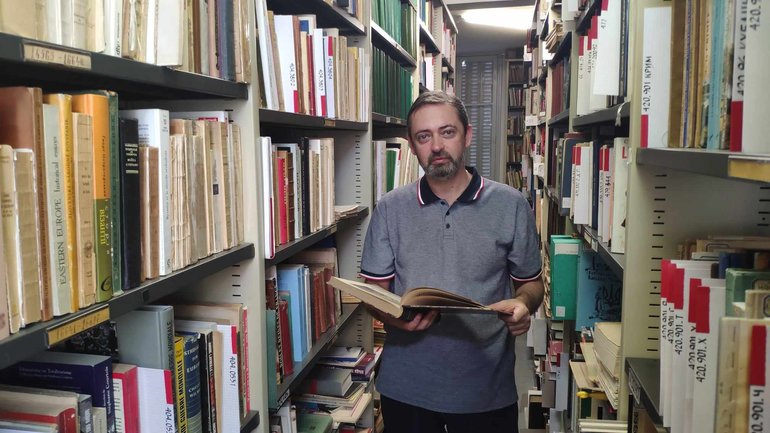
Serhiy Shumylo, Doctor of Philosophy, member of the Sophia Brotherhood
Report at the International Ecumenical Seminar in Paris (January 23, 2024), organized by Collège des Bernardins and Institut chrétiens d’Orient (Paris, France).
The current situation in Ukrainian Orthodoxy can be characterized as a form of “newborn crisis.” It represents an intermediate period between “intrauterine” and “extrauterine” modes of existence, a transition to a new form of life, where numerous “physiological systems” begin to function anew, generating a kind of “crisis.”
Adding to this is the broader crisis in global Orthodoxy. The unjustifiably prolonged period of “stagnation” in world Orthodoxy ended after the Pan-Orthodox Council held in 2016, with events in Ukraine acting as a significant catalyst.
When discussing the state of Ukrainian Orthodoxy, it is essential to note that, in addition to the problem of divisions, the Soviet-Sergian heritage also heavily influences it. All Orthodox jurisdictions currently active in Ukraine, to varying extents, inherit aspects of “Soviet Orthodoxy” with both its negative and positive traits. Having been shaped by the Soviet era, these jurisdictions have not fully escaped this spiritually impaired state. While flags and slogans have long changed, the internal essence often remains the same.
The old Soviet church system, which has outlived the USSR itself, has moved from stagnation to a stage of deep crisis, which affects not only Moscow but also Kyiv. However, Kyiv has a chance to emerge from this in a new form.
According to the classical definition, a crisis reveals hidden conflicts and imbalances. It is a turning point when the existing means to achieve goals become inadequate, leading to unpredictable situations. Yet, a crisis is also a resolution, a turning point, a pivotal moment.
In this regard, a crisis is beneficial; it always brings change after a period of stagnation. Either death or new life follows. The old must perish for the new to be born. Today, we are witnessing both.
Birth is always painful and even messy—a natural process. Therefore, it is unrealistic to expect these “births” to be easy, pleasant, or clean. What matters is how the so-called “newborn crisis” can be overcome as the transition to a new mode of existence unfolds.
In this report, we intentionally focus on problematic aspects of the activity and state of Ukrainian Churches to help establish a correct “diagnosis” and identify potential solutions to current “ailments.” This does not mean that Ukrainian Orthodoxy lacks positive trends. There are many, undoubtedly, but others will address them. Sometimes, it is beneficial to take a critical look at oneself. Usually, this is the first and most necessary step toward healing.
Ukrainian Orthodoxy: Competition and Contradictions
Before delving into the modern state of Ukrainian Orthodoxy and possible paths for its development, it is necessary to briefly examine the origins of its current issues.
Today, Orthodoxy in Ukraine remains in a state of discord. It is highly heterogeneous and fragmented. The Unification Council of the Ukrainian Orthodox Church of the Kyiv Patriarchate (UOC-KP), the Ukrainian Autocephalous Orthodox Church (UAOC), and a group of clergy led by two metropolitans of the Ukrainian Orthodox Church (Moscow Patriarchate), which took place in 2018, and their union into a single Orthodox Church of Ukraine (OCU) and the granting of the tomos of autocephaly by the Ecumenical Patriarchate marked a new chapter in the history of Ukrainian Orthodoxy. However, it did not resolve all existing problems and contradictions, the primary one being the ongoing division between the autocephalous Ukrainian Church (OCU) and the Ukrainian Church (UOC) in unity with the Russian Orthodox Church of the Moscow Patriarchate (ROC MP).
Until recently, the UOC (in unity with the MP), as the direct successor of the ROC Exarchate in Soviet-era Ukraine, maintained a strong position and enjoyed the support of post-Soviet government and oligarchic elites in Ukraine. As of the end of 2019, it consisted of 12,338 parishes. For many years, it held a near-monopoly in most regions of the country (especially in eastern, southern, and central areas), often promoting pro-Russian narratives and influences among Ukrainian believers. The Ukrainian Autocephalous Orthodox Church (UAOC) and the Ukrainian Orthodox Church of the Kyiv Patriarchate (UOC-KP), which were revived in Ukraine after the fall of the communist regime, were discriminated against compared to the UOC (MP) for over 25 years of Ukraine’s independence, laying the groundwork for future conflicts. (The origins and causes of this confrontation, as a kind of “time bomb,” were laid during the communist era, when alternative structures to the ROC MP—such as the Ukrainian Autocephalous Orthodox Church, Ukrainian Greek Catholic Church, the Constantinople and Romanian Patriarchates, and the True Orthodox (Catacomb) Church—were brutally repressed in Ukraine, with their clergy persecuted or executed, and their parishes and churches forcibly transferred to the ROC MP, thus securing its monopoly as the only Orthodox structure under regime control.)
For a long time, the old post-Soviet elites in Ukraine continued to prefer the Moscow Patriarchate Church (i.e., UOC) out of habit. The situation in the country began to change significantly after 2014, when Russia annexed Crimea and started the war in Donbas.
Amid war and Russia’s occupation of parts of Ukrainian territory, Ukrainian society demanded the curbing of Moscow Patriarchate’s influence and monopoly, as its church structures had been conduits for pro-Russian propaganda in Ukraine for many years. The most notorious example was the infiltration of a sabotage group into Ukraine led by retired FSB colonel I. Girkin (Strelkov), who coordinated the annexation of Crimea and initiated combat actions in Donbas, exploiting the ROC’s connection with the UOC.
Since then, this issue has ceased to be solely an internal matter of the Church, as it once was, and has come to be viewed through the lens of national security. Unfortunately, the UOC leadership has failed to draw conclusions, shed its dependence on Moscow, or curb its influence among bishops, clergy, and believers. Consequently, amid Russia’s hybrid war against Ukraine, a significant challenge for the UOC has been the Ukrainian government’s initiatives to achieve spiritual independence from Moscow, unify Ukrainian Orthodoxy, and proclaim the autocephaly (independence) of the Ukrainian Church. The UOC leadership, heeding recommendations from the Moscow Patriarchate, refused to engage in dialogue on this issue, hoping to disrupt and block the process. However, this stance only led to the process proceeding without the UOC’s participation, resulting in adverse consequences for the UOC itself.
In 2018, an agreement was reached to unite the Ukrainian Orthodox Church of the Kyiv Patriarchate (UOC-KP, with 5,363 parishes), the Ukrainian Autocephalous Orthodox Church (UAOC, with 1,171 parishes), and a group of clergy led by two metropolitans from the Ukrainian Orthodox Church (Moscow Patriarchate) into a single Orthodox Church of Ukraine (OCU). This unification was formalized through recognition of the OCU as an autocephalous church by the Ecumenical Patriarchate and several other Local Churches, although it occurred without the participation of most UOC bishops.
The UOC leadership, rejecting proposals to separate from the Moscow Patriarchate, followed the latter in breaking Eucharistic unity with the Ecumenical Patriarchate of Constantinople and other Orthodox Churches (Alexandrian, Greek, and Cypriot) that had recognized the OCU’s autocephaly. Consequently, the UOC adopted a confrontational stance, further deepening the schism in Ukraine and within global Orthodoxy. These developments have led to heightened internal conflicts within the Church in Ukraine. Many UOC priests and believers who disagreed with their leadership’s position and did not wish to remain under the Moscow Patriarchate started transitioning to the OCU. Between late 2018 and January 2022, approximately 700 parishes transitioned from the UOC to the OCU. As of January 2022, the OCU had approximately 7,000 parishes, making it a serious competitor to the UOC.
The UOC contested each transition to the OCU in court, claiming violations of their rights. However, given Russia’s annexation of Crimea and its war in Donbas, the UOC’s continued association with the Moscow Patriarchate and pro-Moscow sentiments among some of its leaders contributed to a growing negative attitude in Ukrainian society toward Moscow Patriarchate structures in Ukraine. This occasionally led to conflicts and physical confrontations between followers of both jurisdictions in various communities, as well as numerous lawsuits over church property.
The Situation in the UOC After February 2022
The full-scale Russian invasion of Ukraine in February 2022 and its attempt to occupy Ukrainian territory had a significant impact on the church situation in the country. The head of the Russian Federation, V. Putin, justified the invasion by citing, among other reasons, the need to protect UOC (MP) structures in Ukraine. The head of the Russian Orthodox Church, Patriarch Kirill (Gundyaev), fully supported the war against Ukraine, blessing the invasion and providing religious-ideological justification for the war and the crimes committed by Russian forces on Ukrainian soil.
In response, negative sentiments in Ukrainian society toward all things associated with Russia, including Moscow Patriarchate structures in Ukraine, have intensified. The war has escalated tensions between the two Orthodox jurisdictions (UOC and OCU) and has led to divisions and “unrest” within the UOC itself.
From the very beginning of the Russian invasion, many UOC priests ceased commemorating Patriarch Kirill during services as a protest against his actions. A grassroots “petition movement” emerged within the UOC, leading to widespread calls for change. In response, an extraordinary UOC Council was convened in Feofaniya in May 2022.
Many priests and believers expected the Council to announce the UOC’s exit from the Moscow Patriarchate and proclaim its autocephaly. However, Metropolitan Onufriy and the episcopate did not take this step. Instead, they issued half-measures that allowed the UOC to maintain its former status as a self-governing entity within the ROC, while carefully concealing references to its affiliation with the ROC in the new edition of the UOC “Statute of Governance.” The statute retained a provision (point 1) outlining the UOC’s relationship with global Orthodoxy through the ROC.
The “Feofaniya” Council permitted the discontinuation of commemorating the Moscow Patriarch during services but did not issue any declarations on the UOC’s departure from the ROC or withdrawal of its hierarchy from ROC governing bodies. The Council also did not condemn the actions of Patriarch Kirill and other high-ranking ROC leaders for their support and blessing of Russia’s war against Ukraine, or the quasi-religious ideology of the “Russian World” they promote. Instead, the Council mildly and ambiguously expressed “disagreement with the position of Patriarch Kirill of Moscow and All Russia regarding the war in Ukraine.”
Developments in 2022–2023 have shown that the UOC leadership, unfortunately, has no intention of enacting significant changes in the face of war. The UOC has yet to formally exit the ROC. This has intensified the already tense situation and increased public demand for a complete ban on organizations, including religious ones, associated with centers in the aggressor state.
The UOC’s leadership has persistently aimed to maintain unity with Moscow over the past 30 years of Ukraine’s independence. This attachment to the Moscow Patriarchate has turned into an irreversible crisis for the UOC under current conditions.
The UOC’s chosen strategy of obfuscating canonical ties to the ROC, rather than fully severing them, has created discontent within its ranks. Many priests and believers have started transferring to the OCU. According to official data, between February 2022 and December 2023, 924 religious communities left the UOC for the OCU. The UOC considers these transitions illegal, contesting them in court and resisting during attempts to take possession of church buildings. This has reignited conflicts and competition for church property and influence. In some regions, violent church takeovers have been reported, with notable incidents in Ivano-Frankivsk and Cherkasy, which were even condemned by representatives of the OCU. The Moscow Patriarchate, along with pro-Russian lobbying organizations and media outlets, is portraying this conflict as “religious persecution” in Ukraine, attempting to create a negative image of Ukraine in the international democratic community and, indirectly, justifying Russia’s actions against the Ukrainian state.
The “Petition Movement” and Internal Pressures
The grassroots “petition movement” within the UOC in 2022, which advocated for full autocephaly, gradually shifted from a church vanguard that influenced the convening of the “Feofaniya” Council to an opposition force by early 2023. The movement’s manifesto, the “10 Questions of Clergy and Believers to the UOC Synod” (January 2023), was signed by nearly 300 priests and over 1,000 laypeople. Key points of the manifesto called for the Synod to adopt concrete measures for the UOC’s complete separation from the ROC. However, no response came from Metropolitan Onufriy and the UOC Synod. Instead, some of the most active movement participants (Fr. A. Pinchuk, Fr. O. Kolb, and others) faced church penalties. The movement’s momentum was suppressed through church sanctions and intimidation to prevent its spread within the UOC.
Collaborations and Repressions in Occupied Territories
In occupied territories, instances of collaboration have increased among UOC clergy. As of early 2024, several UOC dioceses, including Simferopol, Dzhankoy, Feodosia, and Rovenky, as well as parts of Kherson and Zaporizhzhia dioceses, have come under the direct jurisdiction of the Moscow Patriarch. These cases have not been condemned by the UOC Synod. On the contrary, Metropolitan Onufriy stated that UOC clergy in occupied territories are “not collaborators, but true heroes.”
Meanwhile, cases of repression against OCU, UGCC, and other clergy unwilling to join the Moscow Patriarchate have intensified in Russian-occupied areas. The most infamous case involved the torture and killing of OCU priest Fr. Stepan Podolchak in Kherson Oblast by Russian occupiers in early 2024.
Societal Sentiment and Government Response
The presence of Moscow Patriarchate structures in Ukraine is now viewed through the lens of resisting Russian aggression and safeguarding national security. The Moscow Patriarchate has repeatedly used its influence in Ukraine to promote Russian imperialism, fundamentalism, and separatist ideas, as well as to spread the “Russian World” ideology and denigrate the Ukrainian language.
Religious issues have acquired a distinctly political color, leading to new societal divisions.
Before Russia’s annexation of Crimea and the start of its war in Donbas, the UOC was the largest church in Ukraine. However, the situation has changed drastically since 2014.
Surveys by the Razumkov Center indicate that the proportion of Ukrainians identifying with the UOC steadily declined from 24% in 2010 to 12% in 2018, while those affiliating with the UOC-KP grew from 15% in 2010 to 29% in 2018. Following Russia’s full-scale invasion, the percentage of Ukrainians identifying with the UOC fell from 13% in 2021 to 6% in 2023, while those associating with the OCU increased to 42%.
While these statistics do not fully reflect the actual number of parishioners in each jurisdiction, they do illustrate emerging trends and shifting public attitudes.
The UOC (in unity with the MP), which had over 12,000 parishes and clergy before 2014, has gradually lost its dominance. From late 2018 to 2023, over 1,500 communities have moved from the UOC to the OCU, with 924 of those transitions occurring between 2022 and 2023.
Given that the UOC Synod no longer controls dioceses in occupied areas, the number of parishes under UOC control in Ukrainian-controlled areas
is now just over 9,000. With the OCU now numbering around 8,000 registered communities, the two jurisdictions are nearly equal in parish count, though societal sympathies have long shifted away from the UOC.
The Crisis in Ukrainian Orthodoxy: Trends, Challenges, and Possible Solutions
End-of-year 2023 polls indicate that 71% of respondents support banning the activities of religious organizations whose governing centers are located in a state that has committed acts of military aggression against Ukraine. Additionally, 55.5% believe that the Ukrainian Orthodox Church (Moscow Patriarchate) [UOC (MP)] should be banned in Ukraine.
The ongoing war has also prompted changes in government policy. While in 2022 the government’s stance toward the UOC was largely tolerant, partly due to expectations that UOC leaders would eventually fully sever ties with the ROC MP, this attitude shifted in early 2023 as public sentiment grew stronger. Criminal cases have been filed against several UOC hierarchs and priests on charges of collaborationism and inciting religious hatred. Some clerics found guilty of treason have been exchanged for Ukrainian POWs and handed over to Russia. Additionally, several leases of cultural and religious properties, including Kyiv Pechersk Lavra, have been terminated.
A major challenge for the UOC arose when, on October 19, 2023, the Verkhovna Rada passed Bill No. 8371 in its first reading (as of January 2024, the final version of the law had not yet been adopted). This bill is sometimes referred to as the “law on banning the UOC,” although this is inaccurate. It contains no specific mention of the UOC but rather applies to religious organizations affiliated with centers in the aggressor state. Therefore, if the UOC Synod were to issue an official act formally breaking away from the ROC MP, the bill would not apply to the UOC. The bill, according to its authors, is intended not to ban the UOC but to end its dependence on Moscow. In essence, the bill incentivizes the UOC leadership to formally declare its full independence from the ROC MP and sever administrative and canonical ties with it, thus making the UOC genuinely independent from religious centers within the aggressor state.
The Future of the UOC and the Possibility of Multiple Orthodox Jurisdictions Coexisting
The belief that government intervention or pressure could eliminate the UOC, as some suggest, is mistaken. This approach is neither constructive nor practical. Alternative solutions must be sought, such as fostering dialogue and supporting pro-Ukrainian groups within the UOC, to help it become a Ukrainian-centered Church.
It is important to remember that the UOC includes Ukrainian believers, many of whom are Russian-speaking or even pro-Russian. The UOC is a heterogeneous community with its own unique characteristics, traditions, and differences. Over the past 30 years, it has developed its own religious subculture and a form of “identity” shaped by its distinctive mentality and perception of its surroundings. However, many stereotypes persist due to exposure to Russian narratives.
Among the more than 9,000 UOC priests, opinions vary widely. There is a distinctly pro-Ukrainian faction within the clergy, though they lack a recognized spiritual leader and have not yet organized into a coherent movement. The episcopate’s stance is mixed, as seen during an informal episcopal meeting on July 28, 2023, in Kyiv Pechersk Lavra, where about ten bishops attempted, albeit unsuccessfully, to address the need for more decisive steps toward separation from the ROC.
At the same time, a strong pro-Moscow faction remains within the UOC, comprising both clergy and influential hierarchs. A third faction, the so-called “Onufrievtsi,” are followers of Metropolitan Onufriy who are neither pro-Ukrainian nor pro-Moscow but are loyal to Onufriy’s leadership. This group is conservative, at times leaning toward “zealotry” and fundamentalism, with little tolerance for ecumenism, modernization, or liberalism.
Given the ROC MP’s unwavering support for Russia’s military aggression, there is a growing need for the UOC to fully break away from it. This need is supported by the Ukrainian government and society as well as many UOC priests and believers. However, the UOC’s internal diversity and the inertia arising from it prevent the jurisdiction from making appropriate decisions in response to current challenges, deepening its internal crisis and conflicts. The pro-Moscow and pro-Ukrainian factions within the UOC are becoming increasingly incompatible. If the UOC were to formally sever ties with the ROC MP, the pro-Moscow faction (represented by influential UOC bishops) may not accept the decision, potentially leading to a schism.
Meanwhile, the UOC leadership’s strategy of retaining its canonical status as a structural part of the ROC MP in Ukraine is driving away clergy and believers and increasing tensions with society and the state. In trying to prevent a split with pro-Moscow factions, the UOC is gradually losing Ukrainian parishes and members unwilling to have any association with the ROC MP. The UOC’s attempt to appease all factions is yielding diminishing returns, as the polarizing effects of the war make it impossible, and even dangerous, to keep incompatible elements together.
A future schism within the UOC, resulting in the formation of separate factions, cannot be ruled out. Conditions for such a split are emerging, with increasing tensions between internal factions. A possible outcome might be the creation of a “Church of Russian Tradition” in Ukraine, similar to the ROCOR.
At the same time, some UOC clergy are seeking separation from the ROC MP without joining the OCU, exploring alternatives such as forming parallel church structures in Ukraine under the temporary omophorion of the Ecumenical, Romanian, Serbian, or Polish Patriarchates.
Clergy and believers dissatisfied with both the UOC and the OCU are considering other options. If the Ecumenical Patriarchate does not offer an alternative structure, some suggest the Romanian Patriarchate could fill this role. The advantages and disadvantages of these scenarios remain to be evaluated.
Such proposals may not align with canonical norms followed by most Local Orthodox Churches, which generally hold that only one autocephalous Church should exist within a state. However, this principle is not strictly enforced, allowing for some flexibility. For instance, dioceses of the “New Lands” in northern Greece fall under both Constantinople and the Church of Greece; in Romania, the Serbian Church has its own Timișoara Diocese, while the Romanian Patriarchate has a diocese in Vršac, Serbia; and in the U.S. and Western Europe, multiple Orthodox jurisdictions coexist peacefully.
Under peaceful conditions, healthy competition among Churches could potentially enhance the quality of missionary work and drive internal reforms. However, in a time of war, calls for establishing new structures of other national Churches raise concerns beyond canon law, especially in border regions where interethnic tensions could pose risks to Ukraine’s territorial integrity.
For a secular, democratic state where Church and State are separate, canonical restrictions cannot prevent multiple Orthodox and other jurisdictions from coexisting. The presence of multiple jurisdictions in Ukraine is not illegal. Orthodox history includes precedents for multiple jurisdictions in periods when Orthodoxy was not an imperial religion. In the post-Constantinian era, such diversity is natural, though less common. Experiences from democratic countries like the U.S. and EU, where various Orthodox jurisdictions coexist, demonstrate that this model can work in Ukraine as well.
The state’s role is to ensure that these jurisdictions peacefully coexist, avoid anti-state activities, and refrain from spreading ideologies that incite societal conflict, undermine sovereignty, or threaten territorial integrity. The government should monitor religious organizations to ensure compliance with the law and support interjurisdictional dialogue, while any potential unification remains an internal matter for the Churches themselves.
Post-Soviet Legacy, Temptation to Become a “State Church,” and Property Conflicts
The division within Ukrainian Orthodoxy is not the only issue at hand. A significant obstacle to its growth and a source of internal “illnesses” lies in the post-Soviet legacy. This heritage has fostered a distorted view of the Church as a worldly institution, administration, or political entity. Among bishops, clergy, and laity across all Orthodox jurisdictions in Ukraine, the Church as the Mystical Body of Christ is often replaced with purely earthly administrative structures, hierarchies, and struggles over physical property rather than souls—things far removed from the Gospel. Jurisdictional, corporate, and party-like interests overshadow spiritual priorities, as people advocate for their jurisdictions like corporations or political parties, focusing on temples and property while forgetting that the Church is about something much deeper.
This confusion of purpose and meaning is a serious impediment to dialogue and unity. The same ailments inherited from the Soviet era’s spiritual disfigurement are seen across all Ukrainian Churches (UOC and OCU alike). Merely changing signs or jurisdictions does not cure these ailments.
In the OCU, matters are also complex. Like the UOC, the OCU emerged from the “old wineskins” of “Soviet Orthodoxy,” which has left a negative mark. The OCU also contains certain marginal elements who wish to address issues in radical ways that are not in line with the Gospel. The desire to replace the MP, to occupy its former monopolistic position, or even to become a “state church” is worrying.
Recently, the proportion of Ukrainians who support the establishment of a “state church” has grown to match those who oppose it (37.5% vs. 38%). The idea finds the most support among OCU adherents (42%) [30]. This is a test of the OCU’s strength and its adherence to the Gospel’s core tenets.
The lack of significant reform within the OCU and a tendency to emulate the MP are both issues and challenges. Added to this is a personnel shortage—insufficiently qualified priests and monks, a lack of education and church awareness, excessive politicization, and an absence of a solid theological school. Among those who grew up and became priests in the UOC-KP and UAOC, which were isolated from the broader Orthodox world, there remains a tendency towards insularity, coupled with a lack of sound canonical and ecclesiological awareness. Since 2018, as the OCU has emerged from isolation and benefited from a healthy influx of clergy from the UOC, the situation has begun to improve, though problems still remain, particularly in more remote areas.
It must be acknowledged that the hierarchies of both jurisdictions often have corporate interests separate from those of the clergy and laity, which impedes reforms and hinders effective dialogue between the Churches.
Recent cases of forced property transfers, as well as conflicts between adherents of both jurisdictions over these properties, damage Ukraine’s international image as a democratic country and discredit Orthodoxy and religion as a whole. As the “10 Theses for the OCU” initiative states, “Clashes over temple buildings disgrace Orthodox Christianity. In such conflicts, the ultimate loser is Christianity itself in Ukraine… Faith cannot be measured in square meters of cathedrals or monasteries. For our un-Christian behavior, the Lord will empty the temples we seize from our opponents” [31].
The situation is a test of adherence to the Gospel. Can we imagine Christ and the apostles seizing synagogues from the Pharisees? This struggle for church buildings and property is not about faith or Christ. Most importantly, it alienates many from faith. If left unchecked, these church quarrels could leave churches empty within a generation because there will be no one left to attend them. This would be the natural consequence of current inter-church hostility and division [32].
Clearly, property disputes between believers of both jurisdictions should be resolved legally. Neither side should resort to force. Peaceful coexistence and the practice of shared worship in disputed buildings should be restored. This could foster greater closeness. Most importantly, dialogue between the two Churches is needed.
Dialogue as the Path to Healing and Reconciliation
Resolving the crisis in Ukrainian Orthodoxy has no easy answers or solutions. However, it is clear that resolution is possible only through dialogue—not through administrative pressure or external interference, but through dialogue.
Unfortunately, forces within both the UOC and OCU aim to marginalize their Churches, perpetuating division and conflict driven by corporate (church-party) interests. However, healthy forces exist in both jurisdictions. Despite everything, dialogue, communication, and honest discussions among these healthy forces are needed to address the issues that divide or unite them. Certainly, there is more that unites them than divides them. Importantly, there are many within both the OCU and UOC clergy and laity who oppose the use of force to resolve disputes. This gives hope that dialogue and the unity of Ukrainian Orthodoxy on Gospel principles are possible [33].
It is unnatural for Ukrainian Orthodox believers not to have dialogue, friendly contact, or unity among themselves. The absence of such dialogue over the last 30 years is a legacy of Moscow’s interference in Ukrainian church affairs.
Dialogue is the only path to healing and achieving unity in Ukrainian Orthodoxy. This is the path of the Gospel and the commandments of Christ. There is no other way for Christians if we truly follow Christ. This is the test we must pass to show our adherence to the teachings of the One whose name we bear, regardless of our jurisdictional affiliation.
In this regard, the emergence in 2022 of an initiative group for dialogue between UOC and OCU clergy, involving representatives of both jurisdictions, was promising. Joint meetings and discussions of the most pressing inter-church issues have been held, allowing an exchange of views free from ecclesiastical or jurisdictional barriers [34]. This new development in Ukrainian Orthodoxy is being marginalized by some, but let us hope it may still bear positive results in the future [35].
If the hierarchs are unwilling to sit down for dialogue, life itself will create the conditions for such dialogue from below, led by ordinary clergy and believers. This influence should come not from the “top” but from the “bottom.” Perhaps this is for the best, as the role of ordinary clergy and laity in the imperial and Soviet Church was unjustly marginalized. This issue is characteristic of all Ukrainian Churches. Here we witness the resurgence of a “grassroots synodality.” This is essential and should be supported in every way.
We must learn to speak to each other, shake hands, look each other in the eye, and openly discuss what unites and divides us. Even without changing jurisdictions, it is possible to find points of contact. At the very least, through independent round tables and academic conferences, we must begin to sit at the same table, communicate, discuss, and seek common ground. This format could gradually soften the hearts of clergy and laity toward one another, laying the foundation for future unity among Ukrainian Orthodox believers [36].
The Issue of Theological Education and the Need for Reform
A major sign of the crisis in Ukrainian Orthodoxy is the lack of sufficient education—both theological and general—among bishops, clergy, and laity, as well as an absence of effective missionary and social service efforts. This affects inter-church relations, breeding intolerance and a reluctance to engage in dialogue with others. Thus, the crisis in Ukrainian Orthodoxy is not only in external status but also in internal state.
Following Soviet practices, most Orthodox seminaries in Ukraine continue to focus on producing obedient clerics rather than theologians and missionaries. This legacy issue affects all Orthodox jurisdictions in Ukraine, none of which have managed to establish strong theological schools. No Orthodox seminary has produced globally recognized theologians in recent years, a stark contrast to Kyiv-Mohyla Academy in the 17th and 18th centuries.
A lack of education, and sometimes ignorance and poor culture among the clergy and hierarchy, remains a significant issue. Addressing this could benefit from the example of the Ecumenical Patriarchate and other Churches (even the UGCC), where candidates for bishops are often encouraged to pursue higher education in reputable Western institutions and obtain advanced degrees (licentiate or doctorate). This approach fosters broad-mindedness, modern knowledge, and creativity in future clergy and bishops, encouraging them to value and nurture educated, innovative individuals. This leads to a significantly improved quality of ministry, church service, and the operation of church structures themselves.
The Importance of Western Education and Integration into the European Cultural Space
Obtaining education in Western institutions integrates Orthodox bishops and clergy into the modern European cultural space. Moreover, obtaining a degree there is not feasible through bribes, as is sometimes practiced in spiritual institutions within post-Soviet countries. This is a vital factor that, at an early stage, shapes individuals with different approaches, where diligence, personal creativity, and ability are valued and rewarded above careerism and sycophancy. This approach also helps reduce corruption in spiritual education and subsequent church service. Consequently, in the reform of church life, the quality of education (including training and study in Western universities) is of particular importance. This approach was notably initiated in the Kyiv Church by St. Petro Mohyla.
Recently, encouraging progress has been observed in the OCU in this regard. Kyiv and Volyn Theological Academies of the OCU are making efforts to overcome the former state of “self-isolation” by strengthening external cooperation with Greek and other theological educational institutions and academic centers [37]. Over time, such collaboration, with exchanges of faculty and students, could yield positive outcomes. Additionally, this would serve as an important element of promoting Ukraine’s image and narratives abroad. However, the work currently being done appears insufficient. A significant hindrance is the lack of language proficiency among Ukrainian faculty and students. Furthermore, the level of theological education in Ukrainian theological institutions still requires reform and improvement.
Seizing the Opportunity to Overcome Soviet Legacy
Despite all the challenges and inconsistencies, in the current crisis, Ukrainian Orthodoxy has a unique chance to rid itself of the lingering remnants of the Soviet legacy. This process of ecclesiastical decommunization requires both the renewal of church leadership and a transformation in consciousness. This is a challenging and, again, painful process, requiring changes not only in titles, flags, slogans, and personnel but also in mentality, education, and understanding. There must be a new perspective on the Church—not as an earthly administrative structure or “party” (a hallmark of Soviet atheist consciousness), but as a universal spiritual-mystical body—the Body of Christ, where all Christians are spiritually united, even despite external divisions. Shepherds, missionaries, and spiritual leaders are needed, not church bureaucrats and officials seeking to become “lords” or “feudal lords” of the Church, regardless of jurisdictional affiliation [38].
Once again, the quality and contemporary education of new clergy and the cultivation of a new ecclesiastical elite are essential. The old cadres cannot be reeducated, but the Church’s future lies with the youth. It is crucial for future priests and bishops to study and intern at Western universities, both secular and theological, including not only Orthodox but also Catholic and Protestant institutions, as was the case during the time of St. Petro Mohyla.
The experience of the Ukrainian Greek Catholic Church (UGCC) and its educational institutions (notably the Ukrainian Catholic University) could be especially beneficial, as one of the most successful models in the post-Soviet space.
Notably, in one of their meetings, the leaders of the OCU and UGCC announced an intention to develop a “roadmap” for cooperation and to identify common ground that can unite Christians in Ukraine [39]. Primarily, this involved spiritual education and joint scientific and educational projects. Unfortunately, this direction has yet to progress beyond discussion. Nonetheless, it remains highly promising.
Advancing Ecumenical Dialogue and Collaborative Programs
In the context of deepening ecumenical dialogue, it would be helpful to implement student exchange programs between Orthodox and Greek Catholic institutions, allowing students to intern and study at leading Western Catholic and Protestant universities. Moreover, it would be beneficial to increase joint ecumenical conferences and roundtable discussions on various issues of history and contemporary life, implement collaborative research and publishing projects, and hold summer theological camps and schools. In this regard, the experience and platform of the Ukrainian Catholic University, the Institute of Ecumenical Studies, and the “Kyivan Christianity” academic project could prove invaluable.
Broader Concerns Beyond Autonomy: Resolving Internal Crises in Ukrainian Churches
Thus, it is necessary to address not only the status of autocephaly but also the internal crisis within Ukrainian churches. Issues of restoring a fully developed theological school, the quality of spiritual education and enlightenment, missionary and social service, openness, ecumenism, synodality, adherence to the Gospel, the role of the community and believers in the Church, overcoming dangerous formalism in church life, alignment with the Gospel, and returning to the roots of the early Church. These responses to current challenges, as well as efforts to find solutions, reform, and infuse them with authentic meaning, should be of primary concern for representatives of Ukrainian churches. These topics should be the subject of dialogue and discussion. Only on this basis can true, unadulterated spiritual unity be achieved.
Notes:
- Шумило С. В. Кризис рождения. О Константинополе, советском наследии, старообрядчестве и украинской автокефалии, 07.11.2018 // Релігія в Україні.
- «Гнана» Церква: УПЦ МП збільшилася за рік на 246 парафій // РІСУ
- Сімсот парафій УПЦ МП за три роки перейшли до ПЦУ // Лівий берег.
- ПЦУ налічує 47 єпархій, 77 монастирів і 7000 парафій // Релігія в Україні.
- Цитата зі звернення В. Путіна від 21.02.2022: «В Киеве продолжают готовить расправу и над Украинской православной церковью Московского патриархата. И это не эмоциональная оценка, об этом говорят конкретные решения и документы. Трагедию церковного раскола власти Украины цинично превратили в инструмент государственной политики. Нынешнее руководство страны не реагирует на просьбы граждан Украины отменить законы, ущемляющие права верующих. Более того, в Раде зарегистрированы новые законопроекты, направленные против духовенства и миллионов прихожан Украинской православной церкви Московского патриархата» (см.: Обращение Президента Российской Федерации от 21 февраля 2022 года // Kremlin.ru – официальный сайт Президента Российской Федерации.)
- Шумило, С. В. «Православний шахідизм» та неоязичницька теологія війни московського патріарха Кіріла // Радіо Свобода; Шумило, С. В. Фальшиві «пророцтва» як виправдання війни: сектантські містифікації московського патріарха Кирила // Радіо Свобода; Шумило, С. В. «Звичайний фашизм»: розбір тез про «священную войну» Росії проти України та Заходу // Радіо Свобода.
- “Завдяки Путіну МП в Україні більше не буде, бо не має на це ані морального, ані канонічного права”, – Сергій Шумило // РІСУ.
- Статут про управління Української Православної Церкви (з доповненнями і змінами) від 27.05.2022 // РІСУ.
- «Украинская Православная Церковь, соединенная через нашу Русскую Православную Церковь с Единой Святой, Соборной и Апостольской Церковью» (п. 1). Визначення про статус УПЦ (1990 р.) // РІСУ.
- Шумило, С. В. Відійти від Москви. Чи обере УПЦ шлях автокефалії від РПЦ МП? // Радіо Свобода.
- Постанова Собору Української Православної Церкви від 27 травня 2022 року // Офіційний сайт УПЦ.
- Відповідь першого заступника Голови ДЕСС В. Войналовича на запит С. Шумила, № 69/10.1-99/24 від 04.01.2024 р.
- Учасники міжправославного діалогу засудили силові методи вирішення конфліктів між громадами // РІСУ; Ініціативна група духовенства і мирян “Десять тез для ПЦУ” засудила силові методи приєднання храмів УПЦ МП до ПЦУ // РІСУ; Чи виграє українське православ’я у війні за храми між ПЦУ та УПЦ МП? // Дзеркало тижня.
- Духовенство і миряни УПЦ МП вимагають від єпископату відповідей на 10 питань щодо статусу їх Церкви та виходу з РПЦ // РІСУ.
- Автором тексту звернення «10 запитань духовенства та віруючих до Синоду УПЦ» був д-р Сергій Шумило.
- Шумило, С. В. Відійти від Москви. Чи обере УПЦ шлях автокефалії від РПЦ МП? // Радіо Свобода.
- Алгоритми захоплення Москвою єпархій УПЦ на тимчасово окупованих територіях // Лівий берег.
- Предстоятель УПЦ прокоментував звинувачення у колаборації священників, які не виїхали з окупованих територій // СПЖ.
- Росіяни закатували священнослужителя ПЦУ на Херсонщині // РІСУ.
- Українське суспільство, держава і церква під час війни. Церковно-релігійна ситуація в Україні-2023 / Уклад. Ю. Якименко (керівник проєкту), А. Биченко, М. Міщенко. Київ: Український центр економічних та політичних досліджень ім. О. Разумкова, 2023. С. 6.
- За останні п’ять років до ПЦУ перейшли 1,5 тисячі парафій з Московського патріархату // Укрінформ.
- Відповідь першого заступника Голови ДЕСС В. Войналовича на запит С. Шумила, № 69/10.1-99/24 від 04.01.2024 р.
- Відповідь першого заступника Голови ДЕСС В. Войналовича на запит С. Шумила, № 69/10.1-99/24 від 04.01.2024 р.; Звіт про мережу релігійних організацій станом на 01.01.2023, уточнена 27.06.2023 року // ДЕСС.
- Українське суспільство, держава і церква під час війни. Церковно-релігійна ситуація в Україні-2023 / Уклад. Ю. Якименко (керівник проєкту), А. Биченко, М. Міщенко. Київ: Український центр економічних та політичних досліджень ім. О. Разумкова, 2023. С. 21.
- Проект Закону про внесення змін до деяких законів України щодо діяльності в Україні релігійних організацій // Офіційний сайт Верховної Ради України.
- Viktor Yelenskyi: On the Ukrainian Church of the Moscow Patriarchate // Fos Fanariou.; Московський Патріархат є безпосереднім учасником агресії проти України, – голова ДЕСС //РІСУ; Підпорядкування московському патріархату не є частиною православного віровчення – Голова ДЕСС // Офіційний сайт Державної служби України з етнополітики та свободи совісті (ДЕСС).
- Шумило С. В. Три шляхи УПЦ МП // РІСУ.
- Приходько Г., свящ. Історичні прецеденти паралельного співіснування двох канонічних східно-християнських юрисдикцій на одній території: приклад церковної організації на території імперії Сасанидів (I–V ст.) // Православ’я в Україні. До 300-річчя з Дня народження прп. Паїсія Величковського та Григорія Сковороди: Збірник статей. – Київ; Кам’янець-Подільський: ТОВ “Друкарня “Рута””, 2022. С. 231–242.
- Хто та як може поставити крапку в церковному розколі в Україні, 10.11.2014 // РІСУ.
- Українське суспільство, держава і церква під час війни. Церковно-релігійна ситуація в Україні-2023 / Уклад. Ю. Якименко (керівник проєкту), А. Биченко, М. Міщенко. Київ: Український центр економічних та політичних досліджень ім. О. Разумкова, 2023. С. 17.
- Ініціативна група духовенства і мирян “Десять тез для ПЦУ” засудила силові методи приєднання храмів УПЦ МП до ПЦУ // РІСУ.
- Чую від людей, як їм останнім часом все більше нудить від “церковних новин” // РІСУ.
- “Не є християнами ті, хто не прагне діалогу, а лише обвинувачує”, — д-р С. Шумило про міжправославні стосунки // РІСУ.
- У Києві відбулась перша неформальна зустріч духовенства ПЦУ та УПЦ МП // РІСУ; Священнослужителі ПЦУ та УПЦ МП підписали Декларацію порозуміння // РІСУ; Рух за діалог Церков: Духовенство і миряни УПЦ та ПЦУ провели другу зустріч // РІСУ; Учасники міжцерковного діалогу в Софії Київській порадили УПЦ МП та ПЦУ вже розпочати об’єднання // РІСУ; Звернення учасників міжцерковного діалогу в Софії Київській до єпископату, духовенства та вірян Української Православної Церкви і Православної Церкви України, 20 лютого 2023 // Офіційний сайт Державної служби України з етнополітики та свободи совісті.
- “Those who do not seek dialogue and only accuse are not Christians,” – Dr. Serhii Shumylo on Inter-Orthodox relations // RISU.
- “Those who do not seek dialogue and only accuse are not Christians,” – Dr. Serhii Shumylo on Inter-Orthodox relations // RISU.
- Делегація КПБА відвідала Грецію, де підписала низку угод про співпрацю // Pomisna.info – офіційний сайт ПЦУ.
- Шумило С. В. Кризис рождения. О Константинополе, советском наследии, старообрядчестве и украинской автокефалии, 07.11.2018 // Релігія в Україні.
- Предстоятелі ПЦУ та УГКЦ домовилися розробити дорожню карту співпраці // РІСУ.
About the Author: Dr. Serhii Shumylo, Ph.D. in History, Doctor of Theology, Director of the International Institute of Athonite Heritage, Visiting Research Fellow at the Department of History, Classics, Religion, and Theology at the University of Exeter (UK), Research Fellow at the Institute of History of Ukraine, NASU. Email: institute@afon.org.ua
Published in French: Shumylo, Serhii (2024). Crise de l’orthodoxie ukrainienne : tendances, défis et moyens de les surmonter // Les églises et la construction de la paix en Ukraine (Ed. Prof. Antoine Arjakovsky). Paris: L’Harmattan, 2024. P. 47–60.