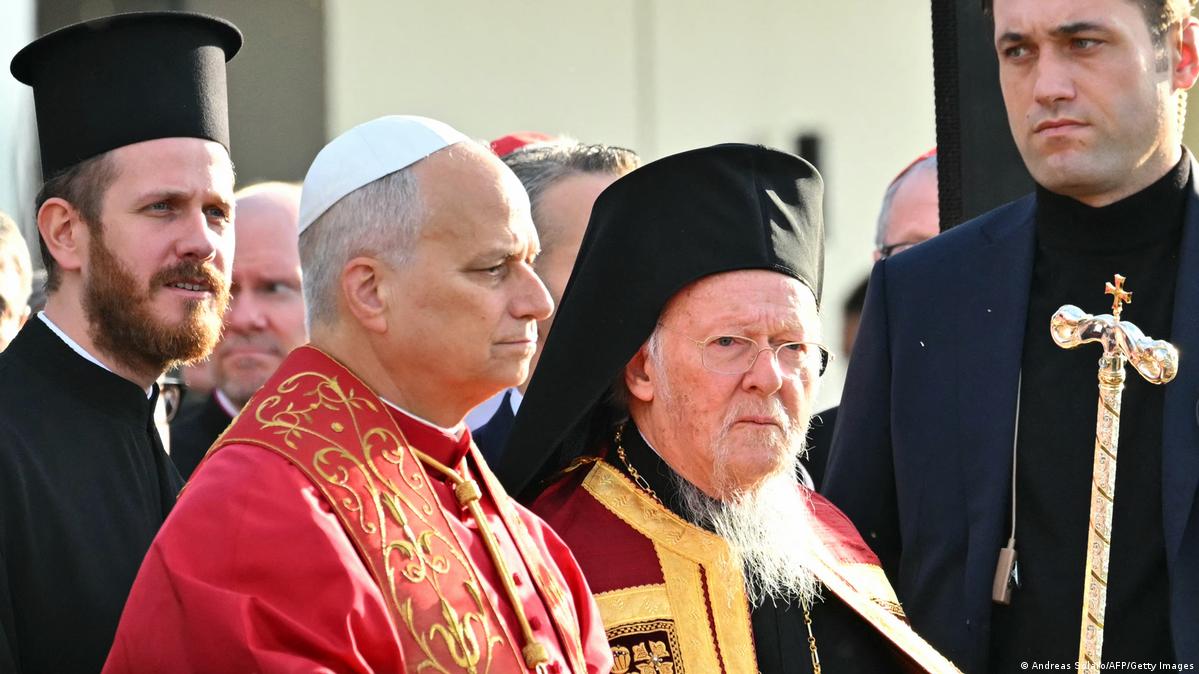
Yakiv Tsypin, Sophia Brotherhood
The Visit of the Bishop of Rome to Constantinople: Historical Context and Jubilee Dates
At the end of November 2025, the Apostolic Visit of Pope Leo XIV to Turkey and the Ecumenical Patriarchate took place. This journey, which lasted from November 27 to 30, was connected with several dates of great significance for the Christian world. The principal occasion was the celebration of the 1700th anniversary of the First Ecumenical Council, convened in Nicaea in 325, where the foundations of Christian doctrine were formulated and the Creed was adopted. The Vatican chose as the motto of the visit the words of the Apostle Paul: “One Lord, one faith, one baptism.”
In addition to the Nicene jubilee, the year 2025 was marked by two other important events. First, the entire Christian world celebrated Easter on the same day — April 20 — which Patriarch Bartholomew and Pope Leo XIV described as a special sign of divine providence and a call to work toward a common calendar. Second, December marked the 60th anniversary of the lifting of the mutual anathemas of 1054 by Pope Paul VI and Patriarch Athenagoras in 1965, an act that once opened the path to the so-called “dialogue of love” between the Churches.
This visit became the first foreign trip of the new pontiff. After the death of Pope Francis in April 2025, the conclave elected Cardinal Robert Francis Prevost, a 69-year-old native of Chicago and a member of the Augustinian Order, to the papal throne. He became the first American pope in history. The choice of the name Leo XIV carries a complex historical resonance: while in the West it is associated with the greatness of Leo I and the social doctrine of Leo XIII, in the East this name recalls Leo IX, during whose pontificate the Great Schism of 1054 occurred. Nevertheless, the choice of Constantinople as the destination of the first journey was intended to demonstrate the new Pope’s commitment to continuing the ecumenical dialogue.
For the Ecumenical Patriarchate, the arrival of the Bishop of Rome was a significant sign of support. The Pope’s presence at the feast of the Apostle Andrew underscored Rome’s solidarity with the Phanar, especially against the backdrop of strained relations between the latter and the Moscow Patriarchate over the Ukrainian issue. During the celebrations, Patriarch Bartholomew once again described the war in Ukraine as “fratricidal and shameful,” offering a clear assessment of attempts to justify aggression by religious arguments. Thus, the meeting aimed to move beyond declarative gestures toward a discussion of essential matters of faith within the shared heritage of the undivided Church.
The Apostolic Letter In Unitate Fidei and the Defense of the Nicene Faith
A few days before the beginning of the visit, on November 23, 2025, the Vatican published Pope Leo XIV’s Apostolic Letter entitled In Unitate Fidei (“In the Unity of Faith”). This document set the intellectual and theological tone for the entire journey, shifting the focus from diplomatic protocols to the very essence of Christian Revelation. At the heart of the letter, the pontiff drew a bold historical parallel between the spiritual crisis of the fourth century and the condition of modern humanity. He recalled that the Alexandrian presbyter Arius taught that Christ was a “supreme creature,” but not true God, consubstantial with the Father. Today, according to Leo XIV, we witness a resurgence of Arianism in a new form: the world readily accepts Jesus as a great moral teacher, a brilliant reformer, or a “spiritual superhero,” yet stubbornly refuses Him ontological divinity.
The Bishop of Rome emphasized that fidelity to the word consubstantial is not ecclesiastical archaeology but the defense of the reality of the Incarnation, without which Christianity becomes a powerless set of moral exhortations. The letter once again raised the question that had been central in the halls of the Nicene palace: “If God did not become man, how can mortals partake of eternal life at all?” Thus, the defense of Nicene orthodoxy was presented as the only way to preserve Christian identity in the contemporary secular world.
Beyond defending the faith, the letter also contained a strategic ecumenical signal. By defining the Niceno-Constantinopolitan Creed as “the common confession of all Christian traditions,” Leo XIV provided theological justification for its recitation in its original form, free from later Latin additions. The document became a kind of theological prelude, attesting to Rome’s readiness to return to the sources of the faith of the undivided Church and opening the door to a historic step that was to take place in Nicaea. This approach served as a theological “road map” that helped create an atmosphere of trust and prepared the ground for common prayer directly in Nicaea.
The Diplomatic Stage in Ankara and Symbolic Gestures
On November 27, 2025, an Ita Airways aircraft carrying Pope Leo XIV landed in Ankara. The official part of the journey began, and at this stage it had a distinctly state-oriented character. The program in the capital started with a visit to Anıtkabir, the mausoleum of Mustafa Kemal Atatürk, the founder of the modern Republic of Turkey. With a moment of silence at the tomb and an entry in the Book of Honorary Guests describing Turkey as a “bridge between East and West,” the Bishop of Rome expressed respect for the principle of the separation of religion and state.
The central event of the day was an audience at the Beştepe Presidential Complex with Recep Tayyip Erdoğan. During the meeting, the parties discussed the status of Jerusalem and conflicts in the Middle East, emphasizing the inadmissibility of violence on religious grounds. A particular resonance was caused by the exchange of gifts: the President of Turkey presented the pontiff with a ceramic panel depicting the “Good Shepherd.” This image is a copy of an early Christian fresco discovered by archaeologists in August 2025 in an underground third-century tomb in the city of İznik (ancient Nicaea). Experts interpreted this gesture by the Turkish authorities as an act of cultural diplomacy, demonstrating Turkey’s recognition of its role as a guardian of Anatolia’s early Christian heritage.
In the evening, Leo XIV met with Turkey’s small Catholic community. Addressing the faithful as a “little flock,” he emphasized that living on the lands of the first Ecumenical Councils is not only a gift but also a responsibility to preserve Christian presence. The diplomatic meetings in Ankara laid the necessary foundation for subsequent events in Nicaea and Istanbul, underscoring the political weight of dialogue in the region.
Ecumenical Prayer in Nicaea by the Submerged Basilica
On November 28, 2025, the central events of the visit moved to ancient Nicaea (modern İznik). The main event was a joint prayer service on the shore of Lake İznik, near the ruins of the Basilica of Saint Neophytos. This church, discovered underwater in 2014, is considered a probable site of the sessions of the First Ecumenical Council of 325. For the service, a special platform was constructed directly above the ancient foundations.
The event, titled “Ecumenical Prayer Service,” gathered a wide range of representatives of Christian denominations. In addition to Patriarch Bartholomew and Pope Leo XIV, the prayer was attended by primates and delegates of the ancient Eastern Patriarchates — Alexandria, Antioch, and Jerusalem. Hierarchs of the Non-Chalcedonian Churches (Coptic, Syriac, Armenian), representatives of the Anglican Communion, and Protestant communities were also present. In their addresses, the leaders emphasized the importance of the Council of Nicaea as a common foundation of faith that unites Christians despite centuries of division.
The defining moment of the gathering was the joint proclamation of the Nicene Creed in Greek and English. A significant theological detail was that the Bishop of Rome recited the text without the Latin insertion Filioque (“and the Son”), using the original Greek wording: “who proceeds from the Father.” This step became a de facto recognition by Rome of the priority of the Greek text of 381 and a return to the shared dogmatic foundation of the first millennium.
The service took place amid heightened security measures due to protests by radical groups. Outside the perimeter of the event, members of the Turkish Islamist party Yeniden Refah Partisi, led by Mehmet Kaygusuz, staged a demonstration, claiming an alleged threat to national sovereignty and criticizing a “revival of Byzantinism.” Despite this, the planned program was fully carried out, and in the evening the delegations returned to Istanbul.
Istanbul: Interreligious Dialogue and the Joint Declaration at the Phanar
On November 29, 2025, the program in Istanbul combined events of both interreligious and ecumenical character. The morning began with a visit to the Blue Mosque (Sultanahmet), where Leo XIV became the third Bishop of Rome in history to cross its threshold. The pontiff was accompanied by Turkey’s Minister of Culture and Tourism, Mehmet Nuri Ersoy, and the Chief Mufti of Istanbul, Emrullah Tuncel. During the visit, Leo XIV refrained from demonstrative prayer gestures. When the imam said, “This is the house of Allah… if you wish, you may pray,” the Pope replied simply, “That’s OK.” He did not make the sign of the cross or other Christian gestures, but spent several minutes in silent contemplation, showing respect for the place. Later, the Vatican clarified that, out of respect for a “house of prayer,” the Head of the Catholic Church refrained from joint religious actions in order to avoid accusations of syncretism and to clearly affirm Christian identity.
Around noon, the pontiff visited the Syriac Orthodox Church of Mor Ephrem, where he met with representatives of the city’s Christian minorities: Armenians, Syriacs, Chaldeans, and Catholics of various rites. Patriarch Bartholomew was also present, greeting the Pope on neutral ground before the official reception at the Phanar. At 3:30 p.m., the Bishop of Rome arrived at the residence of the Ecumenical Patriarch, where a thanksgiving prayer (doxology) was held in the Cathedral of Saint George. The Pope noted that he was deeply moved by the deacon’s petition for the unity of all.
The central event of the day was the signing of the Joint Declaration in the hall of the Patriarchal Palace. In the document, the parties reaffirmed their determination to continue the path of dialogue toward the restoration of full unity between the “sister Churches” and described the Nicene jubilee as an exceptional moment of grace. The Declaration affirmed shared faith in the Nicene Creed and expressed support for the work of the Joint International Commission for Theological Dialogue, which is currently addressing the most complex issues, including Filioque and papal primacy. The leaders also declared their desire to find a permanent solution for the common celebration of Easter, recalling the experience of 2025. Special attention was given to condemning any use of God’s name to justify violence and calling for an end to wars.
In the evening, the pontiff celebrated Mass for the Catholic community at Volkswagen Arena, attended by about 4,000 faithful, including diplomats and refugees from the Middle East. In his homily, he developed the concept of the “logic of littleness,” emphasizing that the strength of the Church lies in the quality of Christian witness rather than in resources. Patriarch Bartholomew was also present at the Mass — in a prayerful but not liturgical capacity. This became a mirror gesture of respect: just as the Pope the next day at the Phanar, the Patriarch testified to brotherhood without crossing existing canonical boundaries.
The Feast of Saint Andrew and the Conclusion of the Visit
On November 30, 2025, the feast of the Holy Apostle Andrew the First-Called, the visit reached its final stage. Before the main celebrations, Leo XIV visited the Armenian Cathedral of the Holy Mother of God in the Kumkapı district, where he met with Patriarch Sahak II (Mashalian). This visit was an act of solidarity by Rome with the Armenian people and with all Eastern Christians who suffered severe persecutions in the twentieth century but remained faithful to Christ.
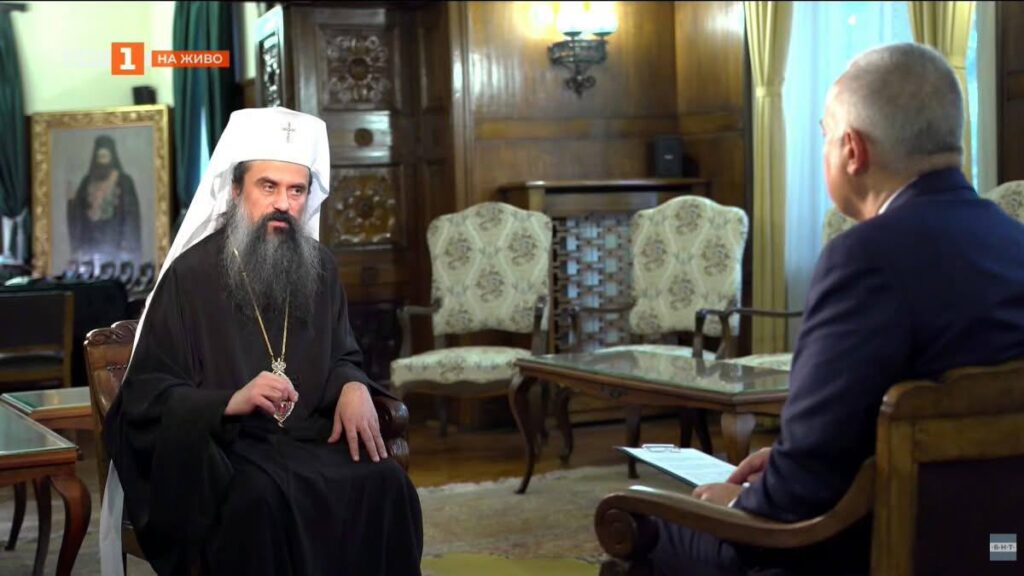
The main event of the day took place in the Patriarchal Cathedral of Saint George at the Phanar, where the festive Divine Liturgy was celebrated. It was presided over by Patriarch Bartholomew, concelebrated by Patriarch Theodore II of Alexandria. The joint service of the primates of the Churches of Constantinople and Alexandria — first and second in honor in the diptychs — became a powerful signal of unity among the ancient Patriarchates in support of the ecumenical course. The Bishop of Rome was present at the liturgy as an honorary guest, vested in an episcopal omophorion. As full Eucharistic communion remains impossible at present, the Pope did not concelebrate. He participated prayerfully from a place of honor (the stasidion) and recited the Lord’s Prayer.
In his homily, Patriarch Bartholomew emphasized that contacts between Rome and Constantinople are a concrete expression of the desire for unity. In his address after the liturgy, Leo XIV stated that the joint pilgrimage to Nicaea had confirmed the importance of the Nicene Creed as a foundation for recognizing Christians as brothers and sisters. The pontiff also outlined new horizons for common Christian witness. In addition to issues of ecology and peace, he stressed that technological progress and artificial intelligence must serve the integral development of every human person rather than become a privilege of the few. In this ethical dimension, the voice of united Christianity must sound especially strong.
After the service, the Primates jointly blessed the faithful from the balcony of the residence. As a sign of respect, gifts were exchanged: the Pope presented the Patriarch with a commemorative gift (according to media reports, an icon of the holy brothers-apostles Peter and Andrew), and Bartholomew presented the guest with an icon of the Holy Apostle Andrew containing a relic. The visit concluded with an official ceremony at the airport, after which Leo XIV flew to Beirut. The Lebanese stage of the journey had a pronounced prayerful character — the pontiff went to venerate the relics of Saint Charbel, the great Eastern ascetic venerated by both Catholics and Orthodox.
Reactions of the Christian World to the Pontiff’s Visit
Pope Leo XIV’s visit to Turkey elicited mixed reactions in the Christian milieu, reflecting differing expectations and concerns. For the Ecumenical Patriarchate, the event was an important sign of support from Rome, especially amid the ongoing conflict with the Moscow Patriarchate over the Ukrainian church issue. Greek church media, including Romfea and Orthodoxia News Agency, covered the events extensively, focusing on the joint prayer in Nicaea and the signed Declaration. Patriarch Bartholomew’s statements describing the war in Ukraine as “fratricidal and shameful” were perceived as a sign of solidarity with the Ukrainian people.
Official Moscow chose to ignore the event, publishing no mention of the visit on the resources of the Moscow Patriarchate, which is explained by the rupture of Eucharistic communion with Constantinople. At the same time, unofficial Russian resources reacted sharply, describing the meeting as a “Uniate orgy” and a “Latin trap.” These circles voiced accusations of a “betrayal of Orthodoxy” and attempts to create an “Eastern papism.” Similar sentiments were expressed by Greek traditionalist circles. The publication Orthodoxos Typos called the Pope a “leader of heresy,” and the visit a “disturbing signal” and a “dark design,” pointing to canonical prohibitions on common prayers with heterodox Christians and expressing fears of the erosion of Orthodox identity.
In the Catholic world, reactions were also divided between approval and concern. Mainstream media described the event as a “Nicene moment,” emphasizing the recitation of the Creed without Filioque. However, the conservative wing, represented by outlets such as Inside the Vatican and Catholic World Report, expressed concern about possible doctrinal relativism and the abandonment of one’s own traditions for diplomatic purposes. In Ukraine, the Orthodox Church of Ukraine and the Ukrainian Greek Catholic Church welcomed the rapprochement of the Primates. Particular attention was drawn to the prospect of establishing a common date for Easter.
Conclusions of the Visit and Perspectives Toward 2033
Having completed his historic mission on the shores of the Bosphorus, the Pope left the Christian world with a number of important questions for further reflection. Experts characterize the results of the pontiff’s four-day stay in Turkey as a transition from an “ecumenism of gestures” to an “ecumenism of essences,” in which the discussion of fundamental matters of faith comes to the fore. The main result of the journey was not merely the observance of diplomatic protocol, but a return to the shared dogmatic heritage of the first millennium. A symbolic act of returning to a common doctrinal foundation was the public recitation of the Creed without the Filioque addition. By this step, Rome confirmed the priority of the original 381 text not only in words, but also in liturgical practice.
The Joint Declaration signed at the Phanar recorded the intention of the parties to work toward resolving complex theological and canonical differences through the Joint International Commission. Among the key tasks listed were the agreement on a common date for celebrating Easter and the theological rethinking of papal primacy. Both leaders repeatedly mentioned the year 2033 — the 2000th anniversary of the Resurrection of Christ. The proposal to meet in Jerusalem in 2033 shifts the focus from the past (Nicaea-325) to the future. This gives the Churches eight years for real preparation, the main point of which should be the final reform of the calendar for the common celebration of Easter.
For the Orthodox world, a significant fact remains that the new pontiff chose precisely this ecumenical vector for his first foreign journey. In the Ukrainian context, the visit demonstrated the solidarity of Rome and Constantinople, providing moral support amid the condemnation of military aggression. The joint voice of the Primates confirmed the position that Christianity cannot be an ideology in the service of empires, and that any use of God’s name to justify violence is unacceptable.
Despite the achieved understanding, structural differences and a millennium-long experience of division remain real obstacles. The absence of common communion during the liturgy at the Phanar served as a reminder that the path to full unity requires further efforts. Nevertheless, the visit to Nicaea testified that unity begins not only in official offices, but in the willingness of believers to see one another as brothers and sisters in Christ. The concluding words of the Joint Declaration — that God will not abandon humanity — underscore hope for a common witness of faith in the face of contemporary challenges.
Photo: dw.com